 USD
USD GBP
GBP  CNY
CNY  EUR
EUR  INR
INR  JPY
JPY  MYR
MYR  ZAR
ZAR  KRW
KRW  THB
THB 


Growth Opportunities in the Smart Water Metering Solutions Market, Asia-Pacific, 2025–2032
Policies Endorsing Water Conservation and Efficiency, along with Dedicated Funding for Smart Water Metering, are Driving Demand for Ami-based Smart Water Metering
09-Oct-2025
Asia Pacific
Market Research
PFUX-01-00-00-00
EN_2026_34574
Report Summary: Asia Pacific Smart Water Metering Market
The Asia Pacific smart water metering market size was estimated at USD 1.57 billion in 2024 and is projected to reach USD 9.46 billion by 2032, growing at a CAGR of 25.2% from 2025 to 2032. Rising concerns around water scarcity, non-revenue water (NRW) losses, and rapid urbanization are accelerating investments in smart water infrastructure across the region. Governments and utilities are increasingly adopting AMI- and AMR-based smart water metering systems to improve operational efficiency, strengthen billing accuracy, and support long-term water conservation goals.
Key Market Trends & Insights
- APAC utilities are rapidly digitizing water distribution infrastructure to improve network visibility and reduce leakage losses.
- China, Australia, India, and Southeast Asian countries are increasing investments in smart utility modernization and sustainable water management initiatives.
- Smart water meters are becoming a foundational technology within the broader Asia Pacific smart water management market ecosystem.
- Utilities are increasingly deploying IoT-enabled metering platforms integrated with analytics, cloud monitoring, and customer engagement systems.
- Meter data management (MDM), customer information systems (CIS), and network communication platforms are witnessing strong adoption across regional utilities.
Market Size & Forecast
- 2024 Market Size: USD 1.57 Billion
- 2032 Projected Market Size: USD 9.46 Billion
- CAGR (2025–2032): 25.2%
- APAC remains one of the fastest-growing regions for smart utility infrastructure investments.
- Public and private water utilities continue to be the primary adopters of intelligent metering technologies.
The Asia Pacific smart water metering market is benefiting from strong policy support for water conservation, smart city infrastructure, and utility digitization. Increasing urban populations and climate-related water stress are forcing utilities to adopt intelligent monitoring systems capable of real-time data collection, automated billing, and predictive maintenance. As utilities modernize aging infrastructure and prioritize operational sustainability, smart water metering solutions are becoming central to the long-term digital transformation of water management systems across APAC.
Market Overview & Trends: Asia Pacific Smart Water Metering Market
The Asia Pacific smart water metering market is evolving into a critical pillar of regional water infrastructure modernization as utilities face mounting pressure from urban population growth, climate volatility, aging infrastructure, and increasing water scarcity. Countries across APAC are rapidly adopting intelligent metering technologies to improve operational efficiency, reduce leakages, optimize water consumption, and strengthen billing transparency. Water conservation initiatives and national sustainability mandates are becoming major catalysts for large-scale smart water meter deployments.
The increasing incidence of non-revenue water losses across urban utilities is accelerating the adoption of digitally connected metering systems capable of enabling real-time monitoring, automated billing, and predictive maintenance. Utilities are increasingly shifting away from traditional mechanical meters toward advanced AMI and AMR solutions that support two-way communication, remote diagnostics, and granular consumption analytics. This transition is supporting the broader expansion of the Asia Pacific smart water management market.
Digital transformation initiatives are also driving investments in network communication platforms, meter data management systems, customer information systems (CIS), customer engagement portals, and analytics-driven operational intelligence platforms. Governments in countries such as China, Australia, Malaysia, and India are integrating smart water metering into larger smart city and sustainable infrastructure development programs. Rising utility digitization spending is creating opportunities for technology providers, network integrators, and software vendors across the value chain.
Another major trend shaping the market is the integration of IoT-enabled sensors, cloud-based monitoring platforms, and AI-powered analytics into utility operations. These technologies help utilities identify leakage points, forecast consumption patterns, automate billing processes, and improve customer engagement. Utilities are also prioritizing end-to-end smart water ecosystems rather than standalone meter deployments.
Despite strong growth momentum, high upfront capital expenditure, fragmented regulatory policies, and price-sensitive utility environments remain key adoption barriers in several developing APAC markets. However, increasing awareness around water sustainability and government-backed infrastructure funding continue to strengthen long-term market potential.
Scope of Analysis: Asia Pacific Smart Water Metering Market
This study analyzes the Asia Pacific smart water metering market across the complete smart water utility value chain, focusing on revenue generation, unit shipment forecasts, infrastructure digitization trends, and technology adoption patterns between 2022 and 2032. The base year for the study is 2024, while the forecast period extends from 2025 to 2032.
The report evaluates the deployment of smart water metering systems across residential utility networks and examines how utilities are integrating intelligent monitoring technologies to reduce NRW losses, improve operational efficiency, and enhance customer billing accuracy. The study also assesses the broader Asia Pacific smart water management market ecosystem, including network connectivity infrastructure, software platforms, analytics solutions, and utility engagement technologies.
Geographically, the analysis covers Australia, China, Japan, South Korea, India, Indonesia, Malaysia, Vietnam, and the Rest of APAC. The report focuses specifically on residential smart water meter deployments implemented by public and private water utilities.
Market segmentation includes smart water meters, network solutions, meter data management (MDM), customer information systems (CIS), customer engagement portals (CEP), data analytics platforms, design and engineering services, and project management solutions. The report further evaluates market drivers, restraints, competitive intensity, partnership activity, and utility modernization initiatives shaping regional market development.
The research methodology combines primary interviews, utility deployment analysis, technology trend evaluation, policy assessment, and market forecasting models to identify emerging growth opportunities and long-term investment priorities within the APAC water infrastructure ecosystem.
Revenue & Spending Forecast: Asia Pacific Smart Water Metering Market
The Asia Pacific smart water metering market is projected to experience significant revenue expansion through 2032 as governments and utilities accelerate investments in digital water infrastructure modernization. The market generated approximately USD 1.57 billion in revenue in 2024 and is expected to reach nearly USD 9.46 billion by 2032, registering a robust CAGR of 25.2% during the forecast period.
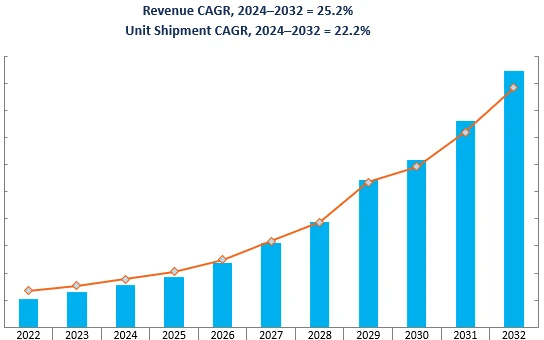
Strong revenue growth is being supported by rising deployments of AMI-based smart water meters, expanding urban utility networks, and increasing demand for automated billing and leak detection capabilities. Utility operators across APAC are prioritizing investments in network digitization to improve operational efficiency, reduce NRW losses, and strengthen long-term sustainability planning.
In parallel, smart meter unit shipments are expected to rise substantially through 2032 as water utilities scale residential smart metering projects across both developed and emerging economies. China, Australia, India, Malaysia, and Southeast Asian markets are expected to remain key investment hotspots due to increasing water stress and expanding smart city initiatives.
Spending is also increasing across supporting infrastructure categories, including network connectivity platforms, meter data management software, customer engagement systems, and analytics-driven monitoring solutions. The broader Asia Pacific smart water management market is benefiting from integrated utility transformation programs that combine smart metering with digital asset management and predictive maintenance capabilities.
Long-term market momentum will continue to be shaped by regulatory mandates, public infrastructure investments, utility modernization strategies, and growing pressure to improve water conservation outcomes across densely populated urban regions.
Market Segmentation Analysis: Asia Pacific Smart Water Metering Market
The Asia Pacific smart water metering market is segmented across multiple value chain components that collectively support utility digitization and intelligent water infrastructure management. Smart water meters represent the foundational segment and include both AMR- and AMI-enabled devices equipped with communication modules for real-time or remote data transmission. These solutions are increasingly replacing conventional mechanical meters as utilities prioritize automation and operational visibility.
Network solutions form another major segment, covering collectors, gateways, communication platforms, and connectivity infrastructure required to transfer data from smart meters to centralized utility systems. LPWAN and RF mesh technologies are widely used to support scalable and cost-effective deployments across urban and suburban environments.
Meter data management (MDM) solutions are becoming increasingly important as utilities generate larger volumes of consumption data. MDM platforms help utilities manage, validate, and analyze smart meter data while supporting billing accuracy and operational planning. Customer information systems (CIS) and billing platforms are also experiencing strong demand as utilities modernize customer service operations and automate revenue management.
Customer engagement portals (CEP) and analytics platforms are emerging as strategic investment areas within the Asia Pacific smart water management market. These solutions enable consumers to monitor usage patterns, receive leak alerts, and improve water conservation awareness while helping utilities optimize demand forecasting and operational efficiency.
The market also includes design and engineering services, project management solutions, and end-to-end system integration support. Countries such as China, Australia, and Malaysia are leading regional adoption due to stronger infrastructure funding and utility modernization programs, while India and Southeast Asian markets are witnessing accelerating deployment opportunities driven by urban expansion and sustainability priorities.
Growth Drivers: Asia Pacific Smart Water Metering Market
One of the primary growth drivers for the Asia Pacific smart water metering market is the increasing level of water stress caused by climate change, rapid urbanization, and rising population density across major APAC economies. Utilities are adopting smart metering technologies to reduce water losses, optimize consumption monitoring, and improve resource management efficiency.
Government-led water conservation initiatives and sustainability regulations are accelerating deployment activity throughout the region. Several APAC countries are introducing policies aimed at reducing non-revenue water losses, modernizing utility infrastructure, and strengthening long-term water security planning. These initiatives are creating favorable conditions for large-scale smart water meter rollouts.
Another important driver is the rapid digitization of utility operations. Utilities are increasingly investing in connected infrastructure, IoT-enabled monitoring systems, cloud-based analytics, and automated billing platforms to improve operational visibility and customer service performance. Smart water metering serves as a foundational technology within the broader Asia Pacific smart water management market transformation.
Urban infrastructure expansion is also supporting market growth. Developing APAC countries are investing heavily in universal water access programs and residential utility upgrades, driving demand for scalable metering solutions across densely populated urban centers.
Technological advancements in communication platforms, analytics software, and real-time monitoring capabilities are further strengthening adoption. Utilities are prioritizing intelligent solutions that improve leakage detection, demand forecasting, and maintenance efficiency while enabling more data-driven operational decision-making.
Growth Restraints: Asia Pacific Smart Water Metering Market
Despite strong long-term growth potential, the Asia Pacific smart water metering market faces several structural and operational challenges that may slow adoption across certain countries and utility segments. One of the most significant restraints is the high upfront capital expenditure associated with large-scale smart meter deployment programs. Many utilities in developing APAC economies remain highly price-sensitive, limiting investment capacity for advanced digital infrastructure.
Policy fragmentation and inconsistent regulatory frameworks also create deployment barriers across the region. While some countries have introduced dedicated water digitization initiatives, others still lack cohesive national policies supporting smart water metering implementation and utility modernization.
Another major challenge is the relatively low cost of water across many APAC markets. In regions where water tariffs remain heavily subsidized, utilities often face difficulty justifying large infrastructure investments tied to smart metering systems. Consumer resistance to higher water charges may further delay project execution timelines.
Limited awareness and slower adoption momentum compared to smart electricity metering programs also continue to affect market penetration. Several APAC governments have prioritized smart grid modernization more aggressively than smart water utility transformation, creating uneven technology adoption across the region.
Infrastructure limitations, integration complexity, and fragmented utility ecosystems may additionally slow deployment scalability in certain emerging markets. Utilities often face challenges related to communication network readiness, legacy infrastructure compatibility, and operational workforce training during digital transformation initiatives.
Competitive Landscape: Asia Pacific Smart Water Metering Market
The competitive environment within the Asia Pacific smart water metering market is moderately fragmented, with approximately 150 active market participants operating across smart meter manufacturing, network infrastructure, analytics software, and utility integration services. Around 50 companies generate annual revenues exceeding USD 10 million, reflecting growing market maturity and increasing infrastructure investments.
Competition is primarily shaped by smart meter reliability, total cost of ownership, communication efficiency, long-term utility partnerships, and end-to-end service delivery capabilities. Vendors are increasingly differentiating themselves through integrated digital water management platforms that combine smart metering, analytics, billing systems, customer engagement tools, and predictive maintenance solutions.
Leading companies operating within the Asia Pacific smart water management market include Itron, Diehl, Axioma, Xylem Sensus, Kamstrup, Sagemcom, Honeywell Elster, George Kent, SH Metering, Zenner International, Bove Technology, and Azbil Kimmon. Regional manufacturers and localized technology providers are also strengthening their market presence through utility partnerships and cost-competitive deployment strategies.
Strategic collaborations, distribution partnerships, and utility modernization agreements are becoming increasingly common across the market. Companies are focusing on expanding regional deployment capabilities, improving interoperability standards, and strengthening software integration expertise to support large-scale smart utility transformation programs.
The market is also witnessing rising activity among system integrators, OEMs, and network connectivity providers as utilities increasingly demand comprehensive turnkey deployment models. Long-term growth opportunities are expected to favor vendors capable of delivering scalable, data-driven, and interoperable smart water infrastructure ecosystems across diverse APAC utility environments.
Why is it Increasingly Difficult to Grow?
The Strategic Imperative 8
The Impact of the Top 3 Strategic Imperatives on the Smart Water Metering Solutions Industry
Scope of Analysis
Segmentation
Competitive Environment
Distribution Channels
6Ps: Shaping the APAC Smart Water Metering Solutions Industry’s Growth Opportunities
NRW Loss in APAC
Key Open/Public LPWAN Solution Providers and Coverage
Growth Metrics
Growth Drivers
Growth Restraints
Forecast Considerations
Revenue and Unit Shipment Forecast
Revenue Forecast by Segment
Revenue Forecast by Country
Revenue Forecast Analysis
Unit Shipment Forecast by Country
Unit Shipment Forecast Analysis
Indonesia
Malaysia
Vietnam
South Korea
Australia
Japan
China
India
Rest of APAC
Companies to Action
Growth Opportunity 1: Static AMI-Based Smart Water Meters
Growth Opportunity 2: Performance-Based Contracts and Innovative Funding Models
Growth Opportunity 3: Integrated Water Network Management Solutions
Benefits and Impacts of Growth Opportunities
Next Steps
List of Exhibits
Legal Disclaimer
Frequently Asked Questions (FAQ) – Asia Pacific Smart Water Metering Market
1. What is the Asia Pacific smart water metering market?
The Asia Pacific smart water metering market refers to the ecosystem of digital water metering technologies, communication networks, analytics platforms, and utility management systems used to monitor, measure, and optimize water consumption across APAC countries.
2. What is driving growth in the Asia Pacific smart water metering market?
Rapid urbanization, rising water scarcity, increasing non-revenue water (NRW) losses, and government-backed smart utility modernization initiatives are major factors driving growth in the Asia Pacific smart water metering market.
3. What is the projected revenue forecast for the Asia Pacific smart water metering market?
The Asia Pacific smart water metering market was valued at approximately USD 1.57 billion in 2024 and is projected to reach around USD 9.46 billion by 2032, expanding at a strong CAGR during the forecast period.
4. Which technologies are commonly used in smart water metering systems?
Common technologies include Advanced Metering Infrastructure (AMI), Automatic Meter Reading (AMR), IoT-enabled sensors, cloud-based analytics, LPWAN communication networks, and real-time monitoring platforms for utility operations.
5. How does the Asia Pacific smart water management market support utility modernization?
The Asia Pacific smart water management market helps utilities improve operational efficiency, automate billing, reduce leakages, monitor consumption patterns, and strengthen long-term sustainability through data-driven infrastructure management.
6. Which countries are leading smart water meter adoption in APAC?
China, Australia, Japan, South Korea, India, Malaysia, and several Southeast Asian countries are actively investing in smart water metering infrastructure to address water conservation and utility efficiency challenges.
7. What are the key applications of smart water metering solutions?
Smart water metering solutions are widely used for residential water monitoring, automated billing, leak detection, pressure monitoring, demand forecasting, customer engagement, and utility network optimization.
8. What challenges are affecting the Asia Pacific smart water metering market?
High upfront infrastructure costs, policy inconsistencies, limited funding in developing regions, and slow adoption by traditional utilities remain major challenges for the Asia Pacific smart water metering market.
9. Who are the major end users in the smart water metering industry?
Public and private water utilities are the primary end users, deploying smart water metering systems to improve billing efficiency, reduce operational losses, and strengthen long-term water resource management.
10. Why are smart water meters important for sustainable urban development?
Smart water meters enable efficient water consumption monitoring, improve conservation efforts, reduce waste, and support smart city initiatives by providing utilities with accurate, real-time operational insights.
Speak directly with our analytics experts for tailored recommendations.
Recent related Water research
12 Oct 2026 | Europe | Strategic Imperatives
Top 10 Strategic Imperatives in the European Circular Economy for Used Electrical and Electronic Equipment (EEE) and ITAD Services Sector, 2026
This report examines the key transformations shaping Europe’s circular economy for used electrical and electronic equipment (EEE) and assesses the growth opportunities emerging from these shifts. It analyzes how evolving legal and regulatory frameworks, data security expectations, global supply chai...
02 Oct 2026 | Global | Technology Research
Innovations in Carbon Capture, Waste Conversion, Wastewater Treatment, Bioreactors, Artificial Protein and Plastic Recycling
This edition of the Industrial Bioprocessing TOE features information on carbon capture, waste conversion, wastewater treatment, bioreactors, artificial protein and plastic recycling among others.The Industrial Bioprocessing TOE provides intelligence on technologies, processes and strategic insights...
25 Sep 2026 | South Asia, Middle East & North Africa | Market Research
Circular Economy for Used Electrical and Electronic Equipment (Used EEE) and ITAD Services Market, India, 2025–2032
The circular economy for used electrical and electronic equipment (used EEE) in India is experiencing transformational growth as an expanding domestic electronics manufacturing industry, rapid digitalization, and shorter electronics replacement cycles intersect with a stricter policy environment and...
22 Sep 2026 | Europe | Strategic Imperatives
Top 8 Strategic Imperatives for the Membrane-Based Water & Wastewater Treatment Systems Market, Europe, 2026
Europe has been faced with unprecedented heatwaves and droughts triggered by climate change. This has affected surface and groundwater availability across regions, leading to water use restrictions and investment in water reuse infrastructure.Southern European countries such as Spain, Cyprus, Malta,...
16 Sep 2026 | Europe | Frost Radar
Frost Radar™: European Membrane-Based Water and Wastewater Treatment Systems, 2026
Most parts of Europe face recurring droughts as below-average rainfall combined with heatwaves exacerbate water stress. The latest revision of European Union wastewater directives has driven nations to invest in tertiary treatment of wastewater and proactively encouraged water reuse to meet agricult...
Purchase includes:
- Report download
- Growth Dialog™ with our experts
Growth Dialog™
A tailored session with you where we identify the:- Strategic Imperatives
- Growth Opportunities
- Best Practices
- Companies to Action
Impacting your company's future growth potential.