 USD
USD GBP
GBP  CNY
CNY  EUR
EUR  INR
INR  JPY
JPY  MYR
MYR  ZAR
ZAR  KRW
KRW  THB
THB 


Growth Opportunities in the Industrial Semiconductors Market, Global, 2024–2029
Sustainability, Digital Transformation, and the Convergence of AI and Connectivity will Drive Demand for Specialty Semiconductors, Such as AI Chipsets and Compound Semiconductors, in the Industrial Semiconductor Market
22-Jul-2025
Global
Market Research
K8EC-01-00-00-00
TM_2025_33672
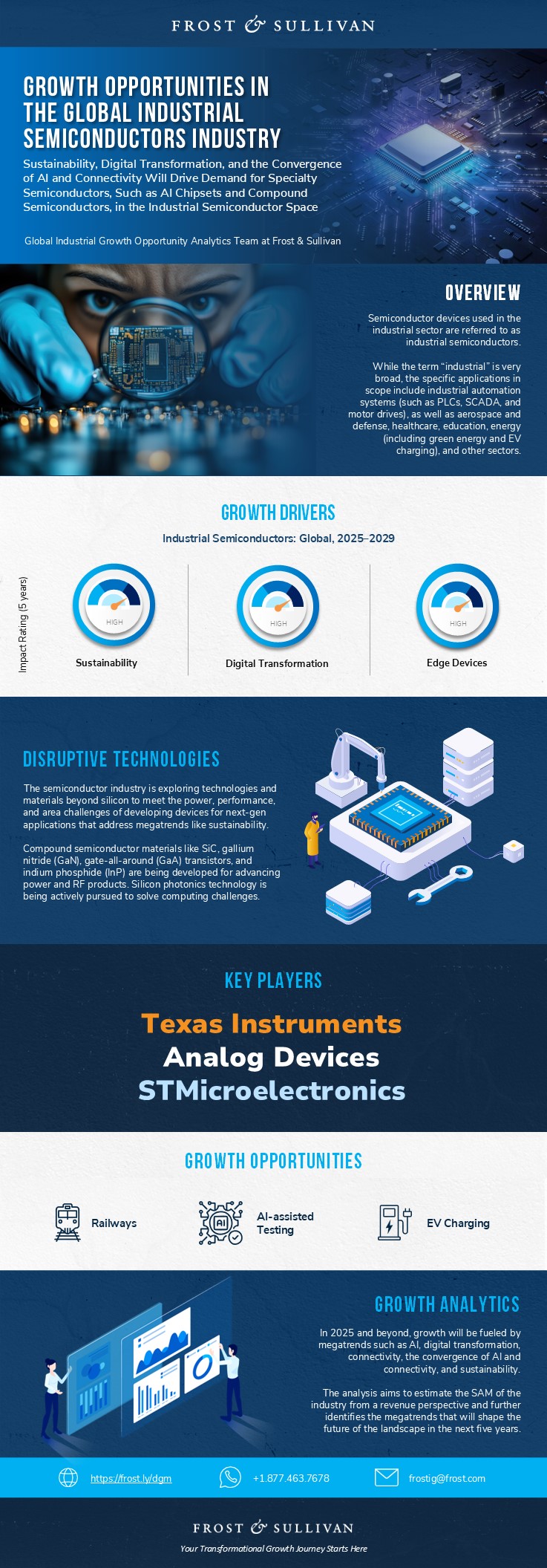
Semiconductor devices used in the industrial sector are referred to as industrial semiconductors. While the term “industrial” is very broad, the specific applications in scope include industrial automation systems (such as PLCs, SCADA, and motor drives), as well as aerospace and defense, healthcare, education, energy (including green energy and EV charging), and other sectors.
Current weaknesses in the industrial semiconductor market are primarily attributed to the global macroeconomic scenario, which has led to inventory depletion at customer sites. Consequently, demand has been low, resulting in a decline in sales.
However, some market participants expect the situation to improve by the end of 2024 or by mid-2025, after which the market for industrial semiconductors is expected to enter a growth phase once again.
In 2025 and beyond, market growth will be fueled by megatrends such as AI, digital transformation, connectivity, the convergence of AI and connectivity, and sustainability.
The report aims to estimate the SAM of the market from a revenue perspective and further identifies the trends that will shape the future of the market in the next five years.
The market revenues only represent sales of new chips; they exclude sales of refurbished components.
The study provides a global analysis of the industrial semiconductor market, with segmentation by the following regions:
• The Americas, which includes North America (the United States and Canada), Latin America (Brazil, Mexico, Argentina, and Central and South America), and others (e.g., the Caribbean Islands)
• Europe, the Middle East, and Africa (EMEA), including Russia
• Asia-Pacific (APAC), which includes countries on the western border of the Pacific Ocean, those on the Indo-Chinese Peninsula and the Pacific Islands, and in Central Asia
Author: Prabhu Karunakaran
Revenue Forecast
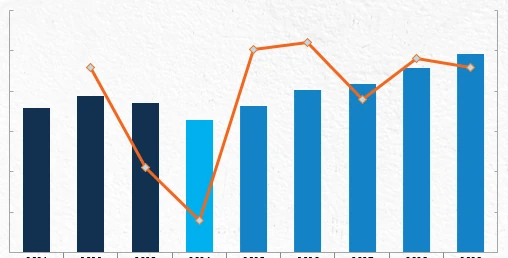
The revenue estimate for the base year 2024 is $65.87 billion, with a CAGR of 8.4% for the study period from 2024 to 2029.
Scope
| Item | Description |
|---|---|
| Market Analysis | In-depth analysis of the industrial semiconductors market. |
| Key Players | Identification of major players in the market. |
| Growth Strategies | Evaluation of effective growth strategies in the sector. |
| Technological Trends | Insights into technological advancements influencing the market. |
| Scope | |
|---|---|
| Geographic Coverage | Global |
| Study Period | 2021–2029 |
| Base Year | 2024 |
| Forecast Period | 2025–2029 |
| Monetary Unit | US Dollars |
The Impact of the Top 3 Strategic Imperatives on the Global Industrial Semiconductors Industry
Disruptive Technologies
- Why
- The semiconductor industry is exploring technologies and materials beyond silicon to meet the power, performance, and area challenges of developing devices for next-gen applications that address megatrends like sustainability.
- Compound semiconductor materials like SiC, gallium nitride (GaN), gate-all-around (GaA) transistors, and indium phosphide (InP) are being developed for advancing power and RF products. Silicon photonics technology is being actively pursued to solve computing challenges.
- Frost Perspective
- The material and technology platforms mentioned above are at various stages of R&D and commercial maturity. In 2025, there will be more momentum for leveraging materials beyond silicon and for adopting new computing technologies for two reasons:
- To reduce the race to be a leader in emerging technologies.
- Alternative and superior technologies need not be manufactured in isolation.
Internal Challenges
- Why
- The skill shortage issue widely impacts the semiconductor industry as time-to-market and cost issues increase across design and manufacturing processes. In the industrial semiconductor market, this problem is amplified mainly because of the need for design customization at scale driven by the sheer breadth of applications.
- As a result, design engineers are required to handle a large volume of requests while striving to remain competitive.
- Frost Perspective
- EDA solutions need to play a larger role. Overcoming skill shortages with software solutions is not an easy approach. Engineers working across design and manufacturing processes need to be empowered with AI-powered design, allowing and enabling them to tackle challenges while providing end-to-end design testing and quality productivity.
- STEM initiatives are needed to boost new workforce generation, and industries need to partner with academic institutions and invest in infrastructure, education, and training for successful careers in the semiconductor industry.
Geopolitical Chaos
- Why
- Post-pandemic supply chain disruptions highlighted the semiconductor industry’s overreliance on the South Asian region.
- Countries are intensively having nationalized semiconductor industries, sparking a race for self-sufficiency and technological dominance.
- Trade wars (e.g., the US vs. China) and the imposition of sanctions and tariffs across industries have negatively impacted power semiconductor supply chains.
- The Russo-Ukrainian War and China-Taiwan conflict destabilized international markets.
- Frost Perspective
- The industry needs an electronics ecosystem that connects all parts of the value chain.
- The global ecosystem for semiconductors is so extensive that making it completely self-sufficient is not a viable goal.
- Western countries cannot compete with Asian countries' cost advantages. Instead of reshoring, Western countries should focus on friend-shoring and near-shoring to reap cost benefits.
- Establishing back and fabs for power semiconductor chips will help make their position in the semiconductor supply chain.
Key Competitors
Global
- Analog Devices
- Fuji Electric
- Infineon Technologies
- Microchip Technology
- MINEBEA MITSUMI Inc.
- Mitsubishi Electric
- Navitas Semiconductor
- Nexperia
- Onsemi
- Power Integrations
- Renesas Electronics
- ROHM
- Sanan IC
- Semikron-Danfoss
- STMicroelectronics
- Texas Instruments
- Toshiba Electronic Devices
- Transphorm
- Vincotech GmbH
- Vishay Intertechnology
- Wolfspeed
APAC
- Actron Technology Corp.
- BYD Semiconductor
- CR Micro
- Fuji Electric
- Innoc Semiconductor
- KEC Corporation
- Kyocera
- Leapers Semiconductor
- Magnachip
- MINEBEA MITSUMI Inc.
- Mitsubishi Electric
- Power Master Semiconductor
- Renesas Electronics
- ROHM
- Sanan IC
- Sanken Electric
- SemilQ
- Silan Microelectronics
- SIRETEXFIR Corp.
- Star Semiconductor Corp.
- Toshiba Electronic Devices
- WeEn Semiconductors
EMEA
- CambridgeGaN Devices
- Diotec Semiconductor AG
- Dynex Semiconductor Ltd.
- Infineon Technologies
- Nexperia
- Robert Bosch
- Semikron-Danfoss
- STMicroelectronics
- Vincotech GmbH
- VisIC Technologies
Americas
- Alpha and Omega
- Semiconductor
- C&H Technology Inc.
- Diodes Inc.
- Efficient Power Conversion
- Litefuels
- MaxPower Semiconductor
- Microchip Technology
- Navitas Semiconductor
- Onsemi
- Polar Semiconductor
- Power Integrations
- Power Semiconductors Inc.
- Powerex Inc.
- Oorvo
- SiPower Inc.
- Texas Instruments
- Transphorm
- Vishay Intertechnology
- Wolfspeed
Competitive Environment
| Number of Competitors | More than 50 |
| Competitive Factors | Cost, performance, technology, product portfolio, supply chain resilience, reliability, supplier relationships, original equipment manufacturer (OEM) relationships, and distribution channels |
| Key End-User Industry Verticals | Automotive, industrial, consumer electronics, communications and IT, and energy and utility |
| Leading Competitors | Texas Instruments, Analog Devices, STMicroelectronics, Microchip, Onsemi, Infineon, and Renesas |
| Revenue Share of Top 6 Competitors 2024 | 40.2% |
| Other Notable Competitors | Nexperia, Power Integrations, Navitas Semiconductor, Efficient Power Conversion, Innoscience, Transphorm, Microchip Technology, BYD Semiconductor, Robert Bosch, Leapers Semiconductor, Semikron-Danfoss, Orov, CR Micro, Star Semiconductor Corp., Littelfuse, VisIC Technologies, Sanken Electric, Alpha and Omega Semiconductor, Diodes Inc., KEC Corporation, Magnachip, Wolfspeed, Sanan IC, Renesas Electronics, MaxPower Semiconductor, Texas Instruments, Kyoera, Cambridge GaN Devices, GaN Power International, Coheus, Danxi, Tagore Technology, Wise Integration, Semi0, MinebeaMitsumi Inc., Polar Semiconductor, Power Master Semiconductor, Silan Microelectronics, Power Semiconductors Inc., C&H Technology Inc., Yangzhou Positioning Group, Dynex Semiconductor Ltd., Powerex Inc., WeEn Semiconductors, SiPower Inc., Siretcifler Corp., Vincotech GmbH, Actron Technology Corp., Sansha Electric Manufacturing Co. Ltd., Diotec Semiconductor AG, and PFC Device Inc |
| Distribution Structure | Direct sales and distributors |
| Notable M&As | Renesas Electronics acquired Transphorm in 2024; MinebeaMitsumi acquired Hitachi Power Semiconductor in 2024; Power Integrations acquired Odyssey Semiconductor in 2024; Infineon Technologies acquired GaN Systems in 2023; Onsemi acquired GT Advanced Technologies in 2021; Renesas Semiconductor acquired GeneSiC Semiconductor in 2022; and Onsemi acquired GT Advanced Technologies in 2021 |
Growth Drivers
- Sustainability.
- Digital Transformation.
- Edge Devices.
- Manufacturing Investments to Regain Momentum:
Growth Restraints
Macro-economic Scenario:
The industrial sector contributed 13.7% of the total semiconductor devices market revenue in 2023 despite a decline in revenues in the same year. The sector was poised for growth in the following years, riding the momentum of two consecutive years of revenue growth, as industry implementation in the post-pandemic world gained steam. However, a weak macroeconomic situation, which began in late 2023, continued to impact the industrial sector. As a result, inventory levels in industrial and markets remained high in the first half. Furthermore, an expected revival of demand in the following year has been delayed due to uncertainty surrounding geopolitics and a resulting weaker investment climate.
Lack of Skilled Resources:
The shortage of skilled talent significantly impacts the overall semiconductor industry, with concerns over time-to-market and cost management increasing across both design and manufacturing processes. In the Industrial semiconductor market, this problem is further amplified because the need for design customization is large due to the high volume of applications in this sector.
High Time-to-market and Design Costs:
The challenges in designing next-generation semiconductor devices are increasing due to shrinking process nodes, effectively testing the physical and scientific limits of semiconductor technology. As a result, developing products is becoming expensive and time-consuming. The industry is becoming very stringent in assessing the long-term commercialization prospects of research investments. Smaller branch projects are likely to be shelved, thus missing opportunities to drive new innovations.
Scope of Analysis
Product Segmentation
Segmentation by End-User Vertical
Why is it Increasingly Difficult to Grow?
The Strategic Imperative 8™
The Impact of the Top 3 Strategic Imperatives on the Global Industrial Semiconductors Industry
Distribution Channels
Competitive Environment
Key Competitors
Growth Metrics
Growth Drivers
Growth Restraints
Forecast Considerations
Revenue Forecast
Revenue Forecast by End Markets
Revenue Forecast by Semiconductor Devices
Revenue Forecast by Region
Revenue Forecast Analysis
Megatrend 1—Artificial Intelligence in Manufacturing
Megatrend 2—Sustainability: Innovating to Zero
Revenue Share
Revenue Share By End Market, 2024
Revenue Share Analysis
Growth Metrics
Revenue Forecast
Revenue Forecast by Semiconductor Devices
Revenue Forecast Analysis
Growth Metrics
Revenue Forecast
Revenue Forecast by Semiconductor Devices
Forecast Analysis
Forecast Analysis
Forecast Analysis—Wireless EV Charging Systems and Methods
Growth Metrics
Revenue Forecast
Revenue Forecast by Semiconductor Devices
Forecast Analysis
Growth Metrics
Revenue Forecast
Revenue Forecast by Semiconductor Devices
Forecast Analysis
Growth Metrics
Revenue Forecast
Revenue Forecast by Semiconductor Devices
Forecast Analysis
Growth Opportunity 1: Railways
Growth Opportunity 2: AI-assisted Testing
Growth Opportunity 3: EV Charging
Benefits and Impacts of Growth Opportunities
Next Steps
List of Exhibits
Legal Disclaimer
Speak directly with our analytics experts for tailored recommendations.
Recent related Semiconductor research
27 Jul 2026 | Global | Technology Research
Advancements in Wide-Bandgap Materials (GaN, SiC, Ga₂O₃) for Power and RF Electronics
This study examines the technology landscape, commercialization progress, and future growth opportunities of wide-bandgap (WBG) semiconductor materials, with a primary focus on silicon carbide (SiC), gallium nitride (GaN), and gallium oxide (Ga₂O₃) for power and RF electronics. It evaluates how thes...
24 Mar 2026 | Global | Technology Research
Energy-Harvesting Sensors for Large-Scale Ambient IoT
Energy harvesting sensor solutions are emerging as a foundational layer for large-scale ambient IoT, enabling autonomous, battery-free sensing across distributed and infrastructure-intensive environments. By converting ambient energy sources such as light, heat, vibration, and RF into usable power, ...
13 Feb 2026 | Global | Technology Research
Top 10 Sensor Technologies Transforming the eCommerce and Logistics Industries
The eCommerce and logistics industries are entering a period of accelerated transformation driven by the need for higher throughput, improved accuracy, and real-time operational intelligence. Emerging sensor technologies are becoming essential to support this shift as fulfillment centers, transport ...
02 Dec 2025 | Global | Technology Research
Next-Gen Lithography for Advanced Nodes: Technologies and Applications
The semiconductor industry is approaching the physical and economic limits of traditional lithography, driving the emergence of next-generation patterning technologies essential for scaling beyond 3 nm and into the sub-2 nm era. This report explores the technological evolution, ecosystem enablers, a...
29 Oct 2025 | Global | Technology Research
Frost Radar: Edge AI Accelerators, 2025
The edge AI accelerator market is scaling rapidly as industries demand low-latency, privacy-aware intelligence for autonomous vehicles, industrial automation, smart cameras, robotics, and other applications. Cloud-based inference faces more limits from bandwidth, latency, and data sovereignty concer...
Purchase includes:
- Report download
- Growth Dialog™ with our experts
Growth Dialog™
A tailored session with you where we identify the:- Strategic Imperatives
- Growth Opportunities
- Best Practices
- Companies to Action
Impacting your company's future growth potential.
Current weaknesses in the industrial semiconductor market are primarily attributed to the global macroeconomic scenario, which has led to inventory depletion at customer sites. Consequently, demand has been low, resulting in a decline in sales.
However, some market participants expect the situation to improve by the end of 2024 or by mid-2025, after which the market for industrial semiconductors is expected to enter a growth phase once again.
In 2025 and beyond, market growth will be fueled by megatrends such as AI, digital transformation, connectivity, the convergence of AI and connectivity, and sustainability.
The report aims to estimate the SAM of the market from a revenue perspective and further identifies the trends that will shape the future of the market in the next five years.
The market revenues only represent sales of new chips; they exclude sales of refurbished components.
The study provides a global analysis of the industrial semiconductor market, with segmentation by the following regions: • The Americas, which includes North America (the United States and Canada), Latin America (Brazil, Mexico, Argentina, and Central and South America), and others (e.g., the Caribbean Islands) • Europe, the Middle East, and Africa (EMEA), including Russia • Asia-Pacific (APAC), which includes countries on the western border of the Pacific Ocean, those on the Indo-Chinese Peninsula and the Pacific Islands, and in Central Asia
Author: Prabhu Karunakaran
| Deliverable Type | Market Research |
|---|---|
| Industries | Test and Measurement Instrumentation |
| No Index | No |
| Is Prebook | No |
| Keyword 1 | industrial semiconductors market |
| Keyword 2 | industrial IoT semiconductors |
| Keyword 3 | semiconductor manufacturing trends |
| Podcast | No |
| Predecessor | None |
| WIP Number | K8EC-01-00-00-00 |
Growth Opportunities in the Industrial Semiconductors Market, Global, 2024–2029
$4,950.00
Special Price $4,455.00 save 10 %