 USD
USD GBP
GBP  CNY
CNY  EUR
EUR  INR
INR  JPY
JPY  MYR
MYR  ZAR
ZAR  KRW
KRW  THB
THB 


Growth Opportunities in the US Battery Energy Storage Industry, 2025–2035
Strong Growth for BESS, Driven by a Range of Policy Support and Market Conditions
03-Sep-2026
North America
Market Research
M1P6-01-00-00-00
EG_2026_34865
Key Takeaways: US battery energy storage system market
- The US battery energy storage system market is becoming a critical part of the energy transition, supporting grid reliability, renewable integration, and electricity-market flexibility.
- Battery Energy Storage Systems (BESS) deployment is expected to remain strong, with 2026 forecast to exceed the record investment level achieved in 2025.
- Total BESS capex revenue is projected to increase from $23.24 billion in 2025 to $45.42 billion by 2035, supported by expanding grid-scale, residential, and C&I deployments.
- Grid-scale storage will remain the largest segment, reaching approximately $30.99 billion by 2035, while residential BESS is forecast to grow at 7.0% CAGR and C&I BESS at 26.5% CAGR during 2025–2035.
- The Battery Energy Storage Systems Market will increasingly favor longer-duration systems, with average grid, C&I, and residential durations expected to rise through 2035.
- Lithium-ion remains the dominant technology, but sodium-ion, flow batteries, and other chemistries are gaining attention as developers seek cost, supply-chain, and long-duration alternatives.
- The energy storage systems market will increasingly be shaped by domestic companies, with competition extending across equipment manufacturing, system integration, installation, energy services, and project development.
Report Summary: U.S. battery energy storage system market
The U.S. battery energy storage system market has emerged as one of the fastest-growing segments of the energy transition. Battery Energy Storage Systems (BESS) are increasingly important for maintaining grid reliability, integrating renewable generation, managing peak demand, and improving electricity-market flexibility. Utilities and independent power producers are therefore increasing investments in storage infrastructure as solar PV and other renewable resources expand.
The market benefited from declining technology costs, supportive state-level policies, increasing electricity prices, and continued renewable-energy deployment. These factors helped drive record storage deployment in 2025, with another record year anticipated in 2026. Large-scale projects are expanding across California, Texas, Arizona, and the Northeast, addressing grid congestion, peak demand, and renewable intermittency.
The Battery Energy Storage Systems Market nevertheless faces challenges, including supply-chain constraints, permitting complexity, and a less supportive federal policy environment. Technology development remains important, particularly in lithium-ion systems, alternative chemistries, energy-management software, and longer-duration storage.
The study evaluates the U.S. market across grid-scale, commercial and industrial (C&I), and residential BESS. It examines capex evolution, system duration, technology chemistry, market dynamics, and future investment opportunities through 2035.
Analyst Words: U.S. battery energy storage system market
Vasanth Krishnan, North American Energy Consultant, Battery Energy Storage Market, highlights that the industry experienced considerable uncertainty in early 2025 as changes in administration created significant policy-priority shifts. Despite this uncertainty, the market continued to demonstrate strong growth because physical market conditions and policy support remained favorable.
His perspective indicates that the underlying fundamentals of the U.S. battery energy storage system market remain resilient. Storage continues to provide essential support to the broader energy transition, while rising electricity prices and growing renewable deployment strengthen the economic case for BESS.
Three key growth perspectives emerge from the analyst's assessment: 2026 is expected to establish a new record for BESS investment; energy security and resilience will continue supporting residential storage; and domestic companies are expected to remain influential across the BESS value chain, from equipment manufacturing through system integration and installation.
Market Overview & Trends: U.S. battery energy storage system market
The U.S. battery energy storage system market is transitioning from an emerging energy-transition technology into essential power infrastructure. The increasing deployment of renewable generation is creating a greater need for flexible storage capacity that can balance intermittent supply with electricity demand. BESS can provide voltage and grid-regulation support, renewable integration, peak-demand management, and other grid services.
A major market trend is the continued expansion of grid-scale Battery Energy Storage Systems. Utility-scale projects are driving the largest share of market investment because of their ability to address system-level capacity requirements, transmission constraints, renewable intermittency, and electricity-market needs. The report identifies California, Texas, Arizona, and the Northeast as important markets for large-scale projects.
Storage duration is also increasing. Average system durations are expected to reach approximately 5 hours for grid systems, 4.5 hours for C&I systems, and 4 hours for residential systems by 2035. This reflects a shift toward using storage for a broader range of applications rather than relying exclusively on short-duration peak shifting.
The energy storage systems market is also becoming more diversified technologically. Lithium-ion batteries remain dominant, but sodium-ion batteries are expected to gain traction because of their potential cost advantages. Flow batteries are attractive for longer-duration projects, while other technologies, including iron-air and nickel-cadmium batteries, form part of the broader technology landscape.
Residential storage represents another important trend. Higher residential electricity prices, increasing solar PV adoption, and growing interest in energy security and resilience are supporting household-level BESS deployment. The report forecasts residential capex to grow at 7.0% CAGR from 2025 to 2035.
The C&I segment is smaller but is projected to expand rapidly, with a 26.5% CAGR over the forecast period. However, the report notes that the U.S. C&I BESS market remains relatively underdeveloped, meaning growth is coming from a comparatively low base.
Scope of Analysis: U.S. battery energy storage system market
The study provides a detailed assessment of the U.S. battery energy storage system market from 2023 through 2035, using 2025 as the base year and covering the 2026–2035 forecast period. The geographic scope is limited to the United States, with analysis focused on the development and investment outlook for stationary battery energy storage.
The analysis covers BESS capital expenditure and examines how total system costs evolve over the forecast period. Included cost components encompass battery cells and racks, balance-of-system components, power conversion systems, energy-management systems, assembly, shipping, installation, testing, and commissioning. Revenue generated from operating these storage assets is excluded from the capex analysis.
The study segments the market into three principal end-user categories:
- Grid BESS: Front-of-the-meter electrochemical storage systems typically owned by utilities, independent power producers, grid aggregators, power distribution companies, and transmission-system operators. The segment includes standalone BESS and systems colocated with generation facilities.
- C&I BESS: Behind-the-meter systems deployed at commercial, industrial, and institutional facilities. The segment includes standalone systems and BESS colocated with distributed generation, generally solar PV.
- Residential BESS: Behind-the-meter electrochemical storage systems deployed at homes. The segment includes standalone BESS and systems colocated with distributed solar PV but excludes portable batteries.
The report excludes the traditional industrial-battery space dominated by UPS-based solutions. System-level data and forecasts are provided specifically for the residential segment, while chemistry forecasts cover lithium-ion, lead-acid, sodium-ion, flow batteries, and other battery technologies.
Market Segmentation Analysis: U.S. battery energy storage system market
The U.S. battery energy storage system market is segmented primarily by end user, comprising grid-scale, commercial and industrial, and residential applications. Each segment has a different investment profile, project scale, growth trajectory, and underlying demand driver.
Grid-scale BESS
Grid-scale BESS represents the largest and most strategically important segment. These systems are generally deployed in front-of-the-meter applications and can support utilities, independent power producers, grid aggregators, power distributors, and transmission operators. Grid-scale projects can range from several megawatts to several hundred megawatts.
The segment benefits from the increasing need to integrate renewable energy, manage grid congestion, support peak demand, and improve system reliability. Grid-scale capex is forecast to increase from $17.50 billion in 2025 to $30.99 billion in 2035, representing a 5.9% CAGR.
Annual grid-scale BESS deployment is also expected to expand. Annual additions rise from 17.2 GW in 2025 to 30.2 GW in 2035, while cumulative capacity increases from 45.5 GW to 311.3 GW during the same period.
Commercial and industrial BESS
C&I BESS consists of behind-the-meter systems serving commercial, industrial, and institutional users. These installations can help businesses manage electricity costs, improve resilience, integrate distributed generation, and optimize energy consumption.
Although the C&I segment is currently relatively underdeveloped in the United States, it is expected to record the fastest capex growth among the three segments. C&I capex is projected to increase from $0.37 billion in 2025 to $3.90 billion by 2035, equivalent to a 26.5% CAGR.
This rapid expansion highlights a significant opportunity for system integrators, technology providers, installers, and energy-service companies.
Residential BESS
Residential BESS includes behind-the-meter storage deployed at homes, either as standalone systems or alongside distributed solar PV. Residential adoption is being supported by rising electricity prices, solar PV growth, energy resilience requirements, and consumer interest in greater control over electricity consumption.
Residential capex is expected to rise from $5.36 billion in 2025 to $10.53 billion in 2035, corresponding to a 7.0% CAGR. Average residential system size is expected to increase from 12 kWh in 2025 to 18 kWh by 2035.
Chemistry segmentation
Lithium-ion remains the leading chemistry within the Battery Energy Storage Systems Market because of its established supply chain, performance characteristics, and declining costs. However, sodium-ion batteries are emerging as an alternative as manufacturers seek to reduce costs and dependence on constrained materials.
Flow batteries are particularly relevant for longer-duration applications, while other battery technologies such as iron-air and nickel-cadmium contribute to the broader technology landscape.
Revenue & Spending Forecast: U.S. battery energy storage system market
The U.S. battery energy storage system market is expected to experience substantial investment growth through 2035. Total BESS capex revenue is forecast to increase from $23.24 billion in 2025 to $45.42 billion in 2035, demonstrating the scale of capital being directed toward storage infrastructure.
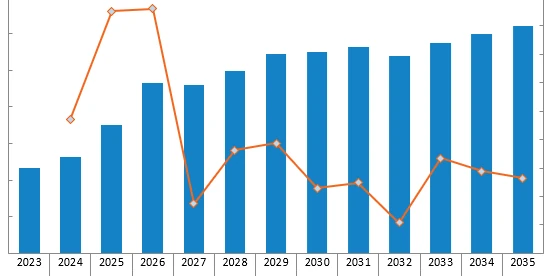
Grid-scale projects will continue to dominate total spending because of their large project sizes and role in supporting renewable integration and grid reliability. Grid-scale capex increases from $17.50 billion in 2025 to $30.99 billion in 2035, representing a 5.9% CAGR.
Residential storage is expected to remain a strong secondary investment area. Residential capex rises from $5.36 billion in 2025 to $10.53 billion by 2035, reflecting a 7.0% CAGR. Higher electricity prices and continued solar PV adoption will support this segment.
C&I storage is expected to experience the fastest growth, despite starting from a smaller base. C&I capex increases from $0.37 billion in 2025 to $3.90 billion in 2035, representing a 26.5% CAGR.
The grid-scale deployment outlook reinforces the investment opportunity. Annual grid BESS additions are projected to rise from 17.2 GW in 2025 to 30.2 GW in 2035, while cumulative capacity reaches 311.3 GW by 2035.
Scope of Analysis
Battery Energy Storage End-User Segmentation & Definitions
Why is it Increasingly Difficult to Grow?
The Strategic Imperative 8™
The Impact of the Top 3 Strategic Imperatives on the United States Battery Energy Storage Industry
Key Findings
Grid, C&I, & Residential Capex Forecasts
Grid, C&I, & Residential Capacity Additions (GW) Forecasts
Trend #1: Residential Storage Becomes a Grid Asset Through VPP Participation
Trend #2: Commercial Storage Shifts from Peak Shaving to Multi-Management Energy Services
Trend #3: Data Center Expansion Creates a New Growth Segment for BTM Storage
Trend #4: Solar Export Compensation Reforms Drive Higher BTM Storage Attachment Rates
Residential BESS Annual & Cumulative System Forecasts
Residential BESS Battery Chemistry Forecasts
Residential BESS Competitive Landscape
C&I BESS: Key Enablers
C&I BESS: Significance of the Key Enablers
C+I BESS Annual & Cumulative GW Forecasts
C+I BESS Annual & Cumulative GWh Forecasts
C&I BESS Capex Forecasts
C&I Battery Chemistry Forecasts
C&I BESS Competitive Landscape
Growth Opportunity 1: Flexibility Requirements from Data Centers Create a New Stream of Projects
Growth Opportunity 2: Geographic Expansion into New Regions of the United States
Growth Opportunity 3: Growth of Virtual Power Plants and Distributed Energy Networks
Grid-Scale Enabler Definitions: Market Design
Grid-Scale Enabler Definitions: Physical Market
Grid-Scale Enabler Definitions: Supportive Policies
C&I Enabler Definitions: Market Design
C&I Enabler Definitions: Physical Market
C&I Enabler Definitions: Supportive Policies
Residential Enabler Definitions: Market Design
Residential Enabler Definitions: Physical Market
Residential Enabler Definitions: Supportive Policies
Benefits and Impacts of Growth Opportunities
Next Steps
List of Exhibits
Legal Disclaimer
Frequently Asked Questions (FAQs) – U.S. Battery Energy Storage System Market
1. What is the U.S. battery energy storage system market?
The U.S. battery energy storage system market comprises stationary electrochemical storage systems used to store electricity and provide services such as grid regulation, renewable energy integration, peak-demand management, energy resilience, and electricity-market flexibility. The market includes grid-scale, commercial and industrial (C&I), and residential battery energy storage systems.
2. What is the forecast period for the U.S. battery energy storage system market?
The study covers the U.S. battery energy storage system market from 2023 to 2035, with 2025 as the base year and 2026–2035 as the forecast period. The geographic scope is limited to the United States.
3. How large will the U.S. battery energy storage system market be by 2035?
Total battery energy storage system capex revenue is forecast to increase from $23.24 billion in 2025 to $45.42 billion by 2035. Grid-scale systems are expected to account for the largest share of investment throughout the forecast period.
4. Which segment will dominate the Battery Energy Storage Systems Market?
Grid-scale BESS is expected to remain the dominant segment of the Battery Energy Storage Systems Market. Grid-scale capex is projected to increase from $17.50 billion in 2025 to approximately $30.99 billion by 2035, representing a 5.9% CAGR.
5. Which BESS segment will grow the fastest?
The commercial and industrial (C&I) BESS segment is expected to record the fastest growth. Its capex is forecast to increase from $0.37 billion in 2025 to $3.90 billion by 2035, representing a 26.5% CAGR.
6. What is driving residential battery energy storage adoption?
Residential battery energy storage adoption is being supported by higher electricity prices, continued solar PV expansion, and increasing demand for energy security and resilience. Residential BESS capex is projected to grow at a 7.0% CAGR from 2025 to 2035.
7. What battery chemistry dominates the energy storage systems market?
Lithium-ion is currently the dominant chemistry in the energy storage systems market. However, sodium-ion batteries are expected to gain traction because of their potential cost advantages, while flow batteries are attractive for longer-duration storage projects.
8. How much grid-scale BESS capacity is expected by 2035?
Annual grid-scale BESS additions are forecast to reach 30.2 GW in 2035, compared with 17.2 GW in 2025. Cumulative grid-scale capacity is projected to increase from 45.5 GW in 2025 to approximately 311.3 GW by 2035.
9. How will BESS system duration change through 2035?
Average BESS duration is expected to increase as asset owners seek to maximize revenue opportunities. By 2035, average system durations are forecast to reach approximately 5 hours for grid systems, 4.5 hours for C&I systems, and 4 hours for residential systems.
10. Who are the key players in the U.S. battery energy storage system market?
Tesla is identified as the dominant player across BESS categories. Other companies with a presence in the market include Generac, Wärtsilä, Ameresco, and Schneider Electric. Competition spans equipment manufacturing, system integration, installation, and energy services.
Speak directly with our analytics experts for tailored recommendations.
Recent related Power Generation research
12 Oct 2026 | Global | Market Research
Growth Opportunities in the Global Nuclear Power Industry, 2025–2035
The Growth Opportunities in the Global Nuclear Power Industry study examines global commercial nuclear power development from 2025 to 2035, covering reactors above 10 MWe and the life cycle services supporting the installed fleet. Global installed capacity is projected to grow 23.8%, reaching approx...
09 Oct 2026 | Global | Technology Research
Innovations in Enhanced Oil Recovery, Continuous Emission Monitoring, Infrared Gas Detection, and Reservoir Optimization
This edition of the Oil and Gas (O&G) Technology Opportunity Engines features information on enhanced oil recovery, crude oil separation, leak detection, distributed gas monitoring, real-time monitoring of distributed fuel operations, among others.The Oil and Gas TOE provides intelligence on innovat...
28 Sep 2026 | Global | Technology Research
CO₂ Gas Injection for Enhanced Oil Recovery and Carbon Utilization
CO₂ gas injection for enhanced oil recovery (CO₂-EOR) is a mature tertiary recovery technology that improves oil production from depleted reservoirs while enabling long-term geological carbon storage. This report provides a fundamental overview of oil recovery, covering primary, secondary, and terti...
28 Sep 2026 | Global | Technology Research
CO₂ Gas Injection for Enhanced Oil Recovery and Carbon Utilization
CO₂ gas injection for enhanced oil recovery (CO₂-EOR) is a mature tertiary recovery technology that improves oil production from depleted reservoirs while enabling long-term geological carbon storage. This report provides a fundamental overview of oil recovery, covering primary, secondary, and terti...
28 Sep 2026 | Global | Technology Research
Quasi-Solid-State Batteries: Key Innovations Transforming Electrochemical Energy Storage Systems
Quasi-solid-state batteries (QSSBs) are emerging as a promising next-generation lithium battery technology that bridges the gap between conventional lithium-ion batteries (LIBs) and all-solid-state batteries (ASSBs). By integrating a confined liquid electrolyte within a polymer, inorganic, or hybrid...
Purchase includes:
- Report download
- Growth Dialog™ with our experts
Growth Dialog™
A tailored session with you where we identify the:- Strategic Imperatives
- Growth Opportunities
- Best Practices
- Companies to Action
Impacting your company's future growth potential.
Driven by declining technology costs, supportive state policies, and the continued expansion of solar pv, the US market has experienced record levels of storage deployment in 2025 and this record is forecast to be broken again in 2026. Large-scale battery projects are now being developed across key markets such as California, Texas, Arizona, and the Northeast, addressing challenges associated with peak demand, grid congestion, and renewable intermittency. At the same time, advancements in lithium-ion technology, alternative battery chemistries, and energy management software continue to improve system performance and project economics.
Despite strong momentum, the sector faces a range of challenges, including supply chain constraints, permitting complexities, and a less supportive (but not openly hostile) federal climate. This report examines the current state of the U.S. battery energy storage market, key growth drivers, competitive dynamics, regulatory developments, and future opportunities, providing insight into a key energy sector.
Author: Vasanth Krishnan
| Deliverable Type | Market Research |
|---|---|
| Industries | Energy |
| No Index | No |
| Is Prebook | No |
| Podcast | No |
| Predecessor | None |
| WIP Number | M1P6-01-00-00-00 |