 USD
USD GBP
GBP  CNY
CNY  EUR
EUR  INR
INR  JPY
JPY  MYR
MYR  ZAR
ZAR  KRW
KRW  THB
THB 


Growth Opportunity Analysis in the Vehicle Leasing Market, Global, 2024–2029
The Global Vehicle Leasing Market is Experiencing Transformational Growth by Shifting Toward Operational, Full-Service, and EV-Driven Leasing Models, with Revenue Set to Hit $520.28 Billion by 2029
30-Dec-2025
Global
Market Research
PFI4-01-00-00-00
AU_2026_34244
Report Summary: Global Vehicle Leasing Market
The global vehicle leasing market was valued at USD 398.24 billion in 2024 and is projected to reach USD 520.28 billion by 2029, growing at a CAGR of 5.5% during the forecast period. The expansion of the Light Commercial Vehicle (LCV) Leasing Market and the rising penetration of the passenger vehicle (PV) leasing market are the primary growth engines, supported by increasing fleet outsourcing, rapid e-commerce expansion, and the accelerating adoption of electric vehicles across global mobility ecosystems.
Key Market Trends & Insights
- Europe and North America together accounted for the largest share of the global vehicle leasing market in 2024, driven by high corporate fleet penetration and mature leasing ecosystems.
- The Light Commercial Vehicle (LCV) Leasing Market continues to expand due to strong demand from logistics, last-mile delivery, and service fleets.
- The passenger vehicle (PV) leasing market is growing rapidly as consumers increasingly prefer subscription-based and operational leasing models.
- Operational leasing is gaining share over financial leasing as customers seek predictable costs and bundled services.
- Electric vehicle leasing is emerging as a major growth catalyst within the light commercial vehicle leasing market and PV segment.
Market Size & Forecast
- 2024 Market Size: USD 398.24 Billion
- 2029 Projected Market Size: USD 520.28 Billion
- CAGR (2024–2029): 5.5%
- Largest Region: Europe
- Fastest Growing Region: Asia-Pacific
The increasing shift toward asset-light mobility, combined with the digitization of fleet management and rapid EV adoption, is structurally transforming the global vehicle leasing market. Companies and consumers are turning to leasing as a cost-efficient and flexible alternative to ownership, while leasing providers are expanding their value proposition through telematics, charging solutions, and integrated mobility services. As e-commerce, urbanization, and sustainability mandates continue to reshape transportation, the Light Commercial Vehicle (LCV) Leasing Market and the passenger vehicle (PV) leasing market are expected to remain central to the long-term growth of the global vehicle leasing market.
Market Overview: Global Vehicle Leasing Market
The global vehicle leasing market has evolved into one of the most critical pillars of the modern automotive and mobility ecosystem, enabling fleet renewal, electrification, and capital-efficient mobility across corporate and private customers. The market covers multi-year lease contracts for both the passenger vehicle (PV) leasing market and the Light Commercial Vehicle (LCV) Leasing Market, supporting millions of corporate fleets, SMEs, and individual consumers worldwide.
In 2024, global leasing revenue reached USD 398.24 billion, supported by 48.4 million active lease contracts. By 2029, revenue is expected to reach USD 520.28 billion, while active contracts will increase to 56.3 million, indicating that value growth is outpacing unit growth as leasing shifts toward higher-value, service-bundled and EV-centric contracts
This reflects a structural upgrade in the light commercial vehicle leasing market and passenger vehicle (PV) leasing market, where leasing providers now bundle maintenance, telematics, battery coverage, and charging solutions into monthly payments.
Operational leasing is outgrowing financial leasing because customers want predictable TCO, risk transfer, and simplified fleet management. Digital platforms, AI-driven residual value modeling, and connected-vehicle data are transforming how leases are priced, managed, and renewed. These trends are pushing the global vehicle leasing market toward integrated digital mobility ecosystems, where leasing companies become long-term fleet partners rather than simple financiers.
Scope of Analysis: Global Vehicle Leasing Market
This study analyzes the global vehicle leasing market across passenger vehicles and light commercial vehicles serving both corporate and private customers. The scope includes four core leasing models: Corporate Financial Leasing (CFL), Corporate Operational Leasing (COL), Private Financial Leasing (PFL), and Private Operational Leasing (POL), which together represent the full universe of the light commercial vehicle leasing market and passenger vehicle (PV) leasing market
The study period spans 2019–2029, with 2024 as the base year and 2025–2029 as the forecast period. All revenues are reported in US dollars and calculated using average annual lease value per vehicle multiplied by the number of active lease contracts in each region. Revenue reflects annualized contract income for vehicles under management by leasing companies rather than OEM sales or financing volumes.
Geographic coverage includes North America, Europe, Asia-Pacific, Latin America, and Other regions (Saudi Arabia, South Africa, and UAE). The analysis integrates macroeconomic conditions, fleet electrification trends, digital leasing adoption, and residual value dynamics to model the evolution of the global vehicle leasing market across both the passenger vehicle (PV) leasing market and the Light Commercial Vehicle (LCV) Leasing Market.
Revenue & Spending Forecast: Global Vehicle Leasing Market
The global vehicle leasing market expanded from USD 398.24 billion in 2024 to a projected USD 520.28 billion by 2029, representing a CAGR of 5.5% over the forecast period
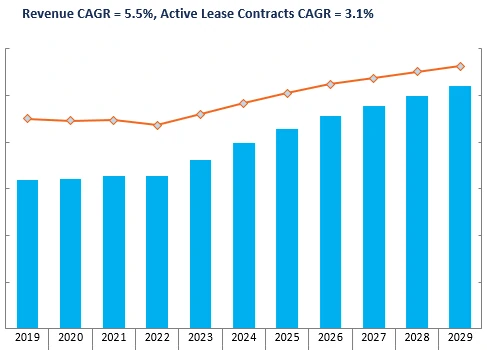
Growth is driven by higher EV penetration, increasing service bundling, and rising operational leasing adoption across both the passenger vehicle (PV) leasing market and the Light Commercial Vehicle (LCV) Leasing Market.
Europe will continue to be the largest regional contributor, reaching USD 228.70 billion by 2029, while North America will grow to USD 178.31 billion. Asia-Pacific will expand to USD 85.78 billion, supported by rapid urbanization, digital leasing platforms, and rising middle-class demand.
Operational leasing revenue will grow faster than financial leasing as full-service EV contracts, telematics, and charging bundles lift monthly lease values. As EV share increases, total revenue in the global vehicle leasing market will grow faster than vehicle volumes, reflecting a structural upgrade toward higher-value mobility solutions.
Market Segmentation Analysis: Global Vehicle Leasing Market
The global vehicle leasing market is segmented by leasing model, vehicle type, customer group, and region, reflecting the complexity of how fleets and personal vehicles are financed and managed worldwide.
By leasing model, operational leasing (corporate and private combined) is the dominant growth engine, expanding at 6.2% CAGR, compared with 3.5% CAGR for financial leasing. This shift is being driven by strong demand for bundled full-service contracts that reduce residual value risk and simplify fleet management across both the light commercial vehicle leasing market and the passenger vehicle (PV) leasing market
By vehicle type, passenger vehicles account for the majority of leased units, especially in private operational leasing, while LCVs dominate corporate operational leasing, driven by logistics, e-commerce, utilities, and field-service fleets. The Light Commercial Vehicle (LCV) Leasing Market benefits from high utilization, predictable fleet replacement cycles, and growing electrification mandates.
Regionally, Europe generated USD 183.73 billion in 2024, followed by North America at USD 128.60 billion, making them the two largest contributors to the global vehicle leasing market. Asia-Pacific and Latin America are the fastest-growing regions due to low leasing penetration, SME expansion, and rapid EV adoption.
Growth Drivers: Global Vehicle Leasing Market
The global vehicle leasing market is being propelled by several powerful growth drivers. First, the shift toward asset-light mobility is pushing both corporates and consumers to favor leasing over ownership, particularly within the passenger vehicle (PV) leasing market. Second, the post-COVID expansion of e-commerce and last-mile delivery is fueling sustained demand in the Light Commercial Vehicle (LCV) Leasing Market.
Third, OEM captive finance arms are actively promoting leasing to stabilize vehicle sales and secure recurring revenue streams. Fourth, digitalization of lease origination, fleet telematics, and AI-based residual value modeling is improving scalability and profitability for leasing companies. Finally, government EV incentives and decarbonization mandates are making leasing the preferred channel for EV adoption, as lessors absorb battery, depreciation, and resale risks.
Together, these drivers are accelerating penetration and increasing average contract value across the global vehicle leasing market.
Growth Restraints: Global Vehicle Leasing Market
Despite strong fundamentals, the global vehicle leasing market faces key challenges. High interest rates and funding costs increase monthly lease payments, particularly for service-heavy operational leases. Residual value volatility in EVs creates pricing uncertainty, especially in the passenger vehicle (PV) leasing market.
Supply-chain disruptions and model availability constraints slow fleet renewal in the Light Commercial Vehicle (LCV) Leasing Market, while regulatory uncertainty around EV incentives and taxation complicates long-term planning. In emerging regions, low consumer awareness of full-service leasing and weak used-vehicle remarketing ecosystems limit adoption and profitability.
Competitive Landscape: Global Vehicle Leasing Market
The global vehicle leasing market is highly competitive, with approximately 320 active players worldwide. The top five companies control 22.2% of global revenue, led by Ayvens, Volkswagen Financial Services, Arval, Leasys, and ORIX
OEM-backed lessors benefit from preferential vehicle supply and pricing, while independent leaders differentiate through EV portfolios, charging partnerships, telematics, and digital platforms. M&A activity, such as ALD Automotive’s acquisition of LeasePlan to form Ayvens, is accelerating consolidation and scale across both the passenger vehicle (PV) leasing market and Light Commercial Vehicle (LCV) Leasing Market.
Scope of Analysis
Segmentation
Why is it Increasingly Difficult to Grow?
The Strategic Imperative 8™
The Impact of the Top 3 Strategic Imperatives on the Vehicle Leasing Industry
Competitive Environment
Key Competitors
Growth Metrics
Growth Drivers
Growth Restraints
Forecast Considerations
Revenue and Active Lease Contracts Forecast
Revenue Forecast by Product
Revenue Forecast by Region
Revenue Forecast Analysis
Active Lease Contracts Forecast by Product
Active Lease Contracts Forecast by Region
Pricing Trends and Forecast Analysis
Revenue Share
Revenue Share Analysis
Growth Metrics
Revenue and Active Lease Contracts Forecast
Revenue Forecast by Region
Corporate Financial Leasing—Forecast Analysis
Growth Metrics
Revenue and Active Lease Contracts Forecast
Revenue Forecast by Region
Active Lease Contracts Forecast by Region
Corporate Operational Leasing—Forecast Analysis
Growth Metrics
Revenue and Active Lease Contracts Forecast
Revenue Forecast by Region
Active Lease Contracts Forecast by Region
Private Financial Leasing—Forecast Analysis
Growth Metrics
Revenue and Active Lease Contracts Forecast
Revenue Forecast by Region
Active Lease Contracts Forecast by Region
Private Operational Leasing—Forecast Analysis
Growth Opportunity 1: Accelerating EV-Centric Mobility Solutions
Growth Opportunity 2: Building Integrated Digital Leasing Ecosystems
Growth Opportunity 3: Scaling Leasing in Emerging Mobility Corridors
Benefits and Impacts of Growth Opportunities
Next Steps
List of Exhibits
Legal Disclaimer
Frequently Asked Questions – Global Vehicle Leasing Market
1. What is the global vehicle leasing market?
The global vehicle leasing market refers to the leasing of passenger vehicles and light commercial vehicles to corporate and private customers under financial and operational leasing models.
2. What was the size of the global vehicle leasing market in 2024?
The global vehicle leasing market was valued at USD 398.24 billion in 2024.
3. What is the projected size of the global vehicle leasing market by 2029?
The global vehicle leasing market is projected to reach USD 520.28 billion by 2029.
4. What is the CAGR of the global vehicle leasing market?
The global vehicle leasing market is expected to grow at a CAGR of 5.5% from 2024 to 2029.
5. What is the Light Commercial Vehicle (LCV) Leasing Market?
The Light Commercial Vehicle (LCV) Leasing Market covers the leasing of vans and small commercial vehicles used for logistics, last-mile delivery, utilities, and service fleets.
6. What is the passenger vehicle (PV) leasing market?
The passenger vehicle (PV) leasing market includes the leasing of cars and SUVs to individuals and corporate fleets under long-term and subscription-based contracts.
7. Which regions dominate the global vehicle leasing market?
Europe and North America dominate the global vehicle leasing market due to high fleet penetration and mature leasing ecosystems.
8. Why is operational leasing growing faster than financial leasing?
Operational leasing is growing faster because it offers bundled services, predictable costs, and risk transfer, making it attractive for both corporate and private users.
9. How are electric vehicles impacting the global vehicle leasing market?
Electric vehicles are accelerating leasing adoption as leasing companies absorb battery risk and provide charging and maintenance services within monthly contracts.
10. What is the future outlook for the global vehicle leasing market?
The global vehicle leasing market will continue to grow as mobility shifts toward electrification, digital fleet management, and asset-light transportation models.
Speak directly with our analytics experts for tailored recommendations.
Recent related Fleet and Leasing research
22 Jun 2026 | Global | Market Research
Robotaxi Benchmark in 20 Cities, Global, 2026–2035
This study is a comprehensive evaluation of global city readiness for commercial robotaxi deployment, examining how regulatory frameworks, infrastructure investment, technology ecosystems, and market dynamics are collectively determining which cities will lead the autonomous mobility transition and ...
24 Feb 2026 | Global | Megatrends
Trend Opportunity Profile Series—New Mobility
This series offers a comprehensive overview of the latest advancements and transformative trends that companies worldwide have embraced to develop technologies for a new era of mobility. These trends create direct opportunities for companies in sectors such as mobility, supply chain & logistics, hea...
16 Feb 2026 | Europe | Market Research
Leasing 2035: The Future of Mobility Finance
The global leasing industry is entering a pivotal decade as electrification, innovative financing models, and a more integrated fleet management ecosystem fundamentally reshape the future of mobility finance. By 2035, battery electric vehicles (BEVs) will dominate new fleet acquisitions in most matu...
09 Feb 2026 | Global | Market Research
Growth Opportunity Analysis of the Vehicle Rental Market, Global, 2024–2029
The global vehicle rental market is undergoing a period of accelerated transition as mobility demand patterns shift across business travel, leisure, the gig economy, and last-mile logistics. In a market marked by fluctuating travel volumes, high vehicle acquisition costs, and evolving customer expec...
04 Feb 2026 | South Asia, Middle East & North Africa | Market Research
Growth Opportunities in India’s Two-Wheeler Rental Market, 2025–2029
India’s two-wheeler rental market is undergoing transformative growth, driven by the convergence of rapid expansion in quick commerce, scaling of the gig economy, and electrification. Traditionally dominated by informal and ownership-led models, the market is increasingly shifting toward organized, ...
Purchase includes:
- Report download
- Growth Dialog™ with our experts
Growth Dialog™
A tailored session with you where we identify the:- Strategic Imperatives
- Growth Opportunities
- Best Practices
- Companies to Action
Impacting your company's future growth potential.
Current market dynamics—driven by electrification, supply-chain fluctuations, total cost pressures, and sustainability commitments—are reshaping leasing propositions worldwide. Transformational themes such as EV leasing, used-vehicle leasing, private leasing, and subscription-style access are accelerating as customers seek flexible, low-commitment mobility. Parallel developments in digitalization, connectivity, and fleet automation are improving asset visibility, enabling predictive maintenance, and reducing risk across the value chain. SMEs, in particular, are adopting leasing more rapidly as they seek structured mobility with minimal administrative overhead.
This study offers a holistic view of the global leasing ecosystem, examining the structural shifts, business model innovations, and technology-led disruptions shaping the market today. It also identifies the key growth opportunities that leasing providers and value-chain participants can capitalize on to remain competitive in a rapidly modernizing mobility landscape.
Author: Abishek Narayanan
| Deliverable Type | Market Research |
|---|---|
| Industries | Automotive |
| No Index | No |
| Is Prebook | No |
| Keyword 1 | vehicle leasing market |
| Keyword 2 | global fleet leasing |
| Keyword 3 | mobility leasing services |
| Podcast | No |
| Predecessor | None |
| WIP Number | PFI4-01-00-00-00 |