 USD
USD GBP
GBP  CNY
CNY  EUR
EUR  INR
INR  JPY
JPY  MYR
MYR  ZAR
ZAR  KRW
KRW  THB
THB 


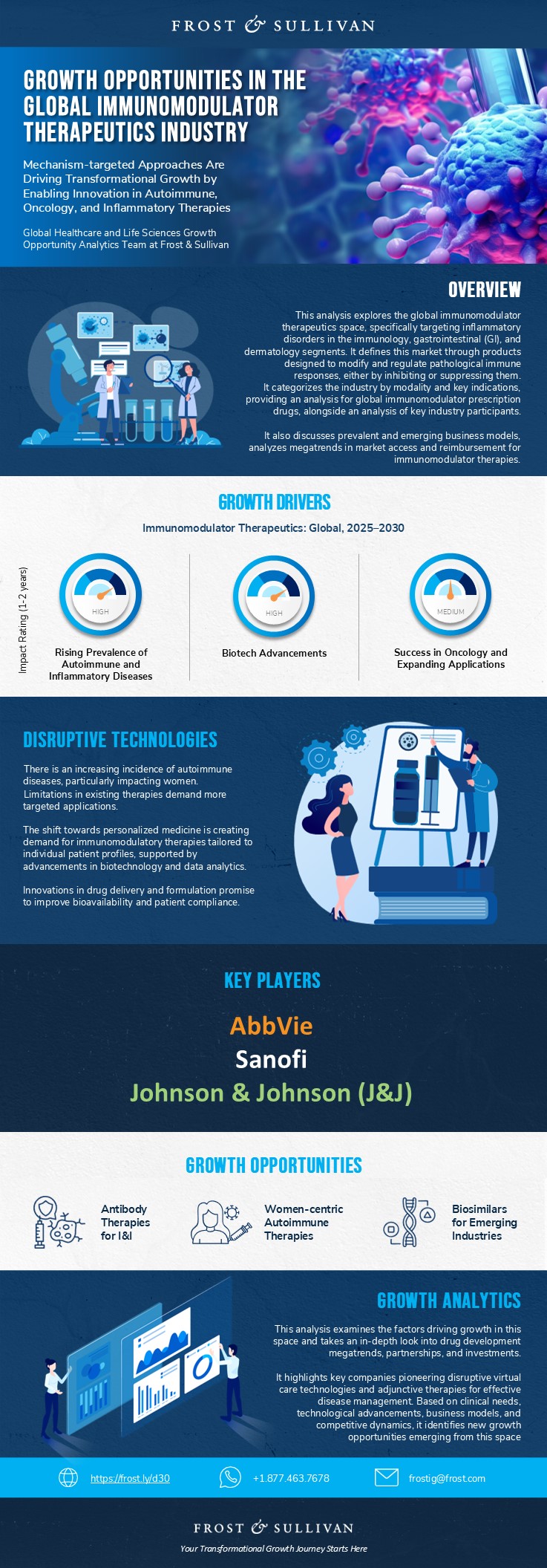
Mechanism-targeted Approaches are Driving Transformational Growth by Enabling Innovation in Autoimmune, Oncology, and Inflammatory Therapies
15-May-2025
Global
Market Research
PFRI-01-00-00-00
HC_2025_33493
Report Summary: Immunomodulator Therapeutics Market
The Immunomodulator Therapeutics Market was valued at USD 87.9 billion in 2024 and is projected to reach USD 147.0 billion by 2030, expanding at a CAGR of 9.0% from 2024 to 2030. The market is driven by the rising global burden of autoimmune and inflammatory diseases, increasing adoption of biologics, and growing therapeutic applications in oncology. Advances in targeted immunotherapies, monoclonal antibodies, and cell-based therapies are enabling more precise immune regulation and improving treatment outcomes. Additionally, the rapid expansion of the tumor immunotherapy drugs market is significantly contributing to overall market growth as immune checkpoint inhibitors and personalized immunotherapies become standard treatments across multiple cancer indications.
Key Market Trends & Insights
- The increasing prevalence of autoimmune diseases such as rheumatoid arthritis, lupus, Crohn’s disease, and psoriasis is accelerating demand within the Immunomodulator Therapeutics Market.
- The rapid expansion of the tumor immunotherapy drugs market is driving innovation in immune-modulating therapies, particularly in oncology and precision medicine.
- Biologic therapies, including monoclonal antibodies and recombinant proteins, continue to dominate treatment pipelines due to improved efficacy and targeted mechanisms of action.
- Pharmaceutical companies are expanding immunology and oncology R&D investments to develop next-generation immunotherapies and cell-based treatments.
- Strategic acquisitions and partnerships among biotechnology and pharmaceutical companies are accelerating innovation across the Immunomodulator Therapeutics Market.
Market Size & Forecast
- 2024 Market Size: USD 87.9 Billion
- 2030 Projected Market Size: USD 147.0 Billion
- CAGR (2024–2030): 9.0%
- North America: Largest regional market due to strong biologics adoption and advanced healthcare infrastructure
- Asia Pacific: Fastest-growing region driven by expanding healthcare access, increasing clinical research, and rising autoimmune disease prevalence
The continued advancement of biologics, gene therapies, and personalized immunology treatments is expected to significantly shape the future of the Immunomodulator Therapeutics Market. As healthcare systems increasingly adopt targeted immune therapies and precision medicine approaches, demand for immunomodulators is expected to rise steadily. The growing clinical success of therapies emerging from the tumor immunotherapy drugs market will further strengthen the adoption of immune-modulating drugs, positioning this sector as a critical component of the global pharmaceutical and biotechnology landscape.
Market Overview: Immunomodulator Therapeutics Market
The Immunomodulator Therapeutics Market encompasses pharmaceutical therapies that regulate immune system activity to treat immune-mediated disorders and cancers. These therapies include immunostimulants that enhance immune responses and immunosuppressants that dampen overactive immune activity. They are widely used in autoimmune diseases, inflammatory conditions, organ transplantation, and oncology applications.
Increasing prevalence of autoimmune diseases is one of the most influential growth drivers in the Immunomodulator Therapeutics Market. Disorders such as rheumatoid arthritis, systemic lupus erythematosus, Crohn’s disease, and psoriasis are becoming more common due to aging populations, environmental factors, and genetic predisposition. These conditions require long-term immune-modulating therapies, driving consistent demand for advanced treatments.
The expanding tumor immunotherapy drugs market is also transforming the broader immunomodulation landscape. Immunotherapies designed to activate immune cells against tumors have become one of the most promising cancer treatment approaches. Checkpoint inhibitors, cytokine therapies, and cell-based immunotherapies are demonstrating improved survival rates in multiple cancers, encouraging continued investment in immune-based oncology treatments.
Regional dynamics also influence the Immunomodulator Therapeutics Market. North America represents the largest market due to strong healthcare infrastructure, high biologics adoption, and significant R&D investment. Europe follows with strong regulatory support for advanced therapeutics, while Asia-Pacific is emerging as a high-growth region due to expanding healthcare access, increasing pharmaceutical manufacturing capacity, and growing clinical research activity.
As pharmaceutical companies accelerate innovation in immunology and oncology, the Immunomodulator Therapeutics Market will continue to evolve with new drug modalities, targeted biologics, and gene-based therapies. These developments will further strengthen the integration between immunology research and the expanding tumor immunotherapy drugs market.
Revenue Forecast: Immunomodulator Therapeutics Market
The Immunomodulator Therapeutics Market is projected to experience steady expansion over the forecast period due to the rising prevalence of autoimmune diseases, increasing adoption of biologics, and growing applications of immune-based therapies in oncology. The global Immunomodulator Therapeutics Market was valued at approximately USD 87.9 billion in 2024 and is expected to reach around USD 147.0 billion by 2030, reflecting a compound annual growth rate (CAGR) of about 9.0%. This growth trajectory is largely supported by advances in biologics, monoclonal antibodies, and cell-based therapies that improve treatment precision and clinical outcomes. Additionally, the rapid evolution of the tumor immunotherapy drugs market is reinforcing revenue growth, as immune checkpoint inhibitors and targeted immunotherapies gain wider adoption across multiple cancer indications. Continuous investments in immunology research, expanding clinical pipelines, and the increasing demand for personalized medicine approaches are expected to further strengthen the revenue outlook for the Immunomodulator Therapeutics Market throughout the forecast period.

Scope of Analysis: Immunomodulator Therapeutics Market
This study provides a comprehensive evaluation of the Immunomodulator Therapeutics Market, focusing on therapies designed to regulate immune system responses for the treatment of autoimmune diseases, inflammatory disorders, and oncology indications. The analysis examines pharmaceutical products that either stimulate immune responses or suppress abnormal immune activity, enabling effective management of complex immune-mediated conditions. The research also evaluates how innovations within the tumor immunotherapy drugs market are influencing the development and commercialization of next-generation immunomodulatory therapies.
The scope of the report covers global market dynamics across key therapeutic areas including immunology, gastroenterology, dermatology, and oncology. It assesses the clinical and commercial potential of various immunomodulatory therapies used in treating diseases such as rheumatoid arthritis, systemic lupus erythematosus, inflammatory bowel disease, psoriasis, and multiple cancer indications. In addition, the study evaluates emerging treatment approaches including monoclonal antibodies, recombinant antibodies, peptide therapeutics, and advanced cell and gene therapies that are shaping the future of the Immunomodulator Therapeutics Market and strengthening innovation within the tumor immunotherapy drugs market.
The analysis includes a detailed assessment of market structure, growth drivers, restraints, technological developments, and investment trends influencing industry expansion. It also evaluates the competitive ecosystem, strategic collaborations, and mergers and acquisitions that are shaping the global landscape of the Immunomodulator Therapeutics Market.
Geographically, the report analyzes market developments across North America, Europe, Asia-Pacific, and the Middle East & Africa and Latin America, highlighting regional adoption patterns, healthcare infrastructure developments, and regulatory environments. The base year for the analysis is 2024, with revenue forecasts extending through 2030, providing strategic insights for stakeholders seeking to understand long-term opportunities within the Immunomodulator Therapeutics Market and the rapidly evolving tumor immunotherapy drugs market.
Market Segmentation Overview: Immunomodulator Therapeutics Market
The Immunomodulator Therapeutics Market is segmented based on product type, technology platform, therapeutic application, and geographic regions. These segmentation categories help define how immunomodulatory therapies are developed, commercialized, and adopted across different disease areas. The market primarily includes therapies that regulate immune system activity either by stimulating immune responses or suppressing excessive immune activity associated with autoimmune and inflammatory diseases. Increasing clinical adoption across multiple therapeutic areas, particularly oncology, is strengthening the integration between the Immunomodulator Therapeutics Market and the expanding tumor immunotherapy drugs market.
Based on product type, the Immunomodulator Therapeutics Market is broadly classified into immunostimulants and immunosuppressants. Immunostimulants enhance the immune response and are commonly used in oncology treatments and vaccine-related therapies, while immunosuppressants reduce immune system activity to manage autoimmune diseases, inflammatory disorders, and organ transplantation complications.
From a technology perspective, the Immunomodulator Therapeutics Market includes therapies developed using both conventional pharmaceutical approaches and advanced biotechnology platforms. Conventional modalities primarily involve small-molecule drugs and plant-derived compounds. Biotechnology-based modalities include monoclonal antibodies, recombinant antibodies, protein and peptide therapeutics, and emerging cell and gene therapies. These advanced biologic platforms are significantly shaping the future of the Immunomodulator Therapeutics Market, particularly through innovations that are closely linked with developments in the tumor immunotherapy drugs market.
In terms of therapeutic application, immunomodulators are widely used in immunology and inflammatory disease management. Key indications include autoimmune diseases such as myasthenia gravis, systemic lupus erythematosus, rheumatoid arthritis, and other immune-mediated conditions. Additionally, therapies are increasingly applied in inflammatory gastrointestinal and dermatology indications, including inflammatory bowel disease, eczema, and psoriasis. The expanding role of immune-based cancer therapies further strengthens the importance of immunomodulation in the rapidly growing tumor immunotherapy drugs market.
Geographically, the Immunomodulator Therapeutics Market is segmented into North America, Europe, Asia-Pacific, and the Middle East & Africa and Latin America. North America currently represents the largest market due to strong pharmaceutical innovation and high adoption of biologic therapies, while Asia-Pacific is emerging as a rapidly growing region driven by expanding healthcare infrastructure, rising disease prevalence, and increasing investments in biotechnology research.
Growth Drivers: Immunomodulator Therapeutics Market
The Immunomodulator Therapeutics Market is experiencing significant expansion driven by the increasing prevalence of autoimmune and inflammatory diseases worldwide. Conditions such as rheumatoid arthritis, systemic lupus erythematosus, Crohn’s disease, and psoriasis are becoming more common due to aging populations, lifestyle changes, and improved disease diagnostics. These chronic conditions require long-term immune-modulating therapies, which is creating sustained demand across the Immunomodulator Therapeutics Market.
Advancements in biotechnology and drug development are another major factor accelerating market growth. The development of monoclonal antibodies, recombinant proteins, and cell-based therapies has significantly improved treatment precision and clinical outcomes. These technological innovations are enabling targeted immune modulation, minimizing systemic side effects while improving therapeutic effectiveness. Such advancements are expanding the treatment landscape within the Immunomodulator Therapeutics Market and are closely aligned with innovation trends observed in the tumor immunotherapy drugs market.
Increasing investment in immunology research and pharmaceutical R&D is also strengthening the market outlook. Governments, academic institutions, and pharmaceutical companies are allocating substantial funding to immunology and oncology research to accelerate the discovery of next-generation immune-based therapies. These investments are contributing to a strong pipeline of innovative treatments across the Immunomodulator Therapeutics Market, while also supporting the rapid growth of the tumor immunotherapy drugs market.
The expanding application of immunomodulators in oncology represents another critical growth driver. Immune checkpoint inhibitors, cytokine therapies, and cell-based immunotherapies are transforming cancer treatment strategies by enhancing the immune system’s ability to identify and destroy cancer cells. The success of these therapies is significantly increasing the clinical relevance of the Immunomodulator Therapeutics Market, particularly as the tumor immunotherapy drugs market continues to grow globally.
Growth Restraints: Immunomodulator Therapeutics Market
Despite strong growth potential, the Immunomodulator Therapeutics Market faces several challenges that could limit its expansion. One of the primary barriers is the stringent regulatory approval process associated with immune-modulating therapies. The development of biologics and advanced immunotherapies requires extensive clinical trials and regulatory evaluations to ensure safety and efficacy, often resulting in long development timelines and high costs for pharmaceutical companies.
Safety concerns related to immune-modulating therapies also pose a significant challenge. Immunomodulators can potentially cause serious adverse effects, including increased susceptibility to infections and immune-related complications. These safety risks require careful patient monitoring and can sometimes limit widespread adoption of certain therapies within the Immunomodulator Therapeutics Market.
Another key restraint is the growing competition from biosimilars following the expiration of patents for several blockbuster biologic drugs. Biosimilar products offer lower-cost alternatives to branded therapies, which can reduce revenue potential for established pharmaceutical companies and intensify price competition within the Immunomodulator Therapeutics Market.
Additionally, patient adherence challenges may affect treatment outcomes and long-term market growth. Many biologic immunomodulators require regular injections or infusion-based administration, which may reduce treatment compliance in some patients. These factors can create barriers to therapy adoption and impact overall expansion within the Immunomodulator Therapeutics Market, even as the tumor immunotherapy drugs market continues to drive innovation in immune-based treatments.
Competitive Landscape: Immunomodulator Therapeutics Market
The Immunomodulator Therapeutics Market is characterized by a highly competitive and innovation-driven ecosystem, with both large multinational pharmaceutical companies and specialized biotechnology firms actively developing immune-modulating therapies. The market includes approximately 59 key competitors, with around 13 companies generating more than USD 1 billion in revenue from immunomodulatory products. Market competition is primarily driven by factors such as drug efficacy, safety profiles, technological innovation, label expansion strategies, pricing competitiveness, and the ability to maintain diversified therapeutic portfolios.
Major pharmaceutical companies dominate the Immunomodulator Therapeutics Market through extensive biologics pipelines, strong clinical research capabilities, and global commercialization networks. Leading companies include AbbVie, Sanofi, Johnson & Johnson, Eli Lilly, Novartis, AstraZeneca, and Amgen. These firms collectively account for approximately 76.4% of the global market revenue, indicating a moderately consolidated competitive environment. Many of these organizations are also actively involved in the rapidly expanding tumor immunotherapy drugs market, where immune checkpoint inhibitors and targeted biologics are becoming central to oncology treatment strategies.
Strategic collaborations and acquisitions are playing a critical role in shaping the competitive dynamics of the Immunomodulator Therapeutics Market. Pharmaceutical companies are increasingly acquiring biotechnology firms with promising immunology pipelines in order to strengthen their product portfolios and accelerate innovation. Notable transactions include Biogen’s acquisition of Human Immunology Biosciences, AbbVie’s acquisition of Celsius Therapeutics, Merck’s acquisition of Prometheus Biosciences for approximately USD 10.8 billion, Eli Lilly’s acquisition of DICE Therapeutics for around USD 2.4 billion, and Amgen’s acquisition of Horizon Therapeutics.
In addition to mergers and acquisitions, companies are investing heavily in advanced therapeutic technologies such as monoclonal antibodies, RNA-based therapeutics, and cell and gene therapies. These innovations are expanding treatment possibilities across autoimmune diseases, inflammatory conditions, and cancer indications. As a result, the Immunomodulator Therapeutics Market is closely linked with ongoing developments in the tumor immunotherapy drugs market, where next-generation immunotherapies continue to transform the treatment landscape.
Overall, competition within the Immunomodulator Therapeutics Market is expected to intensify as pharmaceutical companies expand their immunology research pipelines, pursue strategic partnerships, and introduce innovative therapies targeting complex immune-mediated diseases.
Scope of Analysis
Segmentation
Why is it Increasingly Difficult to Grow?
The Strategic Imperative 8™
The Impact of the Top 3 Strategic Imperatives on the Immunomodulator Therapeutics Industry
Prevalence Trends
Economic Burden
Drug Development Trends—I&I
Drug Development Trends
Trial Landscape
Clinical Trial Design Trends
Regulatory Trends and Initiatives by Region
Trends Advancing Market Growth
Technology Solutions Across the Care Continuum
Digital Solutions for R&D and Commercialization
Business Models
Mergers and Acquisitions M&As Assessment
Venture Financing Assessment
Competitive Environment
Key Competitors
Growth Metrics
Growth Drivers
Growth Restraints
Research Process and Methodology
Forecast Considerations
Forecast Considerations and Limitations
Revenue Forecast Analysis
Revenue Forecast by Product
Forecast Analysis by Product
Revenue Forecast by Technology
Revenue Forecast by Application
Revenue Forecast by Region
Forecast Analysis by Region
Market Access and Reimbursement Trends
Pricing Trends and Forecast Analysis
Revenue Share
Revenue Share Analysis
Companies to Watch
Growth Metrics
Revenue Forecast by Technology
Revenue Forecast by Application
Revenue Forecast Analysis—Technology
Revenue Forecast Analysis—Application
Growth Metrics
Revenue Forecast
Revenue Forecast by Sub-type
Forecast Analysis
Growth Metrics
Revenue Forecast
Revenue Forecast by Sub-type
Forecast Analysis
Growth Metrics
Revenue Forecast
Revenue Forecast by Region
Forecast Analysis by Region
Revenue Forecast by Sub-type
Forecast Analysis by Sub-type
Growth Metrics
Revenue Forecast
Revenue Forecast by Region
Forecast Analysis by Region
Revenue Forecast by Sub-type
Forecast Analysis by Sub-type
Growth Opportunity 1: Antibody Therapies for I&I
Growth Opportunity 2: Women-centric Autoimmune Therapies
Growth Opportunity 3: Biosimilars for Emerging Markets
Growth Opportunity 4: Adjunctive Solutions for Disease Management and Adherence
Benefits and Impacts of Growth Opportunities
Next Steps
List of Exhibits
Legal Disclaimer
Frequently Asked Questions (FAQ) – Immunomodulator Therapeutics Market
1. What is the Immunomodulator Therapeutics Market?
2. What is the current size of the Immunomodulator Therapeutics Market?
3. What are immunomodulator drugs used for?
4. What factors are driving growth in the Immunomodulator Therapeutics Market?
5. Which diseases are commonly treated using immunomodulator therapeutics?
6. Which region leads the Immunomodulator Therapeutics Market?
7. What technologies are used in immunomodulator therapeutics?
8. Who are the major companies in the Immunomodulator Therapeutics Market?
9. What challenges affect the Immunomodulator Therapeutics Market?
10. What is the future outlook for the Immunomodulator Therapeutics Market?
Speak directly with our analytics experts for tailored recommendations.
Recent related Pharmaceuticals research
23 Sep 2026 | Global | Technology Research
Programmable Epigenome Editing for Disease Reversal
Programmable epigenome editing is developing as a distinct approach to controlling gene activity without changing the underlying DNA sequence. This report examines the landscape from the core editing technologies and delivery systems through the companies, academic programs and therapeutic applicati...
18 Sep 2026 | Global | Technology Research
Innovations and Growth Opportunities in AI-Enabled Discovery and Diagnostics, Precision Therapeutics, and Next-Generation Vaccine Platforms
This edition of the Life Science, Health & Wellness Technology Opportunity Engine (TOE) provides a comprehensive overview of breakthrough innovations transforming AI-enabled discovery, precision diagnostics, cell engineering, targeted therapeutics, vaccines, and skin health across oncology, metaboli...
07 Sep 2026 | Global | Technology Research
Synthetic Antibodies and AI-Optimized Immunotherapies
Artificial intelligence is becoming increasingly relevant to antibody discovery and immunotherapy development, supporting target identification, de novo antibody design, antibody engineering, clinical intelligence, and bioprocessing. Advances in generative AI, protein language models, diffusion mode...
21 Aug 2026 | Global | Technology Research
Innovations and Growth Opportunities in AI-Driven Biomanufacturing, Advanced Cell and Gene Therapies, and Precision Immunotherapy
This edition of the Life Science, Health & Wellness Technology Opportunity Engine (TOE) provides a comprehensive overview of breakthrough innovations reshaping biomanufacturing, cell and gene therapy, precision immunotherapy, anti-infectives, and neurotherapeutics across oncology, infectious disease...
31 Jul 2026 | Global | Market Research
Growth Opportunities in Small-Molecule Contract Development and Manufacturing Organizations, Global, 2026–2031
The global small‑molecule CDMO industry is undergoing a structural transformation driven by increasing molecular complexity, patent expiries, cost pressures, and the strategic need to secure resilient pharmaceutical supply chains. Demand is shifting beyond high‑volume commodity generics toward speci...
Purchase includes:
- Report download
- Growth Dialog™ with our experts
Growth Dialog™
A tailored session with you where we identify the:- Strategic Imperatives
- Growth Opportunities
- Best Practices
- Companies to Action
Impacting your company's future growth potential.
| Deliverable Type | Market Research |
|---|---|
| Industries | Healthcare |
| No Index | No |
| Is Prebook | No |
| Keyword 1 | Immunomodulator market |
| Keyword 2 | Therapeutics forecast |
| Keyword 3 | pharmaceutical market |
| Podcast | No |
| Predecessor | None |
| WIP Number | PFRI-01-00-00-00 |
Immunomodulator Therapeutics Market, Global, 2024–2030
$4,950.00
Special Price $4,455.00 save 10 %