 USD
USD GBP
GBP  CNY
CNY  EUR
EUR  INR
INR  JPY
JPY  MYR
MYR  ZAR
ZAR  KRW
KRW  THB
THB 


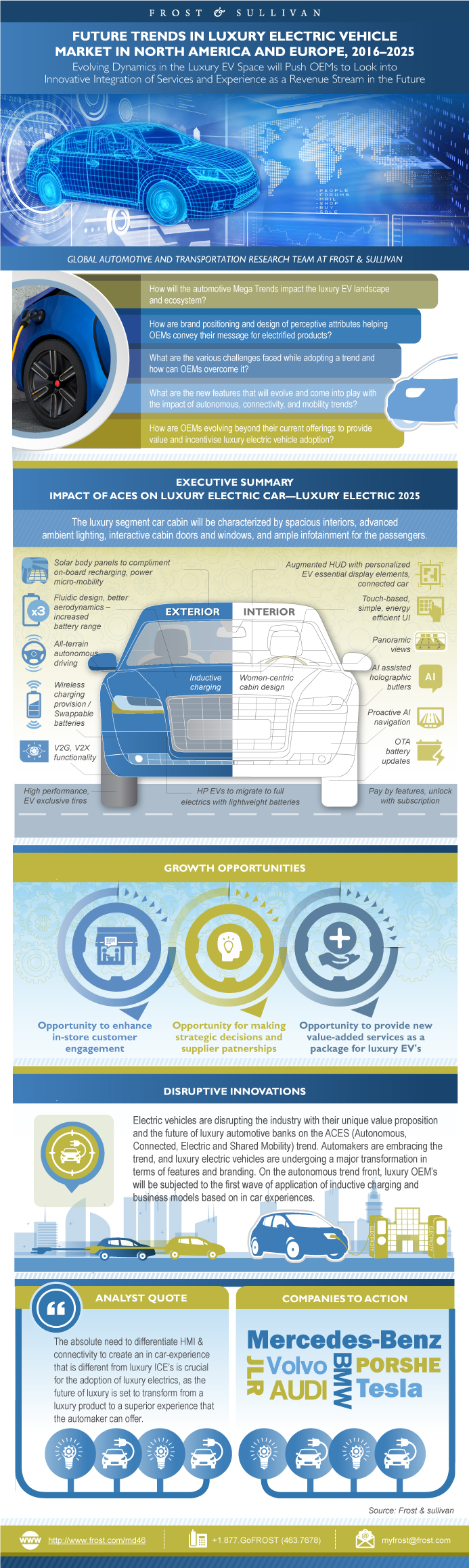
Evolving Dynamics in the Luxury EV Space will Push OEMs to Look into Innovative Integration of Services and Experience as a Revenue Stream in the Future
08-Dec-2017
North America
Market Research
MD46-01-00-00-00
AU01610-NA-MR_21249
Stringent emission regulations have pushed luxury OEMs to electrify their offerings to adhere to the standards. Although battery electric vehicles and plug-in hybrids are being touted as sustainable alternative transportation solutions, low adoption can be attributed to lack of consumer awareness and common misconceptions about electric range and e-technology. While a set of tech savvy consumers and green environmentalists are the early adopters, OEMs need to offer more than a product to attract consumers across varying demographic segments. Moreover, the luxury space is evolving more rapidly than its internal-engine powered counterpart owing to the influential impact of the ACEC trend.
The future of luxury automotive banks on the Autonomous, Connected, Electric, and Shared Mobility (ACES) trend. Automakers are ever agile in the space of luxury electric cars, integrating next-gen technological features owing to the support of autonomous, connectivity, and mobility trends. Automakers are embracing these trends and luxury electric vehicles are undergoing a major transformation in terms of features and branding. On the autonomous trend front, luxury OEMs will be subjected to a first wave of application of inductive charging and business models based on in-car experiences. But the impact on connectivity and HMI innovations is vital for brands looking towards differentiating themselves. AI-based personal assistance and AI-based proactive navigation to eliminate range anxiety and optimal use of battery charge will be a few examples of features included in the car. With regards to HMI, intuitive touch-based systems are set to become a norm. Women-centric designs will also be in the radar of premium makers, especially in the SUV segments. In the prospect of autonomous shared mobility economy only 2 distinctive segments will survive—premium and low cost. Therefore, it becomes essential for OEMs to look beyond the product and lean on customer experience (CX) to not only better enable a sustainable revolution but to also diversify their offerings to stay ahead of the competition.
Research Benefits
This study captures future trends in luxury electric vehicles and discusses about challenges to OEM's and their remediation strategies.
Key Issues Addressed
- How will the automotive Mega Trends impact the luxury EV landscape and ecosystem?
- How are brand positioning and design of perceptive attributes helping OEMs convey their message for electrified products?
- What are the various challenges faced while adopting a trend and how can OEMs overcome it?
- What are the new features that will evolve and come into play with the impact of autonomous, connectivity, and mobility trends?
- How are the OEMs evolving beyond their current offerings to provide value and incentive luxury electric vehicle adoption?
Executive Summary—Key Findings
Executive Summary—Premium Luxury Brand Timeline
Customer Strategy—EV Brand Positioning
Women as Customers—Design Trends
Electrification—Future Vehicle Segment Analysis
HMI—A Look into Future Trends
Body Design & Styling—Luxury Electric 2025
Leasing Features Analysis—Identifying the Grey Area
Region-wise Analysis of OEMs’ Mobility Business Models
Building Better CX—Possible Customer Service Business Models
Proposition Analysis—Owning the ACES Space
Research Scope
Research Aims and Objectives
Key Questions this Study will Answer
Research Methodology
Product Segmentation
EV Segmentation
Classification of Premium & High Performance Vehicles
Forecast Summary—Premium & High Performance Vehicles
Why Luxury EVs?
Key Trends that Impact the Luxury Electric Vehicle Market
Boom in Luxury EV Investments and New Market Entrants
How Tesla Creates an Ecosystem of Green Mobility
Consumer Analysis—Demographics Classification
Customer Preference—Electric Vehicles
Customer Strategy—EV Brand Positioning
Women as Customers—Snapshot
Women as Customer—Design Trends
Product Launch Map of Luxury BEV Launches
Product Launch Map of Luxury PHEV Launches
Product Launch Map of Luxury PHEV Launches (continued)
Long-range Luxury BEVs to Rule the Market
ACES Interest Mapping
Threat from Tech Companies in Luxury EV Segment
Evolution of Supplier Value Chain
Electrification—Luxury EV Market
Electrification—Luxury EV Platform Strategies
Electrification—Market Overview
Electrification—Future Vehicle Segment Analysis
Luxury EV—Europe and North America Landscape
Luxury EV—OEM Market Share
Electrification—Trend Progression
Autonomous—Future Trends in Luxury
Autonomy—Challenges to Luxury EV and Remediation Strategies
Autonomy—Future OEM Strategies
Connectivity & HMI
HMI—A Look into Future Trends
Predictive Analytics—AI in the Future of Luxury Electric Cars
Inside Faraday Future and Lucid Motors
Connectivity and HMI—Trend Progression
Body Design and Styling—Design Challenges
Body Design and Styling—Luxury Electric 2025
Future Battery Chemistries—Market Introduction Roadmap
Luxury Electric Vehicle—Battery Trends
End-of-Lifecycle Analysis—Lifecycle of Batteries
Luxury Electric Vehicle—Charging Trends
Battery and Charging in Luxury EV—Trend Progression
Changing Ownership Trends
OEM Marketing Mix—Comparative Landscape
Trends in Automotive Retail Stores
EV only Retail Store or Mixed Retailing Concept?
OEM Retail Strategies
Recommended EV Retail Elements—Critical Success Factors
Financial Lease Type Segmentation
Financial Feature Analysis
Leasing Features Analysis—Identifying the Grey Area
Future Innovations
Retail Trends in Luxury EV—Trend Progression
Consumer Perception—New Mobility Acceptance
Mobility as a Service (MaaS)
Region-wise Analysis of OEMs’ Mobility Business Models
Exhibit C—Maven Electric Carsharing
Exhibit D: Subscription Based Business Model
Building Better CX—Possible Customer Service Business Models
Mobility—Trend Progression
EV Product Positioning—Price vs Range
EV Product Positioning—Battery Capacity vs Range
Proposition Analysis—Owning the ACES Space
Growth Opportunity—Social Collaboration
Strategic Imperatives for Global Luxury EV Industry
Conclusion
Future of Luxury Electric Vehicle—Snapshot (2025)
Global Luxury EV Market—3 Big Predictions
Legal Disclaimer
Abbreviations and Acronyms Used
EV Incentives—North America
EV Incentives—North America (continued)
EV Incentives—Europe
EV Incentives—Europe (continued)
EV Incentives—Europe (continued)
EV Incentives—Asia
Market Engineering Methodology
Speak directly with our analytics experts for tailored recommendations.
Recent related Powertrain research
06 Jun 2023 | North America | Market Outlook
2023 Prediction of Global Electric Car Growth Outlook
This Frost & Sullivan study provides an outlook for the electric vehicle industry based on the latest industry data; it provides an outline of current trends and an in-depth analysis of future developments, as well as a breakdown of the main stakeholders in the sector and their performance. EV sal...
23 Mar 2023 | North America | Market Research
Strategic Analysis of WBG Semiconductors in Power Electronics Applications for EVs, Forecast to 2030
The increasing use of electric vehicles (EVs) worldwide boosts power semiconductor demand. Government laws and subsidies, original equipment manufacturers' (OEMs') dedication to net zero emissions, and sustainability goals accelerate EV penetration in the vehicle industry. This study focuses on wide...
30 Dec 2022 | North America | Market Research
Opportunity Analysis of EV Digital Products and Services
The electric vehicle (EV) market is growing rapidly and impacting the energy market and associated services. As OEMs integrate more software-defined solutions into EVs, a potential market for digital products and services (P&S) exists. EV-dedicated digital P&S allows key participants to continuously...
23 Dec 2022 | Latin America | Market Research
Electric Vehicle Competitive Landscape for Key North American Vehicle Manufacturers & xEV Component Strategies
Stringent emission regulations boost the growth of the emerging EV industry. Supply chain disruptions caused by COVID-19 and the Russo-Ukrainian war have led to a surge in commodity prices, which affected the global automotive value chain. In addition, economic sanctions between multiple countries ...
23 Dec 2022 | Europe | Customer Research
Voice of the Customer: Electric Vehicle & Powertrain Services and Features, 2022
Europe continues to be the leading market for electric vehicles. BEVs are considered ‘clean’ innovations where tech gadgets render high-tech attributes when compared to ICEs. Frost & Sullivan assessed new customer attitudes and preferences for alternative vehicles and powertrains by vehicle segment ...
Purchase includes:
- Report download
- Growth Dialog™ with our experts
Growth Dialog™
A tailored session with you where we identify the:- Strategic Imperatives
- Growth Opportunities
- Best Practices
- Companies to Action
Impacting your company's future growth potential.
Research Benefits
This study captures future trends in luxury electric vehicles and discusses about challenges to OEM's and their remediation strategies.
Key Issues Addressed
- How will the automotive Mega Trends impact the luxury EV landscape and ecosystem?
- How are brand positioning and design of perceptive attributes helping OEMs convey their message for electrified products?
- What are the various challenges faced while adopting a trend and how can OEMs overcome it?
- What are the new features that will evolve and come into play with the impact of autonomous, connectivity, and mobility trends?
- How are the OEMs evolving beyond their current offerings to provide value and incentive luxury electric vehicle adoption?
| Deliverable Type | Market Research |
|---|---|
| No Index | No |
| Podcast | No |
| Author | Pooja Bethi |
| Industries | Automotive |
| WIP Number | MD46-01-00-00-00 |
| Is Prebook | No |
| GPS Codes | 9800-A6,9807-A6,9813-A6,9882-A6,9AF6-A6 |
Future Trends in Luxury Electric Vehicle Market in North America and Europe, 2016–2025
$4,950.00
Special Price $3,712.50 save 25 %