 USD
USD GBP
GBP  CNY
CNY  EUR
EUR  INR
INR  JPY
JPY  MYR
MYR  ZAR
ZAR  KRW
KRW  THB
THB 


Latin American Data Center Colocation Services Growth Opportunities
The Shift from Hyperscale to Hyperdense Accelerating Growth in Colocation Services
04-Nov-2025
Global
Market Research
KBBC-01-00-00-00
IT_2025_34020
Report Summary: Latin American Data Center Colocation Services Market
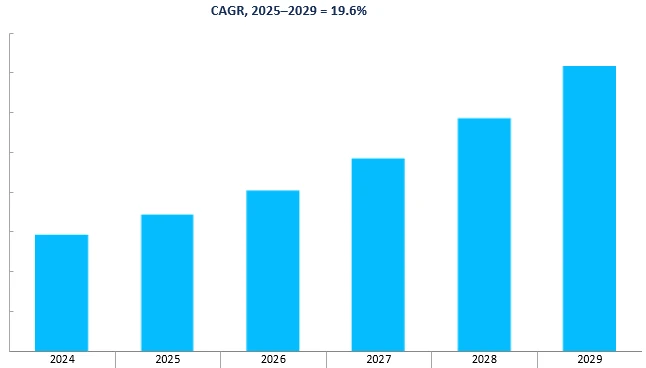
The Latin American data center colocation services market is entering a high-growth phase, driven by digital transformation, AI adoption, and expanding hyperscale investments. Valued at $1.47 billion in 2024, the market is projected to reach $3.59 billion by 2029, registering an impressive CAGR of 19.6%.
Rapid cloud adoption, the rise of AI workloads, and increasing demand for high-density colocation infrastructure are accelerating investments in Brazil, Chile, Mexico, and Colombia. Hyperscalers like AWS, Microsoft, and Google are expanding regional footprints, while local operators such as Ascenty, Scala, ODATA, and Elea Digital lead with next-generation AI-ready data centers.
Key Insights:
- Over 122 new facilities are expected by 2029 across Latin America.
- Renewable energy accounts for 60% of the region’s power matrix, supporting sustainability goals.
- Brazil dominates the data center colocation market with 54% revenue share.
- Surge in AI inference and edge computing demand is fostering high-density facility builds.
- Strong investor activity as private equity and infrastructure funds target colocation expansion.
As AI-driven workloads, cloud gaming, and data localization policies reshape infrastructure needs, the data center colocation services market in Latin America offers high potential for scalable, renewable, and strategically positioned colocation ecosystems.
Market Overview: Latin American Data Center Colocation Services Market
The Latin American data center colocation market is undergoing transformation, driven by surging enterprise digitization, hyperscale expansion, and the rise of AI-driven computing. Enterprises increasingly outsource infrastructure to colocation providers for scalability, reliability, and compliance.
The data center colocation services market is expanding rapidly, supported by robust demand for AI, IoT, and 5G-ready infrastructure. Strategic colocation hubs—Brazil, Mexico, Chile, and Colombia—are witnessing accelerated hyperscale activity. Brazil leads with a mature renewable energy ecosystem, offering low-carbon energy solutions critical for power-intensive AI workloads.
Technology Integration:
The convergence of AI, edge computing, and green energy is redefining the colocation landscape. Service providers are adopting liquid and immersion cooling, modular designs, and AI-powered data center management. Submarine cables like TAM-1, Humboldt, and Firmina enhance cross-border connectivity, reducing latency and bandwidth costs for hyperscalers.
Regional Strengths:
- Brazil: AI hub with 9 cloud regions and leadership in clean energy.
- Mexico: Strategic gateway for North–South connectivity.
- Chile: Naturally cool climate optimizes energy efficiency.
- Colombia: Rising hub due to strong fiber connectivity and stable regulation.
The region’s clean energy advantage—combined with increasing foreign investment and infrastructure modernization—positions Latin America as one of the fastest-growing contributors to the global data center colocation market.
Scope of Analysis: Latin American Data Center Colocation Services Market
This study evaluates the data center colocation services market in Latin America for the period 2024–2029, focusing on retail and hyperscale colocation, edge facilities, and AI-ready infrastructure.
Geographic Scope: Brazil, Chile, Colombia, Mexico, and Other LATAM countries (Peru, Argentina, Ecuador, etc.).
Service Scope:
- Space leasing (racks, cages, private suites)
- Power and cooling infrastructure
- Network connectivity
- Security and remote hands
- Managed and edge colocation services
The analysis covers market sizing, forecast trends, technology evolution, and competitive benchmarking. It excludes enterprise-owned or public cloud-only data centers.
Frost & Sullivan’s bottom-up model combines capacity forecasts (MW), primary research with leading providers, and public investment data.
Revenue Forecast: Latin American Data Center Colocation Services Market
The data center colocation services market in Latin America is expected to grow from $1.47 billion in 2024 to $3.59 billion by 2029, achieving a CAGR of 19.6%.
By Country (2024 Revenue Share):
- Brazil – 53.8%
- Mexico – 16.8%
- Chile – 15.7%
- Colombia – 5.6%
- Others – 8.1%
Over 49% of market revenue is concentrated among top four players: Ascenty, Equinix, Scala, and América Móvil. More than 122 new colocation sites will become operational by 2029.
Growth Factors:
- AI infrastructure requiring >20kW per rack densities
- Expansion of edge and micro data centers
- Renewable power integration
- Submarine cable connectivity driving latency reduction
Brazil, supported by a mature power grid and sustainable energy policy, will remain the anchor of regional colocation growth.
Segmentation Analysis: Latin American Data Center Colocation Services Market
By Type:
- Retail Colocation: SMEs, financial services, and government workloads
- Hyperscale Colocation: Cloud, AI, gaming, and content providers
By Service:
- Space & Power Leasing
- Connectivity & Security
- Managed and Edge Services
By Industry:
- Cloud & IT
- BFSI
- Media & Entertainment
- Government
- AI/Research
By Geography:
Brazil dominates due to energy availability and AI hub initiatives, while Mexico and Chile attract hyperscale investment through strategic positioning and climate efficiency.
The data center colocation services market segmentation shows a distinct shift toward AI-ready, high-density colocation and edge computing zones, strengthening regional AI infrastructure.
Growth Drivers: Latin American Data Center Colocation Services Market
- AI and Hyperscale Expansion: Demand for GPU-powered workloads.
- 5G and IoT: Fueling edge data center deployment.
- Renewable Energy Adoption: Clean energy enhances ESG compliance.
- Cloud Migration Acceleration: Enterprises outsourcing core infrastructure.
- Submarine Cable Growth: Improving bandwidth and latency performance.
- Government Data Localization: Encouraging regional colocation adoption.
Together, these factors are catalyzing rapid expansion of the data center colocation market across Latin America.
Growth Restraints: Latin American Data Center Colocation Services Market
- Rising Energy Costs: Power remains 50% of operational expense.
- Skilled Workforce Shortage: Lack of trained data center engineers.
- Grid Limitations: Power supply delays in Mexico and Chile.
- CapEx Intensity: High entry cost restricts new entrants.
- Supply Chain Delays: Hardware and GPU shortages affect deployment.
These challenges underline the need for local partnerships, power grid upgrades, and workforce development to sustain the region’s rapid colocation expansion.
Competitive Landscape: Latin American Data Center Colocation Services Market
The Latin American data center colocation market is moderately consolidated with 15+ active participants and 49% revenue share held by the top four.
Major Players:
- Ascenty – Regional leader; 36 facilities with 495MW capacity expansion.
- Scala Data Centers – Building AI City in Brazil with 4.75GW capacity.
- Equinix – Global carrier-neutral footprint with 17 sites.
- ODATA – Expanding AI-ready data centers in Brazil and Mexico.
- Elea Digital – Pioneering “Rio AI City” ecosystem.
Emerging Players: Cirion, América Móvil, EdgeConneX, HostDime, NextStream, and Takoda.
Key differentiation lies in renewable energy sourcing, AI cooling innovation, and edge deployment. Strategic M&A, fiber expansion, and localized design efficiency will determine leadership in the evolving data center colocation services market.
Why is it Increasingly Difficult to Grow?
The Strategic Imperative 8™
The Impact of the Top 3 Strategic Imperatives on the Latin American Data Center Colocation Services Industry
Scope of Analysis
Definitions
Data Center Colocation Services Ecosystem
Market Overview
Critical Success Factors for Growth
Growth Metrics
Growth Drivers
Growth Driver Analysis
Growth Restraints
Growth Restraint Analysis
Revenue Forecast Considerations
Revenue Forecast
Revenue Forecast Analysis
Revenue Share by Country
Data Center Colocation Service Providers by Country
Revenue Share Analysis by Country
Key Market Trends
Maturing AI Landscape
Increasing Enterprise AI Workloads
Service Provider Leveraging AI for Differentiation
Embracing Sustainability in Data Center Operations
Data Center Cooling Technologies
Data Center Cooling Revenue Forecast
Data Center Cooling Technologies
Emerging Need for Edge Data Centers
Latency Requirements in Latin America
Geographically Dispersed Assets and Number of Locations Required for Edge Computing
Data Processing and Storage at the Edge
Emerging Need for Edge Data Centers
Competitive Environment
Data Center Colocation Service Providers by Quantity of Operation
Revenue Share
Data Center Colocation Service Providers by Total Capacity
Revenue Share Analysis
Competitive Landscape
Growth Opportunity 1: Establishment of Data Center Facilities to Address High-Density Hyperscale Demand
Growth Opportunity 2: Increased Data Processing for AI Inferencing
Growth Opportunity 3: Renewable Energy to Consolidate Commitment to Advanced Environmental Practices
Growth Opportunity 4: Precision Cooling Solutions for Next-Generation Data Center Architecture
Growth Opportunity 5: Regional AI Edge Zones/Hubs for Low-Latency Applications
Benefits and Impacts of Growth Opportunities
Next Steps
List of Exhibits
Legal Disclaimer
Frequently Asked Questions (FAQ) – Latin American Data Center Colocation Services Market, 2024–2029
1. What is the size and forecast for the Latin American data center colocation market?
2. What is driving growth in the data center colocation services market in Latin America?
3. Which countries lead the Latin American colocation market?
4. How do retail and hyperscale colocation differ?
5. What role does renewable energy play in the colocation market?
6. How is edge computing affecting the data center colocation services market?
7. Who are the major players in the Latin American colocation market?
8. What are the main challenges for colocation providers in the region?
9. How should enterprises choose a colocation services provider?
10. What is the long-term outlook for the data center colocation services market in Latin America?
Speak directly with our analytics experts for tailored recommendations.
Recent related IT Services and Applications research
13 Oct 2026 | Global | Strategic Imperatives
Top 10 Strategic Imperatives for Public Cloud Services, Global, 2026
The global public cloud services industry is shifting from an era focused primarily on cloud migration and cost optimization to one centered on control, trust, intelligence, and measurable business outcomes. Enterprises are no longer asking whether workloads belong in the cloud. Instead, they are de...
06 Oct 2026 | Global | Market Research
Growth Opportunities in Agentic Orchestration Platforms, Global, 2026–2031
The global market for agentic orchestration platforms is entering a pivotal phase of transformation as enterprises shift from isolated artificial intelligence (AI) experimentation to production-scale deployment. This study examines how organizations are moving beyond pilot initiatives toward embeddi...
25 Sep 2026 | Global | Technology Research
Growth Opportunities in AI Robotics, GPU Cloud, Reinforcement Learning, Blockchain Intelligence & Developer API, Geospatial and Agentic Conversational AI
This edition of the IT, Computing and Communication Technology Opportunity Engine captures developments related to Unified AI robotics, Hybrid GPU cloud and MLOps, Production inference stack, Full-stack reinforcement-learning compute, AI Infrastructure, Computer Vision, Software-Defined Applications...
22 Sep 2026 | Global | Market Research
Cellular IoT and Low-Power Wide-Area Network (LPWAN) Market, Global, 2025–2031
This Frost & Sullivan study analyzes the global cellular IoT and LPWAN market between 2025 and 2031, covering traditional cellular IoT (2G/3G, 4G, and 5G), massive cellular IoT (NB-IoT, LTE-M, and 5G RedCap), and massive non-licensed LPWAN technologies (LoRaWAN, Sigfox, and other standards). The ana...
17 Sep 2026 | Global | Market Research
Growth Opportunities in the Western Europe Consumer eSIM Market, 2026–2029
The consumer eSIM market in Western Europe is growing steadily, supported by the rising availability of eSIM-capable devices, particularly smartphones, and expanding travel-related use cases. However, commercialization has yet to translate into mass adoption. Despite Apple’s global launch of an eSIM...
Purchase includes:
- Report download
- Growth Dialog™ with our experts
Growth Dialog™
A tailored session with you where we identify the:- Strategic Imperatives
- Growth Opportunities
- Best Practices
- Companies to Action
Impacting your company's future growth potential.
Continuous digital transformation and the adoption of technologies such as Big Data, IoT, and AI/ML are driving enormous investments from local and global colocation operators. AI data centers require massive and consistent power, but many regions face grid capacity constraints, high costs, grid instability, or stringent sustainability regulations. Latin America’s abundant renewable energy and integrated grid system can support large-scale AI workloads for hyperscalers and environmental, social, and governance (ESG)-conscious enterprises. AI workloads and digital services in Latin America and other regions often rely on servers hosted in the United States or Europe, resulting in latency, increased bandwidth costs, and compliance hurdles.
Strategically located data centers help reduce latency for AI applications, a crucial factor in performance that directly impacts efficiency and user experience. Local data centers also ensure compliance with Latin American data protection regulations and sectoral data localization rules, such as those in healthcare, finance, and government. Scaling AI clusters requires a combination of high-density colocation, advanced cooling, and a skilled workforce. Many emerging markets struggle with one or more of these factors. Latin America, particularly Brazil, has a maturing data center construction ecosystem, experienced data center colocation providers, and a growing workforce with expertise in hyperscale and regional AI deployments. However, the scale of new AI cities poses several challenges, as data center sites are hyperdense and 10 times larger than current ones. This Frost & Sullivan study analyzes the Latin American data center colocation services market, covering strategic imperatives, market insights, competitive landscape, industry background, market trends, country-wise market dynamics, company analysis, and growth opportunities.
Author: Carina Goncalves
| Deliverable Type | Market Research |
|---|---|
| Industries | Information Technology |
| No Index | No |
| Is Prebook | No |
| Keyword 1 | data center colocation market |
| Keyword 2 | LATAM colocation services |
| Keyword 3 | hyperscale colocation market |
| Podcast | No |
| Predecessor | KA91-01-00-00-00 |
| WIP Number | KBBC-01-00-00-00 |