 USD
USD GBP
GBP  CNY
CNY  EUR
EUR  INR
INR  JPY
JPY  MYR
MYR  ZAR
ZAR  KRW
KRW  THB
THB 


Policy, Investment, and Technology Shifts are Driving Sustainable Growth
31-Oct-2025
Latin America
Market Outlook
KBA3-01-00-00-00
EN_2025_34016
Key Takeaways: Latin American Waste Recycling and Circular Economy Markets in 2025
- The Latin American Waste Recycling and Circular Economy Markets in 2025 are projected to grow from $346.6 billion in 2024 to $368.8 billion in 2025, reflecting 6.4% annual growth across collection, transportation, recycling, and disposal activities.
- Transportation remains the largest revenue segment, while collection continues to dominate municipal spending across the Waste Management Market.
- Brazil and Mexico lead regional investment, supported by stronger regulations, expanding urban infrastructure, and increasing private-sector participation.
- Circular economy initiatives are accelerating through waste picker integration, waste-to-energy projects, and Extended Producer Responsibility (EPR) programs.
- Technology adoption—including AI-assisted sorting, digital tracking, smart bins, and automated separation—is improving efficiency across the waste management and recycling market.
- Infrastructure gaps, limited recycling capacity, and funding constraints continue to shape investment priorities across emerging Latin American markets.
Report Summary: Latin American Waste Recycling and Circular Economy Markets in 2025
The Latin American Waste Recycling and Circular Economy Markets in 2025 are entering a new phase of sustainable transformation as governments, municipalities, and private companies expand investments in modern waste infrastructure and circular economy initiatives. Market growth is increasingly supported by stronger environmental regulations, Extended Producer Responsibility (EPR) frameworks, and growing interest in resource recovery rather than traditional disposal methods.
The Waste Management Market continues to rely heavily on collection, transportation, and landfill operations, while recycling and material recovery gradually gain momentum through improved sorting technologies and digital waste management solutions. Brazil, Mexico, Chile, Colombia, Peru, and Argentina remain the region's most influential markets, each progressing at different speeds depending on regulatory maturity and infrastructure readiness.
The broader waste management and recycling market is also benefiting from investments in smart collection systems, automated sorting facilities, waste-to-energy projects, and partnerships that integrate informal waste pickers into formal recycling ecosystems, creating long-term opportunities for sustainable economic growth.
Market Overview & Trends: Latin American Waste Recycling and Circular Economy Markets in 2025
The Latin American Waste Recycling and Circular Economy Markets in 2025 are transitioning from traditional waste disposal models toward more integrated resource recovery systems. While landfill disposal continues to account for a significant share of overall revenue, governments across the region are increasingly prioritizing recycling infrastructure, circular economy policies, and private-sector investment to improve environmental performance.
The Waste Management Market is evolving as cities deploy smarter collection systems, digital route optimization, and AI-assisted sorting technologies that improve operational efficiency while reducing costs. Transportation remains the largest revenue-generating activity because of the region's extensive logistics requirements, although investments in localized sorting centers are helping reduce transportation dependency over time.
The waste management and recycling market is witnessing growing adoption of automated material separation, optical sorting, RFID-enabled collection systems, and blockchain-based material tracking for improved transparency. Brazil continues to lead overall market value through its large municipal waste ecosystem, while Mexico is expanding recycling initiatives and Chile is strengthening circular economy regulations through EPR programs.
Informal waste pickers remain an essential component of the regional recycling ecosystem, and many municipalities are developing policies to formalize their participation within structured collection networks. Waste-to-energy projects are also receiving greater attention as countries seek solutions that address both waste management challenges and rising energy demand.
Despite these positive developments, infrastructure gaps, limited recycling capacity, uneven regulatory enforcement, and financing constraints continue to influence market performance. As policy frameworks mature and technology adoption expands, the Latin American Waste Recycling and Circular Economy Markets in 2025 are expected to become increasingly circular, digitally connected, and investment-driven.
Scope of Analysis: Latin American Waste Recycling and Circular Economy Markets in 2025
The Latin American Waste Recycling and Circular Economy Markets in 2025 study evaluates the regional Waste Management Market across the complete municipal waste value chain, covering collection, transportation, sorting and separation, reuse and recycling, and landfill disposal. The analysis examines how infrastructure investment, environmental regulation, technology adoption, and circular economy initiatives are reshaping waste management practices throughout Latin America.
The study uses 2024 as the base year, reviews market developments from 2021 onward, and focuses on the 2025 forecast period, providing both historical context and forward-looking market insights. Country-level assessments include Argentina, Brazil, Chile, Colombia, Mexico, Peru, and the broader Rest of Latin America, highlighting differences in regulatory maturity, municipal infrastructure, recycling capacity, and investment priorities.
The waste management and recycling market assessment also evaluates smart collection technologies, automated sorting systems, waste-to-energy initiatives, digital tracking solutions, and the growing role of Extended Producer Responsibility (EPR) policies. In addition, the report examines the integration of informal waste pickers, public-private partnerships, and sustainability strategies that support circular economy development. This comprehensive scope enables stakeholders to identify emerging investment opportunities while understanding the operational, regulatory, and technological factors shaping the future of waste management across Latin America.
Market Segmentation Analysis: Latin American Waste Recycling and Circular Economy Markets in 2025
The Latin American Waste Recycling and Circular Economy Markets in 2025 consist of five interconnected segments that collectively define the regional Waste Management Market. Each segment contributes differently to revenue generation, operational efficiency, and long-term sustainability objectives across municipalities and private waste operators.
The collection segment forms the foundation of the waste management and recycling market, encompassing smart waste containers, fill-level sensors, RFID-enabled collection systems, mobile applications, pneumatic collection networks, and decentralized source separation programs. As cities modernize municipal services, digital collection technologies are becoming increasingly important for improving operational efficiency.
Transportation represents the largest revenue contributor within the Waste Management Market, supported by expanding logistics networks, fleet management systems, route optimization platforms, and business monitoring tools that improve waste movement across urban and industrial areas.
Sorting and separation remain critical growth areas as municipalities invest in mechanical, magnetic, optical, AI-assisted, and robotic sorting technologies that improve material recovery while reducing contamination. These investments strengthen recycling efficiency and support circular economy objectives.
The reuse and recycling segment is expanding through digital material passports, blockchain-based traceability systems, mechanical recycling, chemical recycling, organic waste composting, and digital material banks. These technologies help maximize resource recovery while creating new commercial opportunities for recyclable materials.
Landfill disposal continues to play an important role despite growing sustainability initiatives. Modern landfill operations increasingly incorporate methane management, landfill gas recovery, bioreactor systems, biological stabilization, and environmental monitoring to reduce long-term environmental impacts.
Together, these segments demonstrate how the Latin American Waste Recycling and Circular Economy Markets in 2025 are gradually evolving from disposal-focused systems toward more integrated, technology-enabled, and circular resource management ecosystems.
Revenue & Spending Forecast: Latin American Waste Recycling and Circular Economy Markets in 2025
The Latin American Waste Recycling and Circular Economy Markets in 2025 are expected to generate approximately $368.8 billion, representing 6.4% year-over-year growth from $346.6 billion in 2024. This expansion reflects rising investment in municipal infrastructure, improved collection systems, and increasing adoption of circular economy practices throughout the Waste Management Market.
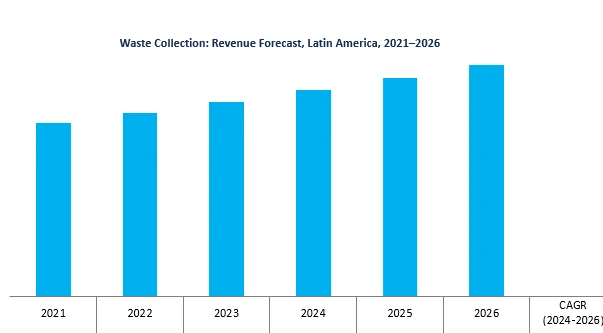
Transportation remains the largest revenue-generating segment, growing from approximately $160.7 billion to $173.7 billion, supported by expanding waste logistics networks across major metropolitan areas. Collection also demonstrates strong momentum, increasing from roughly $51.7 billion to $54.8 billion as municipalities deploy smarter collection technologies and improve service coverage.
Landfill disposal continues to generate substantial revenue despite sustainability initiatives, while sorting and separation and reuse and recycling gradually expand as infrastructure investments accelerate. Brazil accounts for the largest share of regional revenue, followed by Mexico and Chile, with additional growth opportunities emerging across Colombia, Peru, and the broader Rest of Latin America.
Future spending within the waste management and recycling market is expected to increasingly prioritize automated sorting facilities, waste-to-energy projects, digital waste tracking platforms, and public-private partnerships that strengthen circular economy implementation throughout the region.
Growth Environment: Latin American Waste Recycling and Circular Economy Markets in 2025
The Latin American Waste Recycling and Circular Economy Markets in 2025 operate within a growth environment shaped by regulatory reforms, infrastructure modernization, urbanization, and increasing sustainability commitments. Governments across the region are strengthening environmental policies while encouraging private investment to improve waste collection, recycling, and resource recovery capabilities throughout the Waste Management Market.
Brazil, Mexico, and Chile continue leading investment activity due to stronger institutional frameworks, larger municipal budgets, and more advanced recycling ecosystems. Extended Producer Responsibility (EPR) regulations are creating additional incentives for packaging recovery, electronics recycling, and material traceability, while public-private partnerships help accelerate infrastructure development across multiple countries.
The waste management and recycling market is increasingly benefiting from technological innovation, including AI-assisted optical sorting, robotic material separation, digital waste tracking, smart bins, RFID-enabled collection systems, and blockchain-based transparency tools. These technologies improve operational efficiency while supporting circular economy objectives.
Despite these positive developments, several structural challenges continue influencing market performance. Limited recycling infrastructure, uneven regulatory enforcement, funding constraints, transportation costs, and dependence on landfill disposal remain significant barriers across many municipalities. Informal waste pickers continue playing an essential role in material recovery, and successful market development increasingly depends on integrating these workers into formal recycling systems.
Looking ahead, waste-to-energy projects, decentralized recycling infrastructure, circular business models, and stronger regional collaboration are expected to create additional investment opportunities. As policy enforcement strengthens and technology adoption expands, the Latin American Waste Recycling and Circular Economy Markets in 2025 are expected to become increasingly efficient, resilient, and aligned with long-term sustainability objectives.
The 2023 Latin American Waste Recycling and Circular Economy Markets: Forecast Versus Actual
Historical Analytics
Top Predictions for 2025
Why is it Increasingly Difficult to Grow?
The Strategic Imperative 8
The Impact of the Top 3 Strategic Imperatives on the Latin American Waste Recycling and Circular Economy Markets
Growth Opportunities Fuel the Growth Pipeline EngineTM
Segmentation
Types of Waste Streams
Growth Environment
Companies to Action
The 2025 Waste Management Index—Key Assumptions
2025 Waste Management Index by Country
Overview of Waste Metrics
Overview of Economic Indicators
Argentina
Brazil
Chile
Colombia
Mexico
Peru
2025 Market Snapshot—LATAM Waste Recycling and Circular Economy Markets
Revenue Forecast by Segment
Revenue Forecast by Country
Revenue Forecast by Country
Prediction 1: Closure of Open Dumpsites Accelerates
Prediction 2: Recycling Grows but Faces Material Quality Challenges
Prediction 3: Organics Valorization Gains Ground in Cities
Prediction 4: Digital Tools Become Standard in Waste Management
Prediction 5: Integration of the Informal Sector into Urban Policy
2025 Market Snapshot—Collection
Total Revenue Forecast—Collection
Revenue Forecast by Country—Collection
Expenditure Forecast by Country—Collection
Revenue Forecast by Country—Collection
2025 Market Snapshot—Transportation
Total Revenue Forecast—Transportation
Revenue Forecast by Country—Transportation
Expenditure Forecast by Country—Transportation
Revenue Forecast by Country—Transportation
2025 Market Snapshot—Sorting and Separation
Total Revenue Forecast—Sorting and Separation
Revenue Forecast by Country—Sorting and Separation
Expenditure Forecast by Country—Sorting and Separation
Revenue Forecast by Country—Sorting and Separation
2025 Market Snapshot—Reuse and Recycling
Total Revenue Forecast—Reuse and Recycling
Revenue Forecast by Country—Reuse and Recycling
Expenditure Forecast by Country—Reuse and Recycling
Revenue Forecast by Country—Reuse and Recycling
2025 Market Snapshot—Landfill Disposal
Total Revenue Forecast—Landfill Disposal
Revenue Forecast by Country—Landfill Disposal
Expenditure Forecast by Country—Landfill Disposal
Revenue Forecast by Country—Landfill Disposal
2025 Predictions: Collection
2025 Predictions: Transportation
2025 Predictions: Sorting and Separation
2025 Predictions: Reuse and Recycling
2025 Predictions: Landfill Disposal
Growth Opportunity 1: Driving Decentralized Recycling by Integrating Waste Picking into the Circular Economy
Growth Opportunity 2: Leveraging Waste-to-Energy WtE to Tackle Energy Demand and Inadequate Waste Management
Growth Opportunity 3: Consultancy Services Promoting Cooperation and Best Practices
Conclusions and Future Outlook
Benefits and Impacts of Growth Opportunities
Next Steps
List of Exhibits
Legal Disclaimer
Frequently Asked Questions (FAQs) – Latin American Waste Recycling and Circular Economy Markets in 2025
1. What are the Latin American Waste Recycling and Circular Economy Markets in 2025?
2. What is driving growth in the Waste Management Market?
3. Which countries lead the waste management and recycling market in Latin America?
4. Which segment generates the highest revenue in the market?
5. What technologies are transforming the waste management and recycling market?
6. How does the circular economy influence the market?
7. What challenges affect market expansion?
8. What is the outlook for the Latin American Waste Recycling and Circular Economy Markets in 2025?
Speak directly with our analytics experts for tailored recommendations.
Recent related Waste Management research
02 Oct 2026 | Global | Technology Research
Innovations in Carbon Capture, Waste Conversion, Wastewater Treatment, Bioreactors, Artificial Protein and Plastic Recycling
This edition of the Industrial Bioprocessing TOE features information on carbon capture, waste conversion, wastewater treatment, bioreactors, artificial protein and plastic recycling among others.The Industrial Bioprocessing TOE provides intelligence on technologies, processes and strategic insights...
25 Sep 2026 | South Asia, Middle East & North Africa | Market Research
Circular Economy for Used Electrical and Electronic Equipment (Used EEE) and ITAD Services Market, India, 2025–2032
The circular economy for used electrical and electronic equipment (used EEE) in India is experiencing transformational growth as an expanding domestic electronics manufacturing industry, rapid digitalization, and shorter electronics replacement cycles intersect with a stricter policy environment and...
22 Sep 2026 | Europe | Strategic Imperatives
Top 8 Strategic Imperatives for the Membrane-Based Water & Wastewater Treatment Systems Market, Europe, 2026
Europe has been faced with unprecedented heatwaves and droughts triggered by climate change. This has affected surface and groundwater availability across regions, leading to water use restrictions and investment in water reuse infrastructure.Southern European countries such as Spain, Cyprus, Malta,...
16 Sep 2026 | Europe | Frost Radar
Frost Radar™: European Membrane-Based Water and Wastewater Treatment Systems, 2026
Most parts of Europe face recurring droughts as below-average rainfall combined with heatwaves exacerbate water stress. The latest revision of European Union wastewater directives has driven nations to invest in tertiary treatment of wastewater and proactively encouraged water reuse to meet agricult...
04 Sep 2026 | Global | Technology Research
Innovations in Carbon Capture, Battery & Plastic Recycling, Wastewater Treatment, Bioreactors, and Plastic Recycling
This edition of the Industrial Bioprocessing TOE features information on advanced carbon capture technology, plastic recycling, biogas treatment, reverse osmosis, wastewater treatment, cell culture, clean sustainable aviation fuel production and direct air capture, among others.The Industrial Biopro...
Purchase includes:
- Report download
- Growth Dialog™ with our experts
Growth Dialog™
A tailored session with you where we identify the:- Strategic Imperatives
- Growth Opportunities
- Best Practices
- Companies to Action
Impacting your company's future growth potential.
The segmentation includes collection, transportation, sorting and separation, reuse and recycling, and landfill disposal.
The countries the study covers are Argentina, Brazil, Chile, Colombia, Mexico, and Peru. A detailed analysis of each country's market landscape is included, covering revenue and technology trends, as well as legal frameworks, flagship projects, and an overview of economic and municipal indicators.
Latin America presents varied levels of development in waste management and circular economy, with significant differences in infrastructure, regulatory enforcement, and technology adoption. Urban areas in market leaders, such as Brazil, Chile, and Mexico, have consolidated and expanded collection and disposal systems, but rural areas and smaller municipalities face challenges with underserved populations, open dumping, and limited recycling capacity. This presents important opportunities for the market to tackle these structural gaps through improved regulation, investment, and the promotion of circular models.' Growth opportunities for this market include:
Driving decentralized recycling by integrating waste picking into the circular economy Leveraging waste-to-energy to tackle energy demand and inadequate waste management Consultancy services promoting cooperation and best practices
| Deliverable Type | Market Outlook |
|---|---|
| Industries | Environment |
| No Index | No |
| Is Prebook | No |
| Keyword 1 | LATAM recycling market |
| Keyword 2 | circular economy 2025 |
| Keyword 3 | waste management LATAM |
| Podcast | No |
| Predecessor | K878-01-00-00-00 |
| WIP Number | KBA3-01-00-00-00 |