 USD
USD GBP
GBP  CNY
CNY  EUR
EUR  INR
INR  JPY
JPY  MYR
MYR  ZAR
ZAR  KRW
KRW  THB
THB 


Increasing Adoption of Mobile-First Work Environments Drives Transformational Growth in Mobile Security Solutions
11-Jun-2026
Global
Market Research
M1H1-01-00-00-00
AE_2026_34649
Key Takeaways: Mobile Threat Defense Market
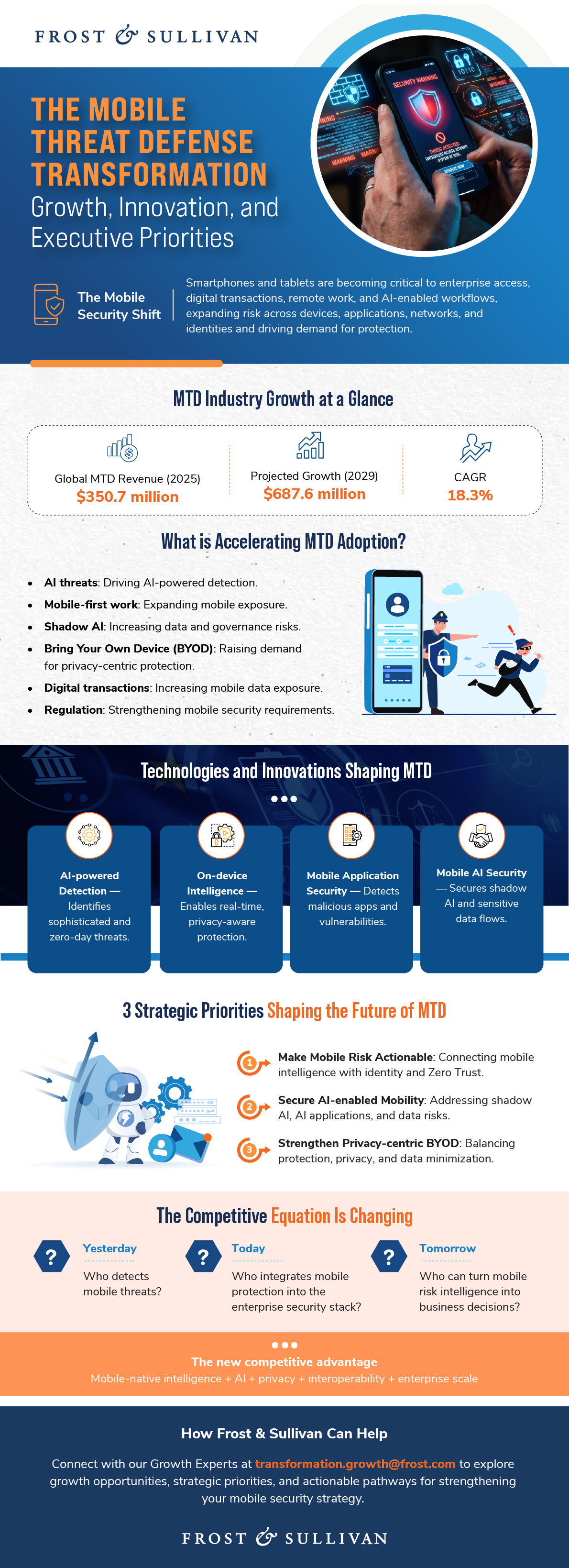
- The global Mobile Threat Defense Market is projected to grow from USD 350.7 million in 2025 to approximately USD 687.6 million by 2029, registering a strong CAGR of 18.3% during the forecast period.
- Market revenue is expected to rise from USD 389.9 million in 2026 to USD 453.7 million in 2027, USD 555.9 million in 2028, and USD 687.6 million in 2029.
- Increasing adoption of mobile-first work environments, remote work models, and frontline workforce applications is significantly accelerating demand for mobile security solutions.
- Growing sophistication of mobile malware, phishing attacks, AI-powered cyber threats, and zero-day exploits is driving enterprise investments in Mobile Threat Defense (MTD) platforms.
- Mobile Threat Defense solutions are increasingly becoming a critical component of enterprise cybersecurity strategies, complementing MDM, UEM, SIEM, XDR, and identity security frameworks.
- Rising BYOD (Bring Your Own Device) adoption is creating greater demand for real-time mobile threat detection and risk management capabilities.
- Banking, financial services, government, defense, healthcare, technology, and professional services sectors remain key adopters of MTD solutions.
- Artificial intelligence and machine learning are enhancing mobile threat detection accuracy through behavioral analytics, anomaly detection, and predictive threat intelligence.
- Mobile payments, digital banking applications, and mobile commerce ecosystems are generating new opportunities for advanced mobile security solutions.
- Regulatory compliance requirements and growing concerns around data privacy are encouraging organizations to implement comprehensive mobile threat protection frameworks.
- North America currently leads the market due to strong cybersecurity spending and widespread enterprise mobility adoption.
- Asia-Pacific is emerging as a high-growth region supported by mobile-first economies, increasing cyber threats, and expanding regulatory requirements.
- Market competition is driven by scalability, deployment flexibility, integration capabilities, AI-powered threat intelligence, and ecosystem partnerships.
- Leading market participants include Check Point, Lookout, and Zimperium, while Corrata, ESET, Jamf, and Pradeo continue to strengthen competitive dynamics.
- Despite strong growth prospects, misconceptions regarding native mobile security protections, privacy concerns, and budget limitations remain key market challenges.
Report Summary: Mobile Threat Defense Market
The global Mobile Threat Defense Market is experiencing rapid expansion as organizations increasingly rely on smartphones and tablets to support business operations, workforce productivity, and digital transformation initiatives. Mobile Threat Defense (MTD) solutions are designed to protect corporate-owned and BYOD devices against sophisticated cyber threats targeting mobile operating systems, applications, networks, and user identities.
Modern MTD platforms leverage a combination of on-device security analytics, AI-powered threat intelligence, behavioral monitoring, and cloud-based analysis to detect known and emerging threats in real time. These solutions help organizations defend against mobile malware, phishing attacks, malicious applications, network exploits, operating system vulnerabilities, and credential theft.
The market is benefiting from growing enterprise mobility, increasing remote work adoption, and expanding mobile application ecosystems. Organizations are recognizing that mobile devices have become primary business endpoints requiring dedicated protection beyond traditional endpoint security solutions.
As cybercriminals increasingly target mobile environments, demand for advanced MTD platforms capable of providing continuous monitoring, automated threat response, and comprehensive risk visibility is expected to accelerate significantly through 2029.
Market Overview & Trends: Mobile Threat Defense Market
The global Mobile Threat Defense Market is rapidly evolving as mobile devices become indispensable tools for enterprise productivity, communication, and digital business operations. Organizations increasingly rely on smartphones, tablets, and mobile applications to support hybrid work environments, customer engagement initiatives, and business-critical workflows. This growing dependence on mobile technology is simultaneously expanding the attack surface available to cybercriminals.
One of the most significant market trends is the rise of mobile-first work environments. Employees are accessing sensitive corporate data from mobile devices more frequently than ever before, creating a pressing need for advanced security controls capable of identifying threats in real time. Enterprises are implementing MTD solutions to address risks associated with device vulnerabilities, malicious applications, compromised networks, and phishing attacks.
Artificial intelligence is becoming a key differentiator in the market. AI-driven threat detection engines can analyze user behavior, detect anomalies, identify emerging attack patterns, and respond to threats with greater speed and accuracy than traditional security solutions. These capabilities are particularly important as cybercriminals increasingly leverage AI to launch sophisticated attacks.
The growing popularity of shadow AI applications and unauthorized generative AI tools is creating new security challenges. Organizations are adopting MTD platforms to monitor risky mobile app behavior, prevent data leakage, and maintain visibility into mobile device activities.
Another important trend is the integration of Mobile Threat Defense with broader cybersecurity ecosystems. Enterprises increasingly demand seamless interoperability between MTD platforms and existing security solutions such as Unified Endpoint Management (UEM), Mobile Device Management (MDM), Security Information and Event Management (SIEM), Extended Detection and Response (XDR), and Security Orchestration, Automation, and Response (SOAR) platforms.
The expansion of mobile banking, digital payments, and mobile commerce is also driving market growth. Financial institutions are investing heavily in mobile security technologies to protect customer data, secure transactions, and comply with evolving regulatory requirements.
As cybersecurity threats continue to evolve, Mobile Threat Defense solutions are expected to become a foundational component of enterprise security architectures worldwide.
Scope of Analysis: Mobile Threat Defense Market
This analysis evaluates the global Mobile Threat Defense Market across major regions, industries, and organizational sizes. Mobile Threat Defense solutions are designed to protect mobile devices against threats targeting applications, operating systems, networks, user credentials, and sensitive corporate information.
The study examines MTD platforms that combine on-device threat detection, AI-driven analytics, cloud-based intelligence, and continuous monitoring capabilities. These solutions help organizations identify and mitigate risks associated with malware, phishing attacks, insecure networks, operating system vulnerabilities, and malicious applications.
Geographically, the analysis covers North America, Europe, the Middle East and Africa (EMEA), Asia-Pacific (APAC), and Latin America (LATAM). Industry coverage includes banking and finance, government, healthcare, education, manufacturing, telecommunications, retail, utilities, media and entertainment, and professional services.
The study also evaluates adoption patterns across organizations of varying sizes, including small businesses, medium-sized enterprises, large organizations, and multinational corporations. Market performance is analyzed using 2025 as the base year, with forecasts extending through 2029.
Market Segmentation Analysis: Mobile Threat Defense Market
The global Mobile Threat Defense Market can be segmented by region, industry vertical, and organizational size.
By Region
North America remains the largest market due to high cybersecurity spending, mature enterprise mobility ecosystems, and the presence of leading technology vendors. Strong BYOD adoption and extensive mobile workforce deployments continue driving demand.
Europe, Middle East, and Africa (EMEA) is witnessing steady growth supported by regulatory initiatives such as GDPR and NIS2. Organizations increasingly prioritize mobile risk monitoring, compliance management, and secure access controls.
Latin America (LATAM) presents emerging opportunities as mobile internet penetration expands across countries such as Brazil and Mexico. Growing digital banking adoption is accelerating demand for mobile security solutions.
Asia-Pacific (APAC) is expected to experience the fastest growth. Mobile-first economies such as India and China, increasing cybersecurity regulations, and government-led digital transformation programs are contributing to strong adoption rates.
By Industry Vertical
Major industry segments include:
- Banking and Financial Services
- Government and Defense
- Healthcare
- Education
- Technology and Telecommunications
- Manufacturing
- Retail and E-commerce
- Utilities and Energy
- Professional Services
Among these sectors, banking, government, healthcare, and technology organizations represent the highest levels of investment due to their exposure to sensitive data and elevated cyber risk profiles.
By Organization Size
The market serves organizations ranging from small businesses to global enterprises. Large organizations currently account for the majority of spending due to complex mobile environments and stringent security requirements.
Revenue & Spending Forecast: Mobile Threat Defense Market
The global Mobile Threat Defense Market is forecast to achieve substantial growth through 2029. Market revenue is expected to increase from USD 350.7 million in 2025 to approximately USD 687.6 million by 2029, representing a CAGR of 18.3%.

Revenue growth is expected to accelerate significantly after 2026 as enterprises increase cybersecurity investments and mobile devices become primary business endpoints. The market is projected to reach USD 389.9 million in 2026, USD 453.7 million in 2027, and USD 555.9 million in 2028 before surpassing USD 687 million in 2029.
Spending will be driven by increasing deployment of cloud-based security platforms, AI-powered threat detection solutions, managed security services, and integrated mobile security ecosystems. Financial services, healthcare, government, and technology sectors are expected to account for a significant share of overall market expenditures.
Growth Drivers: Mobile Threat Defense Market
Several powerful factors are driving expansion within the global Mobile Threat Defense Market.
The primary growth driver is the increasing adoption of mobile-first work environments. Organizations are enabling employees to access business applications and sensitive information from mobile devices, creating a greater need for dedicated security solutions.
The rapid growth of mobile malware, phishing attacks, credential theft, and zero-day vulnerabilities is further accelerating demand. Cybercriminals increasingly target mobile devices because they often serve as gateways to enterprise networks and sensitive corporate data.
The emergence of shadow AI applications and unauthorized generative AI tools has created additional security concerns. Enterprises are investing in MTD platforms to identify risky applications, monitor device behavior, and prevent data exposure.
Growth in digital banking, mobile payments, and customer-facing applications is also contributing to increased adoption. Organizations require advanced protection capabilities to secure transactions and maintain customer trust.
Additionally, evolving cybersecurity regulations and privacy requirements are encouraging businesses to implement comprehensive mobile security strategies.
Growth Restraints: Mobile Threat Defense Market
Despite strong growth potential, several factors may hinder the expansion of the Mobile Threat Defense Market.
Many organizations still believe that mobile operating systems provide sufficient built-in security, reducing the perceived need for dedicated MTD solutions. This misconception continues to delay adoption among some enterprises.
Reliance on existing MDM and UEM platforms also presents a challenge. Organizations often assume these solutions offer adequate protection, even though they typically lack advanced threat detection and behavioral analytics capabilities.
Privacy concerns remain another significant restraint, particularly in BYOD environments. Employees may resist security monitoring due to fears regarding personal data visibility and device tracking.
Budget constraints and competing cybersecurity priorities can further limit adoption. Organizations often allocate resources toward network security, cloud security, endpoint detection and response, and identity management before investing in mobile-specific security solutions.
Competitive Landscape: Mobile Threat Defense Market
The global Mobile Threat Defense Market is moderately competitive, with more than 15 significant vendors competing across enterprise mobility and cybersecurity segments.
Competition is based on several key factors including deployment flexibility, scalability, AI-driven threat intelligence, integration capabilities, device-level protection, cloud-native architectures, and ecosystem partnerships. Vendors that provide seamless integration with MDM, UEM, SIEM, XDR, and SOAR platforms are gaining competitive advantages.
Leading market participants include Check Point, Lookout, and Zimperium, which have established strong reputations for delivering comprehensive mobile security solutions. These companies continue investing heavily in AI-powered threat intelligence, machine learning, and automated response capabilities.
Other notable competitors include Corrata, ESET, Jamf, and Pradeo, each targeting specific market segments and deployment models.
The banking and finance sector remains one of the most lucrative verticals due to increasing mobile banking adoption and growing cybersecurity threats. Government agencies, defense organizations, healthcare providers, and technology firms also represent significant customer segments.
Distribution strategies include direct sales, channel partnerships, managed security service providers, OEM relationships, and telecommunications carrier partnerships. As market demand expands, strategic alliances and platform integrations are expected to play an increasingly important role in vendor growth strategies.
Scope of Analysis
Segmentation
Importance of the MTD Industry
Mobile Device Management vs. Mobile Device Security
MTD Capabilities
Coruna Spyware
DarkSword Incident
Why is it Increasingly Difficult to Grow?
The Strategic Imperative 8™
The Impact of the Top 3 Strategic Imperatives on the Mobile Threat Defense Industry
Competitive Environment
Key Competitors
Growth Metrics
Growth Drivers
Growth Driver Analysis
Growth Restraints
Growth Restraint Analysis
Forecast Considerations
Revenue Forecast
Revenue Forecast by Region
Revenue Forecast by Industry Vertical
Revenue Forecast by Business Size
Revenue Forecast Analysis
Pricing Trends and Forecast Analysis
Growth Metrics
Revenue Forecast
Forecast Analysis
Growth Metrics
Revenue Forecast
Forecast Analysis
Growth Metrics
Revenue Forecast
Forecast Analysis
Growth Metrics
Revenue Forecast
Forecast Analysis
Insights for CISOs—Changing Nature of the Spyware Threat
Insights for CISOs—AI Use as a New Attack Vector on Mobile
Insights for CISOs—MTD Buying Guide
Growth Opportunity 1: Integrating Mobile Threat Defense into XDR Infrastructure and Identity Security
Growth Opportunity 2: Privacy-Centric Approaches for Increased Adoption
Growth Opportunity 3: Monitoring Shadow AI Use and Securing AI Activity on Mobile Devices
Benefits and Impacts of Growth Opportunities
Next Steps
List of Exhibits
Legal Disclaimer
Frequently Asked Questions (FAQs) – Mobile Threat Defense Market
1. What is the Mobile Threat Defense Market?
The Mobile Threat Defense Market consists of cybersecurity solutions designed to protect smartphones, tablets, and other mobile endpoints from malware, phishing attacks, network threats, operating system vulnerabilities, and malicious applications. These solutions help organizations secure both corporate-owned and BYOD devices.
2. What factors are driving growth in the Mobile Threat Defense Market?
Major growth drivers include the increasing adoption of mobile-first work environments, rising cyber threats targeting mobile devices, growing BYOD usage, expansion of mobile banking and digital payments, and stricter regulatory requirements for data protection and cybersecurity compliance.
3. What is the expected growth rate of the Mobile Threat Defense Market?
The Mobile Threat Defense Market is projected to grow at a CAGR of approximately 18.3% between 2025 and 2029, driven by increasing mobile security investments and the growing sophistication of cyber threats.
4. Which industries are the primary users of mobile threat defense solutions?
Key industries adopting mobile threat defense solutions include banking and financial services, government and defense, healthcare, education, manufacturing, telecommunications, retail, utilities, and professional services. These sectors require advanced mobile security to protect sensitive data and business operations.
5. How do Mobile Threat Defense solutions work?
Mobile Threat Defense solutions combine on-device threat detection, cloud-based analytics, artificial intelligence, machine learning, behavioral monitoring, and threat intelligence to identify and mitigate risks such as malware infections, phishing attempts, insecure networks, and device vulnerabilities in real time.
6. What role does artificial intelligence play in mobile threat defense?
Artificial intelligence enhances mobile threat defense by detecting abnormal device behavior, identifying previously unknown threats, automating threat analysis, reducing false positives, and enabling faster response to evolving cyberattacks targeting mobile environments.
7. Which regions are expected to experience strong growth in the Mobile Threat Defense Market?
North America currently dominates the market due to high cybersecurity spending and enterprise mobility adoption. However, Asia-Pacific is expected to witness the fastest growth because of expanding mobile-first economies, increasing cyber threats, and growing regulatory focus on cybersecurity.
8. What challenges are affecting the Mobile Threat Defense Market?
Challenges include the perception that built-in mobile operating system security is sufficient, privacy concerns in BYOD environments, budget constraints, competing cybersecurity priorities, and reliance on MDM or UEM platforms that may not provide advanced threat detection capabilities.
9. Who are the leading companies in the Mobile Threat Defense Market?
Leading vendors in the Mobile Threat Defense Market include Check Point, Lookout, Zimperium, Corrata, ESET, Jamf, and Pradeo. These companies provide advanced mobile security platforms for enterprises across multiple industries.
10. What is the future outlook for the Mobile Threat Defense Market?
The future outlook for the Mobile Threat Defense Market is highly positive, supported by growing enterprise mobility, increasing mobile cyberattacks, AI-driven security innovations, rising adoption of remote work models, and stronger regulatory requirements for protecting mobile devices and sensitive business data.
Speak directly with our analytics experts for tailored recommendations.
Recent related Security research
09 Oct 2026 | Global | Technology Research
Growth Opportunities in SiC MOSFET, Photodiodes, RISC-Vs, and Advanced Memory
The Microelectronics Technology Opportunity Engine covers innovations pertaining to SiC MOSFET, Photodiodes, RISC-Vs, and Advanced Memory.The Microelectronics Technology Opportunity Engine captures global electronics-related innovations and developments on a weekly basis. Developments are centered o...
09 Oct 2026 | Global | Frost Radar
Frost Radar™: Workforce Identity and Access Management, 2026
Hybrid work and software as a service have shifted security enforcement from the network perimeter to identity, transforming it into a control plane. Workforce identity and access management (IAM) now determines whether every user, device, and session should retain access based on context, risk, and...
07 Oct 2026 | Global | Frost Radar
Frost Radar™: Network Detection and Response, 2026
The rapid evolution of enterprise IT environments, driven by cloud adoption, connected devices, and hybrid infrastructure, has rendered legacy perimeter defenses inadequate. Network detection and response (NDR) has become a strategic imperative, providing continuous visibility across network traffi...
05 Oct 2026 | Global | Market Research
Workforce IAM and IGA, Global, 2025–2030
The workforce identity and access management (IAM) and identity governance and administration (IGA) market is a critical component of modern cybersecurity and digital transformation strategies. As organizations continue to adopt cloud services, hybrid work models, artificial intelligence, and increa...
24 Sep 2026 | Global | Market Research
Insights for CISOs: Securing Software Supply Chains in the Age of AI
Software supply chain security (SSCS) is increasingly a strategic business imperative as organizations rely more on open-source software, cloud-native architectures, AI-driven development, and autonomous development workflows. Modern software supply chains now extend beyond traditional code reposito...
Purchase includes:
- Report download
- Growth Dialog™ with our experts
Growth Dialog™
A tailored session with you where we identify the:- Strategic Imperatives
- Growth Opportunities
- Best Practices
- Companies to Action
Impacting your company's future growth potential.
Advanced mobile application vetting and continuous app analysis capabilities allow MTD platforms to identify malicious, vulnerable, or high-risk applications through behavioral analysis, supply chain assessment, and ongoing reassessment of installed apps, helping organizations secure both enterprise and third-party mobile applications throughout their life cycle. AI- and machine learning-driven detection engines enhance the ability to identify sophisticated, evasive, and zero-day threats directly on the device, enabling faster detection of phishing attempts, advanced exploits, anomalous app behavior, and previously unseen malware without relying solely on cloud analysis.
Author: Ozgun Pelit
| Deliverable Type | Market Research |
|---|---|
| Industries | Aerospace, Defence and Security |
| No Index | No |
| Is Prebook | No |
| Keyword 1 | Mobile Threat Defense Market |
| Keyword 2 | enterprise mobile threat defense solutions |
| Keyword 3 | byod mobile security market forecast |
| Podcast | No |
| Predecessor | K9AC-01-00-00-00 |
| WIP Number | M1H1-01-00-00-00 |