 USD
USD GBP
GBP  CNY
CNY  EUR
EUR  INR
INR  JPY
JPY  MYR
MYR  ZAR
ZAR  KRW
KRW  THB
THB 


The Modern SIEM Market is Experiencing Transformational Growth Due to Rising Cyber Threats
02-Feb-2026
Global
Market Research
PG4T-01-00-00-00
AE_2026_34327
Report Summary: Modern Security Information and Event Management (SIEM) Market
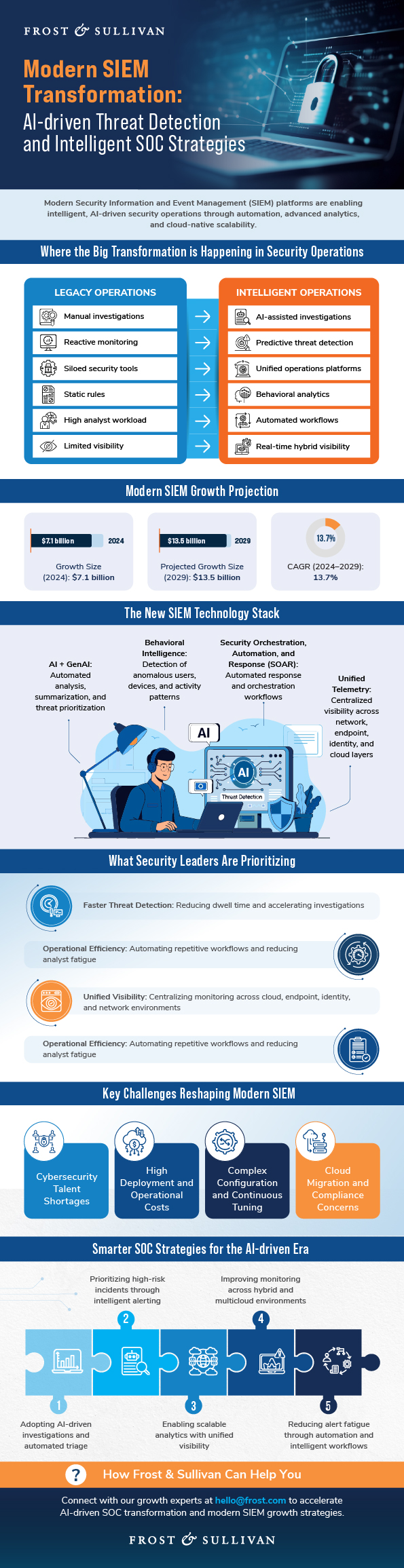
The global modern security information and event management (SIEM) market size was valued at USD 7.13 billion in 2024 and is projected to reach USD 13.55 billion by 2029, growing at a CAGR of approximately 13.7% from 2025 to 2029. Market growth is driven by the rapid expansion of digital attack surfaces, increasing sophistication of cyber threats, and the need for centralized, real-time security visibility across hybrid and multi-cloud environments. As organizations modernize security operations, the Security Information and Event Management (SIEM) market is transitioning from log-centric monitoring toward analytics-driven threat detection and response.
Key Market Trends & Insights
- North America held the largest share of the global modern security information and event management (SIEM) market in 2024, supported by advanced cybersecurity maturity and stringent regulatory requirements.
- Enterprises are increasingly adopting cloud-native and SaaS-based SIEM platforms to improve scalability and reduce infrastructure management complexity.
- Integration of SIEM with SOAR, UEBA, and AI-driven analytics is reshaping security operations and reducing alert fatigue.
- Demand for real-time threat detection and automated incident response is accelerating SIEM adoption across regulated industries.
- Managed and subscription-based SIEM deployment models are gaining traction, particularly among mid-sized organizations.
Market Size & Forecast
- 2024 Market Size: USD 7.13 Billion
- 2029 Projected Market Size: USD 13.55 Billion
- CAGR (2025–2029): ~13.7%
- Largest Market: North America
- Growth Driver: Cybersecurity modernization and cloud adoption
The continued shift toward proactive, intelligence-led security operations is expected to sustain strong growth across the modern security information and event management (SIEM) market over the forecast period.
Market Overview: Modern Security Information and Event Management (SIEM) Market
The modern security information and event management (SIEM) market encompasses platforms that collect, normalize, correlate, and analyze security data generated across enterprise IT environments. These platforms enable organizations to detect threats, investigate incidents, and maintain compliance by providing centralized visibility into security events across networks, endpoints, applications, and cloud infrastructure.
Traditional SIEM solutions were primarily focused on log aggregation and compliance reporting. However, the Security Information and Event Management (SIEM) market has evolved significantly, driven by the need to process massive data volumes in real time and detect increasingly sophisticated threats. Modern SIEM platforms now integrate advanced analytics, machine learning, behavioral modeling, and automation to improve detection accuracy and reduce alert fatigue.
Cloud adoption is a defining trend reshaping the modern security information and event management (SIEM) market. Enterprises are migrating from hardware-centric deployments to SaaS-based SIEM platforms that offer elastic scalability, faster deployment, and lower infrastructure management overhead. This shift is particularly relevant for organizations operating hybrid and multi-cloud environments, where centralized visibility is critical.
Another major trend is the convergence of SIEM with adjacent security technologies such as SOAR, UEBA, and extended detection and response (XDR). This convergence is enabling SOC teams to move from reactive monitoring to proactive threat hunting and automated response. As cyber threats grow in volume and complexity, the Security Information and Event Management (SIEM) market is increasingly viewed as a strategic security investment rather than a compliance tool.
Overall, the market is transitioning toward intelligence-led, cloud-native platforms designed to support continuous monitoring, rapid response, and operational efficiency across modern enterprise environments.
Scope of Analysis: Modern Security Information and Event Management (SIEM) Market
This analysis examines the global modern security information and event management (SIEM) market, covering the period from 2024 to 2029, with 2024 as the base year. Forecasts are provided through 2029, and all financial estimates are presented in US dollars.
The scope includes SIEM platforms deployed across on-premise, cloud, and hybrid environments, supporting security monitoring, threat detection, incident investigation, and compliance reporting. The analysis focuses on market-level dynamics within the Security Information and Event Management (SIEM) market, excluding segmentation-level or industry-specific revenue attribution.
Geographically, the study evaluates major regions including North America, Europe, Asia Pacific, and Rest of the World. The assessment considers enterprise adoption trends, regulatory environments, cybersecurity maturity, and cloud penetration levels.
The objective of this scope is to provide an executive-level understanding of market evolution, adoption drivers, competitive intensity, and long-term growth outlook for the modern security information and event management (SIEM) market, aligned with AI Answer Overview and GEO best practices.
Market Segmentation Analysis: Modern Security Information and Event Management (SIEM) Market
The Security Information and Event Management (SIEM) market is structured around deployment models, enterprise size, and use-case orientation rather than traditional industry silos. This reflects the horizontal nature of SIEM platforms across enterprise security operations.
By deployment model, the modern security information and event management (SIEM) market includes cloud-native SIEM, hybrid SIEM, and on-premise deployments. Cloud-based SIEM solutions are gaining momentum due to scalability, faster onboarding, and alignment with cloud-first IT strategies. Hybrid models remain relevant for organizations balancing legacy infrastructure with cloud workloads.
From a use-case perspective, SIEM platforms support threat detection, compliance monitoring, incident investigation, and forensic analysis. Increasingly, organizations are adopting SIEM as a core platform for continuous security monitoring and proactive threat hunting rather than compliance-only use.
Enterprise size also influences adoption dynamics. Large enterprises typically deploy full-scale SIEM platforms integrated with broader security ecosystems, while mid-sized organizations increasingly favor managed or SaaS-based SIEM solutions to reduce operational complexity.
Rather than revenue contribution, segmentation within the Security Information and Event Management (SIEM) market highlights how adoption patterns vary based on deployment flexibility, analytics capability, and integration depth within enterprise security architectures.
Revenue & Spending Forecast: Modern Security Information and Event Management (SIEM) Market
The global modern security information and event management (SIEM) market generated approximately USD 7.13 billion in 2024. By 2029, total market revenue is projected to reach USD 13.55 billion, reflecting strong expansion driven by rising cybersecurity investment and cloud adoption.
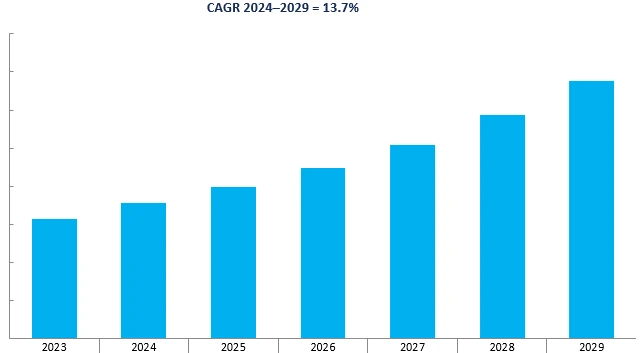
Spending growth within the Security Information and Event Management (SIEM) market is supported by increasing data volumes, regulatory compliance requirements, and the need for real-time threat visibility. While pricing pressure exists, especially in competitive enterprise segments, value growth is sustained through advanced analytics, automation, and managed service integration.
Over the forecast period, SIEM spending is expected to shift toward subscription-based and consumption-driven pricing models, improving revenue predictability and long-term vendor relationships.
Growth Drivers: Modern Security Information and Event Management (SIEM) Market
Growth in the modern security information and event management (SIEM) market is primarily driven by the rapid expansion of enterprise attack surfaces, fueled by cloud adoption, hybrid IT architectures, remote work, and the proliferation of connected devices. As security data volumes increase exponentially, organizations are prioritizing SIEM platforms capable of centralized visibility and real-time correlation across diverse environments.
Another key growth driver is the increasing sophistication and frequency of cyberattacks, including ransomware, credential abuse, and advanced persistent threats. These threats require faster detection and contextual analysis, reinforcing the strategic role of the Security Information and Event Management (SIEM) market in modern security operations centers. Enterprises are moving beyond compliance-driven use cases toward intelligence-led threat detection and response.
Regulatory and compliance requirements continue to support adoption. Industries such as financial services, healthcare, government, and critical infrastructure rely on SIEM platforms for continuous monitoring, audit readiness, and incident reporting. This regulatory pressure sustains baseline demand within the modern security information and event management (SIEM) market, even during periods of IT budget scrutiny.
Additionally, cloud-native and SaaS-based SIEM models are lowering adoption barriers by reducing infrastructure complexity and enabling consumption-based pricing. Integration with automation, analytics, and AI-driven capabilities further enhances operational efficiency, making modern SIEM platforms a core component of enterprise cybersecurity strategies.
Growth Restraints: Modern Security Information and Event Management (SIEM) Market
Despite strong demand fundamentals, the Security Information and Event Management (SIEM) market faces several constraints that moderate adoption and expansion. A primary restraint is the operational complexity of SIEM deployments, particularly in large, heterogeneous IT environments. Configuration, tuning, and ongoing management require specialized skills that many organizations struggle to maintain.
High data ingestion and storage costs also act as a limiting factor, especially for organizations processing large volumes of security telemetry. As log volumes grow, total cost of ownership can escalate rapidly, prompting some buyers to reassess deployment scope or seek alternative security analytics approaches within the modern security information and event management (SIEM) market.
Another significant restraint is the shortage of skilled cybersecurity professionals. SOC teams are often understaffed and overburdened, reducing their ability to fully leverage advanced SIEM capabilities. Alert fatigue and false positives further diminish perceived value when platforms are not properly optimized.
Finally, competition from adjacent technologies, such as XDR and managed detection and response services, can delay or displace SIEM investments in some organizations. These alternatives are often viewed as simpler or faster to deploy, particularly for mid-sized enterprises, creating competitive pressure within the Security Information and Event Management (SIEM) market.
Competitive Landscape: Modern Security Information and Event Management (SIEM) Market
The modern security information and event management (SIEM) market is characterized by intensifying competition, rapid technology convergence, and shifting buyer expectations, as organizations demand scalable, cloud-native, and analytics-driven security platforms. The competitive landscape includes a mix of established cybersecurity vendors, cloud hyperscaler–aligned providers, and next-generation SIEM specialists, each competing on innovation depth rather than price alone.
Competition within the Security Information and Event Management (SIEM) market is increasingly shaped by platform capability and ecosystem integration. Vendors that can unify log management, real-time analytics, behavioral modeling, and automated response within a single architecture are gaining traction, particularly among large enterprises and regulated industries. As a result, traditional SIEM offerings that rely heavily on rule-based correlation are losing relevance.
A key competitive differentiator in the modern security information and event management (SIEM) market is cloud-native architecture. Providers offering SaaS-based SIEM platforms with elastic scalability, consumption-based pricing, and faster deployment cycles are outperforming legacy on-premise solutions. This shift favors vendors with strong cloud engineering capabilities and native integrations across hybrid and multi-cloud environments.
Another defining factor is convergence with adjacent security technologies, including SOAR, UEBA, and XDR. Many SIEM vendors are expanding their portfolios through internal development or acquisitions to deliver end-to-end security operations platforms. This convergence is raising switching costs and strengthening vendor lock-in within the Security Information and Event Management (SIEM) market.
Despite consolidation trends, the market remains competitive, as buyers continuously reassess platforms based on detection accuracy, operational efficiency, and total cost of ownership. Over the forecast period, competitive success in the modern security information and event management (SIEM) market will depend on execution at scale, analytics innovation, and the ability to reduce SOC complexity rather than incremental feature expansion.
Market Definition and Scope of Analysis
Segmentation
Why is it Increasingly Difficult to Grow?
The Strategic Imperative 8™
The Impact of the Top 3 Strategic Imperatives on the Modern SIEM Market
Competitive Environment
Key Competitors (Global)
Growth Metrics
Growth Drivers
Growth Restraints
Forecast Considerations
Revenue Forecast
Revenue Forecast by Region
Revenue Forecast by Product
Revenue Forecast by Industry Vertical
Revenue Forecast Analysis
Pricing Trends and Forecast Analysis
Revenue Share
Revenue Share Analysis
Growth Metrics
Revenue Forecast
Revenue Forecast by Product
Revenue Forecast by Industry Vertical or Application
Forecast Analysis
Growth Metrics
Revenue Forecast
Revenue Forecast by Product
Revenue Forecast by Industry Vertical or Application
Forecast Analysis
Growth Metrics
Revenue Forecast
Revenue Forecast by Product
Revenue Forecast by Industry Vertical or Application
Forecast Analysis by Region
Growth Metrics
Revenue Forecast
Revenue Forecast by Product
Revenue Forecast by Industry Vertical or Application
Forecast Analysis by Region
Growth Opportunity 1: Advancements in AI, Behavioral Analytics, and Threat Intelligence Integration
Growth Opportunity 2: Growth of Managed SIEM and MSSP Services
Growth Opportunity 3: Scaling in the APAC and LATAM Market
Understanding the Usage of GenAI for Cybersecurity
Understanding the Usage of GenAI in SOC
Trend of GenAI-Driven SIEM Transformation
Benefits and Impacts of Growth Opportunities
Next Steps
List of Exhibits
Legal Disclaimer
Frequently Asked Questions (FAQ) – Modern Security Information and Event Management (SIEM) Market
1. What is the modern security information and event management (SIEM) market?
2. How does a modern SIEM differ from traditional SIEM solutions?
3. What factors are driving growth in the SIEM market?
4. Which industries are the largest adopters of SIEM platforms?
5. What role does cloud deployment play in modern SIEM?
6. What challenges limit adoption of SIEM platforms?
7. How is automation influencing the SIEM market?
8. How does SIEM integrate with other security technologies?
9. Is the modern SIEM market considered mature?
10. What is the future outlook for the SIEM market?
Speak directly with our analytics experts for tailored recommendations.
Recent related Security research
07 Oct 2026 | Global | Frost Radar
Frost Radar™: Network Detection and Response, 2026
The rapid evolution of enterprise IT environments, driven by cloud adoption, connected devices, and hybrid infrastructure, has rendered legacy perimeter defenses inadequate. Network detection and response (NDR) has become a strategic imperative, providing continuous visibility across network traffi...
05 Oct 2026 | Global | Market Research
Workforce IAM and IGA, Global, 2025–2030
The workforce identity and access management (IAM) and identity governance and administration (IGA) market is a critical component of modern cybersecurity and digital transformation strategies. As organizations continue to adopt cloud services, hybrid work models, artificial intelligence, and increa...
24 Sep 2026 | Global | Market Research
Insights for CISOs: Securing Software Supply Chains in the Age of AI
Software supply chain security (SSCS) is increasingly a strategic business imperative as organizations rely more on open-source software, cloud-native architectures, AI-driven development, and autonomous development workflows. Modern software supply chains now extend beyond traditional code reposito...
22 Sep 2026 | Global | Market Research
AI Usage for Cybersecurity Operations, 2026–2030
Artificial intelligence is fundamentally transforming cybersecurity operations from reactive, analyst-driven monitoring into intelligent, adaptive, and increasingly autonomous security ecosystems. As organizations face escalating cyber threats, expanding attack surfaces, and persistent security tale...
18 Sep 2026 | Global | Market Research
Environmental Security Technologies, Global, 2026–2030
Environmental risks are expanding the role of security technologies beyond traditional asset and perimeter protection. Climate-related disasters, pollution, environmental crime, biodiversity loss, infrastructure disruption, and growing sustainability requirements are increasing the demand for techno...
Purchase includes:
- Report download
- Growth Dialog™ with our experts
Growth Dialog™
A tailored session with you where we identify the:- Strategic Imperatives
- Growth Opportunities
- Best Practices
- Companies to Action
Impacting your company's future growth potential.
The analysis also identifies the most significant market trends, growth drivers, and restraints affecting adoption, alongside forward-looking insights and actionable growth opportunities for market participants. It offers guidance for CISOs and enterprise security decision-makers on improving operational efficiency, strengthening compliance readiness, and addressing talent constraints through managed SIEM and service-based models. Regional coverage includes North America, Europe, the Middle East and Africa, Asia-Pacific, and Latin America. The base year is 2024, with forecasts extending through 2029, providing a comprehensive view of the modern SIEM market’s evolution and long-term growth potential.
Key Questions This Study Will Answer: - How is the modern SIEM market evolving in response to escalating cyber threats, cloud adoption, and AI-driven security operations? - What strategic imperatives, macroeconomic forces, and regulatory factors are shaping global and regional market growth? - How are deployment models, managed services, and platform convergence (SIEM, UEBA, SOAR, and AI) influencing buyer decisions and vendor differentiation? - Which regions, industry verticals, and opportunities will drive the next phase of market expansion? - How should vendors, CISOs, and security leaders address operational complexity, talent shortages, and compliance demands while maximizing long-term growth?
| Deliverable Type | Market Research |
|---|---|
| Industries | Aerospace, Defence and Security |
| No Index | No |
| Is Prebook | No |
| Keyword 1 | Modern SIEM Market |
| Keyword 2 | SIEM Market Forecast 2029 |
| Keyword 3 | Global Security Information and Event Management Market |
| Podcast | No |
| Predecessor | PFN9-01-00-00-00 |
| WIP Number | PG4T-01-00-00-00 |