 USD
USD GBP
GBP  CNY
CNY  EUR
EUR  INR
INR  JPY
JPY  MYR
MYR  ZAR
ZAR  KRW
KRW  THB
THB 


Managed Security Services Sector, Global, 2023–2028
Increasing Cyber Threats, Operational Complexity, and Regulations Amid Continued Skills Shortages Are Driving Transformational Growth in MSS
26-Feb-2026
Global
Market Research
MHFF-01-00-00-00
AE_2026_34412
Report Summary: Managed Security Services (MSS) Market
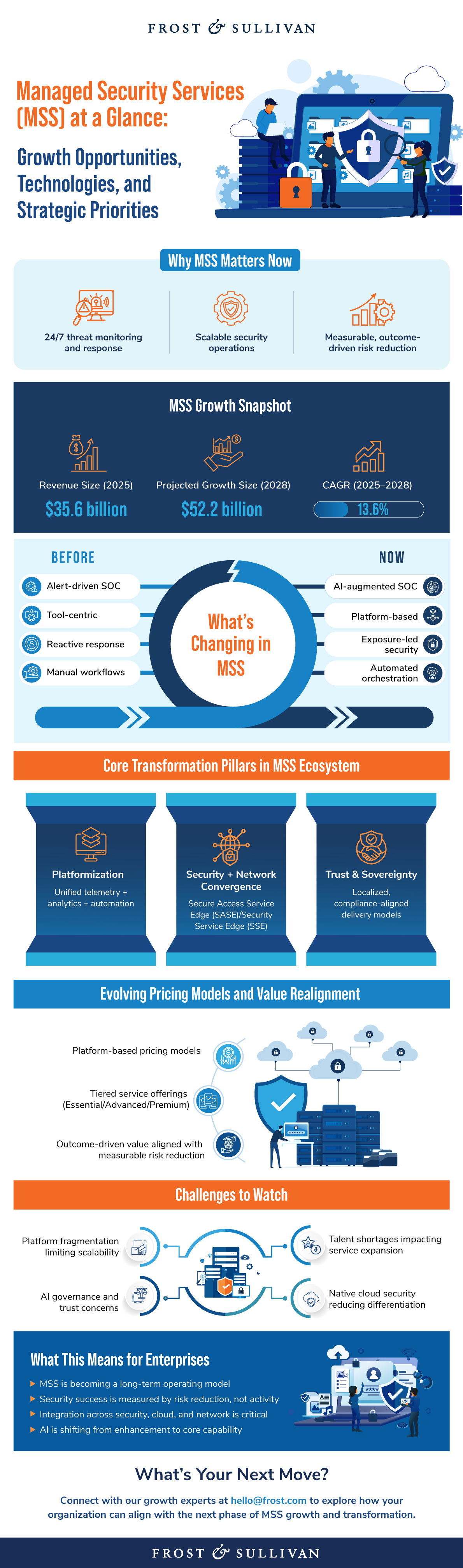
The global managed security services (MSS) market size was valued at USD 35.68 billion in 2025 and is projected to reach USD 52.27 billion by 2028, growing at a CAGR of 13.6% from 2025 to 2028. The rising frequency of ransomware attacks, AI-enabled cyber threats, expanding hybrid IT environments, and increasing regulatory mandates are driving the sustained expansion of the managed security services market.
Key Market Trends & Insights
- North America held the largest revenue share of the global managed security services (MSS) market in 2025.
- EMEA is witnessing accelerated growth due to sovereignty requirements and compliance frameworks such as GDPR, NIS2, and DORA.
- Platformization of SOC operations is replacing fragmented, tool-centric service delivery models.
- AI-augmented SOC workflows are reducing false positives and improving response efficiency.
- SASE and cloud-native convergence are expanding the value proposition of the managed security services market.
Market Size & Forecast
- 2025 Market Size: USD 35.68 Billion
- 2028 Projected Market Size: USD 52.27 Billion
- CAGR (2025–2028): 13.6%
- North America: Largest Market in 2025
- APAC: Fastest Growing Region
The growing complexity of multi-cloud architectures, SaaS sprawl, identity-based attack surfaces, and operational technology environments is reinforcing enterprise dependence on outsourced and co-managed SOC models. As organizations transition from reactive alert handling to exposure-led and outcome-driven security strategies, the managed security services (MSS) market is evolving into a core operational layer of enterprise cybersecurity. Long-term contracts, AI-driven automation, and compliance-driven spending are expected to sustain predictable growth momentum over the forecast period.
Market Overview & Trends: Managed Security Services (MSS) Market
The managed security services market encompasses outsourced and co-managed SOC operations, threat detection and response (MDR/XDR), exposure management, vulnerability monitoring, and compliance-aligned security oversight. Organizations across industries are increasingly outsourcing cybersecurity functions to address hybrid IT complexity, multi-cloud adoption, SaaS sprawl, and expanding identity-based attack surfaces.
A major structural shift within the managed security services (MSS) market is Platformization. Providers are consolidating fragmented SIEM, SOAR, MDR, and cloud security tools into unified operational platforms that centralize telemetry ingestion, analytics, automation, and reporting. This reduces onboarding friction and enables scalable automation across global customer bases.
AI-augmented SOCs represent another defining trend. AI-driven triage, enrichment, and correlation significantly reduce false positives and investigation times. Over the forecast period, the managed security services market will increasingly rely on human-supervised, semi-autonomous workflows to improve both service quality and provider margins.
Exposure-led security models, particularly Continuous Threat Exposure Management (CTEM), are expanding MSS scope beyond reactive incident handling toward continuous risk reduction. This transformation increases average contract values and customer stickiness.
Convergence with SASE and cloud-native architectures is reshaping service delivery. Secure connectivity platforms now serve as telemetry and enforcement layers, enabling faster containment and policy orchestration. Sovereignty and jurisdiction-aware processing have emerged as decisive procurement criteria, particularly in Europe and highly regulated sectors.
Overall, the managed security services (MSS) market is evolving into an integrated operational security platform anchored in measurable outcomes such as reduced dwell time, faster containment, and demonstrable compliance alignment.
Scope of Analysis: Managed Security Services (MSS) Market
The managed security services market analysis covers the global market from 2023 to 2028, with 2025 as the base year.
The study evaluates revenue performance, growth drivers, restraints, pricing trends, regional adoption patterns, vendor ecosystem dynamics, and future opportunities.
Geographic coverage includes North America, EMEA, APAC, and Latin America. The managed security services (MSS) market assessment includes organizations of all sizes—small (1–250 employees), medium (251–2,500), and large enterprises (2,500+ employees).
Services analyzed include managed firewalls, DDoS mitigation, vulnerability management, MDR/XDR, AI-augmented SOC operations, exposure management, and compliance-aligned security monitoring. The research methodology integrates industry benchmarking, vendor disclosures, market modeling, and trend analysis.
The managed security services market evaluation also incorporates regulatory influences, AI adoption maturity, platform convergence trends, and sovereign SOC deployment models. Forecast modeling considers macroeconomic variables, modernization pace, competitive intensity, and governance maturity as forecast-sensitive factors.
Revenue & Spending Forecast: Managed Security Services (MSS) Market
The global managed security services (MSS) market generated USD 35.68 billion in 2025 and is projected to reach USD 52.27 billion by 2028, expanding at a compound annual growth rate (CAGR) of 13.6% from 2025 to 2028. The managed security services market continues to outpace overall cybersecurity spending due to its operationally embedded and recurring revenue model.
Growth momentum is being driven by the expansion of managed detection and response (MDR) into broader exposure management and cloud security services. Enterprises are increasing spending on AI-augmented SOC platforms to reduce mean time to detect (MTTD) and mean time to respond (MTTR), while regulatory mandates are reinforcing continuous monitoring investments.
Unlike discretionary cybersecurity software purchases, spending in the managed security services (MSS) market is increasingly considered non-discretionary. Long-term contracts, outcome-based pricing models, and platformized delivery structures are creating stable and predictable revenue streams.
Over the forecast period, revenue growth will be influenced by AI-driven operational efficiency, convergence with SASE architectures, and sovereign SOC deployment in regulated markets. As organizations transition from reactive defense to continuous risk reduction frameworks, the managed security services market is expected to maintain strong double-digit growth momentum.
Market Segmentation Analysis: Managed Security Services (MSS) Market
The managed security services market is segmented by geography, company size, and vendor type.
By geography, North America leads revenue contribution, driven by mature SOC outsourcing adoption and high enterprise cybersecurity spending. EMEA demonstrates strong compliance-driven demand influenced by sovereignty and regulatory frameworks. APAC is the fastest-growing cloud-native region, while LATAM remains an emerging but high-potential channel-driven market.
By company size, large enterprises account for the highest revenue share due to 24/7 operational requirements, complex IT estates, and regulatory accountability. Medium-sized enterprises increasingly adopt co-managed SOC models, while small enterprises leverage MSP-led MDR attachments for cost efficiency.
By vendor type, consulting firms account for the largest share (~30.8%), followed by service providers and pure-play MSSPs (~28.3%) .
System integrators and telecom providers also play critical roles in integrated service delivery.
The managed security services (MSS) market segmentation highlights a shift toward bundled, tiered, and platform-based service packaging rather than standalone monitoring services.
Growth Drivers: Managed Security Services (MSS) Market
The managed security services (MSS) market is experiencing structurally embedded demand driven by operational, regulatory, and technological transformation.
1. Expanding Attack Surface & Hybrid Complexity
Multi-cloud adoption, SaaS proliferation, remote work, IoT, and OT environments are dramatically increasing enterprise attack surfaces. Organizations lack the internal expertise to manage 24/7 monitoring across distributed control planes, accelerating reliance on the managed security services market.
2. Persistent Cybersecurity Talent Shortage
Global shortages of skilled analysts, incident responders, and cloud security architects are pushing enterprises toward outsourced and co-managed SOC models. The managed security services (MSS) market benefits from this structural workforce imbalance.
3. Regulatory & Compliance Mandates
Frameworks such as GDPR, NIS2, DORA, and sector-specific resilience mandates require continuous monitoring, documented controls, and measurable risk reduction. These requirements are embedding recurring revenue streams across the managed security services market.
4. AI-Augmented SOC Efficiency
AI-driven triage, correlation, enrichment, and guided response workflows are reducing false positives and accelerating containment. This improves scalability and strengthens the economic model of the managed security services (MSS) market.
5. Platformization & SASE Convergence
Unified security platforms and SASE architectures are expanding MSS scope beyond monitoring into integrated, outcome-driven operational security.
Growth Restraints: Managed Security Services (MSS) Market
Despite strong expansion, the managed security services (MSS) market faces operational and strategic constraints.
1. Internal MSSP Platform Fragmentation
Many providers operate heterogeneous SIEM, SOAR, and MDR stacks across regions. This limits automation scalability, increases delivery costs, and compresses margins within the managed security services market.
2. Talent Dependency in Advanced Services
Although automation is increasing, premium services such as threat hunting, digital forensics, and OT monitoring remain human-intensive. Continued skills shortages constrain service expansion.
3. AI Governance & Trust Concerns
Enterprise hesitation around autonomous response actions, AI explainability, and accountability slows adoption of semi-autonomous SOC models in the managed security services (MSS) market.
4. Hyperscaler & Native Security Overlap
Cloud providers are expanding built-in detection and posture capabilities, forcing MSSPs to demonstrate differentiated, cross-domain value beyond baseline monitoring.
5. Regulatory Fragmentation & Sovereignty Costs
Divergent data residency and jurisdiction requirements increase operational complexity, raising delivery costs and limiting global standardization.
While these restraints moderate near-term acceleration, they do not materially weaken long-term structural demand in the managed security services market.
Competitive Landscape: Managed Security Services (MSS) Market
The global managed security services (MSS) market is highly competitive, with more than 120 active providers operating across consulting-led, telecom-integrated, system integrator, and pure-play MSSP models. The top five vendors account for over 50% of total market revenue, reflecting moderate concentration despite a broad ecosystem of regional and niche specialists.
Leading participants include Accenture, Deloitte, IBM, Verizon, Capgemini, LevelBlue, and other multinational consulting and telecom-integrated providers. These companies differentiate through global SOC footprints, AI-augmented detection platforms, sovereign delivery capabilities, and integrated MDR/XDR offerings. Large consulting firms and global system integrators maintain strong positioning due to deep enterprise relationships and compliance expertise, particularly in regulated industries.
The competitive dynamics within the managed security services market are shifting from price-based competition toward platform-based differentiation. Vendors are consolidating fragmented tool stacks into unified operational platforms that integrate telemetry ingestion, analytics, automation, and governance reporting. AI integration, automation depth, and outcome-driven service models are becoming primary differentiators.
Mergers and acquisitions remain active, with providers expanding sovereign SOC infrastructure, AI-driven capabilities, and exposure-led security offerings. Telecom operators and MSP ecosystems are also strengthening their managed security portfolios through bundled SASE-enabled services.
Overall, the managed security services (MSS) market is evolving toward fewer, platform-centric leaders with strong AI, compliance, and sovereign capabilities, while regional MSS specialists compete through localized expertise and sector-specific customization.
Scope of Analysis
Segmentation
Key Trends
Why is it Increasingly Difficult to Grow?
The Strategic Imperative 8™
The Impact of the Top 3 Strategic Imperatives on Managed Security Services
Competitive Environment
Growth Metrics
Growth Drivers
Growth Driver Analysis
Growth Restraints
Growth Restraint Analysis
Forecast Considerations
Revenue Forecast
Revenue Forecast by Region
Revenue Forecast by Company Size
Revenue Forecast Analysis
Revenue Forecast Analysis by Region
Pricing Trends and Forecast Analysis
Types of MSSPs
Growth Metrics
Revenue Forecast
Revenue Forecast by Company Size
Forecast Analysis
Growth Metrics
Revenue Forecast
Revenue Forecast by Company Size
Forecast Analysis
Growth Metrics
Revenue Forecast
Revenue Forecast by Company Size
Forecast Analysis
Growth Metrics
Revenue Forecast
Revenue Forecast by Company Size
Forecast Analysis
Reframe MSS Selection—From “Outsourcing SOC” to “Operating Model Choice”
Demand Proof of AI-Augmented, Human-Supervised SOC Operations
Shift the MSS Conversation Toward Exposure-Led and Outcome-Driven Security
Clarify the Co-Managed Model: RACI, Authority, and Integration Depth
Incorporate Trust, Sovereignty, and Human Risk into MSS Strategy
Growth Opportunity 1: AI-Augmented, Human-Supervised SOC Platforms
Growth Opportunity 2: Exposure-Led MSS and Continuous Risk Reduction Services
Growth Opportunity 3: Sovereign, Regulation-Aligned MSS for High-Assurance Environments
Benefits and Impacts of Growth Opportunities
Next Steps
List of Exhibits
Legal Disclaimer
Frequently Asked Questions (FAQ) – Managed Security Services (MSS) Market
1. What is the managed security services (MSS) market?
2. What services are included in managed security services?
3. What is the revenue forecast for the managed security services market?
4. What factors are driving growth in the managed security services market?
5. How is artificial intelligence influencing managed security services?
6. Which industries use managed security services the most?
7. Which regions dominate the managed security services market?
8. Who are the leading companies in the managed security services market?
9. What challenges affect the managed security services market?
10. What is the future outlook for the managed security services market?
Speak directly with our analytics experts for tailored recommendations.
Recent related Security research
16 Oct 2026 | Global | Market Research
Customer Transformation Journeys External Risk Mitigation and Management: BitSight
This report explores how organizations are accelerating cyber risk reduction and remediation through Bitsight’s intelligent External Risk Management and Mitigation (ERMM) solution. It examines customer transformation journeys, highlighting how continuous visibility, contextualized risk intelligence,...
15 Oct 2026 | Global | Market Research
Network Detection and Response (NDR) Sector, Global, 2026–2030
This study examines the global NDR market over the 2022–2030 forecast period. It finds that rising investment reflects NDR's evolution from a discretionary security enhancement into a foundational component of enterprise cyber defense, underscoring stronger buyer commitment and heightened vendor com...
09 Oct 2026 | Global | Technology Research
Growth Opportunities in SiC MOSFET, Photodiodes, RISC-Vs, and Advanced Memory
The Microelectronics Technology Opportunity Engine covers innovations pertaining to SiC MOSFET, Photodiodes, RISC-Vs, and Advanced Memory.The Microelectronics Technology Opportunity Engine captures global electronics-related innovations and developments on a weekly basis. Developments are centered o...
09 Oct 2026 | Global | Frost Radar
Frost Radar™: Workforce Identity and Access Management, 2026
Hybrid work and software as a service have shifted security enforcement from the network perimeter to identity, transforming it into a control plane. Workforce identity and access management (IAM) now determines whether every user, device, and session should retain access based on context, risk, and...
07 Oct 2026 | Global | Frost Radar
Frost Radar™: Network Detection and Response, 2026
The rapid evolution of enterprise IT environments, driven by cloud adoption, connected devices, and hybrid infrastructure, has rendered legacy perimeter defenses inadequate. Network detection and response (NDR) has become a strategic imperative, providing continuous visibility across network traffi...
Purchase includes:
- Report download
- Growth Dialog™ with our experts
Growth Dialog™
A tailored session with you where we identify the:- Strategic Imperatives
- Growth Opportunities
- Best Practices
- Companies to Action
Impacting your company's future growth potential.
This study examines the global MSS growth environment from 2023 to 2028, identifying the key transformation forces reshaping provider strategies and buyer expectations. Central to future growth is the platformization of MSS delivery, in which unified operational fabrics integrate telemetry, analytics, automation, and service orchestration across endpoints, identity, the cloud, software-as-a-service, and network security. AI-augmented, human-supervised security operation centers are emerging as the primary engines of scalability and efficiency, enabling providers to deliver consistent outcomes while improving margins.
The analysis highlights three core growth opportunity vectors: the shift toward exposure-led, outcome-driven security operations; the convergence of MSS with security access service edge and secure connectivity control planes; and the rising strategic importance of trust, sovereignty, and jurisdiction-aware delivery in regulated markets. Together, these forces are expanding MSS scope beyond detection and response into continuous risk reduction, resilience, and alignment with compliance. The study provides actionable insights for providers seeking to prioritize growth opportunities and for chief information security officers evaluating MSS as a long-term security operating model rather than a traditional outsourcing decision.
Authors: Claudio Stahnke, Lucas Ferreyra, Vivien Pua
| Deliverable Type | Market Research |
|---|---|
| Industries | Aerospace, Defence and Security |
| No Index | No |
| Is Prebook | No |
| Keyword 1 | managed security services market |
| Keyword 2 | MSS cybersecurity market |
| Keyword 3 | managed SOC services market |
| Podcast | No |
| Predecessor | None |
| WIP Number | MHFF-01-00-00-00 |