 USD
USD GBP
GBP  CNY
CNY  EUR
EUR  INR
INR  JPY
JPY  MYR
MYR  ZAR
ZAR  KRW
KRW  THB
THB 


MV Switchgear Industry, Global, 2025–2035
Strong Global Demand for Grid Products Drives Switchgear Demand
22-Jul-2026
Global
Market Research
PG6O-01-00-00-00
EG_2026_34753
Key Takeaways: MV Switchgear Market
- The global MV Switchgear Market is being driven by grid modernization, electrification, renewable-energy integration, data-center expansion, EV charging infrastructure, and distributed energy resources.
- The MV Switchgear Market generated approximately $25.14 billion in revenue in 2025 and is forecast to reach $49.64 billion by 2035.
- The market is projected to expand at a 7.04% CAGR from 2025 to 2035, with the study identifying the market as being in the growth stage.
- The Medium Voltage Switchgear Market is increasingly required to manage bidirectional power flows, dynamic loads, distributed generation, microgrids, and changing electricity-demand patterns.
- Air-insulated switchgear (AIS) and gas-insulated switchgear (GIS) constitute the two major switchgear types covered in the study.
- Key demand areas include utilities, data centers, industrial facilities, transportation infrastructure, commercial buildings, MUSH/public infrastructure, and power-generation projects.
- Asia-Pacific is supported by urbanization, electrification, industrialization, and infrastructure investment, while Europe and North America are benefiting from grid modernization, decarbonization, automation, and energy-transition initiatives.
- The competitive environment remains fragmented, with more than 300 competitors and the top 10 competitors accounting for 55.4% of 2025 revenue for PTs.
Report Summary: MV Switchgear Market
The global MV Switchgear Market is experiencing sustained demand as utilities, industrial companies, data-center operators, transportation networks, and infrastructure owners invest in grid modernization and electrification. The market is being shaped by renewable-energy deployment, EV charging infrastructure, industrial electrification, distributed energy resources, microgrids, and the expansion of electricity-intensive facilities such as data centers.
The MV Switchgear Market generated approximately $25.14 billion in revenue in 2025 and is forecast to reach $49.64 billion by 2035, representing a 7.04% CAGR between 2025 and 2035. The market is classified in the growth stage, with approximately 1.7 million units/volume in 2025.
The Medium Voltage Switchgear Market is evolving beyond conventional protection and control applications. Customers are increasingly seeking digital monitoring, predictive asset management, remote operations, cybersecurity, and SF?-free technologies. Smart switchgear incorporating sensors, communication systems, and automated distribution capabilities is becoming increasingly relevant as electrical networks become more decentralized and complex.
Demand is also expanding from renewable-energy projects, EV charging infrastructure, battery energy storage systems, cloud and hyperscale data centers, and industrial applications. At the same time, supply-chain volatility, higher material costs, long lead times, high upfront investments, environmental regulations, and skilled-workforce shortages create challenges for market participants.
Analyst Words: MV Switchgear Market
“The medium voltage switchgear market is entering a period of reinvention driven by electrification, renewable energy integration, grid decentralization, and sustainability imperatives. Future market leaders will not compete on equipment alone—they will differentiate through digital intelligence, asset lifecycle optimization, resilient grid architectures, and environmentally sustainable technologies that enable the next generation of energy infrastructure.”
— Manoj Shankar, Industry Analyst, High Voltage (HV) Switchgear Market
The analyst perspective highlights the shift from conventional protection and control equipment toward intelligent, connected, and lifecycle-oriented solutions. Three growth perspectives are particularly relevant: continued utility investment, increasing demand for intelligent connected assets, and closer collaboration among equipment manufacturers, software providers, utilities, EPCs, renewable developers, and technology partners.
Market Overview & Trends: MV Switchgear Market
The global MV Switchgear Market is being transformed by the structural shift toward electrification and increasingly distributed power networks. Medium-voltage switchgear provides switching, protection, interruption, metering, and regulation functions within electrical distribution systems, making it an important component of modern grid infrastructure.
Grid modernization is one of the central market trends. Utilities are upgrading aging distribution networks, replacing older equipment, integrating renewable generation, and deploying digital monitoring capabilities. These investments are creating demand for modern Medium Voltage Switchgear Market solutions capable of supporting greater reliability, automation, and operational visibility.
Renewable-energy integration is another major trend. Solar and wind generation introduce variable power flows and require distribution infrastructure capable of handling changing voltage and load conditions. Distributed energy resources, microgrids, and battery energy storage systems are further increasing the need for flexible switchgear.
Electrification is expanding the addressable market. EV charging stations, industrial electrification, transportation infrastructure, and commercial facilities require reliable medium-voltage distribution. Increasing electricity consumption from data centers is also creating new demand for high-reliability distribution equipment.
The market is simultaneously moving toward smart and connected switchgear. Sensors, digital monitoring, predictive maintenance, remote operation, and automated distribution systems can provide greater visibility into asset performance and network conditions. Cybersecurity is becoming increasingly relevant as switchgear becomes connected to digital infrastructure.
Environmental considerations are also influencing technology development. The study identifies a transition away from SF?-based gas-insulated switchgear toward alternatives such as air-insulated, vacuum, and fluorine-free technologies. These solutions are intended to reduce environmental impact while maintaining required performance.
Scope of Analysis: MV Switchgear Market
The study analyzes the global MV Switchgear Market for the period 2025–2035, with 2025 as the base year and 2026–2035 as the forecast period. The geographic coverage is global, and revenue is measured in US dollars.
Switchgear is defined as an assembly of switching and interrupting devices together with control, metering, protective, and regulating equipment. The study focuses specifically on medium-voltage switchgear, covering voltage ratings between 1.1 kV and 40 kV. Frost & Sullivan divides the voltage range into 1.1–14 kV, 14.1–30 kV, and 30.1–40 kV.
The market measures manufacturer revenue derived from regional MV switchgear demand. Installation, commissioning, and other value-added services provided by distributors and panel builders are excluded from the revenue calculation. Local-company export revenues are also not separately considered; the study calculates constituent country market sizes.
The Medium Voltage Switchgear Market is categorized into two principal technology types: air-insulated switchgear (AIS) and gas-insulated switchgear (GIS). AIS uses air as the primary insulating medium, whereas GIS uses a gas-based insulating medium such as sulfur hexafluoride (SF?).
The market is also segmented by end-use application across commercial, data center, industrial, MUSH/public, transport, and utility/power generation sectors. Regional coverage comprises 11 regions, including North America, Europe, Asia-Pacific subregions, Latin America, Middle East and North Africa, Russia and CIS, and Sub-Saharan Africa.
Market Segmentation Analysis: MV Switchgear Market
The MV Switchgear Market is segmented primarily by end-use industry, switchgear type, voltage range, and geography. These segments reflect differences in electrical-load characteristics, reliability requirements, infrastructure development, and grid modernization priorities.
By End-Use Industry
Commercial applications cover IT parks, office buildings, malls, hotels, and retail spaces where medium-voltage switchgear is required for electrical distribution and protection.
Data centers represent a rapidly developing application area. The segment includes edge, colocation, enterprise, and hyperscale data centers that can require large-scale MV switchgear deployments. Increasing cloud computing, GPU workloads, and high-density computing infrastructure are increasing electricity requirements and creating demand for reliable, resilient distribution equipment.
Industrial applications cover sectors requiring medium-voltage equipment for heavy loads and motor control, including manufacturing, chemicals, mining, and oil and gas. Industrial electrification and capacity expansion support ongoing demand for Medium Voltage Switchgear Market solutions.
MUSH/public infrastructure includes municipal and public facilities such as universities, schools, hospitals, and other government and nonprofit facilities. These facilities require dependable electrical distribution and protection systems.
Transport applications include railways, metros, airports, seaports, container terminals, and EV charging stations. Transportation electrification and charging infrastructure are expanding this segment.
Utility/power generation covers power generation, electrical-grid transmission and distribution infrastructure, substations, and renewable-energy projects. Utility investments remain a major source of demand for MV switchgear.
By Switchgear Type
Air-insulated switchgear (AIS) uses air as the primary insulation medium for protecting, controlling, and isolating electrical circuits. AIS remains important across distribution and industrial applications.
Gas-insulated switchgear (GIS) uses gas-based insulation and can provide compact configurations for applications where space, environmental conditions, or installation requirements influence equipment selection. The study specifically identifies environmental regulations as a factor encouraging development of alternatives to SF?-based systems.
By Voltage Range
The study divides the MV Switchgear Market into three voltage ranges: 1.1–14 kV, 14.1–30 kV, and 30.1–40 kV. Different voltage classes serve different network architectures and application requirements across utilities, industrial facilities, infrastructure projects, and commercial installations.
By Region
The study provides regional analysis across North America, Europe, Asia-Pacific, Latin America, the Middle East and North Africa, Russia and CIS, Sub-Saharan Africa, and other defined regional markets. Asia-Pacific is supported by urbanization, electrification, industrial development, and infrastructure investment. Europe is influenced by decarbonization and energy-transition policies, while North America benefits from grid modernization, automation, and underground distribution investments.
Revenue & Spending Forecast: MV Switchgear Market
The global MV Switchgear Market generated approximately $25.14 billion in revenue in 2025 and is forecast to reach $49.64 billion by 2035. This represents an increase of approximately $24.50 billion over the forecast period and corresponds to a 7.04% CAGR from 2025 to 2035.
By switchgear type, the 2025 market comprises approximately $15.2 billion from AIS and $9.9 billion from GIS. By 2035, AIS revenue is projected at approximately $27.7 billion, while GIS revenue is projected at approximately $22.0 billion.
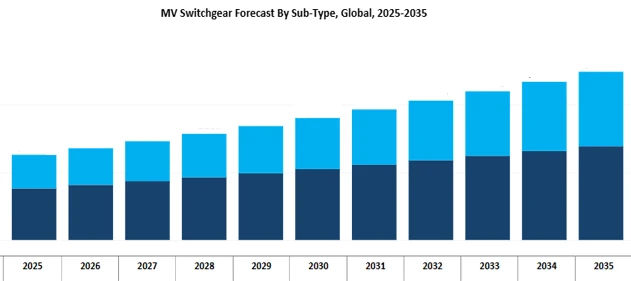
The expansion reflects utility investment, renewable-energy deployment, industrial electrification, data-center development, EV infrastructure, grid replacement cycles, and modernization of aging distribution networks. The supplied study does not provide a separate spending forecast; therefore, the figures above represent the market revenue forecast rather than total customer spending or capital expenditure.
Growth Drivers: MV Switchgear Market
Rising Power Demand and Grid Connectivity
Increasing global electricity demand and expanding grid connectivity are generating sustained demand for distribution network equipment. Urbanization and industrial development across Asia, Africa, and Latin America are increasing electricity requirements, while industrial electrification is creating additional demand for reliable medium-voltage systems.
Renewable-Energy Deployment
Growing renewable-energy capacity requires distribution infrastructure capable of managing variable generation, voltage fluctuations, and changing power flows. Solar and wind projects increasingly require modular switchgear solutions capable of supporting distributed generation and reliable power delivery.
EV Adoption and Charging Infrastructure
Electric-vehicle adoption is changing electricity distribution requirements. The increasing deployment of fast-charging stations across commercial, residential, and industrial locations is creating additional demand for medium-voltage distribution infrastructure. Smart sensors, arc protection, and IoT-based monitoring can further enhance the capabilities of switchgear deployed in EV infrastructure.
Grid Modernization and Asset Replacement
Utilities are replacing aging grid assets and investing in digital monitoring, automation, and smart-grid infrastructure. The study notes that global grid investment is expected to increase substantially, supporting demand for modern MV switchgear with sensors, communications, and predictive-maintenance capabilities.
Data-Center Expansion
Cloud computing, GPU workloads, hyperscale facilities, and colocation data centers are increasing electricity requirements. Large data centers can require high-density power infrastructure and highly reliable medium-voltage distribution systems, creating an important growth opportunity for the MV Switchgear Market.
Industrialization and Infrastructure Development
Industrial capacity expansion and infrastructure projects are increasing demand for reliable and easy-to-maintain switchgear. Manufacturing, utilities, railways, commercial infrastructure, and public facilities are all contributing to market expansion.
Growth Restraints: MV Switchgear Market
Supply-Chain Vulnerability
Trade restrictions, tariffs, geopolitical disruptions, and constraints on raw-material supplies can increase equipment costs and extend delivery timelines. Semiconductor availability is also relevant because electronic components and sensors are increasingly incorporated into modern switchgear.
High Upfront Investment
Advanced switchgear requires significant upfront investment, particularly for newer generations of digitally enabled equipment. High capital requirements can limit adoption among smaller industrial and utility customers with restricted investment budgets.
Environmental and Safety Regulations
The transition away from SF?-based gas-insulated switchgear toward more environmentally sustainable alternatives can increase compliance requirements and R&D costs. Manufacturers must develop alternative technologies while maintaining reliability, safety, and performance.
Skilled Workforce Requirements
Next-generation switchgear increasingly incorporates IoT sensors, predictive maintenance, digital controls, and advanced monitoring capabilities. Installation, commissioning, maintenance, and cybersecurity therefore require personnel with specialized electrical and digital skills.
Long Equipment Replacement Cycles
MV switchgear can have an operating life of approximately 20–30 years, with some installations extending to 35–40 years. Long replacement cycles can delay equipment upgrades, particularly where existing infrastructure remains operational and utilities prioritize extending asset life rather than replacing complete systems.
Extended Lead Times
Complex equipment manufacturing, component shortages, and supply-chain disruptions can extend delivery schedules. Longer lead times can affect project execution and create challenges for utilities, industrial customers, and infrastructure developers.
Competitive Landscape: MV Switchgear Market
The global MV Switchgear Market is highly fragmented, with more than 300 competitors identified in the study. Competition is shaped by price, lead times, efficiency, ability to provide complete technology solutions, track record, manpower, and service capabilities.
The leading competitors identified include Siemens, ABB, Schneider Electric, CHINT Electric, Eaton, and Hitachi Energy. Other notable participants include GE Vernova, Toshiba, and XJ Electric, alongside numerous regional and local manufacturers.
The top 10 competitors accounted for 55.4% of 2025 revenue for PTs, indicating that the market contains a meaningful group of established international suppliers while retaining a substantial fragmented competitive base.
Regional competition differs considerably. In North America, the competitive landscape includes Schneider Electric, Siemens, GE Vernova, Eaton, ABB, HD Hyundai Electric, Toshiba, Powell Industries, IEM, and other electrical-equipment providers. Europe includes major global OEMs alongside regional manufacturers such as SGC, Norelco, Efacec, BRUSH Switchgear, ZPU, E+I Engineering, Tavrida Electric, and others.
Asia-Pacific has a particularly broad base of local participants, with companies such as CHINT Group, ORECCO, Meidensha Corporation, LSIS, TGOOD Global, NHP, Tamco Switchgear, Kinta Switchgear, and other regional manufacturers. The study notes that the APAC market is highly fragmented, with India and China containing numerous local participants.
Competition is increasingly moving beyond equipment specifications toward digital intelligence, lifecycle management, reliability, service, and integrated solutions. Customers are seeking smart switchgear with real-time monitoring, predictive maintenance, remote operations, and cybersecurity capabilities.
Distribution structures include transmission system operators, national utilities, EPC and balance-of-plant contractors, OEM direct sales, project developers and IPPs, specialist testing and commissioning houses, long-term service and maintenance contracts, and strategic procurement channels.
M&A activity is also influencing the competitive environment. The study identifies transactions including Siemens' acquisition of C&S Electric's LV and MV switchgear business, Schneider Electric's acquisition of India's L&T Switchgear business, ABB's acquisition of a stake in Zhejiang Yunyang Power Technology, nVent's acquisition of Avail Infrastructure Group, and other transactions intended to expand product portfolios and regional capabilities.
Scope of Analysis
End-User Segmentation
Regional Segmentation
Key Competitors
Why is it Increasingly Difficult to Grow?
The Strategic Imperative 8™
The Impact of the Top 3 Strategic Imperatives on the MV Switchgear Industry
Key Findings
Growth Metrics
Growth Drivers
Growth Restraints
Major Trends Shaping the MV Switchgear Industry
Rise of Renewable Energy
Global Power Generation Investment Forecast by Region
Global T&D Investment Forecast by Region
Commodity Prices Increase
Global Data Center Investment
Global EV Penetration
SF6 Regulations—Timeline
Forecast Assumptions
Total MV Switchgear Revenue Forecast
Total MV Switchgear Revenue Forecast by Region
Global Revenue and Unit Forecast Discussion
Europe Revenue Forecast Discussion
North America Revenue Forecast Discussion
China Revenue Forecast Discussion
India and South Asia Revenue Forecast Discussion
East Asia Revenue Forecast Discussion
ASEAN Revenue Forecast Discussion
Latin America Revenue Forecast Discussion
MENA Revenue Forecast Discussion
Sub-Saharan Africa Revenue Forecast Discussion
Russia and CIS Revenue Forecast Discussion
Revenue Forecast Discussion by End User
Total MV AIS Switchgear Revenue Forecast by Region
Total AIS Revenue Forecast by KV
Revenue Forecast by End User for AIS
Global AIS Revenue, Unit, and End-User Forecast Discussion
Total GIS MV Switchgear Revenue Forecast by Region
Total GIS Revenue Forecast by KV
Revenue Forecast by End User for GIS
Global GIS Revenue, Unit, and End-User Forecast Discussion
Competitive Environment
Revenue Share
Revenue Share Analysis
Growth Opportunity 1: Organic Expansion and M&A
Growth Opportunity 2: Digitalization
Growth Opportunity 3: As-a-service Business Model
Growth Opportunity 4: Next-Generation Medium Voltage (MV) Distribution
Growth Opportunity 5: Services and Aftermarket
Benefits and Impacts of Growth Opportunities
Next Steps
List of Exhibits
Legal Disclaimer
Frequently Asked Questions (FAQs) – MV Switchgear Market
1. What is the MV Switchgear Market?
The MV Switchgear Market comprises medium-voltage electrical switchgear assemblies used for switching, interrupting, controlling, protecting, metering, and regulating electrical circuits. The study covers medium-voltage applications from 1.1 kV to 40 kV and includes air-insulated switchgear (AIS) and gas-insulated switchgear (GIS).
2. What was the MV Switchgear Market revenue in 2025?
The global MV Switchgear Market generated approximately $25.14 billion in revenue in 2025, according to the supplied market study.
3. What will the MV Switchgear Market size be by 2035?
The global MV Switchgear Market is forecast to reach approximately $49.64 billion by 2035, increasing from $25.14 billion in 2025.
4. What is the CAGR of the Medium Voltage Switchgear Market?
The global Medium Voltage Switchgear Market is projected to grow at a 7.04% CAGR from 2025 to 2035, according to the forecast provided in the study.
5. What are the major segments of the MV Switchgear Market?
The MV Switchgear Market is segmented by switchgear type, voltage range, end-use industry, and region. The two major switchgear types are air-insulated switchgear (AIS) and gas-insulated switchgear (GIS). End-use segments include commercial, data centers, industrial, MUSH/public, transport, and utility/power generation.
6. What are the major growth drivers for the MV Switchgear Market?
Major growth drivers include grid modernization, rising electricity demand, renewable-energy integration, EV charging infrastructure, industrial electrification, data-center expansion, distributed energy resources, and replacement of aging electrical-grid assets.
7. How is renewable energy affecting the Medium Voltage Switchgear Market?
Renewable-energy deployment is increasing demand for medium-voltage equipment capable of managing variable generation, changing voltage conditions, distributed power flows, and grid-connected solar and wind projects. This is creating opportunities for modular and digitally enabled Medium Voltage Switchgear Market solutions.
8. What are the key restraints affecting the MV Switchgear Market?
Key restraints include supply-chain disruptions, raw-material and component price volatility, high upfront investment requirements, environmental compliance costs, shortages of skilled workers, long equipment replacement cycles, and extended lead times.
9. Who are the leading companies in the MV Switchgear Market?
Leading companies identified in the study include Siemens, ABB, Schneider Electric, CHINT Electric, Eaton, and Hitachi Energy. Other notable competitors include GE Vernova, Toshiba, XJ Electric, Mitsubishi Electric, and numerous regional manufacturers.
10. What is the role of smart technology in the MV Switchgear Market?
Smart technology is enabling MV switchgear to incorporate sensors, real-time monitoring, predictive maintenance, remote operations, automated distribution controls, and digital asset management. These capabilities are supporting greater grid visibility, reliability, operational efficiency, and lifecycle management as electrical networks become more connected and decentralized.
Speak directly with our analytics experts for tailored recommendations.
Recent related Power Generation research
12 Oct 2026 | Global | Market Research
Growth Opportunities in the Global Nuclear Power Industry, 2025–2035
The Growth Opportunities in the Global Nuclear Power Industry study examines global commercial nuclear power development from 2025 to 2035, covering reactors above 10 MWe and the life cycle services supporting the installed fleet. Global installed capacity is projected to grow 23.8%, reaching approx...
09 Oct 2026 | Global | Technology Research
Innovations in Enhanced Oil Recovery, Continuous Emission Monitoring, Infrared Gas Detection, and Reservoir Optimization
This edition of the Oil and Gas (O&G) Technology Opportunity Engines features information on enhanced oil recovery, crude oil separation, leak detection, distributed gas monitoring, real-time monitoring of distributed fuel operations, among others.The Oil and Gas TOE provides intelligence on innovat...
28 Sep 2026 | Global | Technology Research
CO₂ Gas Injection for Enhanced Oil Recovery and Carbon Utilization
CO₂ gas injection for enhanced oil recovery (CO₂-EOR) is a mature tertiary recovery technology that improves oil production from depleted reservoirs while enabling long-term geological carbon storage. This report provides a fundamental overview of oil recovery, covering primary, secondary, and terti...
28 Sep 2026 | Global | Technology Research
CO₂ Gas Injection for Enhanced Oil Recovery and Carbon Utilization
CO₂ gas injection for enhanced oil recovery (CO₂-EOR) is a mature tertiary recovery technology that improves oil production from depleted reservoirs while enabling long-term geological carbon storage. This report provides a fundamental overview of oil recovery, covering primary, secondary, and terti...
28 Sep 2026 | Global | Technology Research
Quasi-Solid-State Batteries: Key Innovations Transforming Electrochemical Energy Storage Systems
Quasi-solid-state batteries (QSSBs) are emerging as a promising next-generation lithium battery technology that bridges the gap between conventional lithium-ion batteries (LIBs) and all-solid-state batteries (ASSBs). By integrating a confined liquid electrolyte within a polymer, inorganic, or hybrid...
Purchase includes:
- Report download
- Growth Dialog™ with our experts
Growth Dialog™
A tailored session with you where we identify the:- Strategic Imperatives
- Growth Opportunities
- Best Practices
- Companies to Action
Impacting your company's future growth potential.
The market is experiencing solid growth, supported by investments from utilities and industrial sectors. Utilities are upgrading aging distribution networks and integrating renewables, while industries such as data centers, manufacturing, and transport are expanding capacity. Asia-Pacific leads growth due to urbanization and electrification, while Europe and North America benefit from grid modernization and decarbonization initiatives. Competition remains balanced between global OEMs and regional players with strong local capabilities. Europe is characterized by steady growth driven by decarbonization policies, grid digitalization, and energy transition targets. North America shows strong momentum due to grid resilience investments, automation, and underground distribution projects. A cohort of regional and local manufacturers coexists with leading international OEMs that hold strong shares in projects requiring high ratings, stringent qualification, and digitalized lifecycle support. Success factors include long-standing utility relationships, localized manufacturing/service, proven delivery reliability, cost control under volatile input prices, and extended lead times.
Author: Manoj Shankar
| Deliverable Type | Market Research |
|---|---|
| Industries | Energy |
| No Index | No |
| Is Prebook | No |
| Keyword 1 | MV Switchgear Market Report |
| Keyword 2 | Medium Voltage Switchgear Analysis |
| Keyword 3 | MV Switchgear Market Forecast |
| Podcast | No |
| Predecessor | None |
| WIP Number | PG6O-01-00-00-00 |