 USD
USD GBP
GBP  CNY
CNY  EUR
EUR  INR
INR  JPY
JPY  MYR
MYR  ZAR
ZAR  KRW
KRW  THB
THB 


Future Growth Potential Lies in Precision Medicine and Cloud Adoption in Oncology Care
01-Sep-2020
North America
Market Research
MF3F-01-00-00-00
HC03333-NA-MT_24699
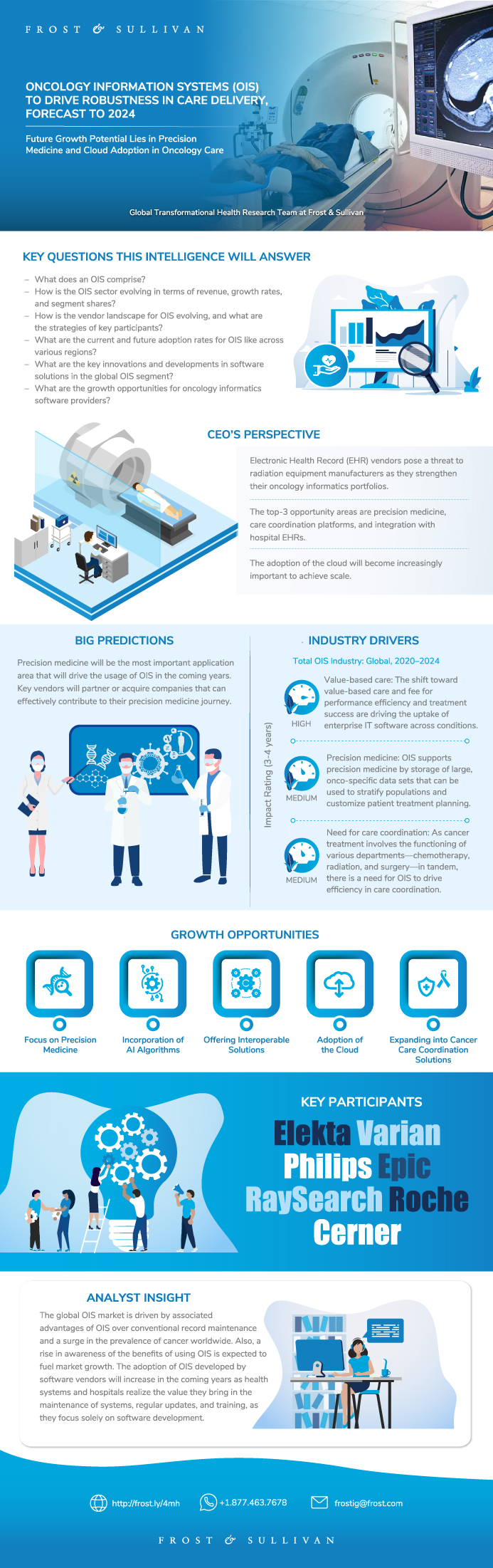
As cancer care becomes increasingly highly complex, the information, image data, and steps that comprise a single patient’s healthcare journey has grown tremendously. Oncology information systems (OIS) software are used by cancer clinics and departments, medical oncologists, radiation specialists, and department employees to manage and plan the treatment module of cancer patients. Automation of the oncology workflow with the EMR not only delivers greater department efficiency but can also help in improving the quality of care, reducing medical errors, decreasing clinical documentation time, providing rich data for clinical research, and controlling health costs. The software has evolved over the last decade as a tool to centralize the patient’s electronic medical record (EMR) in an easily accessible place and to manage the treatment process from referral to treatment and eventually disease management. The main market participants are Elekta and Varian that are also major radiation equipment manufacturers. Their large customer base in radiation centers and the integration capabilities that their software offers with their radiation equipment are major positives. Oncology has been a ripe space for healthcare IT systems in the recent past, and EHR companies such as Epic and Cerner have made a place for themselves with oncology-specific EHRs and data analytics capabilities. Data analytics and visualization tools have also gained importance with increasing sophistication of the disease. The global OIS market is driven by associated advantages of OIS over conventional record maintenance, and surge in prevalence of cancer worldwide. In addition, rise in awareness of the benefits of using OIS is expected to fuel the market growth. The adoption of OIS developed by software vendors will increase in the coming years as health systems and hospitals realize the value they bring in the maintenance of systems, regular updates, and training, as they focus solely on software development. Further, EHR and other software vendors will invest in R&D to develop stronger OIS solutions and focus on interoperability with current radiation equipment. Integration of oncology information systems into main hospital workflows, shift to the cloud, and increased usage of artificial intelligence (AI) in oncology information systems are slated to be growth opportunities for key market participants in the near future. Increased sophistication of OIS will take place as value-based rules come into the picture, patient engagement takes center stage, and telehealth becomes the new normal (post COVID-19). An OIS will have to encompass all the market dynamics to stay relevant to oncology practices around the world.
Author: Chandni Mathur
Scope and Segmentation
Key Questions this Study will Answer
Market Engineering Measurements
CEO’s Perspective
Global Adoption of OIS and Key Vendors
Executive Summary—3 Big Predictions
Five Growth Opportunities Critical for Future Strategy
Market Overview and Definitions
Market Segmentation
Shift to Offering Cloud Based Oncology Software
OIS Vendors Pushing the Cloud Agenda
Incorporation of AI Tools into OIS
OIS and Key Healthcare Concepts
Value-based Care—A Key Driver for the Adoption of OIS
OIS—Advantage of Driving Precision Medicine in Oncology
Data Aggregated from a Comprehensive OIS—A Critical Component of a PHM Strategy
Vendor Ecosystem
Vendor Types and Strategies
Vendor Types and Strategies (Radiation Equipment Vendors + Other Med-tech companies)
Vendor Types and Strategies (EHR Vendors)
Vendor Types and Strategies (other Software Vendors)
Competitor Assessment
Elekta
Varian Medical Systems
RaySearch Laboratories
Epic Systems
Philips
Recent Notable Developments That Impact the OIS Market
Distribution Structure
Critical Success Factors
Market Drivers
Market Restraints
Plotting Impact of External Factors (Opportunities and Threats)
Revenue Calculation Model
Revenue Forecast Assumptions
Market Engineering Measurements
Revenue Forecast
Percent Revenue Forecast by Region
Revenue Forecast
Revenue Forecast
Market Share of Key Vendors
Current State of Adoption
Current State of Adoption—North America
Current State of Adoption—Europe
Current State of Adoption—APAC
Five Growth Opportunities Critical for Future Strategy
Growth Opportunity 1—Focus on Precision Medicine
Growth Opportunity 2—Incorporation of AI Algorithms
Growth Opportunity 3—Offering Interoperable Solutions
Growth Opportunity 4—Adoption of the Cloud
Growth Opportunity 5—Expanding into Cancer Care Coordination Solutions
Identifying Your Company’s Growth Zone
Growth Opportunities 1–5—Vision and Strategy
Growth Opportunities Matrix
Prioritized Opportunities through Implementation
Legal Disclaimer
List of Exhibits
List of Exhibits (continued)
Speak directly with our analytics experts for tailored recommendations.
Recent related Healthcare research
08 Oct 2026 | Global | Frost Radar
Frost Radar: Endoscopy Device Technology Ecosystem, 2026
The endoscopy device market is advancing toward higher-quality visualization and improved clinical decision-making, with innovation across 4K ultrahigh-definition display systems, image-enhanced endoscopy, and computer-aided detection systems. Advanced visualization is evolving through improvements ...
07 Oct 2026 | Global | Technology Research
Growth Opportunities in Image-Guided Cancer Ablation Systems
Image-guided cancer ablation systems are minimally invasive medical technologies that use real-time imaging to accurately guide the placement of an ablation device into a tumor, enabling localized destruction of cancerous tissue while minimizing damage to surrounding healthy structures.The increasin...
06 Oct 2026 | Global | Technology Research
Trends in Laboratory Automation, Global, 2021–2025
This research study provides a comprehensive assessment of the recent trends, technological advancements, and strategic developments shaping the global laboratory automation industry. The analysis traces the evolution of laboratory automation from task-specific automation systems to integrated, inte...
05 Oct 2026 | Global | Frost Radar
Frost Radar™: Point-of-Care Ultrasound Imaging Technology Ecosystem, 2026
The point-of-care ultrasound imaging industry is undergoing a fundamental transformation from equipment-intensive ultrasound to portable, handheld, wireless, AI-enabled, and connected point-of-care solutions. Driven by the need for rapid bedside diagnosis and decentralized healthcare delivery, speci...
25 Sep 2026 | Global | Technology Research
Innovations and Growth Opportunities in Advanced Medical Devices, Diagnostic Solutions, and Implantables
The latest issue of Advanced MedTech Technology Opportunity Engine (TOE) spotlights a diverse slate of innovations across advanced medical devices, diagnostic solutions, and implantables.The issue features advanced medical devices such as peritoneal dialysis fluid system, cold sterilization-based au...
Purchase includes:
- Report download
- Growth Dialog™ with our experts
Growth Dialog™
A tailored session with you where we identify the:- Strategic Imperatives
- Growth Opportunities
- Best Practices
- Companies to Action
Impacting your company's future growth potential.
| Deliverable Type | Market Research |
|---|---|
| No Index | No |
| Podcast | No |
| Author | Chandni Mathur |
| Industries | Healthcare |
| WIP Number | MF3F-01-00-00-00 |
| Is Prebook | No |
| GPS Codes | 9564-B1,9575-B1,9600-B1,9612-B1,99BC-B1 |
Oncology Information Systems to Drive Robustness in Care Delivery, Forecast to 2024
$4,950.00
Special Price $3,712.50 save 25 %