 USD
USD GBP
GBP  CNY
CNY  EUR
EUR  INR
INR  JPY
JPY  MYR
MYR  ZAR
ZAR  KRW
KRW  THB
THB 


In-cabin Monitoring Systems Experiencing Transformational Growth as the Next Pillar of Vehicle Safety, Experience, and Differentiation
04-Jun-2025
Global
Market Research
PFTQ-01-00-00-00
AU_2025_33538
Report Summary: Passenger Vehicle Cabin Monitoring Systems Market
The global Passenger Vehicle Cabin Monitoring Systems Market is experiencing significant growth, with the market valued at USD 3,360.0 million in 2024 and projected to reach USD 13,748.5 million by 2031, expanding at a CAGR of 22.3%. This strong revenue trajectory is driven by increasing regulatory mandates, rising adoption of advanced driver assistance systems (ADAS), and growing emphasis on in-vehicle safety and user experience. Automakers are integrating advanced sensing technologies such as cameras, radar, and AI-based analytics to monitor driver behavior and occupant conditions in real time, accelerating market expansion.
Key Market Trends & Insights
- Europe leads adoption due to stringent safety regulations such as GSR and Euro NCAP requirements
- Increasing integration of AI-powered driver monitoring systems is enhancing real-time safety capabilities
- OEMs are leveraging cabin monitoring systems for differentiation through personalization and comfort features
- Rising adoption of electric and autonomous vehicles is boosting demand for in-cabin sensing technologies
- Multi-modal sensor fusion (camera + radar + infrared) is improving system accuracy and reliability
Market Size & Forecast
- 2024 Market Size: USD 3,360.0 Million
- 2031 Projected Market Size: USD 13,748.5 Million
- CAGR (2024–2031): 22.3%
- Europe: Largest Market due to regulatory enforcement
- Asia-Pacific: Fastest Growing Market driven by vehicle production and technology adoption
The increasing focus on driver safety, regulatory compliance, and enhanced in-cabin experience is driving continuous innovation and adoption across the Passenger Vehicle Cabin Monitoring Systems Market, positioning it as a key component of next-generation automotive systems.
Market Overview & Trends: Passenger Vehicle Cabin Monitoring Systems Market
The Passenger Vehicle Cabin Monitoring Systems Market represents a transformative shift in automotive safety and in-cabin intelligence, driven by the convergence of regulatory compliance, ADAS deployment, and evolving consumer expectations. As vehicles become increasingly connected and autonomous, the need for continuous monitoring of driver behavior and occupant conditions has become fundamental, positioning the Passenger Vehicle Cabin Monitoring Systems Market as a core enabler of next-generation mobility.
A major structural trend shaping the Passenger Vehicle Cabin Monitoring Systems Market is the transition from passive safety systems to active and predictive safety solutions. Driver monitoring systems are now essential for enabling Level 2 and Level 3 automation, ensuring that drivers remain attentive and capable of taking control when required. Simultaneously, occupant monitoring systems are expanding beyond safety to include wellness, comfort, and personalization applications.
Technological innovation is playing a pivotal role in the Passenger Vehicle Cabin Monitoring Systems Market. The integration of AI-powered computer vision, machine learning algorithms, and multi-modal sensor fusion is enabling real-time analysis of driver behavior, including gaze tracking, emotion recognition, and posture detection. These capabilities are enhancing system accuracy and enabling proactive safety interventions.
Another key trend in the Passenger Vehicle Cabin Monitoring Systems Market is the increasing adoption of software-defined architectures. OEMs are embedding cabin monitoring functionalities into centralized computing platforms, allowing for over-the-air updates, feature upgrades, and enhanced scalability. This shift is driving collaboration between automotive manufacturers, Tier 1 suppliers, and technology companies.
Regionally, Europe leads the Passenger Vehicle Cabin Monitoring Systems Market due to stringent safety regulations such as the General Safety Regulation (GSR) and Euro NCAP requirements. North America follows with strong adoption driven by ADAS integration, while Asia-Pacific is emerging as a high-growth region supported by increasing vehicle production and regulatory developments.
The Passenger Vehicle Cabin Monitoring Systems Market is also witnessing expanding applications across electric vehicles and shared mobility platforms, where safety, user experience, and regulatory compliance are critical differentiators.
Scope of Analysis: Passenger Vehicle Cabin Monitoring Systems Market
The Passenger Vehicle Cabin Monitoring Systems Market analysis provides a comprehensive evaluation of global market trends, technological advancements, and regulatory frameworks influencing adoption. The study focuses on key system components, including driver monitoring systems (DMS) and occupant monitoring systems (OMS), which collectively define the functional scope of the Passenger Vehicle Cabin Monitoring Systems Market.
The research covers the period from 2024 to 2031, with 2024 designated as the base year and forecasts extending through 2031. It evaluates the role of sensing technologies such as infrared cameras, RGB cameras, radar systems, ultrasonic sensors, and biometric solutions in enabling advanced in-cabin monitoring capabilities. The Passenger Vehicle Cabin Monitoring Systems Market scope also includes analysis of artificial intelligence applications for behavior recognition, fatigue detection, and real-time safety alerts.
Geographically, the Passenger Vehicle Cabin Monitoring Systems Market spans Europe, North America, and Asia-Pacific, reflecting major automotive manufacturing hubs and regulatory environments. The study examines OEM strategies, Tier 1 supplier integration, and ecosystem partnerships shaping market development.
Additionally, the Passenger Vehicle Cabin Monitoring Systems Market analysis considers evolving use cases, including driver safety, occupant protection, personalization, and human-machine interaction, providing a holistic view of market dynamics.
Revenue & Spending Forecast: Passenger Vehicle Cabin Monitoring Systems Market
The Passenger Vehicle Cabin Monitoring Systems Market demonstrates strong revenue growth potential driven by regulatory mandates and increasing integration of advanced sensing technologies. The market was valued at approximately USD 3,360.0 million in 2024 and is projected to reach USD 13,748.5 million by 2031, reflecting a compound annual growth rate (CAGR) of 22.3%.

Year-wise growth in the Passenger Vehicle Cabin Monitoring Systems Market is supported by the gradual rollout of mandatory driver monitoring systems across key automotive markets. Early adoption is concentrated in premium and mid-range vehicles, with broader penetration expected as costs decline and regulatory requirements expand.
Spending patterns in the Passenger Vehicle Cabin Monitoring Systems Market indicate increasing investment in AI-driven analytics, sensor fusion technologies, and software-defined vehicle architectures. OEMs and Tier 1 suppliers are allocating resources toward integrating advanced in-cabin monitoring solutions into next-generation vehicle platforms.
The Passenger Vehicle Cabin Monitoring Systems Market is also benefiting from rising demand for electric vehicles and autonomous driving technologies, which require enhanced safety and monitoring capabilities. Additionally, increasing consumer awareness of vehicle safety features is contributing to higher adoption rates.
Overall, the Passenger Vehicle Cabin Monitoring Systems Market is expected to witness sustained revenue growth, supported by technological innovation, regulatory compliance, and expanding application areas across the automotive ecosystem.
Market Segmentation Analysis: Passenger Vehicle Cabin Monitoring Systems Market
The Passenger Vehicle Cabin Monitoring Systems Market is segmented based on system type, technology, and application, reflecting the diverse functionalities and deployment scenarios within modern vehicles.
By system type, the Passenger Vehicle Cabin Monitoring Systems Market is categorized into driver monitoring systems (DMS) and occupant monitoring systems (OMS). DMS solutions focus on detecting driver distraction, drowsiness, and attention levels using camera-based and AI-driven analytics. OMS solutions extend monitoring capabilities to passengers, enabling features such as child presence detection, occupant classification, seatbelt monitoring, and posture analysis. Together, these systems form the foundation of integrated in-cabin monitoring solutions.
From a technology perspective, the Passenger Vehicle Cabin Monitoring Systems Market includes camera-based systems and sensor-based solutions. Camera technologies such as infrared (IR), RGB, and time-of-flight (ToF) cameras are widely adopted for their accuracy in tracking facial features and body movements. Sensor-based technologies, including radar, ultrasonic, biometric, and LiDAR systems, complement camera solutions by providing additional data points for enhanced reliability and performance.
Application-wise, the Passenger Vehicle Cabin Monitoring Systems Market spans safety, comfort, and convenience functions. Safety applications dominate the market, driven by regulatory mandates and ADAS integration. Comfort and convenience applications, including gesture recognition, personalization, and biometric authentication, are gaining traction as OEMs seek to differentiate their offerings.
Regionally, the Passenger Vehicle Cabin Monitoring Systems Market is segmented into Europe, North America, and Asia-Pacific. Europe leads due to stringent safety regulations, while Asia-Pacific is witnessing rapid growth driven by increasing vehicle production and technological adoption.
Growth Drivers: Passenger Vehicle Cabin Monitoring Systems Market
The Passenger Vehicle Cabin Monitoring Systems Market is driven by a combination of regulatory, technological, and consumer-driven factors. One of the primary drivers is the implementation of stringent safety regulations mandating driver monitoring and occupant detection systems. These regulations are accelerating OEM adoption and expanding the Passenger Vehicle Cabin Monitoring Systems Market across key regions.
The increasing adoption of ADAS and autonomous driving technologies is another significant driver. Driver monitoring systems are essential for ensuring safe operation in semi-autonomous vehicles, reinforcing their importance within the Passenger Vehicle Cabin Monitoring Systems Market.
Advancements in artificial intelligence and sensor technologies are also contributing to market growth. AI-powered systems enable real-time analysis of driver behavior and occupant conditions, improving safety outcomes and system performance.
Additionally, OEMs are leveraging in-cabin monitoring systems to enhance user experience through personalization, gesture recognition, and biometric authentication. This trend is expanding the value proposition of the Passenger Vehicle Cabin Monitoring Systems Market beyond safety applications.
Growth Restraints: Passenger Vehicle Cabin Monitoring Systems Market
The Passenger Vehicle Cabin Monitoring Systems Market faces several challenges that may impact its growth trajectory. One of the key restraints is the technical limitation of sensing systems, particularly issues related to sensor placement, occlusion, and varying lighting conditions, which can affect system accuracy.
Another challenge is the lack of standardized validation frameworks for occupant monitoring systems. Variations in regulatory requirements and performance benchmarks create uncertainty for OEMs and suppliers operating in the Passenger Vehicle Cabin Monitoring Systems Market.
Privacy concerns also pose a significant barrier, as in-cabin monitoring systems collect sensitive data related to driver behavior and occupant characteristics. Compliance with data protection regulations such as GDPR adds complexity to system deployment.
Cost considerations and integration challenges further limit adoption, particularly in cost-sensitive vehicle segments. These factors may slow the expansion of the Passenger Vehicle Cabin Monitoring Systems Market in certain regions.
Competitive Landscape: Passenger Vehicle Cabin Monitoring Systems Market
The Passenger Vehicle Cabin Monitoring Systems Market is characterized by a competitive ecosystem comprising OEMs, Tier 1 suppliers, semiconductor companies, and AI solution providers. Key players such as Seeing Machines, Smart Eye, Cipia, and Jungo Connectivity are leading innovation in driver monitoring technologies.
Tier 1 suppliers including Continental, Bosch, Valeo, Magna, and ZF play a crucial role in integrating cabin monitoring systems into vehicle platforms. These companies collaborate closely with OEMs to deliver scalable and compliant solutions within the Passenger Vehicle Cabin Monitoring Systems Market.
Semiconductor companies such as NXP Semiconductors, Infineon Technologies, and STMicroelectronics provide critical components enabling advanced sensing and processing capabilities. Their contributions are essential for the development of high-performance in-cabin monitoring systems.
The Passenger Vehicle Cabin Monitoring Systems Market is also witnessing increased collaboration and partnerships aimed at accelerating technology development and deployment. Strategic alliances between automotive manufacturers and technology providers are shaping the competitive landscape.
Distribution channels primarily involve OEM integration and Tier 1 supplier networks, with growing emphasis on software-driven solutions and centralized vehicle architectures.
Key Findings
Why is it Increasingly Difficult to Grow?
The Strategic Imperative 8
The Impact of the Top 3 Strategic Imperatives on Passenger Vehicle Cabin Monitoring Systems
Scope of Analysis
Segmentation
Segmentation
Regional Segmentation
Market Definition
SAE Definitions for ADAS and Autonomous Driving Features
Value Chain
Major Trends in Automotive In-cabin Sensing
Overview of Regulations for In-cabin Monitoring
European Legislation
Euro NCAP Roadmap
United States Regulations for In-cabin Sensing
Overview of NTSB Recommendations to Standardize DMS in the United States
Asia-Pacific Regulation Overview
Competitive Environment
Key Competitors
Growth Drivers
Growth Restraints
Block Diagram
Product Roadmap and Technological Advancement
In-cabin Sensing System Applications
Vision vs Radar Use Case Placement
Growth Metrics
Forecast Considerations
Revenue and Vehicle Sales with In-cabin Sensing Forecast
DMS and OMS Revenue Forecast
In-cabin sensing Vehicle Sales with In-cabin Sensing Forecast by Region
Revenue Forecast by Region
Revenue Forecast Analysis
Pricing Trends and Forecast Analysis
Growth Metrics
Revenue and Vehicle Sales with In-cabin Sensing Forecast
DMS and OMS Revenue Forecast
In-cabin Sensing Penetration Forecast
Forecast Analysis
Growth Metrics
Revenue and Vehicle Sales with In-cabin Sensing Forecast
DMS and OMS Revenue Forecast
In-cabin Sensing Penetration Forecast
Forecast Analysis
Growth Metrics
Revenue and Vehicle Sales with In-cabin Sensing Forecast
DMS and OMS Revenue Forecast
In-cabin Sensing Penetration Forecast
Forecast Analysis
In-cabin Sensing Supplier Landscape
In-cabin Sensing Adoption by OEMs
Portfolio and Snapshot by Technology Provider
SmartEye
Seeing Machines
Cipia
Eyeris
Jungo Connectivity
Emotion 3D
Growth Opportunity 1: Vision-based Systems as a Foundation for In-cabin Intelligence
Growth Opportunity 2: Personalization and AI-driven Cabin Intelligence
Growth Opportunity 3: Multi-modal Sensor Fusion
Benefits and Impacts of Growth Opportunities
Next Steps
List of Exhibits
Legal Disclaimer
Frequently Asked Questions (FAQ) – Passenger Vehicle Cabin Monitoring Systems Market
1. What is the Passenger Vehicle Cabin Monitoring Systems Market?
The Passenger Vehicle Cabin Monitoring Systems Market refers to technologies that monitor driver behavior and occupant conditions using cameras, sensors, and AI to enhance vehicle safety, comfort, and user experience.
2. What is the revenue forecast for the Passenger Vehicle Cabin Monitoring Systems Market?
The Passenger Vehicle Cabin Monitoring Systems Market is projected to grow from USD 3,360.0 million in 2024 to USD 13,748.5 million by 2031, registering a CAGR of 22.3%.
3. What are the key components of cabin monitoring systems?
Key components include driver monitoring systems (DMS), occupant monitoring systems (OMS), cameras, infrared sensors, radar, and AI-based analytics platforms.
4. What factors are driving growth in this market?
Growth is driven by regulatory mandates, increasing adoption of ADAS, advancements in AI and sensor technologies, and rising demand for enhanced in-cabin safety and personalization.
5. Which regions dominate the Passenger Vehicle Cabin Monitoring Systems Market?
Europe leads the market due to strict safety regulations, followed by North America, while Asia-Pacific is the fastest-growing region driven by increasing automotive production.
6. Who are the key players in the market?
Key players include Seeing Machines, Smart Eye, Cipia, Jungo Connectivity, Continental, Bosch, Valeo, Magna, and ZF.
7. What technologies are used in cabin monitoring systems?
Technologies include infrared and RGB cameras, radar sensors, ultrasonic sensors, biometric systems, and AI-driven analytics for real-time monitoring.
8. What are the major challenges in the market?
Challenges include privacy concerns, sensor accuracy limitations, lack of standardization, and high integration costs for OEMs.
9. How does AI impact the Passenger Vehicle Cabin Monitoring Systems Market?
AI enables real-time driver behavior analysis, fatigue detection, emotion recognition, and automated safety alerts, significantly enhancing system capabilities.
10. What is the future outlook for the Passenger Vehicle Cabin Monitoring Systems Market?
The market is expected to grow rapidly due to regulatory enforcement, advancements in autonomous driving, and increasing demand for intelligent, safety-focused vehicle interiors.
Speak directly with our analytics experts for tailored recommendations.
Recent related Infotainment and Telematics research
25 Sep 2026 | Global | Technology Research
Growth Opportunities in Next-Gen Wireless EV charging, Automotive Grade IoT module, Autonomous driving, E-bike Platform, UAVs, and 4D Radars
The Mobility Technology Opportunity Engine (TOE) covers innovations pertaining to EV charging, Automotive Grade IoT module, Autonomous driving, E-bike Platform, UAVs, and 4D Radars.The purpose of the Mobility Technology TOE is to raise awareness of global technology innovations in self-propelled gro...
22 Sep 2026 | Global | Market Research
Growth Opportunities in the Global EV Power Electronics Market, 2025–2032
The rapid push toward e-mobility is accelerating adoption of advanced power electronics by major OEMs. Power electronics underpin electric vehicle reliability, efficiency, and performance. Core systems, including traction inverters, onboard chargers, and DC-DC converters, are gaining strategic impor...
10 Sep 2026 | Global | Market Research
Global Robobus Market, 2026–2032
The global robobus market is at an inflection point. Large autonomous buses are no longer a concept—they are running as paid public services in China, South Korea, Norway, Switzerland, Finland, and the Netherlands. Europe is in its first wave of real deployment, with active L4 commercial service acr...
03 Sep 2026 | Global | Technology Research
Photonic and Optical Computing Chips for AI and Data Center Acceleration
The study evaluates photonic and optical computing technologies as critical enablers of next-generation AI infrastructure, addressing growing bandwidth, latency, power consumption, and scalability constraints associated with copper-based interconnects. The analysis covers photonic integrated circuit...
02 Sep 2026 | Global | Frost Radar
Frost Radar™: In-Vehicle Audio Technology Stacks, 2026
The in-vehicle entertainment industry is going through a dynamic shift. Audio entertainment in the passenger vehicle is no longer limited to music playback through multiple sources. The rise of ADAS/AD and SDVs have made audio a critical part of the passenger vehicle. Audio developers must now cater...
Purchase includes:
- Report download
- Growth Dialog™ with our experts
Growth Dialog™
A tailored session with you where we identify the:- Strategic Imperatives
- Growth Opportunities
- Best Practices
- Companies to Action
Impacting your company's future growth potential.
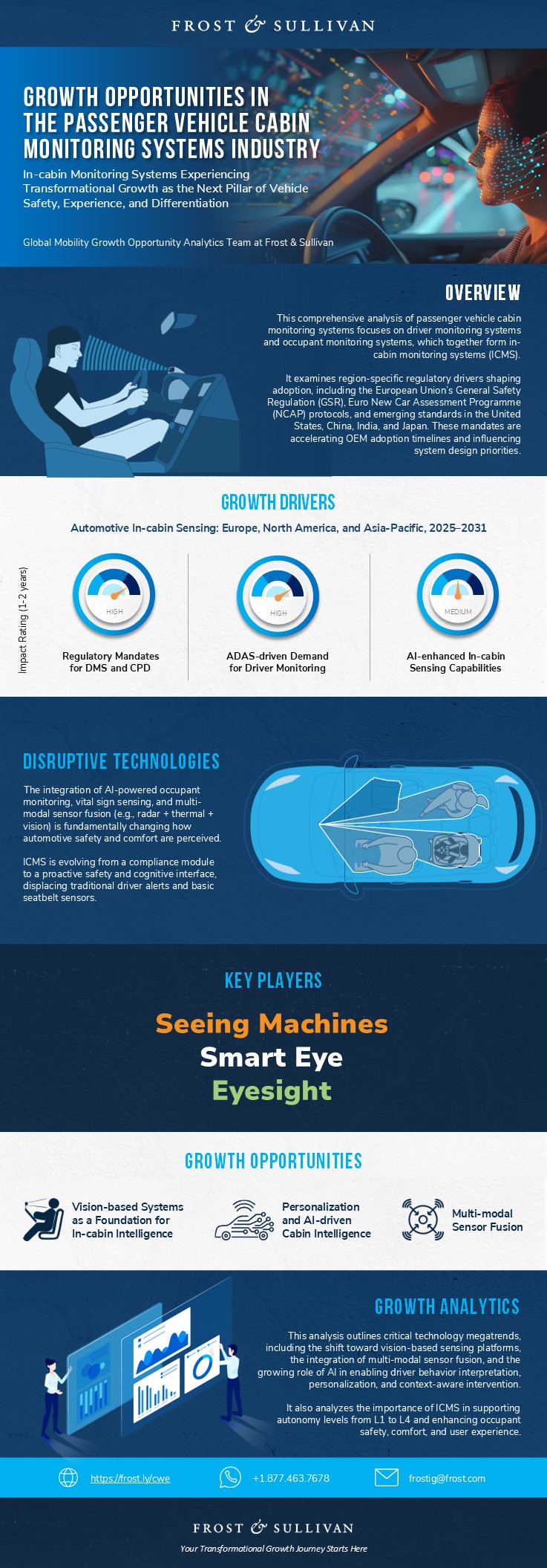
The report outlines critical technology trends, including the shift toward vision-based sensing platforms, the integration of multi-modal sensor fusion, and the growing role of AI in enabling driver behavior interpretation, personalization, and context-aware intervention. It also analyzes the importance of ICMS in supporting autonomy levels from L1 to L4 and enhancing occupant safety, comfort, and user experience. The growth forecasts are based on detailed assumptions regarding market penetration, system pricing, and adoption timelines through 2031. The study offers strategic insights for OEMs, Tier 1 suppliers, and technology firms navigating the transition from regulation-driven DMS to holistic, value-oriented ICMS solutions.
| Deliverable Type | Market Research |
|---|---|
| Industries | Automotive |
| No Index | No |
| Is Prebook | No |
| Keyword 1 | Cabin monitoring systems |
| Keyword 2 | Smart cabin technology |
| Keyword 3 | In-cabin behavioral analytics |
| Podcast | No |
| Predecessor | MFA3-01-00-00-00 |
| WIP Number | PFTQ-01-00-00-00 |
Passenger Vehicle Cabin Monitoring Systems, Global, 2024–2031
$4,950.00
Special Price $4,455.00 save 10 %