 USD
USD GBP
GBP  CNY
CNY  EUR
EUR  INR
INR  JPY
JPY  MYR
MYR  ZAR
ZAR  KRW
KRW  THB
THB 


Personal Care Packaging is Experiencing Transformational Growth Driven by Shifts in Consumer Behavior, Sustainability Demands, and Innovative Packaging Solutions
30-Jun-2026
Global
Market Research
PG9U-01-00-00-00
CM_2026_34692
Key Takeaways: Personal Care Packaging Market
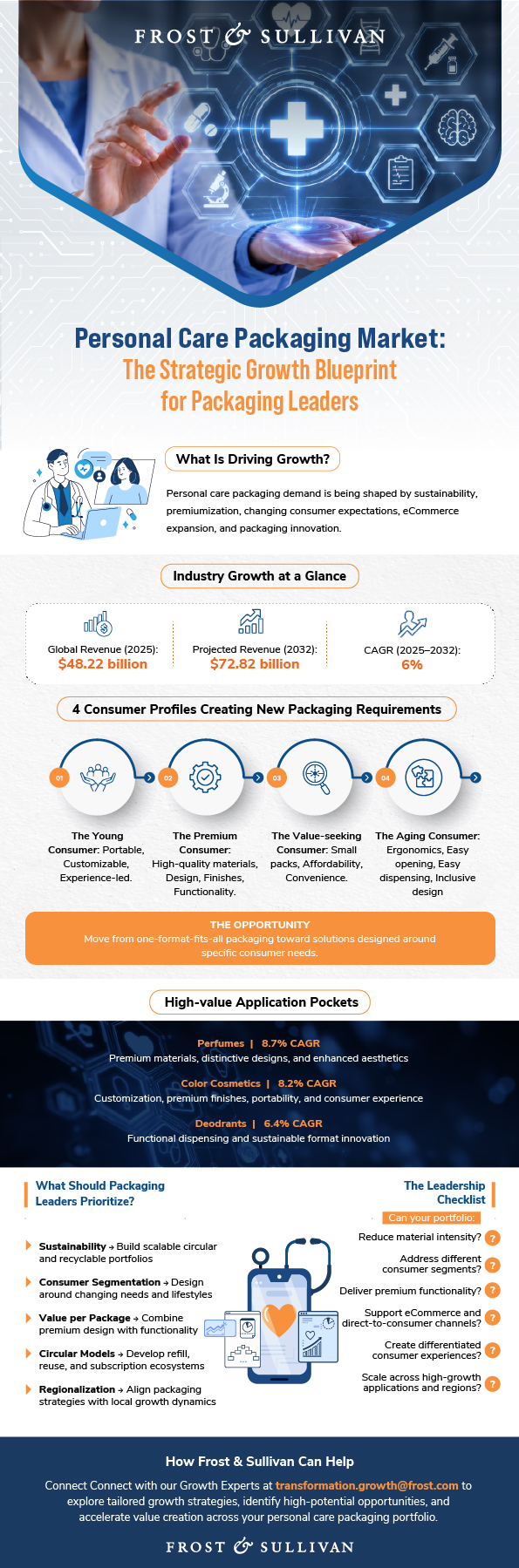
- The Personal Care Packaging Market is projected to grow from US$48.22 billion in 2025 to US$72.82 billion by 2032, registering a CAGR of 6.0% during the forecast period (2025–2032). This growth is supported by increasing global consumption of beauty and personal care products, premium packaging demand, and continuous innovation in sustainable materials.
- Global unit shipments are expected to increase from 164.68 billion packaging units in 2025 to 206.32 billion units by 2032, reflecting a CAGR of 3.3%. Higher shipment volumes will be driven by expanding skincare, haircare, oral care, fragrances, deodorants, and color cosmetics categories.
- Sustainability remains the single largest transformation factor within the Personal Care Packaging Market. Brand owners are increasingly adopting recyclable materials, mono-material packaging, refill systems, lightweight packaging, and circular economy strategies to comply with evolving environmental regulations and changing consumer expectations.
- The Beauty and Personal Care Packaging Market is witnessing strong premiumization, with brands investing in high-quality dispensing systems, airless pumps, luxury glass containers, sustainable paper packaging, and smart packaging technologies to improve consumer experience and strengthen brand differentiation.
- Flexible plastics continue to dominate high-volume packaging applications due to their cost-effectiveness and versatility, while rigid plastics, glass, metal, and paper-based packaging continue gaining traction across premium, refillable, and environmentally friendly product segments within the Cosmetic Packaging Market.
- Emerging markets across Asia-Pacific, Latin America, the Middle East, and Africa are creating new growth opportunities through rising disposable incomes, rapid urbanization, increasing beauty awareness, and expanding retail and e-commerce distribution channels.
- Digital commerce is reshaping packaging design priorities. Manufacturers are developing durable, lightweight, leak-resistant, and e-commerce-ready packaging formats capable of protecting products during shipping while enhancing shelf appeal and customer experience.
- Innovation in dispensing technologies, refill solutions, sustainable materials, digital printing, and personalization is enabling packaging suppliers to differentiate their offerings while addressing increasingly complex consumer and regulatory requirements.
Report Summary: Personal Care Packaging Market
The Personal Care Packaging Market has evolved into one of the most innovation-driven segments within the global packaging industry, where packaging serves as far more than a protective container. Modern packaging plays a central role in brand identity, consumer engagement, sustainability performance, product functionality, and purchasing decisions across numerous personal care categories. As beauty and hygiene products become increasingly premium and personalized, manufacturers are investing heavily in advanced packaging technologies that improve both product performance and customer experience.
The study evaluates the global Personal Care Packaging Market across major packaging materials including plastics, glass, metal, paper, and paperboard, while analyzing key packaging formats such as bottles, jars, tubes, pumps, dispensers, flexible pouches, aerosols, and refill systems. Demand is assessed across diverse application categories including hair care, skin care, oral care, color cosmetics, bath and shower products, deodorants, fragrances, and other personal care segments. Regional analysis covers the Americas, Europe, Asia-Pacific (APAC), and the Middle East, Africa, and South Asia (MEASA), highlighting variations in consumer behavior, regulatory requirements, packaging preferences, and material adoption.
The Beauty and Personal Care Packaging Market is undergoing structural transformation as manufacturers respond to stricter sustainability regulations, increasing demand for recyclable materials, refillable packaging systems, lightweight designs, and reduced plastic consumption. Simultaneously, premiumization, personalization, digital commerce, and smart packaging technologies are reshaping product development strategies. These trends are creating new opportunities for packaging manufacturers capable of combining innovative design, material science, regulatory compliance, and sustainable manufacturing practices.
Analyst's Words:
According to Anbuselvan Rajendran, Research Analyst, Personal Care Packaging Market, the industry is undergoing a significant transformation as packaging shifts from being a protective component to becoming a strategic tool for sustainability, consumer engagement, and brand differentiation. Future growth will be driven by premium beauty products, rising personal care consumption in emerging economies, and increasing regulatory pressure for recyclable and refillable packaging solutions. Manufacturers that successfully combine material innovation, sustainable design, and enhanced consumer experience will be well positioned to capture long-term value across the Personal Care Packaging Market.
Top 3 Growth Perspectives
- Premiumization and rising personal care consumption are accelerating demand for innovative, convenience-oriented packaging solutions that enhance product value and improve customer experience across the global Beauty and Personal Care Packaging Market.
- Refillable, recyclable, and circular packaging solutions are creating long-term competitive advantages for packaging manufacturers by helping brands achieve sustainability targets, strengthen consumer loyalty, and comply with evolving environmental regulations.
- Strategic collaboration across brands, packaging manufacturers, material suppliers, and recycling ecosystems will play a critical role in advancing sustainable packaging adoption, improving recyclability, accelerating material innovation, and meeting future regulatory and consumer expectations within the Cosmetic Packaging Market.
Market Overview & Trends: Personal Care Packaging Market
The Personal Care Packaging Market continues to expand as global demand for beauty, hygiene, and wellness products increases across both developed and emerging economies. Packaging has become a strategic differentiator that directly influences product protection, shelf visibility, brand positioning, convenience, sustainability, and overall consumer perception. Rather than serving purely as a protective solution, packaging has evolved into an essential marketing and value-creation tool throughout the Beauty and Personal Care Packaging Market.
Consumer preferences are increasingly shifting toward premium, aesthetically appealing, and environmentally responsible packaging solutions. Brands are investing in innovative dispensing technologies, refillable packaging systems, airless pumps, mono-material designs, lightweight containers, and smart labeling solutions that improve both product functionality and environmental performance. Premium packaging continues to play an important role in skincare, fragrances, luxury cosmetics, and high-end beauty products where packaging significantly influences purchasing decisions.
Sustainability has become the dominant long-term trend within the Personal Care Packaging Market. Governments across North America, Europe, and Asia-Pacific are implementing stricter regulations targeting plastic waste reduction, recyclability, extended producer responsibility (EPR), and circular economy practices. In response, manufacturers are accelerating investments in recycled plastics, paper-based alternatives, bio-based polymers, refill systems, reusable packaging formats, and lightweight material designs that reduce environmental impact without compromising product performance.
Material innovation continues to reshape the Cosmetic Packaging Market. Flexible plastics remain widely used because of their versatility, lightweight properties, and cost efficiency, particularly in developing economies. However, premium product categories increasingly utilize glass containers, aluminum packaging, premium paperboard, and advanced dispensing systems to strengthen brand differentiation while supporting sustainability objectives. Mono-material packaging is also gaining popularity because it simplifies recycling processes and helps brands comply with evolving environmental regulations.
Changing retail channels are further transforming packaging requirements. The rapid growth of e-commerce, social commerce, direct-to-consumer sales, and influencer-driven beauty brands has increased demand for packaging that provides greater durability during shipping while maintaining premium shelf appeal upon delivery. Packaging manufacturers are therefore focusing on impact resistance, leak prevention, lightweight construction, and digital customization capabilities to support omnichannel retail strategies.
Regional growth patterns continue to differ significantly. Mature markets such as North America and Europe emphasize sustainability, premiumization, refill adoption, and regulatory compliance. Meanwhile, Asia-Pacific remains the fastest-growing region, supported by rising disposable incomes, expanding middle-class populations, increasing beauty awareness, urbanization, and rapidly growing online retail channels. Latin America, the Middle East, and Africa are also experiencing healthy growth driven by demographic expansion and increasing personal care consumption.
Innovation across digital printing, smart packaging, connected packaging technologies, personalization, and circular packaging systems is expected to further transform the Personal Care Packaging Market over the forecast period. Companies capable of balancing sustainability, operational efficiency, consumer convenience, and premium design will be best positioned to capitalize on emerging opportunities throughout the global Beauty and Personal Care Packaging Market.
Scope of Analysis: Personal Care Packaging Market
The Personal Care Packaging Market study provides a comprehensive assessment of packaging materials, formats, applications, and regional demand patterns across the global personal care industry. The research evaluates how evolving consumer preferences, sustainability initiatives, premiumization, and technological innovations are influencing packaging demand and reshaping competitive dynamics between 2025 and 2032.
The study examines the consumption of personal care packaging across five primary material categories, including flexible plastics, rigid plastics, paper and paperboard, metal, and glass. Each packaging material is analyzed based on shipment volumes, revenue generation, application suitability, pricing trends, sustainability performance, and expected adoption throughout the forecast period. The analysis also evaluates the impact of recyclable materials, lightweight packaging, refill systems, and mono-material packaging designs on future market growth.
From an application perspective, the Personal Care Packaging Market covers all major beauty and hygiene product categories, including hair care, skin care, oral care, color cosmetics, bath and shower products, deodorants, perfumes, and other personal care applications such as sun care, baby care, and men's grooming products. The study analyzes packaging demand for each application while identifying changing consumer preferences, premium packaging requirements, and evolving product format trends.
Geographically, the research provides detailed coverage across the Americas, Europe, Asia-Pacific (APAC), and the Middle East, Africa, and South Asia (MEASA). Regional assessments examine consumption patterns, regulatory developments, sustainability initiatives, material preferences, pricing structures, refill adoption, and market maturity levels that influence packaging demand in each region.
The study also evaluates packaging consumption based on unit shipments, revenue, and average selling prices. Revenue figures are measured at the packaging manufacturer's level, while shipment data reflects total packaging units supplied to personal care product manufacturers and contract fillers. The research further investigates packaging size evolution, refill penetration, premium packaging adoption, and changing consumer purchasing behavior across both developed and emerging economies.
Overall, the Personal Care Packaging Market analysis delivers strategic insights into material innovation, packaging technology, sustainability transitions, regional demand variations, and competitive developments that will shape the future of the Beauty and Personal Care Packaging Market through 2032.
Market Segmentation Analysis: Personal Care Packaging Market
The Personal Care Packaging Market is segmented based on packaging type, application, and geographic region, allowing manufacturers and brand owners to align packaging strategies with evolving consumer preferences, sustainability requirements, and regional market dynamics. Each segment demonstrates distinct growth patterns driven by material innovation, premiumization, convenience, and regulatory developments.
By Packaging Type
Packaging materials remain one of the most important competitive differentiators within the Personal Care Packaging Market. Flexible plastic packaging continues to dominate global unit shipments due to its lightweight structure, cost efficiency, durability, and versatility across products such as shampoos, lotions, refill pouches, and travel-size packaging. Flexible packaging also supports efficient transportation and lower material consumption.
Rigid plastic packaging remains widely adopted for bottles, jars, pumps, dispensers, and containers used across skincare, haircare, oral care, and body care products. Manufacturers continue to increase the use of recycled plastics and mono-material designs to improve recyclability and reduce environmental impact.
Glass packaging maintains a strong presence within premium skincare, luxury fragrances, and cosmetic products where premium aesthetics, product preservation, and brand perception are critical purchasing factors. Meanwhile, metal packaging continues to serve aerosol products, deodorants, hair sprays, and specialty applications requiring durability and product protection.
Paper and paperboard packaging is experiencing rapid growth as sustainability initiatives encourage brands to reduce plastic consumption. Cartons, secondary packaging, and fiber-based packaging solutions are increasingly replacing traditional plastic packaging across several personal care categories.
By Application
Application-based demand represents one of the strongest growth drivers within the Beauty and Personal Care Packaging Market. Hair care remains one of the largest application segments, utilizing bottles, pumps, tubes, refill pouches, and dispensers for shampoos, conditioners, mousses, and hair treatments.
Skin care continues to experience significant expansion due to increasing global demand for moisturizers, facial serums, sunscreens, anti-aging products, facial masks, and body lotions. Premium packaging formats such as airless pumps, glass jars, and refillable containers are becoming increasingly common within this segment.
The oral care segment includes toothpaste tubes, mouthwash bottles, dental care packaging, and specialty oral hygiene products, where convenience, hygiene, and product protection remain primary considerations.
Within the Cosmetic Packaging Market, color cosmetics require highly differentiated packaging solutions including lipstick cases, compact containers, mascara tubes, eyeliner packaging, foundation bottles, and nail polish containers. Premium aesthetics, innovative dispensing systems, and brand differentiation remain particularly important in this segment.
Other major applications include bath and shower products, deodorants, perfumes, sun care, baby care, and men's grooming, each requiring specialized packaging formats designed for product protection, consumer convenience, and visual appeal.
By Region
Regional demand varies considerably across the Personal Care Packaging Market. North America and Europe emphasize sustainability, refill adoption, premiumization, recyclable materials, and regulatory compliance. Brands operating in these regions increasingly invest in circular packaging solutions and environmentally responsible materials.
Asia-Pacific represents the fastest-growing regional market, driven by rapid urbanization, increasing disposable incomes, expanding middle-class populations, rising beauty awareness, and strong growth in e-commerce. Countries such as China, India, South Korea, Japan, and Southeast Asian nations continue to generate significant opportunities across both mass-market and premium beauty packaging.
The Americas, MEASA, and other emerging markets continue benefiting from demographic expansion, increasing personal care consumption, expanding retail infrastructure, and rising demand for affordable yet attractive packaging solutions.
Overall, diversified material innovation, expanding product portfolios, sustainability-driven packaging transitions, and regional customization strategies will continue shaping future growth across the Personal Care Packaging Market, while creating significant opportunities throughout the broader Beauty and Personal Care Packaging Market and Cosmetic Packaging Market.
Revenue & Spending Forecast: Personal Care Packaging Market
The Personal Care Packaging Market is expected to maintain strong and consistent growth throughout the forecast period as global demand for beauty, skincare, hygiene, and wellness products continues to expand. Packaging is increasingly viewed as a strategic differentiator that enhances product protection, brand identity, consumer convenience, sustainability performance, and purchasing experience. These evolving market dynamics are creating long-term revenue opportunities across both mature and emerging economies.
According to the study, the Personal Care Packaging Market is projected to grow from US$48.22 billion in 2025 to approximately US$72.82 billion by 2032, representing a compound annual growth rate (CAGR) of 6.0% during the forecast period. Alongside revenue expansion, global packaging unit shipments are expected to increase from 164.68 billion units in 2025 to 206.32 billion units by 2032, reflecting a volume CAGR of 3.3%. Revenue growth is expected to outpace shipment growth as manufacturers increasingly focus on premium packaging formats, sustainable materials, value-added dispensing technologies, and customized packaging solutions.
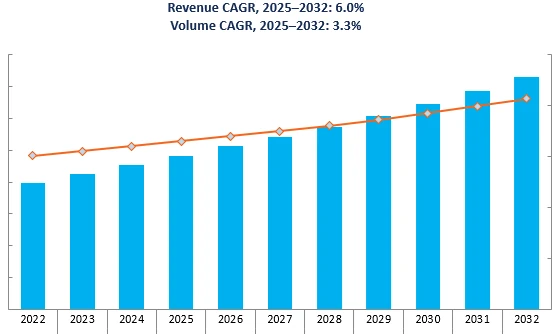
Growth will be supported by rising global consumption of personal care products across skincare, hair care, cosmetics, oral care, fragrances, deodorants, and bath and shower products. Increasing disposable incomes, urbanization, digital commerce, and expanding beauty awareness are driving higher packaging demand, particularly across Asia-Pacific, Latin America, and other emerging markets. At the same time, premium beauty brands continue investing in aesthetically appealing, functional, and environmentally responsible packaging to strengthen brand differentiation.
The transition toward refillable packaging, recyclable materials, lightweight designs, mono-material packaging, and post-consumer recycled (PCR) plastics is also reshaping revenue generation within the Personal Care Packaging Market. While these sustainability initiatives may reduce material intensity in certain packaging formats, they create new opportunities for higher-value packaging innovations that command premium pricing.
Within the broader Beauty and Personal Care Packaging Market, demand for premium dispensing systems, airless pumps, refill packs, smart packaging technologies, and luxury cosmetic containers is expected to generate higher average selling prices. Consequently, manufacturers capable of combining sustainability, functionality, design innovation, and cost efficiency will be well positioned to capture future growth opportunities across both the Cosmetic Packaging Market and the global Personal Care Packaging Market.
Growth Drivers: Personal Care Packaging Market
Several long-term structural trends are accelerating expansion within the Personal Care Packaging Market, creating sustained opportunities for packaging manufacturers, material suppliers, converters, and brand owners. Consumer lifestyle changes, sustainability initiatives, premium beauty products, digital commerce, and packaging innovation are collectively transforming packaging demand across every major application segment.
One of the strongest growth drivers is the continuous increase in global personal care product consumption. Rising awareness of skincare, haircare, grooming, hygiene, and wellness products is expanding the overall addressable market for packaging solutions. Social media influence, digital marketing, beauty influencers, and growing consumer spending on premium personal care products continue to stimulate packaging demand across multiple product categories.
Another significant growth driver is the increase in per capita spending on beauty and personal care products. Consumers are purchasing a wider variety of products while seeking greater convenience, premium aesthetics, and improved user experiences. These changing purchasing behaviors encourage manufacturers to develop innovative packaging formats featuring pumps, dispensers, refill systems, airless containers, and customized designs that improve functionality and strengthen brand differentiation.
Population growth and rapid urbanization are also contributing to sustained market expansion. Emerging economies across Asia-Pacific, Latin America, the Middle East, and Africa continue experiencing increasing demand for packaged personal care products as disposable incomes rise and organized retail channels expand. These demographic trends create substantial opportunities for both mass-market and premium packaging manufacturers.
Packaging innovation remains another major catalyst within the Beauty and Personal Care Packaging Market. Manufacturers are investing heavily in lightweight packaging, mono-material designs, recyclable plastics, refillable systems, bio-based materials, and smart packaging technologies that improve sustainability while enhancing consumer convenience. Regulatory pressure to reduce plastic waste is accelerating adoption of environmentally responsible packaging solutions across both developed and developing markets.
The study also highlights that pack size diversification continues to influence packaging demand. Smaller packaging formats remain popular in price-sensitive emerging markets, while premium larger-size and refill packaging are gaining traction in developed economies. This diversification enables manufacturers to serve multiple consumer segments while optimizing production efficiency.
Overall, the combination of expanding consumer demand, premiumization, sustainability initiatives, material innovation, digital commerce, and regional market expansion is expected to support robust long-term growth across the Personal Care Packaging Market, while strengthening opportunities throughout the broader Cosmetic Packaging Market and Beauty and Personal Care Packaging Market.
Growth Restraints: Personal Care Packaging Market
Despite its positive long-term outlook, the Personal Care Packaging Market faces several structural challenges that may moderate growth over the forecast period. Increasing environmental regulations, changing consumer preferences, material cost volatility, and evolving packaging requirements are forcing manufacturers to rethink conventional packaging strategies while balancing sustainability, performance, and profitability.
One of the most significant restraints is the growing regulatory pressure surrounding plastic packaging. Governments across Europe, North America, and several Asia-Pacific countries continue implementing stricter regulations targeting single-use plastics, recyclability standards, extended producer responsibility (EPR), and packaging waste reduction. These policies are compelling manufacturers to redesign packaging formats using recyclable, mono-material, and lightweight alternatives. Although these initiatives support long-term sustainability goals, they increase development costs and create operational complexity for packaging suppliers.
Another important challenge is the rapid adoption of refillable and reusable packaging systems. Consumers are increasingly embracing refill solutions that reduce packaging waste and improve environmental performance. While refill models create opportunities for innovative packaging providers, they also reduce demand for traditional single-use packaging, particularly within premium skincare, personal hygiene, and cosmetic product categories. As refill infrastructure expands, manufacturers must adapt their product portfolios to maintain long-term competitiveness.
The Personal Care Packaging Market also faces continued raw material price volatility and supply chain disruptions. Fluctuating prices for plastics, aluminum, glass, paperboard, and specialty resins directly affect manufacturing costs and profit margins. Global geopolitical uncertainties, transportation constraints, energy price fluctuations, and disruptions in raw material availability continue to challenge packaging manufacturers attempting to maintain stable production and competitive pricing.
Another restraint affecting the broader Beauty and Personal Care Packaging Market is the growing complexity of balancing sustainability with product performance. Brands increasingly demand packaging that is lightweight, aesthetically appealing, durable, refillable, recyclable, and compatible with high-speed manufacturing processes. Achieving all these objectives simultaneously often requires significant investments in material science, production technology, and product redesign, creating barriers for smaller manufacturers.
Furthermore, consumer expectations continue evolving rapidly within the Cosmetic Packaging Market, requiring frequent packaging innovation, customization, and shorter product development cycles. Companies unable to keep pace with changing market trends, regulatory compliance, and sustainability expectations may experience declining competitiveness.
Overall, while these restraints create operational and financial challenges, they are also encouraging greater innovation throughout the Personal Care Packaging Market. Manufacturers capable of developing cost-effective, sustainable, and high-performance packaging solutions will be better positioned to overcome these challenges and capitalize on future growth opportunities.
Competitive Landscape: Personal Care Packaging Market
The Personal Care Packaging Market is highly competitive, featuring a diverse ecosystem of global packaging manufacturers, material suppliers, converters, dispensing technology specialists, and customized packaging solution providers. Competition extends far beyond pricing, with companies increasingly differentiating themselves through innovation, sustainability, design capabilities, material performance, manufacturing efficiency, and customer collaboration.
The market consists of more than 100 competitors worldwide, creating a fragmented yet innovation-driven industry. Companies compete across multiple packaging formats, including flexible packaging, rigid plastic packaging, glass containers, metal packaging, paper-based packaging, pumps, dispensers, jars, bottles, tubes, aerosol containers, refill systems, and customized premium packaging. Growing consumer expectations for convenience, sustainability, and premium aesthetics continue driving continuous product innovation throughout the industry.
Leading participants in the Personal Care Packaging Market include Amcor plc, Aptar Group, Albéa Group, Silgan Holdings, and Gerresheimer AG, all of which possess extensive global manufacturing footprints, advanced packaging technologies, and long-standing partnerships with multinational beauty and personal care brands. Other notable competitors include International Paper, Coveris, ProAmpac, WestRock, SCG Packaging, ITC Packaging and Printing Business, UFlex Limited, TNPL, EPL Limited, Huhtamaki, ALPLA, Ball Corporation, Mondi Group, Piramal Glass, Viva Packaging, Alltub, Tubex, Graham Packaging, and Glenroy.
Competition is largely driven by price competitiveness, product performance, sustainability, innovation, and customer relationships. Manufacturers continue investing heavily in recyclable materials, mono-material structures, refillable packaging, lightweight solutions, digital printing, smart packaging technologies, and premium dispensing systems that improve product functionality while supporting environmental goals. Increasing demand for customized packaging solutions also encourages closer collaboration between packaging suppliers and personal care brands during product development.
The Beauty and Personal Care Packaging Market serves numerous end-user applications, including hair care, skincare, oral care, fragrances, deodorants, bath and shower products, and color cosmetics. Each application requires specialized packaging formats designed to preserve product integrity, enhance user convenience, strengthen shelf appeal, and comply with regulatory requirements. As a result, suppliers with broad product portfolios and strong technical expertise maintain significant competitive advantages.
Distribution strategies generally rely on direct sales and distributor networks, allowing manufacturers to efficiently serve both multinational consumer goods companies and regional personal care brands. Long-term supply agreements, integrated product development capabilities, and global manufacturing networks continue strengthening competitive positioning across international markets.
Another important competitive trend is the integration of circular economy principles into packaging development. Companies are increasingly investing in post-consumer recycled (PCR) materials, bio-based polymers, refill systems, reusable packaging formats, lightweight structures, and improved recyclability to meet tightening environmental regulations and evolving consumer expectations. Digitalization, smart packaging, and AI-supported package design are also emerging as important competitive differentiators.
Research Overview
Scope of Analysis
Segmentation
Packaging Type and Applications Matrix
Why is it Increasingly Difficult to Grow?
The Strategic Imperative 8™
The Impact of the Top 3 Strategic Imperatives on the Personal Care Packaging Industry
Ecosystem Overview
Value Chain—Plastics (Flexible & Rigid)
Value Chain—Paper and Paperboards
Value Chain—Glass
Value Chain—Metal
Competitive Environment
Key Competitors
Ink Market in Personal Care Packaging
Growth Metrics
Growth Drivers
Growth Driver Analysis
Growth Restraints
Growth Restraint Analysis
Forecast Considerations
Revenue and Unit Shipment Forecast
Revenue and Volume Forecast Analysis
Revenue Forecast by Region
Unit Shipment Forecast by Region
Forecast Analysis by Region
Revenue Forecast by Packaging Type
Unit Shipment Forecast by Packaging Type
Forecast Analysis by Packaging Type
Revenue Forecast by Application Type
Unit Shipment Forecast by Application Type
Forecast Analysis by Application Type
Pricing Trends and Forecast
Pricing Trends and Forecast Analysis
Revenue Share
Revenue Share Analysis
Mergers and Acquisitions
Growth Metrics
Segment Characteristics and Overview
Forecast Considerations—Hair Care
Forecast Considerations Explanation—Hair Care
Revenue and Unit Shipment Forecast—Hair Care
Revenue and Volume Forecast Analysis—Hair Care
Consumption Forecast by Product Type—Hair Care
Packaging Size Shift Forecast by Unit Size—Hair Care
Revenue Forecast by Region—Hair Care
Unit Shipment Forecast by Region—Hair Care
Forecast Analysis by Region—Hair Care
refill Impact Packaging Forecast by Region—Hair Care
Revenue Forecast by Packaging Type—Hair Care
Unit Shipment Forecast by Packaging Type—Hair Care
Forecast Analysis by Packaging Type—Hair Care
Growth Metrics—Skin Care
Segment Characteristics and Overview—Skin Care
Forecast Considerations—Skin Care
Forecast Considerations Explanation—Skin Care
Revenue and Unit Shipment Forecast—Skin Care
Revenue and Volume Forecast Analysis—Skin Care
Consumption Forecast by Product Type—Skin Care
Packaging Size Shift Forecast by Unit Size—Skin Care
Revenue Forecast by Region—Skin Care
Unit Shipment Forecast by Region—Skin Care
Forecast Analysis by Regions—Skin Care
Refill Impact Packaging Forecast by Region—Skin Care
Revenue Forecast by Packaging Type—Skin Care
Unit Shipment Forecast by Packaging Type—Skin Care
Forecast Analysis by Packaging Type—Skin Care
Growth Metrics—Oral Care
Segment Characteristics and Overview—Oral Care
Forecast Considerations—Oral Care
Forecast Considerations Explanation—Oral Care
Revenue and Unit Shipment Forecast—Oral Care
Revenue and Volume Forecast Analysis—Oral Care
Consumption Forecast by Product Type—Oral Care
Packaging Size Shift Forecast by Unit Size—Oral Care
Revenue Forecast by Region—Oral Care
Unit Shipment Forecast by Region—Oral Care
Forecast Analysis by Regions—Oral Care
Refill Impact Packaging Forecast by Region—Oral Care
Revenue Forecast by Packaging Type—Oral Care
Unit Shipment Forecast by Packaging Type—Oral Care
Forecast Analysis by Packaging Type—Oral Care
Growth Metrics—Color Cosmetics
Segment Characteristics and Overview—Color Cosmetics
Forecast Considerations—Color Cosmetics
Forecast Considerations Explanation—Color Cosmetics
Revenue and Unit Shipment Forecast—Color Cosmetics
Revenue and Volume Forecast Analysis—Color Cosmetics
Consumption Forecast by Product Type—Color Cosmetics
Packaging Size Shift Forecast by Unit Size—Color Cosmetics
Revenue Forecast by Region—Color Cosmetics
Unit Shipment Forecast by Region—Color Cosmetics
Forecast Analysis by Regions—Color Cosmetics
Refill Impact Packaging Forecast by Region—Color Cosmetics
Revenue Forecast by Packaging Type—Color Cosmetics
Unit Shipment Forecast by Packaging Type—Color Cosmetics
Forecast Analysis by Packaging Type—Color Cosmetics
Growth Metrics—Bath and Shower
Segment Characteristics and Overview—Bath and Shower
Forecast Considerations—Bath and Shower
Forecast Considerations Explanation—Bath And Shower
Revenue and Unit Shipment Forecast—Bath and Shower
Revenue and Volume Forecast Analysis—Bath and Shower
Consumption Forecast by Product Type—Bath and Shower
Packaging Size Shift Forecast by Unit Size—Bath and Shower
Revenue Forecast by Region—Bath and Shower
Unit Shipment Forecast by Region—Bath and Shower
Forecast Analysis by Regions—Bath and Shower
Refill Impact Packaging Forecast by Region—Bath and Shower
Revenue Forecast by Packaging Type—Bath and Shower
Unit Shipment Forecast by Packaging Type—Bath and Shower
Forecast Analysis by Packaging Type—Bath and Shower
Growth Metrics—Deodorants
Segment Characteristics and Overview—Deodorants
Forecast Considerations—Deodorants
Forecast Considerations Explanation—Deodorants
Revenue and Unit Shipment Forecast—Deodorants
Revenue and Volume Forecast Analysis—Deodorants
Frequently Asked Questions (FAQs) – Personal Care Packaging Market
1. What is the Personal Care Packaging Market?
The Personal Care Packaging Market comprises packaging solutions used for beauty, cosmetics, skincare, haircare, oral care, fragrances, deodorants, bath and shower products, and other personal care items. The market includes flexible plastics, rigid plastics, glass, metal, paper and paperboard packaging, along with bottles, tubes, jars, pumps, dispensers, aerosol containers, and refillable packaging systems designed to protect products while enhancing brand appeal and consumer convenience.
2. How large is the Personal Care Packaging Market?
The global Personal Care Packaging Market is projected to grow from approximately US$48.22 billion in 2025 to US$72.82 billion by 2032, registering a CAGR of 6.0%. During the same period, global packaging shipments are expected to increase from 164.68 billion units to approximately 206.32 billion units.
3. What factors are driving growth in the Personal Care Packaging Market?
Market growth is driven by rising global consumption of beauty and personal care products, premiumization, expanding e-commerce, increasing disposable incomes, urbanization, demand for sustainable packaging, innovation in dispensing technologies, and the growing popularity of refillable and recyclable packaging solutions.
4. Which packaging materials are commonly used in the Personal Care Packaging Market?
The market primarily utilizes flexible plastics, rigid plastics, paper and paperboard, glass, and metal packaging materials. Flexible plastics dominate high-volume applications, while glass and metal are widely used for premium cosmetics and fragrances. Paper-based packaging is gaining popularity as brands pursue sustainability goals.
5. Which application segments generate the highest demand in the Beauty and Personal Care Packaging Market?
Major application segments include skincare, haircare, oral care, color cosmetics, bath and shower products, fragrances, deodorants, men's grooming, baby care, and sun care products. Skincare and haircare continue to account for a significant share of packaging demand due to their high product volumes and increasing premiumization.
6. Who are the leading companies in the Personal Care Packaging Market?
Leading companies include Amcor plc, Aptar Group, Albéa Group, Silgan Holdings, Gerresheimer AG, International Paper, Coveris, ProAmpac, WestRock, SCG Packaging, UFlex Limited, Huhtamaki, ALPLA, Ball Corporation, Mondi Group, Piramal Glass, Graham Packaging, Alltub, Tubex, and EPL Limited. These companies compete through innovation, sustainability, product quality, and global manufacturing capabilities.
7. What challenges are affecting the Cosmetic Packaging Market?
Major challenges include increasing environmental regulations on plastic packaging, raw material price volatility, growing adoption of refillable packaging that reduces single-use packaging demand, supply chain disruptions, and the need to balance sustainability, product performance, premium aesthetics, and cost efficiency.
8. How is sustainability transforming the Personal Care Packaging Market?
Sustainability is driving the adoption of recyclable materials, post-consumer recycled (PCR) plastics, mono-material packaging, lightweight designs, refill systems, reusable packaging, bio-based materials, and circular economy initiatives. These innovations help brands reduce environmental impact while complying with evolving global packaging regulations.
9. Which region is expected to experience the fastest growth in the Personal Care Packaging Market?
Asia-Pacific is expected to be the fastest-growing regional market due to rising disposable incomes, rapid urbanization, expanding middle-class populations, increasing beauty awareness, and strong growth in organized retail and e-commerce. North America and Europe continue to lead in premium and sustainable packaging innovation.
10. What is the future outlook for the Personal Care Packaging Market?
The future outlook for the Personal Care Packaging Market remains highly positive. Continued innovation in sustainable materials, premium packaging, refillable systems, smart packaging technologies, and digital printing, combined with rising global demand for beauty and personal care products, is expected to drive steady market growth through 2032. Companies investing in circular packaging solutions, consumer-centric design, and material innovation are expected to gain a competitive advantage.
Speak directly with our analytics experts for tailored recommendations.
Recent related Performance Materials research
09 Oct 2026 | Global | Technology Research
Innovations in Transparent Ceramics, Biomaterials, Compostable Bioplastics, Graphite, Silica Foam, Aerogels, and Other Advanced Materials for Diverse Applications
This issue of High-Tech Materials Technology Opportunity Engine (TOE) profiles significant advances in high-tech materials for various industrial applications. The featured innovations include Large-sized Transparent and Bonded Ceramics for High-Power Laser Systems, High-Strength Transparent Alumina...
02 Oct 2026 | Global | Technology Research
Innovations in Nanotechnology Including Nanocoatings, Nanolithography, Carbon Nanotubes, Nanofluids, Graphene, Ceramic Aerogels, Nanocatalysts, and Nanocomposites
This issue of the Nanotechnology Opportunity Engine profiles significant advances in nanotechnology for various industrial applications. The featured innovations include Sulfate-Free CNCs for Versatile Applications, Contact-Active Antimicrobial Nanocoating With Broad-Spectrum Protection, Nanoimprint...
21 Sep 2026 | Global | Strategic Imperatives
Top 10 Strategic Imperatives in the Composites Market, 2026
The composites industry is undergoing a significant transformation as demand for lightweight, high-performance, and sustainable materials accelerates across transportation, aerospace, marine, construction, renewable energy, and industrial applications. Advances in material science, automation, digit...
18 Sep 2026 | Global | Technology Research
Innovations in Surface Technologies for Automotive Coatings, Protective Coatings, Oleophobic Coatings, Plasma Coatings, Icephobic Coatings, and Others
This edition of the Advanced Coating & Surface Technology Opportunity Engine profiles significant advances in advanced coatings and surface treatments for various industrial applications. The featured innovations include Ultra-Black Nanocarbon Coatings for Next-Generation Automotive Surface Finishes...
11 Sep 2026 | Global | Technology Research
Innovations in Advanced Materials, Sustainable Polymerics, Functional Composites, Bio-based Materials, Quantum Materials, Photonics, and Clean Energy Technologies
This issue of High-Tech Materials Technology Opportunity Engine (TOE) profiles significant advances in high-tech materials for various industrial applications. The featured innovations include Recyclable Liquid Thermoplastic Resins for Advanced Composite Manufacturing, Thermoplastic Polyurethane for...
Purchase includes:
- Report download
- Growth Dialog™ with our experts
Growth Dialog™
A tailored session with you where we identify the:- Strategic Imperatives
- Growth Opportunities
- Best Practices
- Companies to Action
Impacting your company's future growth potential.
The market is analyzed across key material segments, like plastics, glass, metal, and paper-based packaging, alongside detailed format-level insights covering bottles, tubes, jars, pumps, dispensers, flexible packaging, and pack-size evolution trends. Demand is evaluated across major application areas, such as hair care, skin care, oral care, color cosmetics, bath & shower, deodorants, perfumes, and others (sun care, baby care, men’s grooming, etc.). The report further provides comprehensive regional coverage across the Americas, Europe, Asia-Pacific, and the Middle East, Africa, and South Asia (MEASA).
The industry is undergoing a structural transformation driven by increasing sustainability pressures, evolving consumer preferences, and regulatory mandates aimed at plastic reduction and recyclability. Key trends such as refillable packaging models, lightweighting, mono-material solutions, and the integration of smart and functional packaging features are reshaping innovation priorities. At the same time, premiumization and personalization trends are elevating the role of packaging in enhancing consumer experience and brand value.
This study highlights how companies are navigating cost pressures, supply chain complexities, and material substitution challenges while investing in circular economy initiatives and advanced packaging technologies. It further identifies the strategic imperatives and high-impact growth opportunities that will define competitive positioning in the personal care packaging market. The base year is 2025, and the forecast period is from 2026 to 2032.
| Deliverable Type | Market Research |
|---|---|
| Industries | Chemicals and Materials |
| No Index | No |
| Is Prebook | No |
| Keyword 1 | Personal Care Packaging Market Report |
| Keyword 2 | Personal Care Packaging Industry Analysis |
| Keyword 3 | Personal Care Packaging Market Forecast |
| Podcast | No |
| Predecessor | MFA7-01-00-00-00 |
| WIP Number | PG9U-01-00-00-00 |