 USD
USD GBP
GBP  CNY
CNY  EUR
EUR  INR
INR  JPY
JPY  MYR
MYR  ZAR
ZAR  KRW
KRW  THB
THB 


Residential Heat Pumps Industry, Global, 2025–2035
The Electrification and Decarbonization of Residential Heating are Driving Transformational Growth
09-Sep-2026
Global
Market Research
PLM4-01-00-00-00
EG_2026_34873
Key Takeaways: Residential Heat Pump Market
- The residential heat pump market is projected to expand from 11.4 million units in 2025 to 21.2 million units by 2035, reflecting sustained electrification of residential heating.
- Market revenue is forecast to increase from $43.86 billion in 2025 to $113.79 billion by 2035, representing a 10.0% CAGR.
- Unit shipments are expected to grow at a 6.4% CAGR between 2025 and 2035, indicating strong long-term adoption across residential applications.
- APAC was the largest region in terms of sales in 2025, while Europe and North America are expected to record higher growth rates during the forecast period.
- Government subsidies, tax incentives, financing schemes, and fossil-fuel phase-out policies are accelerating heat pump adoption.
- Energy efficiency, lower operating costs, decarbonization, and integration with renewable electricity are strengthening the value proposition of residential heat pumps.
- High installation costs, limited skilled installers, customer awareness gaps, electricity-grid requirements, and challenges associated with retrofitting older homes remain important adoption barriers.
- The competitive landscape is led by Daikin, Mitsubishi Electric, Carrier, NIBE, and Vaillant, with the top five accounting for 31.9% of 2025 revenue.
Report Summary: Residential Heat Pump Market
The residential heat pump market is undergoing significant transformation as households, governments, and utilities increasingly prioritize heating electrification, energy efficiency, and decarbonization. According to the research, the global market is expected to reach 21.2 million units by 2035, compared with 11.4 million units in 2025. Market revenue is projected to rise from $43.86 billion in 2025 to $113.79 billion by 2035, supported by increasing adoption of efficient electric heating technologies.
The study excludes heat pumps used for air conditioning and focuses on residential heating applications. APAC represented the largest region by sales in 2025, while Europe and North America are expected to demonstrate stronger growth rates. The market is segmented by technology into air-source and ground-source heat pumps, with coverage across North America, Europe, and APAC and selected priority countries.
Growth is being supported by government incentives, stricter regulations, fossil-fuel heating phase-outs, energy-efficiency requirements, and rising interest in household decarbonization. Heat pumps can provide higher energy efficiency than conventional heating systems and can reduce heating-related energy consumption when appropriately deployed.
However, adoption remains constrained by high upfront installation costs, especially in existing properties, limited availability of skilled workers, inadequate customer awareness, policy uncertainty, and the suitability of some older or poorly insulated homes. The market is therefore moving toward broader installer networks, financing mechanisms, digital integration, and new service-based models that can reduce adoption barriers.
Analyst Words: Residential Heat Pump Market
Neha Tatikota, Industry Analyst, Frost & Sullivan, highlights that the residential heat pump industry is being reshaped by electrification, decarbonization, and changing consumer expectations. Her assessment indicates that policy support, energy-efficiency requirements, and the transition away from fossil-fuel heating are creating a stronger foundation for market expansion. At the same time, adoption is not uniform because installation economics, housing characteristics, electricity infrastructure, and installer availability vary considerably between markets. The analyst perspective emphasizes that sustained growth will increasingly depend on expanding skilled installation capacity, improving customer understanding, and developing solutions that address the economics of retrofitting existing homes. These factors will be particularly important as heat pumps move from early adoption toward broader residential penetration.
Market Overview & Trends: Residential Heat Pump Market
The residential heat pump market is transitioning from a specialized heating technology toward a mainstream component of residential electrification strategies. Heat pumps use electricity to provide efficient heating and can support decarbonization when powered by increasingly renewable electricity. Their efficiency advantages and potential to lower energy consumption are encouraging adoption in both new construction and replacement applications.
A major trend is the increasing alignment between heat pump deployment and government policy. Subsidies, tax incentives, financing programs, and regulatory measures are improving the economic attractiveness of heat pumps. Policies such as the UK's Boiler Upgrade Scheme, France's MaPrimeRénov, and Germany's BEG program illustrate how financial support can reduce adoption barriers.
Another important trend is the gradual phase-out of fossil-fuel heating. Governments are introducing restrictions on new gas and oil heating installations, particularly in new buildings. Although the impact varies by market and policy implementation, these measures are strengthening the long-term position of electric heating technologies.
Energy efficiency and household energy costs are also becoming increasingly important. Heat pumps can provide higher efficiency than traditional heating systems, potentially lowering energy consumption and heating bills. Their ability to improve building energy ratings further strengthens their appeal.
The market is also seeing the expansion of installer networks and new business models, including heat-as-a-service offerings. Digital and smart-home integration, improved system performance, and increasing investment in manufacturing capacity are supporting market development.
However, the transition remains uneven. Natural gas continues to supply a substantial share of residential heating in major markets, while electricity-price structures can affect the economics of heat pump operation. Retrofit complexity, high installation costs, limited skilled labor, and consumer familiarity with conventional boilers continue to influence adoption decisions.
Scope of Analysis: Residential Heat Pump Market
The study provides a global analysis of the residential heat pump market covering the 2023–2035 study period, with 2025 as the base year and 2026–2035 as the forecast period. The analysis focuses specifically on heat pumps used for residential heating and excludes sales associated with air-conditioning applications.
Market revenue is defined as annual residential heat pump sales multiplied by the average cost of the heat pumps. The revenue calculation is based on equipment pricing and unit sales and does not include installation and ancillary fees. This distinction is important because installation and associated services can represent a significant additional expenditure for households.
The geographical scope covers North America, Europe, and APAC, with detailed consideration of 25 priority countries. These include the United States, Canada, Japan, China, France, Germany, Italy, the United Kingdom, Sweden, Denmark, Norway, Finland, Belgium, the Netherlands, Spain, Switzerland, Poland, Portugal, Austria, the Czech Republic, Lithuania, Estonia, Ireland, Hungary, and Slovakia.
Technology segmentation covers air-source and ground-source heat pumps. The study evaluates residential adoption trends, unit shipments, revenue development, regional opportunities, policy influences, and market dynamics across the forecast period.
Market Segmentation Analysis: Residential Heat Pump Market
The residential heat pump market is segmented into Air-Source Heat Pumps (ASHPs) and Ground-Source Heat Pumps (GSHPs). The two technologies differ in their heat sources, system configurations, installation requirements, efficiency characteristics, and suitability for residential applications.
Air-Source Heat Pumps (ASHPs)
ASHPs extract heat from outdoor air and transfer it into buildings for space heating. During cooling operation, the refrigeration cycle reverses to reject heat from the building to the outdoor environment. Typical heating COPs range from approximately 2 to 4, depending on outdoor temperature and operating conditions.
The technology is primarily divided into air-to-air (ATA) and air-to-water (ATW) configurations. ATA systems transfer heat directly to indoor air, while ATW systems transfer heat to a hydronic system for space heating and/or domestic hot water. ASHPs are also available in monobloc and split configurations. Monobloc systems contain the refrigeration circuit primarily within the outdoor unit, whereas split systems divide the refrigeration circuit between the indoor and outdoor units.
ASHPs offer several advantages for residential users, including no on-site combustion emissions, simple operation, lower installation costs, and high efficiency under moderate outdoor temperatures. However, their performance can be affected by cold weather. Frost formation on outdoor units can reduce performance, COP varies with ambient temperature, and supplementary heating may be required under very cold operating conditions.
Ground-Source Heat Pumps (GSHPs)
GSHPs exchange heat with the ground, groundwater, or a nearby water source. In heating mode, they extract low-grade heat and upgrade it for space heating. Typical heating COPs are approximately 3 to 5, with performance generally more stable than ASHPs because ground temperatures fluctuate less than outdoor air temperatures.
GSHP configurations include water-to-air and water-to-water systems. Water-to-air systems transfer heat to an indoor air distribution system, while water-to-water systems transfer heat to a hydronic system used for space heating or domestic hot water.
GSHP installations can use horizontal or vertical systems. Horizontal systems typically require trenches and greater land availability, while vertical systems use boreholes and can be better suited to space-constrained properties. Open-loop systems use groundwater as the heat-exchange medium.
The main advantages of GSHPs include high efficiency, strong energy-saving potential, higher COP than ASHPs, stable ground heat sources, reliable operation, and more consistent performance in extreme weather. However, they require careful assessment of local geology and site conditions, may require substantial land or drilling, can experience reduced performance when ground loops are undersized or thermally imbalanced, and generally involve higher installation costs.
Comparative Technology Outlook
Within the residential heat pump market, ASHPs offer advantages where lower installation costs, simpler deployment, and ease of operation are priorities. GSHPs provide higher and more stable efficiency but require greater site assessment, land availability, drilling, and upfront investment. Consequently, technology selection depends strongly on property characteristics, climate, installation economics, and available space.
Revenue & Spending Forecast: Residential Heat Pump Market
The residential heat pump market is forecast to generate substantial revenue growth during 2025–2035. Global market revenue is expected to increase from $43.86 billion in 2025 to $113.79 billion by 2035, representing a 10.0% CAGR over the forecast period. This means the market is expected to add approximately $69.93 billion in annual revenue between the starting and ending years.
Revenue growth is projected to accelerate alongside increasing residential adoption, with market revenue reaching $50.79 billion in 2026, $57.49 billion in 2027, $64.59 billion in 2028, and $71.36 billion in 2029. The market is expected to surpass $85 billion in 2031, reaching $85.62 billion, before expanding to $92.67 billion in 2032, $99.85 billion in 2033, $106.66 billion in 2034, and $113.79 billion in 2035.
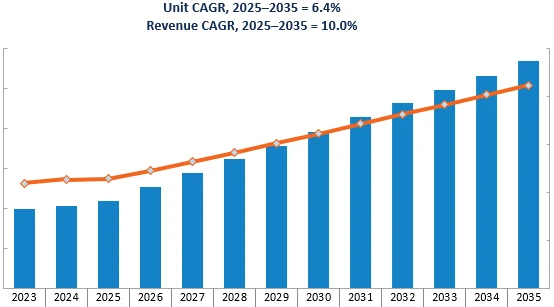
Unit shipments are forecast to increase from 11.4 million units in 2025 to 21.2 million units in 2035, corresponding to a 6.4% CAGR. The faster growth in revenue compared with unit shipments indicates that market expansion will involve both increasing volumes and changes in system value. Rising adoption is supported by policy incentives, energy-efficiency requirements, replacement of fossil-fuel heating systems, and technological improvements.
Growth Drivers: Residential Heat Pump Market
1. Policy Support and Financial Incentives
Government subsidies, tax incentives, financing schemes, and rebate programs are among the most important catalysts for the residential heat pump market. Financial support can reduce the upfront price gap between heat pumps and conventional heating technologies. Existing programs in Europe and other major markets are helping accelerate residential electrification.
2. Energy Efficiency and Cost Savings
Heat pumps offer significantly higher energy efficiency than many conventional heating systems. Their ability to reduce energy consumption and potentially lower heating bills strengthens the economic case for households. Efficiency improvements also contribute to better residential building energy ratings.
3. Fossil-Fuel Heating Phase-Out
Regulatory measures designed to reduce dependence on natural gas and oil heating are creating structural demand for electric heating. Restrictions on new fossil-fuel heating installations and broader decarbonization policies are expected to strengthen the long-term adoption outlook.
4. Residential Decarbonization
Increasing focus on reducing household carbon emissions is encouraging consumers and policymakers to move away from fossil-fuel heating. Heat pumps are particularly relevant when combined with renewable electricity, enabling households to reduce the carbon intensity of heating.
5. Installer Network and Business-Model Development
Expansion of qualified installer networks is improving market accessibility. In parallel, heat-as-a-service and other service-based models can reduce the impact of high upfront costs by shifting expenditure toward managed operating or financing arrangements.
Growth Restraints: Residential Heat Pump Market
1. Dependence on Natural Gas
Natural gas remains a major source of residential heating across several important markets. Existing gas infrastructure, consumer familiarity, and established boiler systems can slow the transition toward heat pumps.
2. High Installation Costs
Installation costs can represent a significant barrier, particularly for existing properties. Retrofit projects may require additional insulation, electrical work, heating-system modifications, or other upgrades, making the total investment substantially higher than equipment cost alone.
3. Short-Term Policy Uncertainty
Changes in subsidy schemes, financing mechanisms, and government budgets can influence household investment decisions. Uncertainty regarding incentives can delay purchases, especially when consumers depend on financial support to achieve acceptable project economics.
4. Shortage of Skilled Installers
The availability of qualified technicians is a critical constraint. Residential heat pump installation requires appropriate technical expertise, particularly for retrofit projects where building characteristics and existing heating infrastructure must be carefully evaluated.
5. Customer Awareness and Familiarity
Some consumers remain more familiar with conventional boiler technology than heat pumps. Limited understanding of operating characteristics, system sizing, installation requirements, and potential savings can delay adoption.
6. Retrofit and Building Suitability
Older or poorly insulated buildings can present challenges for heat pump deployment. System sizing and configuration must be carefully assessed, and inadequate building performance can increase operating costs or reduce expected benefits.
Competitive Landscape: Residential Heat Pump Market
The residential heat pump market has a competitive environment characterized by established HVAC manufacturers, diversified energy-technology companies, and specialist heat pump providers. The leading competitors identified in the research include Daikin, Mitsubishi Electric, Carrier, NIBE, and Vaillant. Together, the top five companies accounted for 31.9% of market revenue in 2025, indicating a competitive structure with significant participation beyond the largest players.
Competitive differentiation is based on cost, system performance, installation schedule, customer support, digital and smart-home integration, energy efficiency, low-GWP refrigerants, reliability, complete technology solutions, customer relationships, consulting capabilities, and service-based offerings.
Distribution occurs through electrical and information-technology distributors, OEM channels, retail sales, and direct sales. The channel structure is important because residential heat pumps require not only equipment supply but also professional installation and technical support.
Other notable competitors identified by the study include Glen Dimplex, Ingersoll Rand, Midea, Panasonic, Stiebel Eltron, BDR Thermea, Viessmann, Johnson Controls, Worcester Bosch, and Honeywell. These companies compete through technology portfolios, geographic reach, manufacturing capabilities, service networks, and product performance.
The market has also experienced meaningful merger and acquisition activity. Examples cited in the research include Carrier's acquisition of Viessmann Climate Solutions, Ariston's acquisition of the WOLF heat pump brand, Johnson Controls' acquisition of Hybrid Energy, NIBE's acquisition of Solzaima, Bosch's acquisition of Johnson Controls' residential and light commercial HVAC business, and other transactions.
Going forward, competitive advantage is expected to depend increasingly on energy efficiency, digital integration, installation support, service capabilities, low-GWP refrigerants, and the ability to deliver complete residential heating solutions. Companies with strong installer networks and comprehensive lifecycle support are positioned to benefit as heat pump adoption expands beyond early-adopter markets.
Scope of Analysis
Market Overview and Definitions
Segmentation: Heat Pumps by Technology
Why is it Increasingly Difficult to Grow?
The Strategic Imperative 8™
The Impact of the Top 3 Strategic Imperatives on the Residential Heat Pump (HP) Industry
Key Insights
Growth Metrics
Distribution Channels
Competitive Environment
Key Competitors
Heat-as-a-Service
Fossil-Fuel Bans Across Europe
Support Mechanisms by Country for HPs in New Buildings
Support Mechanisms by Country for HPs in Renovated Buildings
Growth Restraints
Forecast Considerations
The European Race for Heat Pumps
Heat Pumps Installed Base—Europe
Residential HP Revenue & Unit Shipment Forecast
Residential HP Unit Shipment Forecast by Technology
Residential HP Revenue Forecast by Technology
ASHP (ATA) Application Unit Shipment and Revenue Forecast
ASHP (ATW) Application Unit Shipment and Revenue Forecast
Residential HP Unit Shipment Forecast by Region
Residential HP Revenue Forecast by Region
Revenue and Unit Shipment Forecast Analysis by Region
Residential HP Unit Shipment Forecast by Country
ASHP Unit Shipment Forecast by Country
ASHP (Air-to-Air) Application Unit Shipment Forecast by Country
ASHP (Air-to-Water) Application Unit Shipment Forecast by Country
GSHP Unit Shipment Forecast by Country
Residential HP Revenue Forecast by Country
ASHP Revenue Forecast by Country
ASHP (Air-to-Air) Application Revenue Forecast by Country
ASHP (Air-to-Water) Application Revenue Forecast by Country
GSHP Revenue Forecast by Country
Residential HP Market—France
Residential HP Market—United Kingdom
Residential HP Market—Germany
Residential HP Market—Italy
Residential HP Market—Sweden
Residential HP Market—Denmark
Residential HP Market—Finland
Residential HP Market—Spain
Residential HP Market—Netherlands
Residential HP Market—Belgium
Residential HP Market—Norway
Residential HP Market—Poland
Residential HP Market—United States
Revenue Share
Revenue Share Analysis
Growth Opportunity 1: Life Cycle Heating Solutions (Heat-as-a-Service & Recurring Services)
Growth Opportunity 2: Residential Energy Ecosystem Integration
Growth Opportunity 3: Intelligent & Grid-Interactive Heat Pumps
Growth Opportunity 4: Next-Generation Residential Heat Pumps
Growth Opportunity 5: Residential Retrofit & Electrification
Benefits and Impacts of Growth Opportunities
Next Steps
Legal Disclaimer
Frequently Asked Questions (FAQs) – Residential Heat Pump Market
1. What is the Residential Heat Pump Market?
The Residential Heat Pump Market comprises heat pump systems used primarily for residential heating applications. The market includes air-source and ground-source technologies and focuses on equipment sales for household heating, excluding heat pumps sold specifically for air-conditioning applications.
2. How large is the Residential Heat Pump Market?
The global Residential Heat Pump Market is projected to reach $113.79 billion by 2035, increasing from $43.86 billion in 2025. The market is expected to expand at a 10.0% CAGR between 2025 and 2035.
3. How many residential heat pumps will be sold by 2035?
Residential heat pump unit shipments are forecast to reach approximately 21.2 million units by 2035, compared with 11.4 million units in 2025. Unit shipments are projected to grow at a 6.4% CAGR during 2025–2035.
4. What are the major growth drivers for the Residential Heat Pump Market?
Major growth drivers include government subsidies and tax incentives, energy-efficiency requirements, fossil-fuel heating phase-out policies, residential decarbonization targets, energy-cost savings, expanding installer networks, technological improvements, and emerging heat-as-a-service business models.
5. Which regions are covered in the Residential Heat Pump Market analysis?
The study covers North America, Europe, and APAC. It provides analysis across 25 selected countries, including the United States, Canada, China, Japan, Germany, France, Italy, the United Kingdom, Sweden, Denmark, Norway, Finland, Belgium, the Netherlands, Spain, Switzerland, Poland, Portugal, Austria, and other priority markets.
6. What are the key restraints affecting the Residential Heat Pump Market?
Key restraints include dependence on natural gas heating, high upfront installation costs, policy and subsidy uncertainty, shortages of skilled installers, limited consumer awareness, electricity-price considerations, and technical challenges associated with retrofitting older or poorly insulated homes.
7. Who are the leading companies in the Residential Heat Pump Market?
Leading companies identified in the Residential Heat Pump Market include Daikin, Mitsubishi Electric, Carrier, NIBE, and Vaillant. Other notable participants include Glen Dimplex, Ingersoll Rand, Midea, Panasonic, Stiebel Eltron, BDR Thermea, Viessmann, Johnson Controls, Worcester Bosch, and Honeywell.
8. What technologies are included in the Residential Heat Pump Market?
The analysis segments the market into air-source and ground-source heat pumps. These technologies are evaluated based on residential applications, regional adoption, unit shipments, revenue development, and market growth opportunities through 2035.
Speak directly with our analytics experts for tailored recommendations.
Recent related Power Generation research
16 Oct 2026 | Global | Technology Research
Innovations in Wind Energy, Flow Batteries, Water Electrolysis, Mechanical Energy Storage, Thermal Batteries, and Nuclear Power
This edition of the Energy & Power Systems (EPS) TOE features information about the innovations in wind turbine blade technology, organic flow batteries, electrolyzers, waste heat recovery solutions, solar thermal heaters, flywheel energy storage and mechanical energy storage systems, among others.T...
12 Oct 2026 | Global | Market Research
Growth Opportunities in the Global Nuclear Power Industry, 2025–2035
The Growth Opportunities in the Global Nuclear Power Industry study examines global commercial nuclear power development from 2025 to 2035, covering reactors above 10 MWe and the life cycle services supporting the installed fleet. Global installed capacity is projected to grow 23.8%, reaching approx...
09 Oct 2026 | Global | Technology Research
Innovations in Enhanced Oil Recovery, Continuous Emission Monitoring, Infrared Gas Detection, and Reservoir Optimization
This edition of the Oil and Gas (O&G) Technology Opportunity Engines features information on enhanced oil recovery, crude oil separation, leak detection, distributed gas monitoring, real-time monitoring of distributed fuel operations, among others.The Oil and Gas TOE provides intelligence on innovat...
28 Sep 2026 | Global | Technology Research
CO₂ Gas Injection for Enhanced Oil Recovery and Carbon Utilization
CO₂ gas injection for enhanced oil recovery (CO₂-EOR) is a mature tertiary recovery technology that improves oil production from depleted reservoirs while enabling long-term geological carbon storage. This report provides a fundamental overview of oil recovery, covering primary, secondary, and terti...
28 Sep 2026 | Global | Technology Research
CO₂ Gas Injection for Enhanced Oil Recovery and Carbon Utilization
CO₂ gas injection for enhanced oil recovery (CO₂-EOR) is a mature tertiary recovery technology that improves oil production from depleted reservoirs while enabling long-term geological carbon storage. This report provides a fundamental overview of oil recovery, covering primary, secondary, and terti...
Purchase includes:
- Report download
- Growth Dialog™ with our experts
Growth Dialog™
A tailored session with you where we identify the:- Strategic Imperatives
- Growth Opportunities
- Best Practices
- Companies to Action
Impacting your company's future growth potential.
Author: Neha Tatikota
| Deliverable Type | Market Research |
|---|---|
| Industries | Energy |
| No Index | No |
| Is Prebook | No |
| Podcast | No |
| Predecessor | PFK6-01-00-00-00 |
| WIP Number | PLM4-01-00-00-00 |