 USD
USD GBP
GBP  CNY
CNY  EUR
EUR  INR
INR  JPY
JPY  MYR
MYR  ZAR
ZAR  KRW
KRW  THB
THB 


State of the Global Video Conferencing Devices Market Forecast to 2028 Updated Research Available
Challenging Market Conditions and Cautionary Enterprise Spending Put Brakes on Growth: Long-term Momentum for Video Adoption will Continue
22-Dec-2023
Global
Market Research
K95D-01-00-00-00
TE_2023_475
Key Takeaways: Video Conferencing Devices Market
- The global Video Conferencing Devices Market generated approximately US$3.54 billion in revenue in 2023 and is projected to reach US$7.69 billion by 2028, expanding at a robust compound annual growth rate (CAGR) of 16.8%.
- Global unit shipments are forecast to grow at an 8.5% CAGR through 2028 as enterprises continue modernizing meeting spaces for hybrid work.
- The video conferencing market is being reshaped by AI-powered collaboration, cloud-native meeting platforms, and intelligent room technologies that improve meeting quality and workplace productivity.
- Room endpoints, collaboration bars, USB conference room cameras, and AI-enabled peripherals are expected to drive future hardware demand across enterprise environments.
- Despite cautious enterprise spending in 2023, long-term digital workplace transformation positions the Video Conferencing Hardware Market for sustained global growth.
Report Summary: Video Conferencing Devices Market
The global Video Conferencing Devices Market is entering a new phase of growth as organizations continue investing in intelligent collaboration technologies that support hybrid work, digital transformation, and modern workplace experiences. After generating approximately US$3.54 billion in revenue in 2023, the market is forecast to nearly double to US$7.69 billion by 2028, representing a strong 16.8% CAGR over the forecast period. Unit shipments are also projected to expand steadily at an 8.5% CAGR, reflecting continued deployment of video-enabled meeting spaces worldwide.
Although economic uncertainty, geopolitical instability, and cautious enterprise IT spending temporarily slowed purchasing activity in 2023, long-term demand fundamentals remain strong. Organizations are upgrading meeting rooms with AI-enabled cameras, collaboration bars, intelligent audio systems, room controllers, and cloud-connected conferencing solutions that improve meeting equity and employee productivity.
The broader video conferencing market is increasingly influenced by advances in artificial intelligence, cloud unified communications (UC), and integrated collaboration ecosystems. The Video Conferencing Hardware Market continues to evolve beyond standalone devices toward comprehensive room solutions that combine intelligent video, audio, analytics, automation, and centralized management. As enterprises accelerate workplace modernization and hybrid collaboration strategies, the Video Conferencing Systems Market is expected to experience sustained investment and innovation through 2028.
Market Overview & Trends: Video Conferencing Devices Market
The global Video Conferencing Devices Market is evolving rapidly as hybrid work becomes a permanent component of enterprise collaboration strategies. Organizations are shifting from emergency remote-work deployments toward long-term investments in intelligent meeting spaces that support seamless collaboration between in-office and remote employees. This transformation is creating strong opportunities across the video conferencing market, particularly for AI-powered cameras, collaboration bars, room endpoints, and cloud-integrated conferencing solutions.
One of the most significant trends shaping the Video Conferencing Hardware Market is the growing adoption of artificial intelligence. Vendors are integrating AI-based speaker tracking, automatic framing, intelligent noise suppression, multi-camera switching, meeting transcription, occupancy analytics, and room utilization insights into conferencing devices. These capabilities significantly improve meeting quality while simplifying device management and enhancing the overall collaboration experience.
Cloud-native collaboration platforms are also driving substantial innovation across the Video Conferencing Systems Market. Organizations are increasingly deploying devices certified for Microsoft Teams Rooms, Zoom Rooms, Google Meet, Cisco, and other unified communications platforms that enable simplified deployment, centralized management, and seamless software updates. The growing popularity of all-in-one collaboration bars further reduces deployment complexity while supporting scalable meeting room modernization.
Another emerging trend is the increasing deployment of multi-camera meeting environments for medium and large conference rooms. Enterprises are investing in additional cameras, intelligent audio peripherals, room scheduling displays, and collaboration accessories to deliver equitable meeting experiences regardless of participant location. While personal webcam demand has normalized following pandemic-driven purchasing, enterprise-grade room devices continue to generate significant investment as organizations redesign workspaces for long-term hybrid collaboration.
As digital workplace transformation accelerates, the Video Conferencing Devices Market, broader video conferencing market, and Video Conferencing Hardware Market are expected to benefit from continued advances in AI, cloud collaboration, analytics, and integrated workplace technologies, supporting sustained global market expansion through 2028.
Scope of Analysis: Video Conferencing Devices Market
This study provides a comprehensive assessment of the global Video Conferencing Devices Market, evaluating the technologies, deployment models, and business trends transforming enterprise collaboration. The analysis focuses exclusively on professional and business-grade video conferencing devices used across corporate meeting rooms, conference spaces, educational institutions, and hybrid workplaces. It examines how organizations are modernizing meeting environments through intelligent collaboration hardware, cloud-based communications platforms, and AI-enabled meeting technologies to improve productivity and employee engagement.
The report segments the Video Conferencing Hardware Market into two primary categories: room devices and personal devices. Room devices are further classified into room endpoints (full-compute collaboration systems) and USB conference room cameras, while personal devices include professional webcams, all-in-one desktop collaboration devices, and USB desktop conferencing solutions. The research excludes consumer-grade video devices, cloud meeting software licenses, managed collaboration services, on-premises communications infrastructure, multimedia IP phones, and standalone audio conferencing equipment.
The study covers North America, Europe, the Middle East & Africa (EMEA), Asia-Pacific (APAC), and Latin America, with the research period spanning 2020–2028, 2023 as the base year, and forecasts extending through 2028. Revenue estimates are presented in US dollars, while unit shipment forecasts represent vendor-level device sales. The analysis incorporates vendor interviews, channel partner insights, enterprise customer feedback, and secondary market research to provide a strategic evaluation of growth opportunities, technology adoption, competitive positioning, and future investment trends within the Video Conferencing Devices Market, the broader video conferencing market, and the evolving Video Conferencing Systems Market.
Market Segmentation Analysis: Video Conferencing Devices Market
The global Video Conferencing Devices Market is segmented by device category, meeting room configuration, workspace size, and geographic region, reflecting the diverse collaboration requirements of modern enterprises. As organizations continue investing in hybrid work environments, demand is expanding across both personal collaboration devices and enterprise-grade meeting room solutions, driving innovation throughout the Video Conferencing Hardware Market.
By device category, the market is divided into room devices and personal devices. Room devices represent the largest revenue-generating segment and include room endpoints and USB conference room cameras. Room endpoints consist of full-compute collaboration systems, collaboration bars, integrated meeting room kits, immersive telepresence solutions, and cloud-connected conferencing platforms that provide complete meeting room experiences. USB conference room cameras continue to gain popularity among organizations adopting Bring Your Own Device (BYOD) meeting environments because they offer deployment flexibility while integrating seamlessly with existing collaboration software.
The personal devices segment includes professional webcams, all-in-one desktop collaboration systems, integrated display devices, and USB desktop conferencing solutions designed for individual workspaces and remote employees. Although webcam demand moderated following pandemic-driven purchasing, organizations continue upgrading employees with higher-quality AI-enabled devices that improve video quality, audio performance, and overall meeting experiences.
The Video Conferencing Systems Market is also segmented according to workspace size. Personal workspaces utilize compact collaboration devices for individual productivity, while small meeting rooms and huddle spaces increasingly deploy collaboration bars and USB conference cameras. Medium and large conference rooms require advanced room endpoints, intelligent audio systems, room controllers, multiple cameras, and integrated collaboration technologies capable of supporting complex hybrid meetings. Classrooms and training facilities represent another important segment, utilizing enterprise-grade conferencing systems to support distance learning, corporate training, and large-scale presentations.
Geographically, the Video Conferencing Devices Market spans North America, Europe, Asia-Pacific, Latin America, and the Middle East & Africa. North America continues to lead enterprise technology adoption, while Europe emphasizes workplace modernization and sustainable office transformation. Asia-Pacific is experiencing rapid expansion due to digital transformation initiatives, increasing enterprise IT investments, and growing hybrid workforce adoption. As cloud collaboration platforms, artificial intelligence, and unified communications continue to mature, each market segment is expected to contribute significantly to the long-term growth of the global video conferencing market.
Revenue & Spending Forecast: Video Conferencing Devices Market
The global Video Conferencing Devices Market is expected to witness strong growth as organizations accelerate investments in hybrid work technologies, intelligent collaboration solutions, and AI-enabled meeting environments. The market generated approximately US$3.54 billion in revenue in 2023 and is forecast to reach US$7.69 billion by 2028, representing a robust compound annual growth rate (CAGR) of 16.8% during the forecast period. While cautious enterprise spending and macroeconomic uncertainty slowed market performance in 2023, demand is projected to recover steadily as businesses modernize meeting spaces and expand digital workplace initiatives.
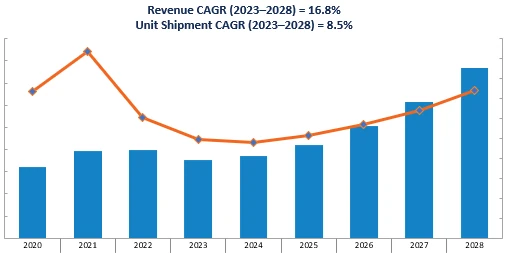
Global unit shipments are forecast to increase at an 8.5% CAGR between 2023 and 2028, supported by the growing deployment of room endpoints, collaboration bars, USB conference room cameras, AI-enabled peripherals, and integrated conferencing solutions. Revenue growth is expected to outpace shipment growth as organizations increasingly purchase premium hardware, intelligent room controllers, scheduling displays, multi-camera systems, and advanced audio-video accessories that command higher average selling prices.
The Video Conferencing Hardware Market is attracting continued investment from enterprise customers seeking cloud-native meeting room ecosystems compatible with Microsoft Teams, Zoom, Google Meet, Cisco, and other unified communications platforms. Spending is also increasing on AI-powered analytics, room management software, automation capabilities, and intelligent meeting experiences that improve employee collaboration and workplace utilization. North America and Europe remain major revenue contributors, while Asia-Pacific continues to emerge as a high-growth region due to rapid enterprise digitalization and expanding IT infrastructure. These investment trends position the Video Conferencing Devices Market for sustained long-term expansion through 2028.
Growth Drivers: Video Conferencing Devices Market
The Video Conferencing Devices Market is being driven by the permanent shift toward hybrid work, enterprise workplace modernization, and increasing demand for intelligent collaboration technologies. Organizations are redesigning meeting rooms to support seamless communication between in-office and remote employees, creating significant demand for AI-powered conferencing devices, cloud-connected collaboration systems, and integrated meeting room solutions.
Artificial intelligence has become one of the strongest growth drivers across the video conferencing market. Vendors are incorporating intelligent speaker tracking, automatic framing, noise suppression, participant recognition, meeting transcription, occupancy analytics, and room utilization insights into conferencing hardware. These AI-enabled capabilities improve meeting quality, enhance collaboration, and simplify IT management, making them increasingly attractive to enterprise customers.
Another major driver is the migration from legacy communications infrastructure to cloud-based unified communications platforms. Organizations are investing in devices certified for Microsoft Teams Rooms, Zoom Rooms, Google Meet, and Cisco environments to simplify deployment, improve interoperability, and centralize device management. The increasing popularity of all-in-one collaboration bars, room endpoints, and cloud-native conferencing systems continues to stimulate growth within the Video Conferencing Hardware Market.
Growing demand for multi-camera meeting rooms, intelligent audio peripherals, room scheduling displays, and workplace analytics further expands revenue opportunities. As enterprises prioritize employee experience, workplace flexibility, and digital collaboration, investments in advanced meeting technologies continue to increase. These trends, combined with ongoing innovation in cameras, audio systems, cloud collaboration, and AI software, are expected to sustain long-term growth across the Video Conferencing Systems Market.
Growth Restraints: Video Conferencing Devices Market
Despite favorable long-term growth prospects, the Video Conferencing Devices Market faces several challenges that may moderate adoption during the forecast period. One of the primary restraints is the slower-than-expected return to office environments. Many organizations continue operating hybrid work models with lower meeting room utilization rates, causing enterprises to postpone or phase investments in large-scale conferencing infrastructure upgrades.
The Video Conferencing Hardware Market also faces challenges associated with cautious enterprise IT spending. Economic uncertainty, inflationary pressures, and budget constraints have encouraged organizations to prioritize essential technology investments while delaying discretionary meeting room modernization projects. Small and medium-sized businesses, in particular, remain highly sensitive to increasing hardware prices and implementation costs.
Interoperability continues to present another significant challenge. Many organizations operate multiple collaboration platforms simultaneously, making it difficult to deploy standardized room solutions across diverse communication ecosystems. This has sustained demand for flexible Bring Your Own Device (BYOD) environments while slowing adoption of fully integrated conferencing systems.
Although artificial intelligence is rapidly transforming the video conferencing market, many enterprises continue evaluating the measurable business value of AI-powered collaboration features before committing to large-scale deployments. Additionally, multi-camera conferencing solutions remain in the early stages of adoption, limiting near-term revenue opportunities. Successfully addressing cost concerns, platform interoperability, and customer adoption barriers will be essential for sustaining long-term growth across the global Video Conferencing Devices Market and broader Video Conferencing Systems Market.
Competitive Landscape: Video Conferencing Devices Market
The global Video Conferencing Devices Market is highly competitive, with established unified communications vendors, collaboration technology providers, and enterprise hardware manufacturers continuously investing in artificial intelligence, cloud integration, and intelligent meeting room solutions. As organizations transition toward hybrid work and digital collaboration, competition has shifted beyond standalone video devices to comprehensive meeting room ecosystems that combine hardware, software, analytics, and centralized device management. Vendors are increasingly differentiating themselves through AI-powered capabilities, interoperability with leading collaboration platforms, and seamless user experiences across enterprise environments.
The Video Conferencing Hardware Market is being shaped by rapid innovation in collaboration bars, room endpoints, USB conference room cameras, professional webcams, room scheduling displays, intelligent audio systems, and meeting room controllers. Manufacturers are integrating advanced features such as automatic speaker tracking, intelligent framing, noise suppression, multi-camera switching, room occupancy analytics, and cloud-based device management to improve meeting equity and simplify IT administration. Native certification for Microsoft Teams Rooms, Zoom Rooms, Google Meet, and Cisco collaboration platforms has become a major competitive advantage as enterprises increasingly standardize their unified communications infrastructure.
Strategic partnerships, ecosystem development, and cloud integration continue to redefine the Video Conferencing Systems Market. Vendors are collaborating with software providers, AV integrators, managed service providers, and channel partners to deliver end-to-end workplace collaboration solutions. At the same time, companies are expanding portfolios beyond conferencing hardware by incorporating workplace analytics, room reservation systems, digital whiteboards, collaboration software, and AI-driven meeting insights into integrated workplace platforms.
Leading companies operating in the Video Conferencing Devices Market include Cisco Systems, Logitech, HP Poly, Microsoft, Zoom, Google, Neat, Lenovo, Jabra, Yealink, Crestron, Barco, DTEN, Huawei, and Avocor. These organizations continue investing in research and development, AI innovation, cloud-native collaboration, enterprise security, and scalable device management platforms to strengthen their competitive positions. Increasing demand for hybrid work technologies has also encouraged vendors to expand portfolios across personal collaboration devices, enterprise meeting room systems, and premium multi-camera conferencing solutions.
Looking ahead, competition within the video conferencing market is expected to intensify as organizations modernize meeting spaces and prioritize intelligent collaboration experiences. Companies that successfully combine AI innovation, cloud interoperability, enterprise security, and integrated workplace management capabilities will be best positioned to capitalize on the sustained growth opportunities within the global Video Conferencing Hardware Market.
Why is it Increasingly Difficult to Grow?
The Strategic Imperative 8™
The Impact of the Top 3 Strategic Imperatives on Video Conferencing Devices
Growth Opportunities Fuel the Growth Pipeline Engine™
Scope of Analysis
Market Segmentation
Segmentation by Room Size
Target Markets
Choice of Deployment Options
Adoption Trends in 2024 and Beyond
Market Overview
Key Growth Metrics
Transformational Shifts
Emerging Work Models
Current Work Model
Shifting Workplace Plans
Key Capabilities for Room Video Conferencing Devices
Migration to Cloud Video Conferencing
Strong Focus on AI and ESG
Workplace Optimization for Hybrid Work
AI-led Innovation is Table stake
Multimodal AI Creates Growth Opportunities—Analyzing Data in Video, Image, and Text Formats
Sustainability is a Key Differentiator
Video Conferencing Devices—Total Addressable Market (TAM)
Growth Drivers
Growth Restraints
Forecast Assumptions
Total Market—Revenue and Unit Shipment Forecast
Total Market—Revenue Forecast by Device Type
Total Market—Unit Shipment Forecast by Device Type
Total Market—Average Pricing Forecast by Device Type
Total Market—Percent of Revenue by Device Type
Total Market—Percent of Unit Shipment by Device Type
Room Devices—Key Growth Metrics
Meeting Room Count and Video Conferencing Penetration Rate
Room Devices—Revenue and Unit Shipment Forecast
Room Devices—Revenue Forecast by Meeting Room Size
Room Devices—Units Forecast by Meeting Room Size
Room Devices—Percent of Revenue Forecast by Room Size
Room Devices—Percent of Unit Forecast by Room Size
Room Devices—Percent of Revenue by Region
Competitive Environment
Room Endpoints—Revenue Share
Room Endpoints—Unit Share
USB Conference Room Cameras—Revenue Share
USB Conference Room Cameras—Unit Share
Key Competitors
Growth Opportunity 1: AI as a Growth Engine
Growth Opportunity 2: Meeting Equality
Growth Opportunity 3: BYOD Enablement
Your Next Steps
Why Frost, Why Now?
List of Exhibits
Legal Disclaimer
Frequently Asked Questions (FAQs) – Video Conferencing Devices Market
1. What is the Video Conferencing Devices Market?
The Video Conferencing Devices Market includes professional hardware used for virtual meetings, such as room endpoints, collaboration bars, USB conference room cameras, webcams, room controllers, and intelligent audio-video systems designed for enterprise collaboration.
2. What is driving growth in the Video Conferencing Devices Market?
Growth is driven by hybrid work adoption, AI-powered meeting technologies, cloud-based unified communications platforms, workplace modernization initiatives, and increasing investments in intelligent meeting room infrastructure.
3. What is the projected growth of the Video Conferencing Devices Market?
The global Video Conferencing Devices Market is projected to grow from approximately US$3.54 billion in 2023 to US$7.69 billion by 2028, registering a 16.8% CAGR. Global unit shipments are expected to grow at an 8.5% CAGR during the same period.
4. What products are included in the Video Conferencing Hardware Market?
The Video Conferencing Hardware Market includes room endpoints, collaboration bars, USB conference room cameras, professional webcams, desktop collaboration devices, room controllers, scheduling displays, microphones, speakers, and AI-enabled conferencing accessories.
5. Which industries are driving demand for the Video Conferencing Systems Market?
Enterprise organizations, educational institutions, government agencies, healthcare providers, financial services firms, and technology companies are major adopters of video conferencing systems to support hybrid collaboration and digital workplace transformation.
6. How is artificial intelligence transforming the Video Conferencing Devices Market?
Artificial intelligence improves meeting experiences through automatic framing, speaker tracking, intelligent noise suppression, meeting transcription, room occupancy analytics, multi-camera switching, and automated device management.
7. Who are the leading companies in the Video Conferencing Devices Market?
Leading companies include Cisco Systems, Logitech, HP Poly, Microsoft, Zoom, Google, Jabra, Yealink, Lenovo, Neat, Crestron, Barco, DTEN, Huawei, and Avocor.
8. What challenges are affecting the Video Conferencing Devices Market?
Major challenges include cautious enterprise IT spending, slower return-to-office adoption, interoperability issues across collaboration platforms, higher hardware costs, and slower commercialization of advanced multi-camera meeting solutions.
9. Why are cloud-connected meeting rooms becoming increasingly popular?
Cloud-connected meeting rooms simplify deployment, enable centralized device management, support automatic software updates, improve security, and provide seamless integration with platforms such as Microsoft Teams, Zoom, Google Meet, and Cisco.
10. What is the future outlook for the Video Conferencing Devices Market?
The Video Conferencing Devices Market is expected to experience sustained long-term growth through 2028, driven by hybrid work, AI-powered collaboration, cloud-native communications platforms, enterprise meeting room modernization, and increasing investments in intelligent workplace technologies.
Speak directly with our analytics experts for tailored recommendations.
Recent related Telecom research
12 Mar 2025 | Global | Market Outlook
Top 10 Growth Opportunities in Enterprise Wireless Services, 2025
4G’s successor, 5G offers higher speeds, greater bandwidth, lower latency, and the ability to support multiple connections simultaneously. It also provides additional benefits, such as platform digitalization and extended device battery life. 5G’s new dimensions are driving new service development a...
19 Feb 2025 | Global | Market Outlook
Top 10 Growth Opportunities in Unified Communications and Collaboration, 2025
Cloud communications empower customer organizations to accelerate their digital transformation efforts. IT decision makers (ITDMs) rank boosting team collaboration, improving the customer experience, and enhancing resiliency and business continuity as the top three UCC technology investment drivers....
13 Feb 2025 | Global | Market Research
Growth Opportunities in Global Enterprise Network Services, 2024-2028
The global enterprise network services market has experienced modest contraction in recent years with this capital-intensive and mature market. Key macroeconomic factors, including elevated interest rates and persistent inflation, have exerted downward pressure on market dynamics. In addition, price...
06 Feb 2025 | Global | Market Research
6G Network Infrastructure, Global, 2029 - 2034
The sixth generation of wireless technology (6G) is now on the horizon. Each of the previous five generations has proven to bring new capabilities and new possibilities to wireless communications and 6G will continue that trend. By the end of the decade, the details of what exactly 6G will bring wil...
15 Jan 2025 | Global | Market Research
UCaaS Market, Asia-Pacific, 2024-2030
This study provides an in-depth analysis of the APAC UCaaS market, including a forecast of installed users and average prices until 2030. The study discusses the state of UCaaS adoption and the growth potential across the five countries/sub-regions, including ASEAN, ANZ, China, India, Japan, and Sou...
Purchase includes:
- Report download
- Growth Dialog™ with our experts
Growth Dialog™
A tailored session with you where we identify the:- Strategic Imperatives
- Growth Opportunities
- Best Practices
- Companies to Action
Impacting your company's future growth potential.
| Deliverable Type | Market Research |
|---|---|
| Author | Roopam Jain |
| Industries | Telecom |
| No Index | No |
| Is Prebook | No |
| Keyword 1 | Video Conferencing Trends |
| Keyword 2 | Video Conferencing Device |
| Keyword 3 | Communication Technology Trends |
| Podcast | No |
| Predecessor | K7DO-01-00-00-00 |
| WIP Number | K95D-01-00-00-00 |
State of the Global Video Conferencing Devices Market Forecast to 2028
$4,950.00
Special Price $3,712.50 save 25 %