 USD
USD GBP
GBP  CNY
CNY  EUR
EUR  INR
INR  JPY
JPY  MYR
MYR  ZAR
ZAR  KRW
KRW  THB
THB 


Assessing Pyrolysis Technology Cross-Industry Use Cases and Pathway Analysis for Advanced Biofuel Production
01-Sep-2025
Global
Technology Research
DB34-01-00-00-00
EN_2025_33765
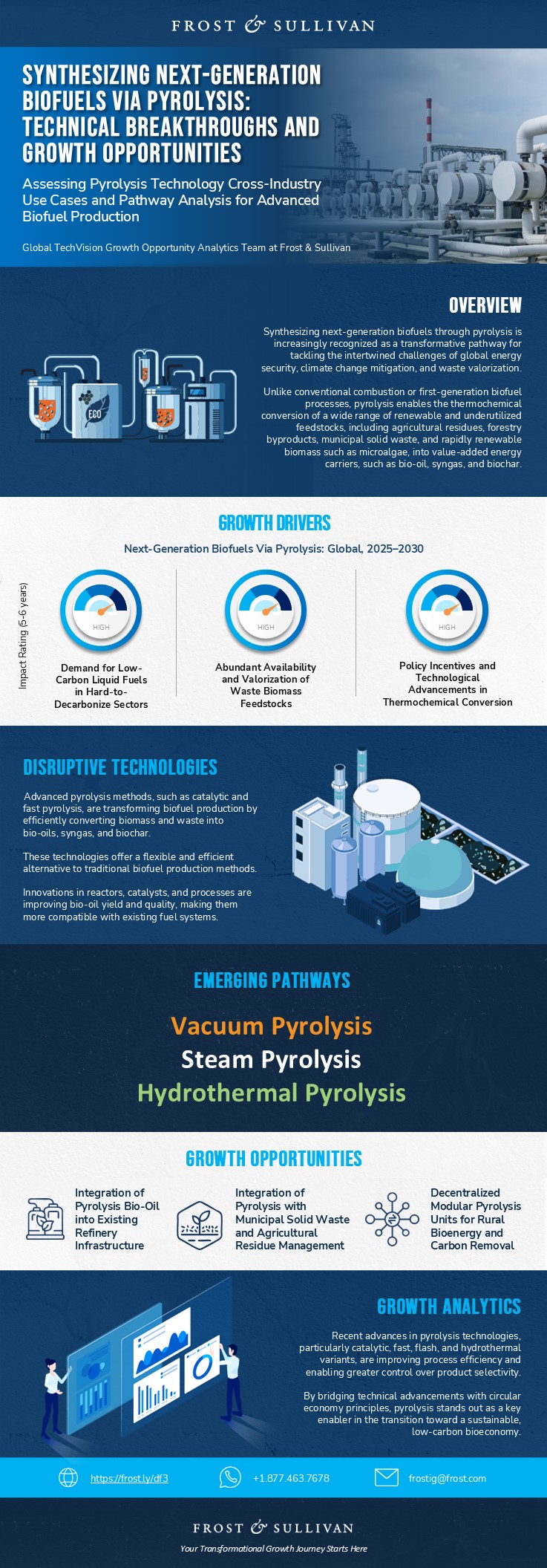
Synthesizing next-generation biofuels through pyrolysis is increasingly recognized as a transformative pathway for tackling the intertwined challenges of global energy security, climate change mitigation, and waste valorization. Unlike conventional combustion or first-generation biofuel processes, pyrolysis enables the thermochemical conversion of a wide range of renewable and underutilized feedstocks, including agricultural residues, forestry byproducts, municipal solid waste, and rapidly renewable biomass such as microalgae, into value-added energy carriers, such as bio-oil, syngas, and biochar.
Recent advances in pyrolysis technologies, particularly catalytic, fast, flash, and hydrothermal variants, are improving process efficiency and enabling greater control over product selectivity. Complementary innovations in reactor engineering, catalyst development, and process integration are further enhancing the physicochemical properties of bio-oil by lowering oxygen content, improving stability, and increasing energy density, making it more suitable for downstream upgrading and fuel blending. Moreover, the alignment of pyrolysis research with industrial stakeholders across agriculture, waste management, and energy sectors underscores its potential scalability and commercial relevance. By bridging technical advancements with circular economy principles, pyrolysis stands out as a key enabler in the transition toward a sustainable, low-carbon bioeconomy.
This research study covers the following:
• A comparative analysis of pyrolysis pathways (e.g., catalytic, fast, flash, hydrothermal) evaluating technical and process parameters such as energy efficiency, feedstock flexibility, product yield (bio-oil, syngas, biochar), and system complexity
• Analysis of the innovation ecosystem, including key commercial players, academic advancements, patent trends (e.g., catalysts, modular reactors), and funding initiatives driving pyrolysis biofuel commercialization
Why Is It Increasingly Difficult to Grow?
The Strategic Imperative 8
The Impact of the Top 3 Strategic Imperatives on Synthesizing Next-Generation Biofuels via the Pyrolysis Industry
Growth Opportunities Fuel the Growth Pipeline Engine
Research Methodology
Scope of Analysis
Segmentation
Growth Drivers
Growth Restraints
Overview of Next-Generation Biofuels Synthesis via Pyrolysis
Next-Generation Biofuels via Pyrolysis—Value Chain
Conventional: Slow Pyrolysis Enables High-Quality Biochar and Stable Bio-Oil Production
Conventional: Fast Pyrolysis Optimizes Maximum Liquid Yields and High-Quality Bio-Oil Production
Conventional: Ultra-Rapid Thermal Conversion for Selective Production of Light Bio-Oil Fractions and Valuable Chemicals
Emerging: Steam Pyrolysis Boosts Hydrogen-Rich Syngas and Lowers Tar, While Microwave Pyrolysis Enables Rapid, Energy-Efficient Conversion with Tunable Selectivity
Emerging: Catalytic Pyrolysis Enhances Bio-Oil Quality and Selectivity, While Vacuum Pyrolysis Promotes Milder Thermal Decomposition and Higher Liquid Yields
Emerging: Hydrothermal Liquefaction Unlocks Efficient Wet Biomass Conversion into Energy-Dense Bio-Crude for Advanced Biofuel Applications
Comparative Analysis of Various Pyrolysis Pathways
Optimized Biocrude Production via Advanced Fast-Catalytic Pyrolysis Technology Honeywell UOP, France
Rapid Renewable Fuel Oil Production and Feedstock Flexible Fast Pyrolysis Ensyn, Canada
Modular Biofuel Synthesis via Electrically Heated Slow Pyrolysis Biogreen Energy, France
Key Companies and Universities Adopting Pyrolysis Pathways
Funding Initiatives by Global Stakeholders
United States Dominates the Patent Landscape
Growth Opportunity 1: Integration of Pyrolysis Bio-Oil into Existing Refinery Infrastructure
Growth Opportunity 2: Integration of Pyrolysis with Municipal Solid Waste and Agricultural Residue Management
Growth Opportunity 3: Decentralized Modular Pyrolysis Units for Rural Bioenergy and Carbon Removal
Technology Readiness Levels TRL: Explanation
Benefits and Impacts of Growth Opportunities
Next Steps
Legal Disclaimer
Speak directly with our analytics experts for tailored recommendations.
Recent related Water research
02 Oct 2026 | Global | Technology Research
Innovations in Carbon Capture, Waste Conversion, Wastewater Treatment, Bioreactors, Artificial Protein and Plastic Recycling
This edition of the Industrial Bioprocessing TOE features information on carbon capture, waste conversion, wastewater treatment, bioreactors, artificial protein and plastic recycling among others.The Industrial Bioprocessing TOE provides intelligence on technologies, processes and strategic insights...
25 Sep 2026 | South Asia, Middle East & North Africa | Market Research
Circular Economy for Used Electrical and Electronic Equipment (Used EEE) and ITAD Services Market, India, 2025–2032
The circular economy for used electrical and electronic equipment (used EEE) in India is experiencing transformational growth as an expanding domestic electronics manufacturing industry, rapid digitalization, and shorter electronics replacement cycles intersect with a stricter policy environment and...
22 Sep 2026 | Europe | Strategic Imperatives
Top 8 Strategic Imperatives for the Membrane-Based Water & Wastewater Treatment Systems Market, Europe, 2026
Europe has been faced with unprecedented heatwaves and droughts triggered by climate change. This has affected surface and groundwater availability across regions, leading to water use restrictions and investment in water reuse infrastructure.Southern European countries such as Spain, Cyprus, Malta,...
16 Sep 2026 | Europe | Frost Radar
Frost Radar™: European Membrane-Based Water and Wastewater Treatment Systems, 2026
Most parts of Europe face recurring droughts as below-average rainfall combined with heatwaves exacerbate water stress. The latest revision of European Union wastewater directives has driven nations to invest in tertiary treatment of wastewater and proactively encouraged water reuse to meet agricult...
09 Sep 2026 | Europe | Strategic Imperatives
Top 10 Strategic Imperatives in the European Residential and Commercial Water Hydration and Treatment Market, 2026
This report identifies the most significant transformations expected to influence the European residential and commercial water hydration and treatment market and evaluates the growth opportunities emerging from these shifts. It examines how evolving regulatory frameworks, sustainability priorities,...
Purchase includes:
- Report download
- Growth Dialog™ with our experts
Growth Dialog™
A tailored session with you where we identify the:- Strategic Imperatives
- Growth Opportunities
- Best Practices
- Companies to Action
Impacting your company's future growth potential.
Recent advances in pyrolysis technologies, particularly catalytic, fast, flash, and hydrothermal variants, are improving process efficiency and enabling greater control over product selectivity. Complementary innovations in reactor engineering, catalyst development, and process integration are further enhancing the physicochemical properties of bio-oil by lowering oxygen content, improving stability, and increasing energy density, making it more suitable for downstream upgrading and fuel blending. Moreover, the alignment of pyrolysis research with industrial stakeholders across agriculture, waste management, and energy sectors underscores its potential scalability and commercial relevance. By bridging technical advancements with circular economy principles, pyrolysis stands out as a key enabler in the transition toward a sustainable, low-carbon bioeconomy.
This research study covers the following:
• A comparative analysis of pyrolysis pathways (e.g., catalytic, fast, flash, hydrothermal) evaluating technical and process parameters such as energy efficiency, feedstock flexibility, product yield (bio-oil, syngas, biochar), and system complexity
• Analysis of the innovation ecosystem, including key commercial players, academic advancements, patent trends (e.g., catalysts, modular reactors), and funding initiatives driving pyrolysis biofuel commercialization
| Deliverable Type | Technology Research |
|---|---|
| Industries | Environment |
| No Index | No |
| Is Prebook | No |
| Keyword 1 | biofuels market size forecast |
| Keyword 2 | pyrolysis biofuels growth analysis |
| Keyword 3 | advanced biofuels industry report |
| Podcast | No |
| Predecessor | None |
| WIP Number | DB34-01-00-00-00 |