 USD
USD GBP
GBP  CNY
CNY  EUR
EUR  INR
INR  JPY
JPY  MYR
MYR  ZAR
ZAR  KRW
KRW  THB
THB 


Tertiary and eCommerce Packaging are Experiencing Transformational Growth due to Rapid eCommerce Expansion, Supply Chain Modernization, and the Push for Sustainable Packaging Materials
28-Nov-2025
Global
Market Research
PG2Y-01-00-00-00
CM_2025_34147
Report Summary: Tertiary and eCommerce Packaging Market
The global tertiary and eCommerce packaging market continues to expand as retailers, logistics operators, and brands adopt more resilient, lightweight, and cost-efficient materials to support omnichannel fulfilment. According to the report, global market revenue reached USD 98.14 billion in 2024 and is expected to grow to USD 134.12 billion by 2031, at a CAGR of 4.6%
Growth is supported by steadily rising retail consumption, the expansion of omnichannel formats, and the increasing penetration of digital commerce, which intensifies demand for tertiary, protective, and transit packaging solutions across categories.
Key Market Insights
- Rapid expansion in food, household, personal care, pharmaceuticals, and consumer electronics is reshaping the consumer packaging market, increasing demand consistency across verticals.
- Paper & paperboard remain the most preferred substrate, driven by recyclability mandates, retailer pressure to reduce plastics, and the need for sustainable e-commerce-ready designs.
- Plastics continue to play a role in high-strength, moisture-resistant formats, particularly in global logistics for beverages, perishables, and durable goods.
- Growth in social commerce, Q-commerce, and subscription services amplifies the need for modular, lightweight tertiary formats within the e-commerce packaging market.
Market Size & Forecast
- 2024: USD 98.14 Billion
- 2031: USD 134.12 Billion
- CAGR (2024–2031): 4.6%
As digital fulfilment networks expand and sustainability intensifies, the Packaging Materials Market—particularly tertiary and eCommerce formats—will continue to evolve to deliver durability, environmental compliance, and cost-optimized logistics performance.
Market Overview & Trends: Tertiary and eCommerce Packaging Market
The tertiary and eCommerce packaging market is undergoing a multi-dimensional transformation driven by retail evolution, sustainability regulations, logistics modernization, and rapid digitalization. The study highlights that tertiary packaging is becoming more central to end-to-end supply chain efficiency as products increasingly travel through omnichannel routes involving warehouses, dark stores, micro-fulfilment centers, and last-mile delivery hubs. This diversifies handling requirements and accelerates demand for robust packaging materials that withstand multiple touchpoints while optimizing weight and cube efficiency.
The e-commerce packaging market continues to expand as global online retail evolves beyond traditional categories into bulky items, home essentials, personal care, pharmacy, and temperature-sensitive shipments. Growth in Q-commerce (10–60 minute delivery), social commerce, and platform-led retail has reshaped expectations for packaging durability, reusability, and ease of returns. Retailers and marketplaces increasingly mandate packaging that reduces damage rates, improves volumetric efficiency, and minimizes excess material usage.
A crucial trend highlighted in the report is the role of sustainability:
- Governments across the Americas, Europe, APAC, and MEASA are implementing regulations that reduce packaging intensity, restrict single-use plastics, and encourage recycled content adoption.
- Retailers themselves are enforcing packaging-light programs, auto-fit box sizing, plastic reduction schemes, and packaging opt-out features. These trends reduce material waste, yet they also require innovation in fibre-based and hybrid materials across the Packaging Materials Market.
Paper & paperboard dominate due to containerboard demand in eCommerce and retail. Containerboard grades—kraft liner, white-top liner, testliner, recycled medium—remain essential to fulfilment packaging. Plastics retain demand for moisture barriers, cushioning, cold-chain packaging, and pallet stretch & shrink films. Wood packaging retains importance for heavy loads, industrial shipments, durables, appliances, and export logistics.
The consumer packaging market also influences tertiary trends. As branded manufacturers push for sustainable secondary packaging, tertiary packaging suppliers adapt by introducing lightweight packaging papers, advanced corrugated grades, molded packaging solutions, and poly-reduced film structures.
Logistics automation is another transformative trend. Robotic picking, automated storage and retrieval systems (AS/RS), and smart warehousing require standardized packaging dimensions, higher compression strength, and improved stackability. This shifts design requirements across all materials, reinforcing the role of the Packaging Materials Market in retail supply chain modernization.
Overall, the market is poised for stable long-term growth as global consumption rises, fulfilment networks expand, sustainability mandates tighten, and eCommerce penetration increases.
Revenue & Spending Forecast: Tertiary and eCommerce Packaging Market
The global tertiary and eCommerce packaging market is projected to grow consistently through 2031, driven by rising consumption, retail expansion, and increased digital commerce activity. According to the PDF, the total market revenue stood at USD 98.14 billion in 2024 and is forecast to reach USD 134.12 billion by 2031, reflecting a CAGR of 4.6% over the forecast period
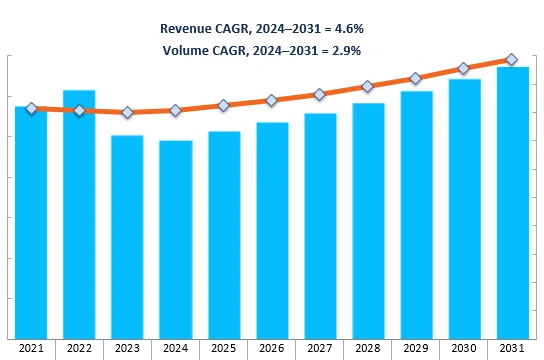
The forecast incorporates GDP movement, retail consumption patterns, packaging material regulations, shifts in containerboard pricing, resin market dynamics, and wood price fluctuations. It also reflects the strong influence of eCommerce fulfilment volumes, last-mile logistics development, and retailer packaging policies targeting waste reduction.
Online retail—particularly marketplaces and direct-to-consumer models—significantly increases tertiary packaging demand due to product-level handling and multi-node distribution. This drives structural growth in paper & paperboard, especially containerboard. Plastics show moderated growth because of tightening environmental regulations, while wood consumption aligns with industrial and durable-goods logistics trends.
Regional growth varies:
- APAC shows the highest incremental consumption, driven by China, India, Japan, and Southeast Asia.
- Europe experiences moderated growth influenced by packaging minimization rules and EPR regulations.
- Americas maintains steady demand through strong retail networks.
- MEASA benefits from rising retail penetration and distribution infrastructure upgrades.
Overall, the forecast data confirms medium-term stability and long-term structural resilience in the Packaging Materials Market and the consumer packaging market.
Scope of Analysis: Tertiary and eCommerce Packaging Market
The study covers the global tertiary and eCommerce packaging market across retail-driven material demand, fulfilment network requirements, and sector-specific packaging needs. The scope includes tertiary packaging used for protection, bundling, stacking, warehousing, shipping, and multi-touch logistics handling.
The report evaluates four primary categories:
- Materials: paper & paperboard, plastics, and wood.
- Substrates & Formats: containerboard, cartonboard, packaging papers, pallet wraps, films, crates, pallets, boxes, mailers, and corrugated formats.
- End-use Industries: food, beverages, pharmaceuticals, personal care, home care, durables, electronics, apparel, toys, furniture, and other retail-driven categories.
- Business Channels: offline (retail stores, wholesale distribution) and online (marketplaces, D2C sellers, rapid commerce, and social commerce).
The analysis spans four regions—Americas, Europe, MEASA, and APAC—with country-level factors integrated into high-level assessments. Market definitions exclude primary packaging and brand-level secondary packaging that does not contribute to tertiary logistics.
The scope incorporates regulatory influences, sustainability compliance, retailer packaging standards, consumption trends, and economic factors influencing the Packaging Materials Market. Retail inflation, GDP movement, logistics bottlenecks, packaging restriction laws, and raw material dynamics (containerboard pulp, resin pricing, wood pricing) are factored into the forecast.
The study emphasizes the expanding role of tertiary formats within the consumer packaging market and eCommerce transition, ensuring a holistic outlook for 2024–2031.
Market Segmentation Analysis: Tertiary and eCommerce Packaging Market
The tertiary and eCommerce packaging market is segmented according to materials, end-use industries, and business channels. Although revenue numbers for individual segments are not included (per your requirement), the PDF provides detailed structural segmentation.
A. By Material Type
Paper & Paperboard:
This is the largest segment globally. Key formats include containerboard (kraft liner, white top liner, testliner, recycled medium), cartonboard (FBB, WLC/URB), and packaging papers (sack kraft, specialty papers). Strong momentum is driven by fibre-based sustainability mandates, recyclability, eCommerce box demand, and lightweight packaging innovations. Paper dominates the global Packaging Materials Market due to cost efficiency, printing compatibility, and regulatory preference.
Plastics:
Includes PE, PP, biodegradable plastics, and engineered films. They remain important for pallet unitization, stretch and shrink wrapping, moisture protection, cushioning, bubble films, and flexibles used for return shipments. Adoption is influenced by plastic taxes, EPR rules, and retailer sustainability commitments.
Wood:
Wood packaging—sawn timber pallets, engineered pallets, crates—retains essential demand for industrial loads, global exporting, automotive, machinery, electronics, furniture, and durables. APAC, MEASA, and Europe show high adoption. Wood supports both eCommerce and offline supply chain handling where load-bearing capacity is critical.
B. By End-Use Industry
The consumer packaging market overlaps closely with tertiary packaging demand. Key sectors include:
- Food & beverages: the largest FMCG category.
- Pharmaceuticals & healthcare: driven by OTC growth and cold-chain distribution.
- Consumer electronics: sensitive, high-damage-risk products requiring robust tertiary protection.
- Apparel, footwear, personal care: large-volume eCommerce categories influencing mailer and corrugated demand.
- Home & living, toys, furniture, appliances: expanding in online retail, increasing bulk packaging demand.
C. By Business Channel
Offline (B&M Retail): Includes supermarkets, convenience stores, wholesale formats, and traditional retail. Drives high-volume tertiary packaging for pallet shipments, bulk stocking, and store-level distribution.
Online (eCommerce): Includes marketplaces, D2C brands, subscription commerce, quick commerce, and social commerce. Driving needs:
- Optimized corrugated packaging
- Auto-fit box designs
- Mailers
- Polybags
- Return-ready packaging
- Frustration-free designs
- Tamper-evident and protective materials
This segmentation reflects how omnichannel logistics shape the modern e-commerce packaging market.
Growth Drivers: Tertiary and eCommerce Packaging Market
Key growth drivers shaping the tertiary and eCommerce packaging market include:
1. Rising eCommerce and Omnichannel Retail
Online retail continues to expand across categories such as essentials, OTC, electronics, apparel, household goods, and furniture—each requiring differentiated tertiary packaging formats. Q-commerce, curated commerce, and subscription commerce add further momentum.
2. Shift Toward Sustainable Materials
Governments and retailers are enforcing sustainable packaging initiatives, accelerating adoption of paper-based formats and reducing plastics in tertiary packaging. This significantly strengthens demand in the Packaging Materials Market, especially containerboard.
3. Expanding Food & Pharma Sectors
Food and beverages remain the largest consumer category globally. Pharmaceuticals and healthcare packaging benefit from cold-chain growth and OTC sales expansion. These sectors increase consistent tertiary packaging consumption.
4. Growth of Logistics Infrastructure
Automated warehousing, robotics, and improved distribution networks require standardized, durable packaging optimized for stacking, storage, scanning, and handling.
5. Increased Household Consumption
Global consumption growth—driven by rising middle-class populations—supports packaging material demand across offline and online retail.
6. Retailer Packaging Policies
Packaging optimization mandates, right-sized packaging, and damage-reduction expectations drive higher-grade packaging materials.
Collectively, these drivers reinforce sustained medium-term demand across the e-commerce packaging market.
Growth Restraints: Tertiary and eCommerce Packaging Market
Despite its growth potential, the tertiary and eCommerce packaging market faces several restraints:
1. Packaging Minimization Legislation
Governments are actively restricting over-packaging and single-use materials. Reduction programs, plastic bans, and packaging taxes lower per-unit material consumption.
2. Retailer-Led Packaging Optimization
Major retailers enforce packaging-light guidelines, right-sized boxes, reduced dunnage, and eco-friendly formats. Auto-fit technology reduces packaging volumes further.
3. Consumer Pushback Against Excess Packaging
Consumers increasingly prefer minimal packaging, opting out of extra packaging layers in eCommerce checkouts. This influences material usage in the consumer packaging market.
4. Regulatory Pressure on Plastics
EPR laws, plastic taxes, and recycling mandates significantly compress growth in tertiary plastic formats.
5. Supply Chain Volatility
Containerboard pulp pricing, resin fluctuations, and wood material constraints impact stability and create cost-pressure across the Packaging Materials Market.
6. Economic Slowdowns
GDP contractions or retail demand dips directly influence tertiary packaging consumption across both online and offline channels.
These restraints collectively moderate long-term material demand despite robust structural market drivers.
Competitive Landscape: Tertiary and eCommerce Packaging Market
The market is competitive and fragmented, with strong regional clusters of manufacturers and global leaders operating across materials.
Global Leaders
Major players include Smurfit WestRock, International Paper, Stora Enso, Mondi, Packaging Corporation of America, Sealed Air, UFP Industries, CHEP (Brambles), Visy, VPK, Oji Paper, Nippon Paper, Georgia-Pacific. These companies supply containerboard, corrugated packaging, plastics, wood pallets, and value-added tertiary formats.
APAC Competitors
Includes Oji, Nippon Paper, Nine Dragons Paper, Lee & Man, SCG Packaging, Muda Paper, Astron Paper, and regional wood and polymer suppliers. APAC dominates containerboard production and exports.
Americas
Dominated by International Paper, PCA, WestRock (Smurfit WestRock), Georgia-Pacific, UFP, and polymer film suppliers.
Europe
Home to Stora Enso, Mondi, DS Smith, Smurfit Kappa (now part of Smurfit WestRock), VPK, and major engineered-wood companies.
MEASA
Includes a mix of emerging corrugated suppliers, timber packaging manufacturers, polymer packaging companies, and regional converters.
Competitive Strategy Trends:
- Fibre-based packaging innovation
- Packaging lightweighting
- Recyclable & biodegradable formats
- Digitalization across packaging production
- Material recovery and circularity
- Automation-ready packaging for fulfilment centers
- Right-sized packaging solutions
The rising prominence of private-label converters and regional specialists also intensifies competition across the e-commerce packaging market.
Research Summary
Scope of Analysis
Scope and Segmentation
Segmentation by Material and Formats
Segmentation by End Use and Regions
Why Is It Increasingly Difficult to Grow?
The Strategic Imperative 8
The Impact of the Top 3 Strategic Imperatives on the Tertiary and eCommerce Packaging Industry
Ecosystem Overview
Vertical Value Chain: Paper and Paperboard
Vertical Value Chain: Plastic
Vertical Value Chain: Wood
Competitive Environment: Paper and Paperboard, Plastic, and Wood
Key Competitors: Paper and Paperboard, Plastic, and Wood
Horizontal Value Chain: Ecosystem Enablers
Business Fulfilment Value Chain: Online
Business Fulfilment Value Chain: Offline
Growth Metrics
Growth Drivers
Growth Driver Analysis
Growth Restraints
Growth Restraint Analysis
Forecast Considerations: Paper and Paperboard
Forecast Considerations: Plastic
Forecast Considerations: Wood
Revenue and Volume Forecast
Revenue and Volume Forecast Analysis
Revenue Forecast by Material
Volume Forecast by Material
Revenue and Volume Forecast Analysis by Material
Pricing Trends and Forecast
Pricing Trends and Forecast by Material
Pricing Trends and Forecast Analysis
Revenue Forecast by Region
Volume Forecast by Region
Revenue and Volume Analysis by Region
Revenue Forecast by End Use
Volume Forecast by End Use
Revenue and Volume Analysis by End Use
Revenue Forecast by Business Channel
Volume Forecast by Business Channel
Revenue Share
Revenue Share Analysis
Mergers and Acquisitions
Growth Metrics
Segment Characteristics and Overview
Revenue and Volume Forecast
Revenue and Volume Forecast Analysis
Revenue Forecast by Region
Volume Forecast by Region
Forecast Analysis by Regions
Revenue Forecast by End Use
Volume Forecast by End Use
Forecast Analysis by End Use
Volume Forecast by Business Channel
Forecast Analysis by Business Channels
Volume Forecast by Product Type
Growth Metrics
Segment Characteristics and Overview
Revenue and Volume Forecast
Revenue and Volume Forecast Analysis
Revenue Forecast by Region
Volume Forecast by Region
Forecast Analysis by Regions
Revenue Forecast by End Use
Volume Forecast by End Use
Forecast Analysis by End Use
Volume Forecast by Business Channel
Forecast Analysis by Business Channel
Volume Share Forecast by Product
Growth Metrics
Segment Characteristics and Overview
Revenue and Volume Forecast
Revenue and Volume Forecast Analysis
Revenue Forecast by Region
Volume Forecast by Region
Forecast Analysis by Region
Revenue Forecast by End Use
Volume Forecast by End Use
Forecast Analysis by End Use
Volume Forecast by Business Channel
Forecast Analysis by Business Channel
Volume Forecast by Product
Growth Opportunity 1: Business Model Innovation – PaaS
Growth Opportunity 2: Product Innovation – Differentiation and Added Functionality
Growth Opportunity 3: Circular Innovation – Build Local
Benefits and Impacts of Growth Opportunities
Next Steps
List of Exhibits
Legal Disclaimer
Frequently Asked Questions (FAQ) – Tertiary and eCommerce Packaging Market, Global, 2024–2031
1. What is tertiary and eCommerce packaging?
2. What materials dominate the tertiary and eCommerce packaging market?
3. What is the revenue outlook for the global tertiary and eCommerce packaging market?
4. What key factors are driving market growth through 2031?
5. Which regions are experiencing the fastest growth?
6. What challenges are restraining market expansion?
7. Which end-use industries drive the highest demand?
8. What role does sustainability play in market evolution?
9. Who are the major competitors in this market?
10. How are eCommerce fulfilment models influencing packaging design?
Speak directly with our analytics experts for tailored recommendations.
Recent related Performance Materials research
09 Oct 2026 | Global | Technology Research
Innovations in Transparent Ceramics, Biomaterials, Compostable Bioplastics, Graphite, Silica Foam, Aerogels, and Other Advanced Materials for Diverse Applications
This issue of High-Tech Materials Technology Opportunity Engine (TOE) profiles significant advances in high-tech materials for various industrial applications. The featured innovations include Large-sized Transparent and Bonded Ceramics for High-Power Laser Systems, High-Strength Transparent Alumina...
02 Oct 2026 | Global | Technology Research
Innovations in Nanotechnology Including Nanocoatings, Nanolithography, Carbon Nanotubes, Nanofluids, Graphene, Ceramic Aerogels, Nanocatalysts, and Nanocomposites
This issue of the Nanotechnology Opportunity Engine profiles significant advances in nanotechnology for various industrial applications. The featured innovations include Sulfate-Free CNCs for Versatile Applications, Contact-Active Antimicrobial Nanocoating With Broad-Spectrum Protection, Nanoimprint...
21 Sep 2026 | Global | Strategic Imperatives
Top 10 Strategic Imperatives in the Composites Market, 2026
The composites industry is undergoing a significant transformation as demand for lightweight, high-performance, and sustainable materials accelerates across transportation, aerospace, marine, construction, renewable energy, and industrial applications. Advances in material science, automation, digit...
18 Sep 2026 | Global | Technology Research
Innovations in Surface Technologies for Automotive Coatings, Protective Coatings, Oleophobic Coatings, Plasma Coatings, Icephobic Coatings, and Others
This edition of the Advanced Coating & Surface Technology Opportunity Engine profiles significant advances in advanced coatings and surface treatments for various industrial applications. The featured innovations include Ultra-Black Nanocarbon Coatings for Next-Generation Automotive Surface Finishes...
11 Sep 2026 | Global | Technology Research
Innovations in Advanced Materials, Sustainable Polymerics, Functional Composites, Bio-based Materials, Quantum Materials, Photonics, and Clean Energy Technologies
This issue of High-Tech Materials Technology Opportunity Engine (TOE) profiles significant advances in high-tech materials for various industrial applications. The featured innovations include Recyclable Liquid Thermoplastic Resins for Advanced Composite Manufacturing, Thermoplastic Polyurethane for...
Purchase includes:
- Report download
- Growth Dialog™ with our experts
Growth Dialog™
A tailored session with you where we identify the:- Strategic Imperatives
- Growth Opportunities
- Best Practices
- Companies to Action
Impacting your company's future growth potential.
Along with tertiary packaging, this study explicitly covers last-mile eCommerce packaging, given its growing importance in online retail business fulfillment. The market is segmented by packaging materials, packaging formats, end-use industry verticals, and business fulfillment channels. Key materials examined include paper and paperboard, plastic, and wood. Geographically, the study covers 4 regions: the Americas, Europe, the Middle East, Africa, and South Asia (MEASA), and Asia-Pacific (APAC).
Paper and paperboard-based packaging hold a dominant position in the global tertiary market due to their strength, stackability, recyclability, and design versatility. These materials balance protection and sustainability, making them the preferred choice for multi-touch logistics and high-volume shipments. APAC leads the market due to fast-growing eCommerce, robust retail demand, and a sizable consumer base, boosting the need for efficient tertiary and eCommerce packaging solutions.
The study analyzes the functioning of the interconnected ecosystem, identifies key growth drivers and challenges, evaluates the competitive landscape, and highlights top opportunities that have the potential to transform the market. The base year of study is 2024, and the forecast period is from 2025 to 2031.
| Deliverable Type | Market Research |
|---|---|
| Industries | Chemicals and Materials |
| No Index | No |
| Is Prebook | No |
| Keyword 1 | ecommerce packaging market, tertiary packaging solutions, sustainable packaging trends |
| Podcast | No |
| Predecessor | None |
| WIP Number | PG2Y-01-00-00-00 |