 USD
USD GBP
GBP  CNY
CNY  EUR
EUR  INR
INR  JPY
JPY  MYR
MYR  ZAR
ZAR  KRW
KRW  THB
THB 


Total Cloud Security Market, Global, 2025–2031
The Cloud Security Market is Experiencing Transformational Growth Driven by Unified Code-to-Cloud-to-SOC Security and AI Protection Requirements
15-Sep-2026
Global
Market Research
PG8M-01-00-00-00
AE_2026_34889
Key Takeaways: Total Cloud Security Market
- The Total Cloud Security Market is expanding beyond traditional CNAPP capabilities toward an integrated platform covering cloud infrastructure, workloads, identities, applications, data, APIs, AI systems, runtime protection, and SOC operations.
- Global revenue is projected to increase from $8,382.5 million in 2025 to $26,813.0 million by 2031, representing a 21.4% CAGR from 2025 to 2031.
- The cloud security market is increasingly shifting from static posture management toward runtime validation, exploitability analysis, exposure management, detection, response, and coordinated remediation.
- AI security, cloud detection and response (CDR), application detection and response (ADR), cloud-native application detection and response (CNADR), data security, and identity security are emerging as important expansion areas.
- North America remains the most mature and largest regional market, while APAC is identified as fast-growing but uneven in cloud-security maturity.
- The market is becoming more consolidated, with the top five competitors accounting for 60.9% of 2025 revenue.
- Major adoption challenges include integration complexity, fragmented security architectures, unclear remediation ownership, cloud-native security skills shortages, pricing and licensing complexity, and concerns about solution effectiveness.
Report Summary: Total Cloud Security Market
The global Total Cloud Security Market is undergoing a structural transition from fragmented cloud-security tools toward broader, integrated platforms capable of protecting increasingly complex cloud-native environments. While CNAPP remains a foundational component of enterprise security, customer requirements are expanding toward runtime protection, cloud and application threat detection and response, data exposure management, identity security, AI security, and SOC-integrated operations.
The cloud security market generated approximately $8,382.5 million in revenue in 2025 and is forecast to reach $26,813.0 million by 2031. This represents a 21.4% CAGR between 2025 and 2031. Revenue is projected to increase to $10,466.4 million in 2026, $12,937.3 million in 2027, $15,822.6 million in 2028, $19,106.3 million in 2029, and $22,766.3 million in 2030.
The market is evolving toward an extended cloud security architecture that connects code, cloud infrastructure, workloads, containers, Kubernetes, identities, applications, APIs, data, runtime activity, AI assets, and SOC workflows. Vendors are increasingly expected to provide not only visibility and posture management but also runtime validation, ownership mapping, risk prioritization, automated or coordinated remediation, and real-time threat response.
The study identifies North America as the largest and most mature market, while APAC represents a fast-growing but uneven opportunity. EMEA adoption is strongly influenced by privacy, sovereignty, compliance, and data-residency requirements, while LATAM is developing from a smaller base supported by cloud modernization and digital transformation.
Analyst Words: Total Cloud Security Market
“The cloud security market is moving beyond visibility, posture, and fragmented control toward the unified extended cloud security platform model that connects code, cloud, runtime, data, identity, AI, and SOC workflows. The next phase of growth will be defined by platforms that do not simply find risk, but validate and prioritize it, assign ownership, accelerate remediation, and support real-time threat detection and response across complex hybrid and multi-cloud environments.”
— Anh Tien Vu, Industry Principal, Cloud Security Market
The analyst perspective highlights the transition from individual security categories toward a more unified operating model. The market is increasingly being shaped by the need to correlate security signals across multiple layers of the technology stack while improving operational efficiency and remediation workflows.
Market Overview & Trends: Total Cloud Security Market
The Total Cloud Security Market is transitioning from a collection of individual security categories toward a more integrated architecture designed to protect the entire cloud application and infrastructure lifecycle. Traditional capabilities such as cloud security posture management (CSPM), cloud workload protection platforms (CWPP), cloud infrastructure entitlement management (CIEM), vulnerability management, and compliance remain important, but customers increasingly expect these capabilities to work together.
A major trend in the cloud security market is the movement from static posture management to runtime-validated security. Organizations increasingly need to understand whether a vulnerability or misconfiguration is actually exploitable, whether sensitive data is exposed, which identities or workloads are affected, and what business impact could result.
The convergence of CloudSec and SecOps is also accelerating. Cloud detection and response, application detection and response, and cloud-native application detection and response are becoming increasingly relevant as organizations seek to investigate and respond to threats across production cloud environments.
Another important trend is the integration of AI security. As enterprises deploy AI applications, models, agents, and data pipelines, security platforms are being required to address AI-specific risks alongside conventional cloud infrastructure and application risks. AI-assisted security operations are also becoming relevant for alert analysis, prioritization, investigation, and remediation.
Data and identity security are similarly becoming central to the market. Cloud environments contain distributed identities, sensitive information, applications, APIs, and workloads, making contextual correlation important for identifying meaningful exposure.
The market is also moving toward platform consolidation. Organizations facing tool sprawl, alert fatigue, fragmented ownership, and complicated remediation processes are increasingly evaluating unified platforms capable of bringing multiple security functions together.
Scope of Analysis: Total Cloud Security Market
The study analyzes the global Total Cloud Security Market from 2025 to 2031, with 2025 as the base year and 2026–2031 as the forecast period. The geographic scope is global, and the monetary unit is the US dollar.
The study covers technology providers offering dedicated cloud-security platforms for cloud-native, hybrid, and multi-cloud environments. Core capabilities include CNAPP, CSPM, CWPP, KSPM, CIEM, DSPM, CDR, cloud workload runtime security, exposure management, AI-SPM, AI security, and cloud-native detection and response.
The analysis includes vendors offering extended cloud security (XCS) portfolios as well as standalone or dedicated products delivering capabilities such as CSPM, CWPP, CIEM, DSPM, CDR, AI-SPM, and related cloud-security functions.
Application security is included when delivered as part of a broader cloud-security platform, including integrated AppSec, API security, IaC scanning, SAST/SCA analysis, software supply-chain visibility, runtime reachability, and application runtime protection where these capabilities support cloud-security use cases.
Standalone application-security vendors whose primary focus is SAST, SCA, DAST, ASPM, developer security, or software testing outside a broader cloud-security platform are excluded. Pure-play ADR or application-runtime vendors that do not provide broader cloud-security platform capabilities are also excluded.
The study provides global analysis with regional breakdowns across North America, EMEA, APAC, and LATAM. Revenue estimates are based on CY2026, with qualitative insights updated through the end of May 2026.
Market Segmentation Analysis: Total Cloud Security Market
The Total Cloud Security Market is segmented geographically across North America, EMEA, APAC, and LATAM, with each region demonstrating different levels of cloud adoption, regulatory maturity, security spending, and platform consolidation.
North America
North America represents the most mature and largest regional market. Adoption is supported by advanced cloud penetration, increased breach exposure, board-level pressure, SOC maturity, and willingness to adopt newer categories such as CDR, ADR, DSPM, AI security, and runtime security.
Procurement is frequently driven by direct buying or marketplace purchasing, with organizations emphasizing platform consolidation, operational efficiency, and measurable risk reduction. The region also benefits from strong adoption of hybrid and multi-cloud architectures, creating demand for integrated cloud-security platforms.
EMEA
EMEA adoption is strongly influenced by regulation, privacy, sovereignty, and data residency. Requirements associated with GDPR, DORA, NIS2, sector-specific financial regulations, and emerging AI-governance frameworks influence security architecture and vendor selection.
Businesses increasingly emphasize auditability, data protection, regional hosting, partner support, and continuous compliance. These requirements support adoption of cloud-security platforms that can provide centralized governance and visibility across distributed environments.
APAC
APAC is identified as fast-growing but highly uneven. Mature markets such as Australia, Singapore, Japan, and parts of India are increasing demand for CNAPP, runtime security, DSPM, and AI security. Other markets remain at earlier stages of cloud-security maturity and rely more heavily on partners, managed service providers, and managed security service providers.
Skills shortages, budget constraints, local regulatory requirements, and hybrid infrastructure adoption influence purchasing behavior across the region.
LATAM
LATAM is developing from a smaller base, with growth supported by cloud modernization, fintech expansion, e-commerce growth, and broader digital transformation. However, adoption can remain constrained by budget sensitivity, talent gaps, macroeconomic volatility, and reliance on partner-led or managed delivery models.
Platform Capability Segmentation
Beyond geography, the market encompasses several interconnected capability categories, including CNAPP, CSPM, CWPP, CIEM, KSPM, DSPM, CDR, AI-SPM, AI security, runtime security, application security, exposure management, and cloud-native detection and response.
The overall direction is toward convergence, with organizations increasingly seeking platforms that correlate signals across infrastructure, workloads, identities, applications, data, APIs, runtime activity, and AI assets rather than operating each security function independently.
Revenue & Spending Forecast: Total Cloud Security Market
The global Total Cloud Security Market is forecast to expand substantially during 2025–2031. According to the supplied Frost & Sullivan forecast, revenue increases from $8,382.5 million in 2025 to $26,813.0 million in 2031, representing a 21.4% CAGR.
The forecast indicates strong double-digit expansion throughout the period, although the annual growth rate gradually moderates from 27.7% in 2025 to 17.8% in 2031. This reflects continued expansion of cloud-native infrastructure, hybrid and multi-cloud environments, AI workloads, runtime security requirements, and platform consolidation.
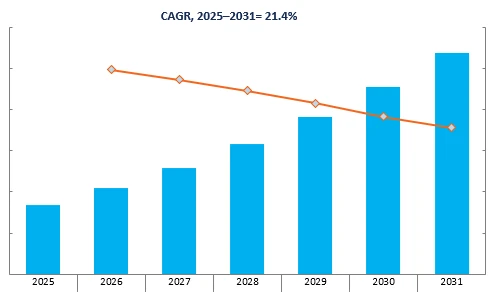
The cloud security market is therefore moving from point solutions toward larger integrated security platforms. Revenue expansion is expected to be supported by increased enterprise spending on consolidated security architectures, runtime protection, AI security, data security, identity security, detection and response, and automated security operations.
Growth Drivers: Total Cloud Security Market
Expansion of Cloud-Native, Hybrid, and Multi-Cloud Environments
The increasing complexity of cloud infrastructure is expanding the attack surface across infrastructure, workloads, identities, applications, data, APIs, containers, Kubernetes, and AI assets. This is increasing demand for platforms capable of correlating security risks across multiple technology layers.
Shift Toward Runtime-Validated Risk
Organizations increasingly need to determine whether vulnerabilities and exposures are exploitable rather than relying exclusively on static posture findings. Runtime context, exploitability analysis, reachability, and business impact are becoming important requirements for modern cloud-security platforms.
Convergence of Cloud Security and SecOps
The convergence of CloudSec and SecOps is driving adoption of CDR, ADR, and CNADR capabilities. Organizations are seeking security platforms that support detection, investigation, response, containment, and remediation across production cloud environments.
Tool Consolidation
Security teams face tool sprawl, alert fatigue, fragmented ownership, and remediation friction. These challenges are increasing interest in CNAPP and broader cloud-security platforms capable of consolidating multiple security functions under a common operating model.
Rapid AI Adoption
The rapid deployment of AI workloads is expanding cloud-security requirements into AI-SPM, AI data protection, AI runtime monitoring, agent governance, and AI-assisted security operations. AI therefore represents both a new security requirement and a technology layer that can support security operations.
Regulatory and Board-Level Pressure
Increasing regulatory requirements, compliance obligations, and board-level attention to cyber risk are encouraging organizations to improve continuous compliance, measurable risk reduction, incident readiness, and operational resilience.
Growth Restraints: Total Cloud Security Market
Concerns About Solution Effectiveness
Organizations can hesitate to expand cloud-security investments when they have uncertainty about whether security tools generate actionable findings, accurately prioritize risk, or reduce real-world exposure. Demonstrating measurable security outcomes remains important for vendors.
Unclear Remediation Ownership
Cloud security frequently crosses infrastructure, development, application, data, identity, and security teams. Unclear responsibility for remediation can delay action and reduce the speed at which organizations realize value from cloud-security investments.
Integration Complexity
Many enterprises operate fragmented security architectures containing multiple vendors, legacy tools, cloud platforms, and internally developed systems. Integrating these technologies can increase deployment complexity and make unified security operations difficult to achieve.
Cloud-Native Skills Shortages
The cloud security market increasingly requires expertise spanning Kubernetes, runtime security, cloud infrastructure, AI workloads, identity, application security, and SOC investigation. Shortages of personnel with these combined capabilities can limit adoption and slow deployment.
Pricing and Licensing Complexity
Multiple product categories, overlapping functionality, consumption-based pricing, complex licensing structures, and uncertainty regarding category definitions can complicate procurement decisions. Organizations may therefore delay platform consolidation until the economic value proposition becomes clearer.
Competitive Landscape: Total Cloud Security Market
The global Total Cloud Security Market contains more than 45 competitors, with competition shaped by features, performance, user experience, cost, branding, unified management, sales support, technology, reliability, professional services, channel partnerships, and long-term vendor viability.
The leading competitors identified in the supplied study are Microsoft, CrowdStrike, Wiz, Palo Alto Networks, Trend Micro, and Sophos. Other notable participants include SentinelOne, Qualys, Aqua Security, Sysdig, Orca Security, Fortinet, Upwind, and Tenable.
The market demonstrates a relatively concentrated competitive structure, with the top five competitors accounting for 60.9% of 2025 revenue. This concentration reflects the presence of large cybersecurity vendors and rapidly scaling cloud-security specialists competing for enterprise platform adoption.
Microsoft
Microsoft participates in the market through its broader security and cloud ecosystem. Its position benefits from the integration of cloud infrastructure, identity, endpoint, security operations, and related security capabilities.
CrowdStrike
CrowdStrike is identified among the leading competitors, with its broader cloud and workload security capabilities supporting organizations seeking integrated security across distributed environments.
Wiz
Wiz represents a cloud-native security platform participant focused on providing visibility and risk context across cloud environments. Its acquisition activity also reflects continued consolidation within the market.
Palo Alto Networks
Palo Alto Networks is among the leading competitors and has expanded its cloud-security portfolio through acquisitions. The supplied study identifies acquisitions including Bridgecrew, Cider Security, and Dig Security.
Other Competitors
The competitive field also includes Trend Micro, Sophos, SentinelOne, Qualys, Aqua Security, Sysdig, Orca Security, Fortinet, Upwind, and Tenable. These companies compete across different combinations of posture management, workload protection, cloud detection and response, data security, application security, exposure management, and related capabilities.
Distribution Structure
The market uses several distribution models, including direct sales, distributors, resellers, system integrators, and service providers. Enterprise buying is increasingly influenced by platform consolidation, integration capabilities, deployment simplicity, professional services, and measurable security outcomes.
Mergers and Acquisitions
M&A activity is an important competitive-development mechanism. The study identifies transactions including Palo Alto Networks' acquisitions of Bridgecrew, Cider Security, and Dig Security; Check Point Software's acquisition of Spectral; Tenable's acquisitions of Accurics and Ermetic; Rapid7's acquisition of DivvyCloud; Aqua Security's acquisition of Argon; Sysdig's acquisition of Apolicy; Fortinet's acquisitions of Lacework and Suridata; Cisco's acquisition of Lightspin and Oort; CrowdStrike's acquisitions of Bionic, Adaptive Shield, and Flow Security; and Wiz's acquisitions of Gem Security and Dazz.
Overall, the competitive environment is moving toward broader platform architectures in which vendors combine posture, workload, identity, data, application, runtime, AI, detection, response, and remediation capabilities.
Scope of Analysis
List of Abbreviations
Segmentation
Why Is It Increasingly Difficult to Grow?
The Strategic Imperative 8™
The Impact of the Top 3 Strategic Imperatives on the Cloud Security Industry
Definitions: Cloud Security Evolution and the Need for XCS Platforms
Definitions: Architectural Pillars and Functional Domains
XCS Platforms
Market Evolution and Adoption Patterns
Market Evolution and Adoption Patterns
Technology Adoption Maturity
Revenue Estimate Disclaimer
Vendor Inclusion and Exclusion
Growth Metrics
Growth Environment
Competitive Environment
Key Competitors
Growth Drivers
Growth Driver Analysis
Growth Restraints
Growth Restraint Analysis
Forecast Considerations
Revenue Forecast
Revenue Forecast by Region
Revenue Forecast Analysis
Revenue Forecast by Technology
Pricing Trends and Forecast Analysis
Revenue Share by Vendor
Growth Metrics
Revenue Forecast
Revenue Forecast Analysis
Revenue Share by Vendor
Growth Metrics
Revenue Forecast
Revenue Forecast Analysis
Revenue Share by Vendor
Growth Metrics
Revenue Forecast
Revenue Forecast Analysis
Revenue Share by Vendor
Growth Metrics
Revenue Forecast
Revenue Forecast Analysis
Revenue Share by Vendor
Growth Opportunity 1: Increasing Demand for Runtime-Informed Cloud Security Operations
Growth Opportunity 2: AI Security as an Extension of CNAPP, DSPM, Identity, and Runtime Security
Growth Opportunity 3: Managed Cloud Security Services are Seeing Increased Demand
Vendor Landscape
CISOs' Concerns: Core Challenges
CISOs' Concerns: Governance and Compliance
CISOs' Concerns: Operational Realities
CISO Recommendations
Benefits and Impacts of Growth Opportunities
Next Steps
List of Exhibits
Legal Disclaimer
Frequently Asked Questions (FAQs) – Total Cloud Security Market
1. What is the Total Cloud Security Market?
The Total Cloud Security Market comprises platforms and solutions designed to protect cloud-native, hybrid, and multi-cloud environments. It includes capabilities such as CNAPP, CSPM, CWPP, CIEM, KSPM, DSPM, cloud detection and response, runtime security, AI security, exposure management, and related cloud-security functions.
2. What was the Total Cloud Security Market size in 2025?
The global Total Cloud Security Market generated approximately $8,382.5 million in revenue in 2025, according to the supplied Frost & Sullivan market forecast.
3. What will the Total Cloud Security Market size be by 2031?
The global Total Cloud Security Market is forecast to reach approximately $26,813.0 million by 2031, increasing from $8,382.5 million in 2025.
4. What is the CAGR of the cloud security market?
The global cloud security market is projected to grow at a 21.4% CAGR from 2025 to 2031. The forecast shows annual growth moderating from 27.7% in 2025 to 17.8% in 2031 while maintaining double-digit expansion.
5. What are the major segments of the Total Cloud Security Market?
The Total Cloud Security Market is analyzed across North America, EMEA, APAC, and LATAM. The market also encompasses capabilities including CNAPP, CSPM, CWPP, CIEM, KSPM, DSPM, CDR, AI-SPM, AI security, runtime security, application security, exposure management, and cloud-native detection and response.
6. What are the key growth drivers of the Total Cloud Security Market?
Key growth drivers include the expansion of cloud-native, hybrid, and multi-cloud environments; increasing runtime-security requirements; convergence of CloudSec and SecOps; security-tool consolidation; rapid AI adoption; and growing regulatory, board-level, and incident-response pressure.
7. Why is runtime security becoming important in the cloud security market?
Runtime security helps organizations evaluate active workloads, applications, identities, data flows, and threats in production environments. The shift toward runtime-validated risk allows security teams to better understand exploitability, exposure, business impact, and remediation priorities beyond static posture findings.
8. What are the major restraints affecting the Total Cloud Security Market?
Major restraints include concerns about the effectiveness of cloud-security solutions, unclear remediation ownership, integration complexity, fragmented security architectures, shortages of cloud-native security skills, and pricing, procurement, and licensing complexity.
9. Who are the leading companies in the Total Cloud Security Market?
Leading competitors identified in the study include Microsoft, CrowdStrike, Wiz, Palo Alto Networks, Trend Micro, and Sophos. Other notable companies include SentinelOne, Qualys, Aqua Security, Sysdig, Orca Security, Fortinet, Upwind, and Tenable.
10. Which region represents the largest Total Cloud Security Market?
North America is identified in the study as the most mature and largest regional market. Its position is supported by advanced cloud adoption, breach exposure, board-level security pressure, SOC maturity, and adoption of capabilities such as CDR, ADR, DSPM, AI security, and runtime security.
Speak directly with our analytics experts for tailored recommendations.
Recent related Security research
21 Oct 2026 | Global | Market Research
Insights for CISOs: The Transition to Quantum-Safe
The emergence of post-quantum cryptography (PQC) reflects a significant problem: powerful quantum computers may soon compromise the cryptographic algorithms underpinning today’s digital economy, threatening the confidentiality and integrity of sensitive data and communications. Addressing this risk ...
16 Oct 2026 | Global | Market Research
Customer Transformation Journeys External Risk Mitigation and Management: BitSight
This report explores how organizations are accelerating cyber risk reduction and remediation through Bitsight’s intelligent External Risk Management and Mitigation (ERMM) solution. It examines customer transformation journeys, highlighting how continuous visibility, contextualized risk intelligence,...
15 Oct 2026 | Global | Market Research
Network Detection and Response (NDR) Sector, Global, 2026–2030
This study examines the global NDR market over the 2022–2030 forecast period. It finds that rising investment reflects NDR's evolution from a discretionary security enhancement into a foundational component of enterprise cyber defense, underscoring stronger buyer commitment and heightened vendor com...
09 Oct 2026 | Global | Technology Research
Growth Opportunities in SiC MOSFET, Photodiodes, RISC-Vs, and Advanced Memory
The Microelectronics Technology Opportunity Engine covers innovations pertaining to SiC MOSFET, Photodiodes, RISC-Vs, and Advanced Memory.The Microelectronics Technology Opportunity Engine captures global electronics-related innovations and developments on a weekly basis. Developments are centered o...
09 Oct 2026 | Global | Frost Radar
Frost Radar™: Workforce Identity and Access Management, 2026
Hybrid work and software as a service have shifted security enforcement from the network perimeter to identity, transforming it into a control plane. Workforce identity and access management (IAM) now determines whether every user, device, and session should retain access based on context, risk, and...
Purchase includes:
- Report download
- Growth Dialog™ with our experts
Growth Dialog™
A tailored session with you where we identify the:- Strategic Imperatives
- Growth Opportunities
- Best Practices
- Companies to Action
Impacting your company's future growth potential.