 USD
USD GBP
GBP  CNY
CNY  EUR
EUR  INR
INR  JPY
JPY  MYR
MYR  ZAR
ZAR  KRW
KRW  THB
THB 


Alternative Protein Ingredients for Human Nutrition, Global, 2025–2032
Advanced Protein Platforms are Driving Transformational Growth through Molecular Engineering and Nutritional Performance Enhancement
03-Apr-2026
Global
Market Research
PG8Q-01-00-00-00
CM_2026_34477
Report Summary: Alternative Protein Ingredients for Human Nutrition Market
The global alternative protein market for human nutrition size was valued at USD 13,876 million in 2023 and is projected to reach USD 29,078.7 million by 2032, expanding at a CAGR of 8.5% from 2025 to 2032. The increasing demand for sustainable, scalable, and high-quality protein sources is significantly driving the growth of the Alternative Protein Market within the broader protein ingredients market.
Key Market Trends & Insights
- North America accounted for the largest revenue share in the alternative protein market for human nutrition in 2024, driven by strong innovation and consumer awareness.
- Rapid advancements in fermentation and precision biotechnology are accelerating product development in the protein ingredients market.
- Plant-based proteins continue to dominate due to cost efficiency and consumer familiarity across global markets.
- Increasing investments and partnerships are strengthening commercialization pipelines within the Alternative Protein Market.
- Demand for clean-label, high-protein, and functional food products is shaping innovation trends in the alternative protein market for human nutrition.
Market Size & Forecast
- 2023 Market Size: USD 13,876 Million
- 2032 Projected Market Size: USD 29,078.7 Million
- CAGR (2025–2032): 8.5%
- North America: Largest market in 2024
- Asia Pacific: Fastest-growing region in the Alternative Protein Market
The rapid shift toward sustainable food systems, combined with increasing consumer preference for plant-based and alternative nutrition, is accelerating the expansion of the alternative protein market for human nutrition. Food manufacturers and biotechnology companies are investing heavily in innovation to improve taste, texture, and nutritional value, addressing key adoption barriers within the protein ingredients market.
Additionally, urbanization, rising disposable incomes, and growing awareness of environmental impacts are contributing to increased consumption of alternative protein products. Emerging markets, particularly in Asia-Pacific, are witnessing strong demand due to population growth and evolving dietary habits.
Overall, the Alternative Protein Market is expected to play a transformative role in the future of global food systems, supported by technological advancements, regulatory developments, and expanding consumer acceptance across the protein ingredients market.
Market Overview: Alternative Protein Ingredients for Human Nutrition Market
The alternative protein market for human nutrition is evolving as a central pillar within the global protein ingredients market, driven by shifting consumer preferences toward sustainable and health-focused diets. Increasing concerns around climate change, resource scarcity, and animal welfare are accelerating the adoption of the Alternative Protein Market globally.
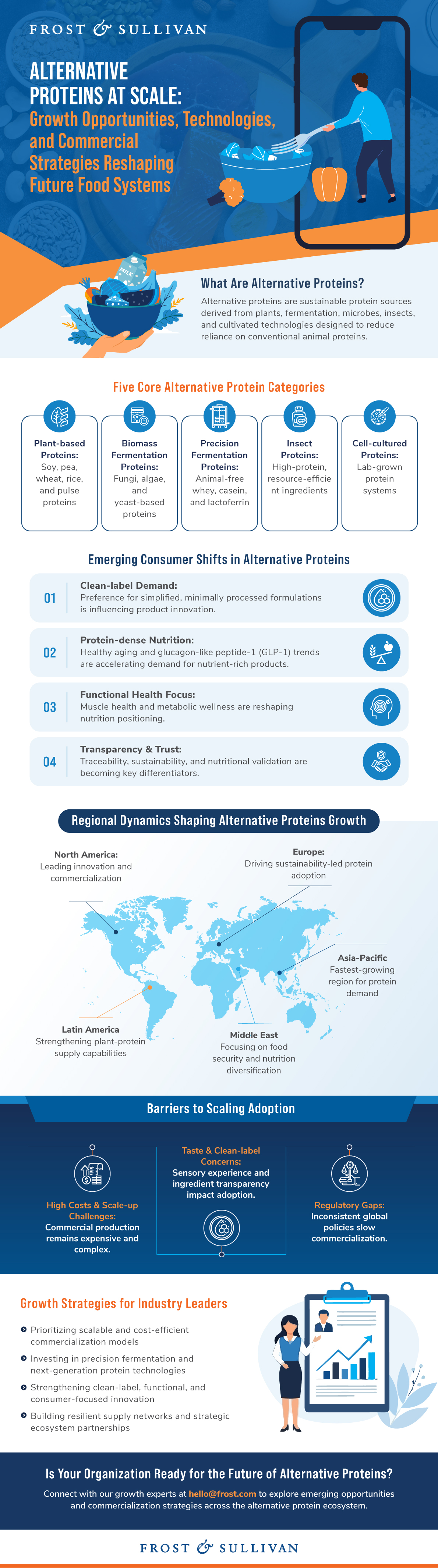
The market comprises five major categories: plant-based proteins, biomass fermentation-derived proteins, precision fermentation proteins, insect proteins, and cell-cultured proteins. Among these, plant-based proteins dominate due to established supply chains and consumer familiarity, while fermentation-based proteins are gaining traction due to scalability and functional benefits.
Technological advancements in molecular engineering, protein structuring, and fermentation efficiency are enabling improved taste, texture, and nutritional profiles. This is addressing earlier barriers associated with the alternative protein market for human nutrition, particularly in meat and dairy analog applications.
From a regional perspective, North America leads in innovation and commercialization, while Europe emphasizes regulatory alignment and sustainability. Asia-Pacific is emerging rapidly due to population growth and increasing protein demand.
The protein ingredients market is also seeing integration across food, beverage, and nutraceutical industries. Strategic partnerships, investments, and product launches are reshaping competitive dynamics within the Alternative Protein Market, making it a key growth engine for future food systems.
Scope of Analysis: Alternative Protein Ingredients for Human Nutrition Market
This study evaluates the global alternative protein market for human nutrition across multiple dimensions, including product types, applications, and geographic regions. The analysis is part of the broader protein ingredients market, focusing on emerging protein sources that address sustainability and scalability challenges.
The geographic scope includes North America, Europe, Asia-Pacific, Latin America, and the Middle East & Africa. The study period spans 2023 to 2032, with 2025 considered the base year for forecasting within the Alternative Protein Market.
Segmentation covers plant proteins (soy, wheat, pea, rice), fermentation-derived proteins (fungi, yeast, algae), insect proteins, and cell-cultured proteins. Applications analyzed include meat analogs, dairy alternatives, dietary supplements, and functional food and beverage products.
The methodology includes analysis of production technologies, regulatory frameworks, commercialization trends, and consumer adoption patterns. The alternative protein market for human nutrition is assessed based on innovation intensity, investment activity, and scalability potential.
The protein ingredients market dynamics are also evaluated in terms of supply chain development, cost structures, and regional policy support. This comprehensive approach ensures accurate forecasting and identification of growth opportunities within the Alternative Protein Market.
Market Segmentation Analysis: Alternative Protein Ingredients for Human Nutrition Market
The alternative protein market for human nutrition is segmented by type and application, forming a diverse ecosystem within the global protein ingredients market. Each segment plays a distinct role in shaping the growth trajectory of the Alternative Protein Market.
By type, plant-based proteins dominate due to widespread availability and consumer acceptance. Soy, pea, wheat, and rice proteins are extensively used in meat and dairy alternatives. Fermentation-derived proteins, including fungi and yeast-based proteins, are gaining momentum due to their scalability and consistent quality.
Precision fermentation is emerging as a high-value segment, enabling the production of specific proteins such as whey and casein without animal sources. Insect proteins remain niche but are gaining traction in dietary supplements and animal feed applications.
Cell-cultured proteins represent the most advanced segment, offering lab-grown meat solutions with high potential but currently limited commercialization.
By application, meat analogs and dairy substitutes account for the largest share in the alternative protein market for human nutrition, driven by consumer demand for plant-based diets. Functional foods and beverages, along with dietary supplements, are also expanding rapidly within the protein ingredients market.
This segmentation highlights the innovation diversity and growth potential across the Alternative Protein Market, with each category contributing uniquely to market expansion.
Revenue & Spending Forecast: Alternative Protein Ingredients for Human Nutrition Market
The alternative protein market for human nutrition demonstrates strong financial growth potential within the broader protein ingredients market. Increasing investments, technological advancements, and consumer adoption are driving consistent revenue expansion in the Alternative Protein Market.
- 2023 Market Revenue: USD 13,876 million
- 2032 Market Revenue: USD 29,078.7 million
The market is expected to grow at a CAGR of 8.5%, reflecting robust demand across food, beverage, and nutraceutical sectors. Volume growth is projected at 5.5% CAGR, indicating increasing production capacity and scalability.
Investment trends show rising funding in fermentation technologies and cell-cultured protein innovations. Cost optimization and scale-up efficiencies are expected to further enhance profitability within the alternative protein market for human nutrition.

The protein ingredients market is also benefiting from partnerships between food manufacturers and biotech firms, accelerating commercialization. As production costs decline and regulatory frameworks mature, the Alternative Protein Market is expected to achieve broader market penetration.
Growth Drivers: Alternative Protein Ingredients for Human Nutrition Market
Several key factors are driving the expansion of the alternative protein market for human nutrition, reinforcing its importance within the global protein ingredients market.
- Rising Global Protein Demand: Population growth and changing dietary patterns are increasing demand for sustainable protein sources, boosting the Alternative Protein Market.
- Shift Toward Plant-Based Diets: Growing vegan and vegetarian populations are accelerating adoption within the alternative protein market for human nutrition.
- Sustainability Concerns: Environmental impact of traditional livestock farming is pushing demand toward alternative solutions in the protein ingredients market.
- Technological Advancements: Innovations in fermentation and cell-culturing are improving product quality and scalability.
- Investment and Partnerships: Increased funding and collaborations are reducing production costs and enhancing commercialization.
- Demand for Functional Nutrition: High-protein foods and supplements are driving innovation across the Alternative Protein Market.
These drivers collectively position the alternative protein market for human nutrition as a high-growth segment with long-term expansion potential.
Growth Restraints: Alternative Protein Ingredients for Human Nutrition Market
Despite strong growth, the alternative protein market for human nutrition faces several challenges within the broader protein ingredients market.
High production costs and scale-up limitations remain significant barriers, particularly for fermentation and cell-cultured proteins. Consumer concerns regarding taste, texture, and nutritional equivalence also impact adoption rates in the Alternative Protein Market.
Regulatory inconsistencies across regions hinder global market expansion. Lack of standardized policies affects commercialization timelines and investment decisions within the alternative protein market for human nutrition.
Additionally, supply chain constraints and limited raw material availability can impact production efficiency. Price sensitivity among consumers further restricts widespread adoption in certain markets.
Addressing these challenges is critical for unlocking the full potential of the protein ingredients market and ensuring sustainable growth of the Alternative Protein Market.
Competitive Landscape: Alternative Protein Ingredients for Human Nutrition Market
The alternative protein market for human nutrition is highly competitive, with a mix of established players and emerging innovators shaping the protein ingredients market.
Key companies in plant-based proteins include major global ingredient manufacturers and food technology firms. In fermentation-based proteins, companies specializing in mycoprotein, algae, and yeast-derived solutions are gaining prominence.
Cell-cultured protein companies are at the forefront of innovation, focusing on lab-grown meat technologies. Strategic partnerships, mergers, and acquisitions are common as companies aim to expand capabilities and market reach within the Alternative Protein Market.
Innovation, scalability, and cost efficiency are key competitive factors. Companies investing in R&D and sustainable production methods are better positioned to capture growth opportunities in the alternative protein market for human nutrition.
Overall, the competitive landscape reflects rapid evolution, with continuous innovation driving differentiation across the protein ingredients market.
Scope of Analysis
Scope and Segmentation
Scope and Segmentation, Plant Proteins Market
Scope and Segmentation, Fermentation-Derived Proteins Market
Scope and Segmentation, Insect Proteins Market
Definitions
Why is it Increasingly Difficult to Grow?
The Strategic Imperative 8™
The Impact of the Top 3 Strategic Imperatives on the Alternative Protein Ingredients for Human Nutrition Industry
Alternative Protein Ingredients for Human Nutrition Market Ecosystem
Key Competitors
Growth Metrics
Growth Drivers
Growth Driver Analysis
Growth Restraints
Growth Restraint Analysis
Forecast Considerations
Revenue and Volume Forecast
Revenue Forecast by Type
Volume Forecast by Type
Revenue Forecast by Region
Volume Forecast by Region
Forecast Analysis
Forecast Analysis by Type
Forecast Analysis by Region
Growth Metrics
Revenue and Volume Forecast
Forecast Analysis
Revenue Forecast by Type
Volume Forecast by Type
Forecast Analysis by Type
Revenue Forecast by Application
Volume Forecast by Application
Revenue Forecast by Application, Other Food and Beverages
Forecast Analysis by Application
Revenue Forecast by Region
Volume Forecast by Region
Forecast Analysis by Region
Revenue Share Analysis, Plant Proteins
Competitive Environment
Competitive Benchmarking
Market Activities: Plant Protein, 2024–2026
Growth Metrics
Revenue and Volume Forecast
Revenue Forecast by Type
Volume Forecast by Type
Revenue Forecast by Application
Volume Forecast by Application
Revenue Forecast by Region
Volume Forecast by Region
Forecast Analysis
Forecast Analysis by Type: Biomass Fermentation
Forecast Analysis by Application: Biomass Fermentation
Forecast Analysis by Region: Biomass Fermentation
Competitive Environment
Competitive Benchmarking
Market Activities: Biomass-Derived Protein, 2024–2026
Growth Metrics
Revenue Forecast
Revenue Forecast by Region
Revenue Share Analysis: By Type of Precision Fermentation
Forecast Analysis: Precision Fermentation
Revenue Share Analysis by Type: Precision Fermentation
Revenue Forecast Analysis by Region: Precision Fermentation
Competitive Environment
Competitive Landscape
Market Activities: Precision Fermentation, 2023–2025
Growth Metrics
Forecast Analysis
Opportunity Forecast Scenario*: Cell-Cultured Proteins
Competitive Landscape: Cell-Cultured Proteins
Market Activities: Cell-Cultured Proteins, 2024–2026
Growth Opportunity 1: Precision Fermentation–Derived Animal Proteins
Growth Opportunity 2: Microbial/Single-Cell Protein (SCP) Produced Using Low-Cost, Sustainable Feedstocks
Growth Opportunity 3: Hybrid Protein Formulations Combining Alternative and Conventional Proteins
Growth Opportunity 4: Proteins for Muscle Health
Growth Opportunity 5: Dairy Companies are Redefining Growth by Becoming Diversified Protein Solution Providers
Benefits and Impacts of Growth Opportunities
Next Steps
List of Exhibits
Legal Disclaimer
Frequently Asked Questions (FAQ) – Alternative Protein Market for Human Nutrition
1. What is the alternative protein market for human nutrition?
The alternative protein market for human nutrition includes protein sources such as plant-based, fermentation-derived, insect, and cell-cultured proteins designed to replace traditional animal-based proteins.
2. What is driving growth in the Alternative Protein Market?
Growth in the Alternative Protein Market is driven by sustainability concerns, rising vegan and vegetarian populations, technological advancements, and increasing demand for high-protein functional foods.
3. How large is the protein ingredients market?
The protein ingredients market is experiencing strong growth globally, supported by increasing demand for alternative protein sources and innovations in food and beverage applications.
4. What are the main types of alternative proteins?
The main types include plant-based proteins, biomass fermentation proteins, precision fermentation proteins, insect proteins, and cell-cultured proteins.
5. Which region leads the alternative protein market for human nutrition?
North America leads the alternative protein market for human nutrition due to strong innovation and consumer awareness, while Asia-Pacific is the fastest-growing region.
6. What are the key applications in the Alternative Protein Market?
Key applications include meat analogs, dairy alternatives, dietary supplements, and functional food and beverage products.
7. What challenges does the protein ingredients market face?
The protein ingredients market faces challenges such as high production costs, scalability issues, taste and texture concerns, and regulatory barriers.
8. What is the projected growth of the Alternative Protein Market?
The Alternative Protein Market is projected to grow at a CAGR of around 8.5% from 2025 to 2032, driven by increasing adoption and innovation.
9. Why are plant-based proteins dominant in the alternative protein market for human nutrition?
Plant-based proteins dominate due to their affordability, established supply chains, and high consumer acceptance compared to newer protein technologies.
10. How is technology shaping the Alternative Protein Market?
Technology is enhancing product quality, taste, and scalability through innovations in fermentation, molecular engineering, and cell-cultured protein production.
Speak directly with our analytics experts for tailored recommendations.
Recent related Nutritional and Health Ingredients research
05 Oct 2026 | Global | Market Research
Impact of GLP-1 on Nutraceuticals, Global, 2025–2032
The rapid adoption of GLP-1 therapies is reshaping the weight management landscape and creating a new set of nutritional needs among consumers using these treatments. While GLP-1 therapies have demonstrated significant benefits for weight loss and metabolic health, associated challenges—including re...
03 Sep 2026 | Global | Market Research
Biotics in Animal Nutrition, Global, 2025–2032
The study analyzes probiotics, prebiotics, and postbiotics used in animal feed, pet food, and supplements, focusing strictly on ingested biotics impacting gut health and performance outcomes. The scope excludes non-feed applications (e.g., silage inoculants, aquaculture bioremediation, and other env...
03 Jul 2026 | Global | Market Research
Medical Food Ingredients Market, Global, 2025–2032
The research assesses growth opportunities for medical food ingredients across key therapeutic applications and regional markets. Medical foods, also referred to as Foods for Special Medical Purposes (FSMPs), occupy a distinct regulatory and commercial position between pharmaceuticals and nutraceuti...
16 Jun 2026 | Global | Market Research
Infant Formula Ingredients Market, Global, 2025–2032
The research assesses growth opportunities for infant formula ingredients across key application segments and regional markets. Driven by demographic shifts, urbanization, and changing lifestyles, infant formula continues to play a critical role in meeting infant nutrition needs, particularly where ...
29 Apr 2026 | Global | Frost Radar
Frost Radar: Non-polluting Flavoring and Coloring Agents, 2026
The market for non-polluting flavoring and coloring agents is transforming because of stricter regulation of synthetic additives, demand for clean-label products, and a focus on sustainability. Natural, bio-based alternatives, such as plant-derived extracts and upcycled ingredients, are replacing co...
Purchase includes:
- Report download
- Growth Dialog™ with our experts
Growth Dialog™
A tailored session with you where we identify the:- Strategic Imperatives
- Growth Opportunities
- Best Practices
- Companies to Action
Impacting your company's future growth potential.
The report examines five major categories of alternative protein ingredients: plant-derived proteins, biomass fermentation-derived proteins, precision fermentation-derived proteins, insect proteins, and cell-cultured proteins. Each category is evaluated in terms of production technologies, ingredient functionality, regulatory landscape, commercialization status, and adoption trends across regions.
In addition, the study analyzes the application landscape of alternative proteins across multiple end-use segments, including meat analogs, dairy analogs, dietary supplements, and functional food and beverage products. The research highlights how ingredient innovation, processing advancements, and consumer demand for clean-label, high-protein, and sustainable products are shaping product development strategies within these application areas.
Regional analysis explores differences in regulatory frameworks, consumer acceptance, investment activity, and technological development across North America, Europe, Asia-Pacific, Latin America, and the Middle East and Africa. The study identifies key growth drivers, market barriers, and emerging opportunities influencing the adoption of alternative protein ingredients globally.
Overall, this research provides a strategic overview of the evolving alternative protein ecosystem, highlighting technological innovations and market dynamics expected to influence the future of protein ingredients for human nutrition.
Author: Akheela Dhiman
| Deliverable Type | Market Research |
|---|---|
| Industries | Chemicals and Materials |
| No Index | No |
| Is Prebook | No |
| Keyword 1 | Alternative Protein Ingredients Market |
| Keyword 2 | Alternative Protein Market |
| Keyword 3 | protein ingredients market |
| Podcast | No |
| Predecessor | PEDE-01-00-00-00 |
| WIP Number | PG8Q-01-00-00-00 |