 USD
USD GBP
GBP  CNY
CNY  EUR
EUR  INR
INR  JPY
JPY  MYR
MYR  ZAR
ZAR  KRW
KRW  THB
THB 


Engine and Cabin Thermal Management Systems in the PV and LCV Industries is Experiencing Transformational Growth due to Technological Progress and High Utilization Requirement
15-Sep-2025
South Asia, Middle East & North Africa
Market Research
PFU9-01-00-00-00
AU_2025_33872
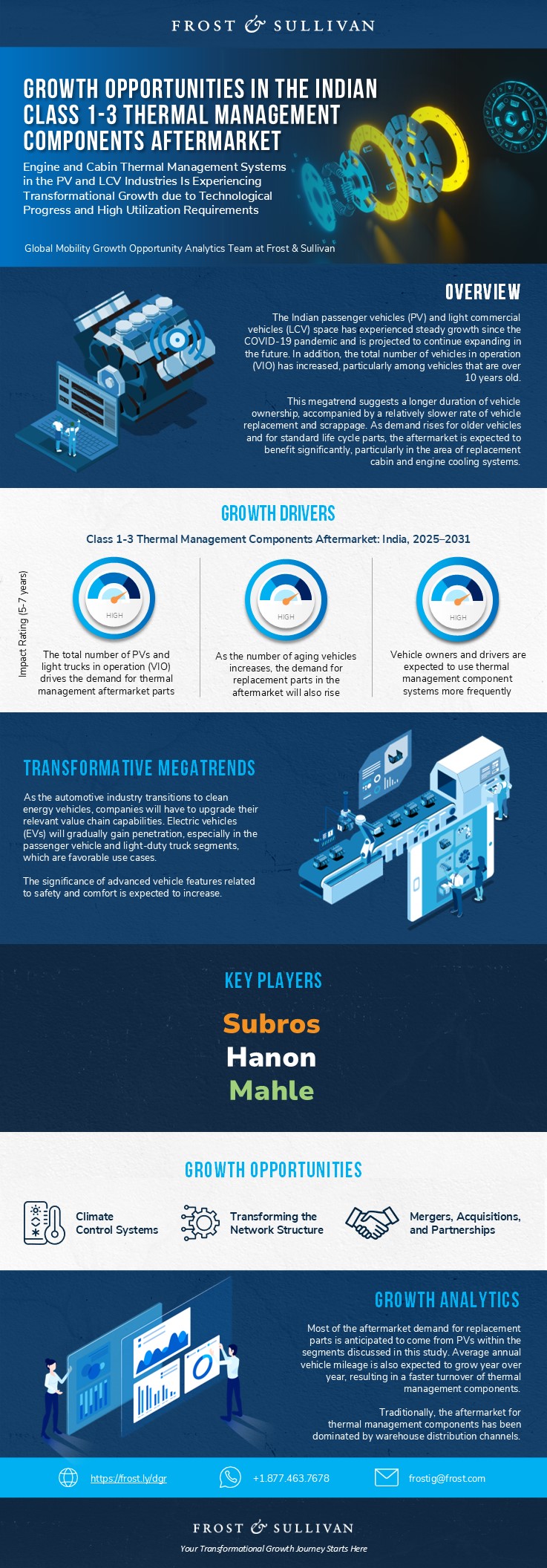
The Indian passenger vehicles (PV) and light commercial vehicles (LCV) market has experienced steady growth since the COVID-19 pandemic and is projected to continue expanding in the future. In addition, the total number of vehicles in operation (VIO) has increased, particularly among vehicles that are over 10 years old. This trend suggests a longer duration of vehicle ownership, accompanied by a relatively slower rate of vehicle replacement and scrappage. As demand rises for older vehicles and for standard life cycle parts, the aftermarket is expected to benefit significantly, particularly in the area of replacement cabin and engine cooling systems. This demand is further influenced by factors such as worsening climatic conditions, traffic congestion, longer transit times, and changing driver habits. Most of the aftermarket demand for replacement parts is anticipated to come from PVs within the segments discussed in this study. Average annual vehicle mileage is also expected to grow year over year, resulting in a faster turnover of thermal management components. Traditionally, the aftermarket for thermal management components has been dominated by warehouse distribution channels, and this trend is expected to continue throughout the forecast period. This study explores the market landscape and dynamics of thermal management components for PVs and LCVs. It examines growth in terms of unit shipment and revenue from 2025 to 2031 while discussing factors that influence the market dynamics.
Author: Jagadesh Chandran
The Impact of the Top 3 Strategic Imperatives on the Indian Class 1-3 Thermal Management Components Aftermarket Industry
Customer Value Chain Compression
- Why
- Major suppliers with established technological and value chain footprints will continue to focus on the Indian automotive industry.
- Manufacturers continually look to extend their supply chain channels or cut cost contributions in line with new technologies and prefer beneficial, cost-effective, and superior partnership opportunities.
- Frost Perspective
- New technological and supplier partnerships are expected as companies evaluate their positioning strategy for the product line they offer.
- Motor vehicle manufacturers should incorporate advanced and updated thermal management product lines in their vehicle models to cater to changing Indian automotive market needs.
- Global suppliers are expected to streamline their product portfolios to succinctly organize their offerings.
Transformative Megatrends
- Why
- As the automotive industry transitions to clean energy vehicles, companies will have to upgrade their relevant value chain capabilities. Electric vehicles (EVs) will gradually gain penetration, especially in the passenger vehicle and light-duty truck segments, which are favorable use cases.
- The significance of advanced vehicle features related to safety and comfort is expected to increase.
- Frost Perspective
- EV demand will influence manufacturers' market strategies and targets. The performance of EVs and their content will be closely monitored and improved during the early phases of adoption.
- Customer preferences regarding safety and comfort will continue to improve, becoming a crucial factor influencing purchasing decisions across various regions.
Geopolitical Chaos
- Why
- The changing geopolitical landscape, with recent revisions in trade pacts, tariffs, and regional commitments, compels companies to re-examine their market strategies.
- Owing to impending trade bottlenecks in the US market for European suppliers, they will look to expand their presence in other markets such as India.
- Frost Perspective
- The incumbent dominance of Asian suppliers will challenge European suppliers in the Indian OE supply channel.
- New joint venture or strategic collaborations can be expected in the near future.
- Reorganizing of supply channels will provide opportunities for on-demand services to grow.
Scope of the Study
| Geographic Coverage | India |
|---|---|
| Study Period | 2021–2031 |
| Base Year | 2024 |
| Forecast Period | 2025–2031 |
| Monetary Unit (?) | All prices and revenue are at the manufacturer or direct-import level when the product enters the 1st level of distribution, unless the analysis mentions otherwise. |
| Vehicle Classification | Passenger vehicles (PVs) and light trucks or light commercial vehicles (LCVs) of Class 1 to Class 3 gross vehicle weight rating (GVWR) |
Competitive Environment
| Number of Competitors | About 15 major companies |
|---|---|
| Competitive Factors | Cost, performance, durability, serviceability, availability, sales network, brand perception |
| Key End-user Industry Verticals | Automotive aftermarket |
| Leading Competitors | Subros, Hanon, Mahle, Doowon, Sanden |
| Unit Shipment Market Share of Top 5 Competitors* | 88%-90% |
| Other Notable Competitors | Denso, Tata Toyo, Hella, Delphi, Estra |
| Distribution Structure | OEMs, retail sales, direct sales, independent aftermarket sales |
Key Competitors
| Competitor |
|---|
| Subros |
| Hanon Systems |
| Mahle |
| Doowon |
| Sanden |
| Delphi |
| Hella |
| Denso |
| Valeo |
| Motherson |
Growth Drivers
- In 2024, the total number of PVs and light trucks in operation (VIO) in India was about 54.9 million, and this number is expected to exceed 70 million by 2030. The demand for thermal management aftermarket parts will be closely related to the number of vehicles on the road, necessitating consistent market growth to meet the increasing demand in the coming years.
- In 2024, more than a quarter of the total VIO was over 10 years old, and this ratio is anticipated to rise steadily. To accommodate growing economic needs, the rate of vehicle phase-out is expected to decrease. Consequently, as the number of aging vehicles increases, the demand for replacement parts in the aftermarket will also rise.
- Owing to adverse climatic conditions and forecasts, vehicle owners and drivers are expected to use thermal management component systems more frequently. Moreover, longer transit times in urban traffic are likely to result in increased use of these systems.
- External factors, such as dust buildup and contamination, as well as a lack of proper periodic maintenance of thermal management component systems, will lead to higher demand for replacements.
- The evolution of cabin heating and cooling systems, which are increasingly seen as a safety feature rather than merely a comfort aspect, will drive the need for better functioning thermal management component systems at all times.
Growth Restraints
- Improvements in the quality and durability of thermal management components will extend replacement cycles. In the aftermarket, the interval between consecutive replacements is likely to be longer, as service personnel and vehicle owners choose improved and more durable products.
- Stricter enforcement of traffic rules, including speed limits, streamlined traffic flow, and improved infrastructure, will reduce accident rates. In addition, a decrease in vehicle collisions is anticipated with the increased adoption of ADAS in new vehicles.
- The functional requirements and performance characteristics of thermal management systems for BEV powertrains differ from those of ICE powertrains. As BEVs continue to penetrate the market, the demand for thermal management components for ICE powertrains is likely to decline.
- With the government’s recent focus on enhancing public transportation infrastructure in densely populated urban areas, private vehicle users will turn to improved public transportation options.
- Vehicle aggregation and pooling practices will reduce the individual vehicle usage rate; however, the thermal management components consumption rate will increase in such cases.
Scope of the Study
Key Questions The Study Answers
Product Segmentation and Definition
Why is it Increasingly Difficult to Grow?
The Strategic Imperative 8
The Impact of the Top 3 Strategic Imperatives on the Indian Class 1-3 Thermal Management Components Aftermarket Industry
Ecosystem in Category Management: Class 1-3 Thermal Management Components Aftermarket in India, 2025
Value Chain Structure
Competitive Environment
Key Competitors
Category Management: Class 1-3 Thermal Management Components Aftermarket, India—Growth Metrics
Key Findings
Growth Drivers
Growth Restraints
Factors Driving the Thermal Management Components Aftermarket
CASE Implications
Forecast Considerations
Unit Shipment and Revenue Forecast
Unit Shipment Forecast by Product Segment
Revenue Forecast by Product Segment
Average Price by Product Segment
Distribution Channel Revenue Share
Market Share at OEM First Fitment
Replacement Compressors—Growth Metrics
Replacement Compressors—Unit Shipment Forecast
Replacement Compressors—Revenue Forecast
Replacement Compressors—Average MLP
Replacement Compressors—Market Share at OEM First Fitment
Replacement eCompressors—Growth Metrics
Replacement eCompressors—Unit Shipment Forecast
Replacement eCompressors—Revenue Forecast
Replacement eCompressors—Average MLP
Summary: Replacement Compressors Aftermarket Analysis
Replacement Evaporators—Growth Metrics
Replacement Evaporators—Unit Shipment Forecast
Replacement Evaporators—Revenue Forecast
Replacement Evaporators—Average MLP
Replacement Evaporators—Market Share at OEM First Fitment
Summary: Replacement Evaporators Aftermarket Analysis
Replacement Radiators—Growth Metrics
Replacement Radiators—Unit Shipment Forecast
Replacement Radiators—Revenue Forecast
Replacement Radiators—Average MLP
Replacement Radiators—Market Share at OEM First Fitment
Summary: Replacement Radiators Aftermarket Analysis
Replacement Condensers—Growth Metrics
Replacement Condensers—Unit Shipment Forecast
Replacement Condensers—Revenue Forecast
Replacement Condensers—Average MLP
Replacement Condensers—Market Share at OE First Fitment
Summary: Replacement Condensers Aftermarket Analysis
3 Big Predictions
Growth Opportunity 1: Climate Control Systems
Growth Opportunity 2: Transforming the Network Structure
Growth Opportunity 3: Mergers, Acquisitions, and Partnerships
Benefits and Impacts of Growth Opportunities
Next Steps
List of Exhibits
Legal Disclaimer
Speak directly with our analytics experts for tailored recommendations.
Recent related Aftermarket research
06 Oct 2026 | Asia Pacific | Market Research
Aftermarket Replacement Turbochargers in Medium- Duty and Heavy-Duty Commercial Vehicles, China, 2026–2032
China's medium- and heavy-duty truck turbocharger aftermarket is entering a mature yet resilient phase, supported by a vehicle parc exceeding 10 million units and sustained replacement demand despite increasing battery electric vehicle (BEV) sales. While turbocharger penetration is nearing saturatio...
16 Sep 2026 | North America | Customer Research
US Automotive Technicians’ Choice Survey, 2025
The 2025 US Automotive Technicians’ Choice study is an insightful voice-of-customer survey that highlights the tool preferences of automotive aftermarket service technicians. The survey of 400 automotive technicians across the United States used a combination of computer-assisted telephone and compu...
17 Aug 2026 | Asia Pacific | Market Research
Passenger Vehicle and Light Commercial Vehicle Aftermarket, APAC, 2024–2032
In this research service, Frost & Sullivan has assessed the automotive aftermarket in the Asia-Pacific (APAC) region, focusing on Australia, China, Indonesia, Japan, Malaysia, and Thailand. The research service provides an aftermarket overview for 2025, covering automotive aftermarket performance an...
13 Aug 2026 | Global | Market Research
AI in the Global Automobile Aftermarket
This analysis examines the AI applications reshaping the automotive aftermarket ecosystem, exploring key adoption areas, regional dynamics, emerging use cases, and AI-driven investments driving change in operations and business models. Structured into six core segments, the report focuses on major v...
23 Jul 2026 | Global | Market Outlook
Growth Opportunities in the Automotive Aftermarket, Global, 2026
The global automotive aftermarket for light vehicles (≤6T GVWR) continues to demonstrate resilience despite moderating momentum in new vehicle sales. With a base year of 2025, this study evaluates market trends through 2030, providing a global perspective with region-specific insights for North Amer...
Purchase includes:
- Report download
- Growth Dialog™ with our experts
Growth Dialog™
A tailored session with you where we identify the:- Strategic Imperatives
- Growth Opportunities
- Best Practices
- Companies to Action
Impacting your company's future growth potential.
Author: Jagadesh Chandran
| Deliverable Type | Market Research |
|---|---|
| Industries | Automotive |
| No Index | No |
| Is Prebook | No |
| Keyword 1 | thermal management aftermarket India |
| Keyword 2 | automotive cooling components market |
| Keyword 3 | vehicle aftermarket growth report |
| Podcast | No |
| Predecessor | None |
| WIP Number | PFU9-01-00-00-00 |