 USD
USD GBP
GBP  CNY
CNY  EUR
EUR  INR
INR  JPY
JPY  MYR
MYR  ZAR
ZAR  KRW
KRW  THB
THB 


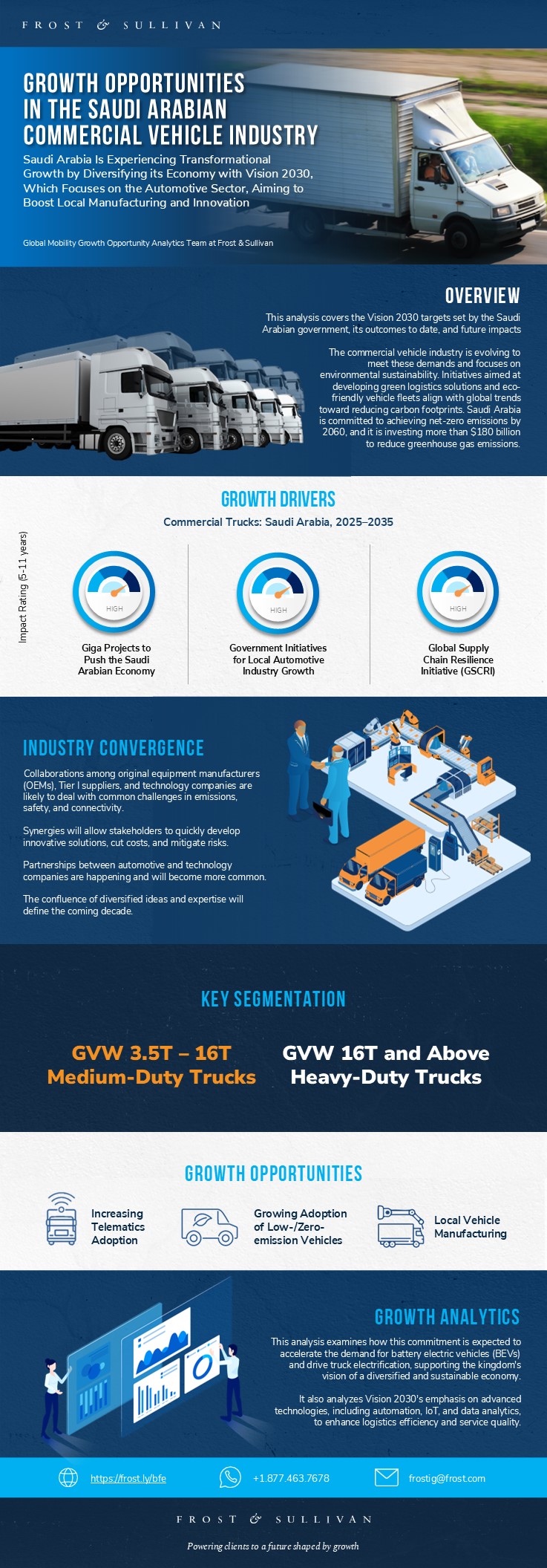
Saudi Arabia is Experiencing Transformational Growth by Diversifying its Economy with Vision 2030, Which Focuses on the Automotive Sector, Aiming to Boost Local Manufacturing and Innovation
10-Oct-2024
Global
Market Research
PFPF-01-00-00-00
AU_2024_1053
Saudi Arabia is undergoing significant economic transformation driven by its Vision 2030 initiative, which aims to reduce dependency on oil and diversify revenue sources. Historically reliant on oil exports, the kingdom is enhancing non-oil sectors to foster sustainable growth. As the second-largest contributor to the Middle East economy after the UAE, Saudi Arabia's economy has grown at an approximate annual rate of 27%. Within the Gulf Cooperation Council (GCC), Saudi Arabia is the largest market for new and used vehicles and automotive parts, leading in automotive imports from the United States, with a portion re-exported.
This study covers the Vision 2030 targets set by the Saudi Arabian government, its outcomes to date, and future impacts.
The truck market, which primarily relies on imports, includes major companies such as Daimler, Mitsubishi Fuso, Hino, Isuzu, Scania, and SinoTruk. The Saudi government promotes localization to bolster the economy, with a projected growth rate of 3% for medium-duty trucks (MDTs) and 5% for heavy-duty trucks (HDTs), according to Frost & Sullivan estimates.
This study examines Vision 2030's emphasis on advanced technologies, including automation, IoT, and data analytics, to enhance logistics efficiency and service quality.
The commercial vehicle industry is evolving to meet these demands and focuses on environmental sustainability. Initiatives aimed at developing green logistics solutions and eco-friendly vehicle fleets align with global trends toward reducing carbon footprints. Saudi Arabia is committed to achieving net-zero emissions by 2060, and it is investing more than $180 billion to reduce greenhouse gas emissions. This study analyzes how this commitment is expected to accelerate the demand for battery electric vehicles (BEVs) and drive truck electrification, supporting the kingdom's vision of a diversified and sustainable economy.
Market Segmentation
Trucks
- GVW 3.5T – 16T
- Medium Duty
- GVW 16T & above
- Heavy Duty
- Medium-duty trucks represent all types of mid-size trucks and vans with GVW between 3,500 kg and 16,000 kg. Typical applications include home delivery, logistics, parcel delivery, utilities, waste collection and recycling, and airport operations.
- Heavy-duty trucks constitute all types of large trucks with GVW of more than 16,000 kg. Typical applications include line haul freight trucks, refuse trucks, mining and construction trucks, and other types of vocations that demand high GVWR trucks.
The Impact of the Top Three Strategic Imperatives on the Commercial Trucks Industry
Industry Convergence
- Why
- Collaborations among original equipment manufacturers (OEMs), Tier I suppliers, and technology companies are likely to deal with common challenges in emissions, safety, and connectivity.
- Synergies will allow stakeholders to quickly develop innovative solutions, cut costs, and mitigate risks.
- Frost Perspective
- Partnerships between automotive and technology companies are happening and will become more common.
- The confluence of diversified ideas and expertise will define the coming decade.
Internal Challenges
- Why
- The trucking industry, dominated by legacy companies with old ideas and resistance to change, has attracted interest from tech-savvy start-ups in recent years.
- These young companies are rewriting the rules of the game through high-level technology and artificial intelligence (AI).
- Frost Perspective
- The next 2-5 years will see many new participants entering the market, especially in electrification.
- Numerous technology companies want a piece of the trucking pie and are working on connectivity, freight brokerage, and autonomous driving.
Transformative Megatrends
- Why
- Frost & Sullivan’s mobility revolution megatrend considers how autonomous mobility, green transportation, and new mobility models will shape our future world.
- In the trucking industry, the keywords are connected, autonomous, shared, and electric (CASE).
- Each will contribute to a cleaner, safer, and more sustainable environment.
- Frost Perspective
- Connected and shared technologies in the form of telematics and digital freight brokerage are in the nascent stage but are already in deployment.
- Frost & Sullivan expects a proliferation of electric trucks in this decade.
- Depending on the level, autonomous driving is still 5-10 years away.
Saudi Arabia: HDT Forecast
Commercial Trucks: HDT Forecast, Saudi Arabia, 2024–2035
CAGR (2024-2035): 5.5%
The HDT truck market in Saudi Arabia will grow at a 5.5% CAGR. Demand will increase due to favorable economic growth, the increasing urbanization, and Vision 2030.

Saudi Arabia: MDT Forecast
Commercial Trucks: MDT Forecast, Saudi Arabia, 2024–2035
CAGR (2024-2035): 3.1%
Owing to the increased demand due to favorable economic growth, increased urbanization, and Vision 2030, the Saudi Arabian MDT truck market will grow at a 3.1% compound annual growth rate (CAGR).

Why is it Increasingly Difficult to Grow?
The Strategic Imperative 8™
The Impact of the Top Three Strategic Imperatives on the Commercial Trucks Industry
Geographic and Economic Parameters, 2023
Economic Landscape
Focus on Economic Diversification
Research Scope
Market Segmentation
Growth Metrics
Growth Drivers
Growth Restraints
Saudi Arabia: Automotive Business Overview
Emission and Fuel Regulations
Key OEM Developments
Daimler Truck: Product Portfolio and Distributor Network
Mitsubishi Fuso Truck and Bus Corp: Product Portfolio and Distributor Network
Hino Motors: Product Portfolio and Distributor Network
MAN Truck & Bus Company: Product Portfolio and Distributor Network
UD Trucks: Product Portfolio and Distributor Network
Hyundai Motor Company: Product Portfolio and Distributor Network
Scania CV AB: Product Portfolio and Distributor Network
Isuzu Motors: Product Portfolio and Distributor Network
China National Heavy Duty Truck Group Co Ltd: Product Portfolio and Distributor Network
Key OEMs’ Platform Presence
OEMs’ Engine Power Coverage
OEMs’ GVW Coverage
Key OEMs: Product Coverage Comparison Based on GVW and Power
Key Forecast Criteria
Saudi Arabia: MDT Forecast
Saudi Arabia: HDT Forecast
Saudi Arabia: Key OEMs’ Market Share
Saudi Arabia: Key OEMs’ Market Share (continued)
Vision 2030 and its Impact on Automotive OEMs
Key Takeaways for Automotive OEMs
Growth Opportunity 1: Increasing Telematics Adoption
Growth Opportunity 1: Increasing Telematics Adoption (continued)
Growth Opportunity 2: Growing Adoption of Low-/Zero-emission Vehicles
Growth Opportunity 2: Growing Adoption of Low-/Zero-emission Vehicles (continued)
Growth Opportunity 3: Local Vehicle Manufacturing
Growth Opportunity 3: Local Vehicle Manufacturing (continued)
Abbreviations
Benefits and Impacts of Growth Opportunities
Next Steps
List of Exhibits
List of Exhibits (continued)
Legal Disclaimer
 List of Figures
- GDP and Oil Dependency, Saudi Arabia, 2000–2023
- Key Factors Driving Economic Diversification, Saudi Arabia, 2024
- Commercial Trucks: Growth Metrics, Saudi Arabia, 2024
- Commercial Trucks: Growth Drivers, Saudi Arabia, 2025–2035
- Commercial Trucks: Growth Restraints, Saudi Arabia, 2025–2035
- Commercial Trucks: Ecosystem and Business Overview, Saudi Arabia, 2024
- Commercial Trucks: Emission and Fuel Regulations, Saudi Arabia, 2024
- Commercial Trucks: OEM Developments, Saudi Arabia, 2024
- Commercial Trucks: Daimler Truck’s Strategy, Saudi Arabia, 2024
- Commercial Trucks: Mitsubishi Fuso Truck and Bus Corp’s Strategy, Saudi Arabia, 2024
- Commercial Trucks: Hino Motors’ Strategy, Saudi Arabia, 2024
- Commercial Trucks: MAN Truck & Bus Company’s Strategy, Saudi Arabia, 2024
- Commercial Trucks: UD Trucks’ Strategy, Saudi Arabia, 2024
- Commercial Trucks: Hyundai Motor Company’s Strategy, Saudi Arabia, 2024
- Commercial Trucks: Scania CV AB’s Strategy, Saudi Arabia, 2024
- Commercial Trucks: Isuzu Motors’ Strategy, Saudi Arabia, 2024
- Commercial Trucks: CNHTC’s Strategy, Saudi Arabia, 2024
- Commercial Trucks: Platform Models’ Applicability, Saudi Arabia, 2024
- Commercial Trucks: Engine Horsepower Comparison, Saudi Arabia, 2024
- Commercial Trucks: GVW Comparison, Saudi Arabia, 2024
- Commercial Trucks: Product Coverage Based on GVW and Engine Power, Saudi Arabia, 2024
- Commercial Trucks: Key Forecast Criteria, Saudi Arabia, 2024
- Commercial Trucks: MDT Forecast, Saudi Arabia, 2024–2035
- Commercial Trucks: HDT Forecast, Saudi Arabia, 2024–2035
- Commercial Trucks: Key Takeaways for Automotive OEMs, 2024
Speak directly with our analytics experts for tailored recommendations.
Recent related Automotive research
06 Oct 2026 | Asia Pacific | Market Research
Aftermarket Replacement Turbochargers in Medium- Duty and Heavy-Duty Commercial Vehicles, China, 2026–2032
China's medium- and heavy-duty truck turbocharger aftermarket is entering a mature yet resilient phase, supported by a vehicle parc exceeding 10 million units and sustained replacement demand despite increasing battery electric vehicle (BEV) sales. While turbocharger penetration is nearing saturatio...
25 Sep 2026 | Global | Technology Research
Growth Opportunities in Next-Gen Wireless EV charging, Automotive Grade IoT module, Autonomous driving, E-bike Platform, UAVs, and 4D Radars
The Mobility Technology Opportunity Engine (TOE) covers innovations pertaining to EV charging, Automotive Grade IoT module, Autonomous driving, E-bike Platform, UAVs, and 4D Radars.The purpose of the Mobility Technology TOE is to raise awareness of global technology innovations in self-propelled gro...
22 Sep 2026 | Global | Market Research
Growth Opportunities in the Global EV Power Electronics Market, 2025–2032
The rapid push toward e-mobility is accelerating adoption of advanced power electronics by major OEMs. Power electronics underpin electric vehicle reliability, efficiency, and performance. Core systems, including traction inverters, onboard chargers, and DC-DC converters, are gaining strategic impor...
16 Sep 2026 | North America | Customer Research
US Automotive Technicians’ Choice Survey, 2025
The 2025 US Automotive Technicians’ Choice study is an insightful voice-of-customer survey that highlights the tool preferences of automotive aftermarket service technicians. The survey of 400 automotive technicians across the United States used a combination of computer-assisted telephone and compu...
10 Sep 2026 | Global | Market Research
Global Robobus Market, 2026–2032
The global robobus market is at an inflection point. Large autonomous buses are no longer a concept—they are running as paid public services in China, South Korea, Norway, Switzerland, Finland, and the Netherlands. Europe is in its first wave of real deployment, with active L4 commercial service acr...
Purchase includes:
- Report download
- Growth Dialog™ with our experts
Growth Dialog™
A tailored session with you where we identify the:- Strategic Imperatives
- Growth Opportunities
- Best Practices
- Companies to Action
Impacting your company's future growth potential.
| Deliverable Type | Market Research |
|---|---|
| Author | Gnanaprakash Shanmugam |
| Industries | Automotive |
| No Index | No |
| Is Prebook | No |
| Keyword 1 | Saudi commercial vehicles |
| Keyword 2 | Saudi vehicle trends |
| Keyword 3 | Saudi fleet growth |
| List of Charts and Figures | GDP and Oil Dependency, Saudi Arabia, 2000–2023~ Key Factors Driving Economic Diversification, Saudi Arabia, 2024~ Commercial Trucks: Growth Metrics, Saudi Arabia, 2024~ Commercial Trucks: Growth Drivers, Saudi Arabia, 2025–2035~ Commercial Trucks: Growth Restraints, Saudi Arabia, 2025–2035~ Commercial Trucks: Ecosystem and Business Overview, Saudi Arabia, 2024~ Commercial Trucks: Emission and Fuel Regulations, Saudi Arabia, 2024~ Commercial Trucks: OEM Developments, Saudi Arabia, 2024~ Commercial Trucks: Daimler Truck’s Strategy, Saudi Arabia, 2024~ Commercial Trucks: Mitsubishi Fuso Truck and Bus Corp’s Strategy, Saudi Arabia, 2024~ Commercial Trucks: Hino Motors’ Strategy, Saudi Arabia, 2024~ Commercial Trucks: MAN Truck & Bus Company’s Strategy, Saudi Arabia, 2024~ Commercial Trucks: UD Trucks’ Strategy, Saudi Arabia, 2024~ Commercial Trucks: Hyundai Motor Company’s Strategy, Saudi Arabia, 2024~ Commercial Trucks: Scania CV AB’s Strategy, Saudi Arabia, 2024~ Commercial Trucks: Isuzu Motors’ Strategy, Saudi Arabia, 2024~ Commercial Trucks: CNHTC’s Strategy, Saudi Arabia, 2024~ Commercial Trucks: Platform Models’ Applicability, Saudi Arabia, 2024~ Commercial Trucks: Engine Horsepower Comparison, Saudi Arabia, 2024~ Commercial Trucks: GVW Comparison, Saudi Arabia, 2024~ Commercial Trucks: Product Coverage Based on GVW and Engine Power, Saudi Arabia, 2024~ Commercial Trucks: Key Forecast Criteria, Saudi Arabia, 2024~ Commercial Trucks: MDT Forecast, Saudi Arabia, 2024–2035~ Commercial Trucks: HDT Forecast, Saudi Arabia, 2024–2035~ Commercial Trucks: Key Takeaways for Automotive OEMs, 2024~ |
| Podcast | No |
| WIP Number | PFPF-01-00-00-00 |
Commercial Vehicle Market, Saudi Arabia, 2024 2035
$4,950.00
Special Price $4,207.50 save 15 %