 USD
 GBP
 CNY
 EUR
 INR
 JPY
 MYR
 ZAR
 KRW
 THB


Electronic Chemical Market, Global, 2025–2032
The Electronic Chemical Market is Driving Transformational Growth due to Advanced Electronics Manufacturing, AI Infrastructure, and Next-Generation Device Technologies
29-Sep-2026
Global
Market Research
PLPQ-01-00-00-00
CM_2026_34932
Key Takeaways: Electronic Chemical Market
- The Electronic Chemical Market is projected to grow from $27.31 billion in 2025 to $41.49 billion by 2032, representing a 6.2% CAGR.
- APAC remains the largest and fastest-growing regional market, supported by semiconductor manufacturing, advanced packaging, and government-backed electronics investments.
- The semiconductor application segment continues to outperform other applications because AI accelerators, high-performance computing, advanced memory, and leading-edge logic manufacturing require sophisticated high-purity chemicals.
- Wet chemicals account for the highest volume consumption because of their extensive use in wafer cleaning, etching, stripping, surface preparation, and contamination control.
- Miniaturization and migration toward advanced technology nodes are increasing demand for ultra-high-purity photoresists, CMP slurries, specialty gases, and process chemicals.
- AI infrastructure, 5G, advanced logic, EV electrification, and advanced packaging are creating new demand opportunities for application-specific electronic chemicals.
- The market remains highly competitive, with 100+ competitors and the top five companies accounting for approximately 42% of 2025 revenue.
- Supply-chain localization, geopolitical realignment, and government incentives are encouraging regional manufacturing and locally qualified electronic chemical supply networks.
- Key restraints include stringent purity standards, regulatory compliance costs, supply-chain concentration, material substitution, and improving process efficiency.
- The Electronic Chemical Market is shifting from volume-oriented chemical supply toward value-intensive partnerships involving formulation precision, process co-development, qualification, and technical support.
Report Summary: Electronic Chemical Market
The Electronic Chemical Market represents a critical foundation for semiconductor, printed circuit board (PCB), flat panel display (FPD), and other advanced electronics manufacturing. Electronic chemicals enable highly controlled processes such as wafer cleaning, etching, lithography, deposition, planarization, electroplating, and surface preparation. As electronic devices become smaller, more powerful, and increasingly sophisticated, manufacturers require higher levels of chemical purity, process consistency, and application-specific performance.
The study analyzes the global Electronic Chemical Market across semiconductor, PCB, FPD, and other application platforms. It evaluates demand by chemical type, end-use application, end industry, manufacturing platform, and region, with geographic coverage across the Americas, Europe, APAC, and MEASA. The research covers the 2022–2032 study period, with 2025 as the base year and 2026–2032 as the forecast period.
The market is undergoing structural transformation because of the expansion of AI infrastructure, electrification of the automotive industry, industrial IoT, advanced semiconductor manufacturing, and next-generation device technologies. These trends are increasing demand for high-purity and specialized chemical formulations.
The market is forecast to increase from $27.31 billion in 2025 to $41.49 billion in 2032, at a 6.2% CAGR. APAC is expected to remain the dominant region, while semiconductor manufacturing is positioned as a major source of demand growth.
Analyst Words: Electronic Chemical Market
Vishwa Desai, Lead Analyst, Electronic Chemicals Market, highlights that the Electronic Chemical Market is reaching a structural inflection point as AI-driven semiconductor scaling, EV electrification, and heterogeneous integration reshape demand for electronic materials.
The analyst perspective indicates that market growth is not simply being driven by higher volumes of existing chemical products. Instead, emerging electronics technologies are creating new requirements for chemical performance, purity, formulation precision, and process compatibility. As semiconductor manufacturers migrate toward advanced nodes and increasingly complex packaging architectures, chemical suppliers are being required to participate more closely in customer process development and qualification.
Three strategic themes are particularly important. First, the market is shifting from commodity-oriented volume supply toward value-intensive competition, where formulation precision and co-development capabilities can differentiate suppliers. Second, AI infrastructure, EV electrification, and advanced packaging are creating chemical categories that have limited legacy equivalents, making early qualification strategically important. Third, geographic diversification of electronics manufacturing is increasing the importance of multi-regional manufacturing footprints and locally qualified portfolios.
For suppliers in the Electronic Chemical Market, the ability to evolve from traditional chemical product providers into process-performance partners will increasingly determine competitive positioning through 2032.
Market Overview & Trends: Electronic Chemical Market
The Electronic Chemical Market is experiencing structural growth as electronics manufacturing becomes increasingly dependent on high-purity, application-specific chemical formulations. Electronic chemicals are essential inputs for semiconductor fabrication, PCB manufacturing, FPD production, advanced packaging, MEMS, optoelectronics, and other electronics applications. Their role extends across cleaning, etching, lithography, deposition, planarization, electroplating, stripping, and contamination-control processes.
One of the strongest trends shaping the Electronic Chemical Market is the rapid expansion of AI infrastructure. AI accelerators, high-performance computing systems, advanced memory, and leading-edge logic devices require increasingly sophisticated manufacturing processes. These technologies are consequently increasing demand for ultra-high-purity chemicals and specialized formulations capable of supporting advanced process nodes.
Miniaturization is another important market trend. As manufacturers migrate toward smaller technology nodes and more complex architectures, chemical specifications are becoming more stringent. Photoresists, CMP slurries, wet chemicals, specialty gases, and other process chemicals must deliver consistent performance at increasingly narrow process tolerances.
APAC remains the largest and fastest-growing regional market because of its strong semiconductor manufacturing base and large-scale investments in advanced packaging. China, Taiwan, South Korea, and Japan remain important centers of electronics manufacturing and chemical consumption.
The Electronic Chemical Market is also being influenced by geopolitical realignment and government incentive programs. Localized semiconductor manufacturing is encouraging chemical suppliers to establish regional production, technical support, and qualification capabilities closer to fabrication clusters.
At the same time, automotive electrification, industrial IoT, 5G infrastructure, advanced displays, and emerging microelectronics applications are expanding the addressable market for specialized electronic chemicals.
Scope of Analysis: Electronic Chemical Market
The scope of the Electronic Chemical Market covers high-purity specialty chemicals used in semiconductor, PCB, FPD, and other advanced electronics manufacturing. These chemicals support critical manufacturing processes including cleaning, etching, lithography, deposition, planarization, and electroplating.
The study evaluates the market across major manufacturing and application platforms, including semiconductor manufacturing, PCB fabrication, FPD manufacturing, MEMS, advanced packaging, optoelectronics, and other electronics applications. The analysis also considers chemical demand according to specific chemical categories and application requirements.
The chemical categories covered include photoresists, wet chemicals, electroplating solutions, specialty gases, CMP slurries, and other process-specific formulations such as deposition chemicals, high-purity reagents, stripping agents, and additives.
The research examines demand across major end industries, including consumer electronics, automotive, industrial systems, telecommunications, healthcare, aerospace, and data centers. Geographic analysis covers the Americas, Europe, APAC, and MEASA.
The study period spans 2022–2032, with 2025 as the base year and 2026–2032 as the forecast period. Market analysis includes both revenue and volume perspectives, with volume measured in tonnes.
Revenue Forecast Analysis: Electronic Chemical Market
The Electronic Chemical Market is projected to demonstrate sustained revenue expansion through 2032, supported by increasing demand for high-purity and application-specific chemicals across semiconductor, PCB, FPD, advanced packaging, and other electronics manufacturing applications. According to the research, the market generated $27.31 billion in revenue in 2025 and is forecast to reach $41.49 billion by 2032, representing a 6.2% compound annual growth rate (CAGR) during 2025–2032.
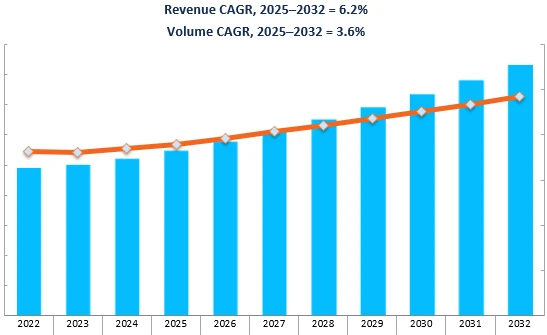
The forecast indicates an absolute revenue increase of approximately $14.18 billion between 2025 and 2032, equivalent to roughly 52% growth over the forecast period. This expansion reflects the increasing chemical intensity and technical complexity of advanced electronics manufacturing. Semiconductor applications, particularly those associated with AI accelerators, high-performance computing, advanced memory, leading-edge logic, and advanced packaging, are expected to remain important contributors to revenue growth.
The market's 2025 base-year growth rate is 4.9%, while the longer-term CAGR of 6.2% indicates an acceleration in revenue growth over the forecast period. Increasing adoption of ultra-high-purity formulations, advanced photoresists, CMP slurries, specialty gases, and process-specific chemicals is expected to support value growth even where improvements in manufacturing efficiency moderate overall chemical volumes.
The research also reports a 2025 market volume of 3,798.4 kilotonnes and an average price per unit of approximately $7,190.4. This indicates that revenue growth will be influenced not only by increasing consumption but also by product premiumization and demand for increasingly sophisticated, high-value chemical formulations.
Overall, the Electronic Chemical Market is positioned for steady expansion through 2032, with revenue expected to reach $41.49 billion as AI infrastructure, semiconductor capacity expansion, advanced technology nodes, EV electrification, and next-generation electronics manufacturing continue to create demand for specialized electronic chemicals.
Market Segmentation Analysis: Electronic Chemical Market
The Electronic Chemical Market is segmented by manufacturing platform, chemical type, end application, end industry, and region. This segmentation provides a detailed view of how demand varies across electronics manufacturing ecosystems and geographic markets.
Manufacturing Platform
The major manufacturing platforms include semiconductors, printed circuit boards, displays, and other electronics applications. Semiconductor manufacturing represents one of the most technologically demanding segments because advanced nodes require increasingly stringent chemical purity and process-control requirements. PCB manufacturing represents another important consumption area, while FPDs and other applications contribute to demand for specialized formulations.
Chemical Type
The Electronic Chemical Market includes several major chemical categories:
- Photoresists
- Wet chemicals
- Electroplating solutions
- Specialty gases
- CMP slurries
- Other process chemicals
Wet chemicals account for the highest volume consumption because they are extensively used across wafer cleaning, etching, stripping, surface preparation, and contamination-control processes. Meanwhile, advanced photoresists, CMP slurries, and specialty chemicals are gaining importance as semiconductor manufacturing moves toward increasingly sophisticated technology nodes.
Application Platform
Application segmentation includes semiconductors, PCBs, FPDs, MEMS, advanced packaging, optoelectronics, and other electronics applications. Semiconductor applications continue to generate strong revenue demand because AI accelerators, advanced memory, high-performance computing, and leading-edge logic devices require sophisticated chemical processes.
End Industry
Key end industries include consumer electronics, automotive, industrial systems, telecommunications, healthcare, aerospace, and data centers. Automotive electronics are becoming increasingly important as EV adoption expands and vehicle architectures become more electronics-intensive. Data centers and AI infrastructure are also supporting demand for advanced semiconductor and packaging technologies.
Region
The regional structure comprises Americas, Europe, APAC, and MEASA. APAC remains the leading region because of its semiconductor manufacturing concentration and large-scale investments in advanced electronics production. Government incentives, domestic semiconductor initiatives, and advanced packaging expansion are strengthening regional chemical demand.
Growth Drivers: Electronic Chemical Market
The Electronic Chemical Market is being driven by several structural factors that are expected to support growth through 2032.
Expansion of AI Infrastructure
The rapid development of AI infrastructure is increasing demand for high-performance processors, AI accelerators, advanced memory, and sophisticated semiconductor packaging. These technologies require high-purity electronic chemicals across multiple manufacturing stages. As AI computing capacity expands, chemical suppliers are expected to benefit from increasing semiconductor production complexity.
Semiconductor Manufacturing Expansion
New semiconductor fabrication investments and expansion of existing production capacity are creating sustained demand for electronic chemicals. Government incentive programs and regional semiconductor strategies are encouraging localized manufacturing, particularly across APAC and other strategic production regions.
Advanced Technology Nodes
Miniaturization and migration toward advanced technology nodes are increasing the need for ultra-high-purity formulations. Advanced photoresists, CMP slurries, wet chemicals, specialty gases, and other process chemicals must meet increasingly stringent specifications to maintain manufacturing yield and device performance.
Advanced Packaging Growth
Heterogeneous integration and advanced packaging are creating additional opportunities for specialized electronic chemicals. Increasing semiconductor complexity is expanding chemical requirements beyond traditional front-end fabrication into advanced packaging and related processes.
EV Electrification
Vehicle electrification is increasing semiconductor content and expanding demand for power electronics and other electronic components. This trend is creating additional opportunities for electronic chemical suppliers serving automotive semiconductor and electronics manufacturing.
Industrial IoT and 5G
The expansion of industrial IoT, 5G infrastructure, connected devices, and advanced communication systems is increasing electronics production. This creates additional demand across semiconductor, PCB, display, and related manufacturing platforms.
Growth Restraints: Electronic Chemical Market
Despite strong structural opportunities, the Electronic Chemical Market faces several restraints that could moderate growth.
Stringent Purity Standards
Increasing purity requirements create significant technical and operational challenges for chemical suppliers. Advanced semiconductor manufacturing requires highly consistent materials with extremely low levels of contamination. Meeting these requirements can increase manufacturing complexity and qualification timelines.
Regulatory Compliance
Chemical manufacturers face increasing regulatory requirements, including frameworks associated with PFAS and REACH. Compliance can increase production costs, require formulation changes, and create additional testing and documentation requirements.
Supply Chain Concentration
Concentration of chemical production and electronics manufacturing in specific geographic locations creates supply-chain risks. Disruptions affecting major semiconductor manufacturing clusters can consequently affect demand and supply availability across the Electronic Chemical Market.
Process Efficiency and Recycling
Improved point-of-use chemical dispensing, process optimization, and chemical recycling can reduce chemical consumption per wafer or manufacturing unit. While these technologies improve manufacturing efficiency, they can reduce volume growth for certain chemical categories.
Material Substitution
The transition toward advanced manufacturing processes can result in substitution of certain materials. The adoption of alternative process technologies and advanced layer etching techniques may reduce demand for some established chemical formulations.
Miniaturization
Although miniaturization creates opportunities for higher-value chemicals, it can also reduce chemical volumes required per manufactured device. Increasing process efficiency can therefore moderate volume growth even while revenue increases through premiumization and higher-value formulations.
Competitor Landscape: Electronic Chemical Market
The Electronic Chemical Market is highly competitive, with more than 100 active competitors spanning major global chemical companies, specialty chemical suppliers, and regional manufacturers. Competitive differentiation increasingly depends on ultra-high-purity specification compliance, process-node co-development, long-term customer qualification, supply-chain reliability, geographic proximity, regulatory compliance, and investment in next-generation chemistries.
The leading competitors identified in the research include Merck KGaA, Shin-Etsu Chemical, FUJIFILM Holdings, DuPont, and JSR Corporation. Together, the top five companies account for approximately 42% of 2025 market revenue, indicating a moderately concentrated competitive environment despite the presence of numerous suppliers.
Merck KGaA maintains a significant position across specialty electronic materials, while Shin-Etsu Chemical has strong capabilities associated with semiconductor manufacturing materials. FUJIFILM Holdings participates across electronic materials and advanced process applications. DuPont has an established presence in electronic materials, while JSR Corporation is positioned strongly in advanced semiconductor-related materials.
Other notable competitors include BASF SE, Tokyo Ohka Kogyo, Resonac Holdings, Linde plc, Air Liquide, Air Products, Sumitomo Chemical, Dongjin Semichem, Stella Chemifa, and Kanto Chemical.
Competitive factors are shifting beyond traditional chemical product specifications. Customers increasingly evaluate suppliers based on their ability to support process development, maintain consistent quality, achieve qualification requirements, and provide technical support near manufacturing clusters. Long-term customer relationships and co-development capabilities are consequently becoming increasingly important.
The distribution structure primarily involves partnerships between chemical producers and customers, supported by distributors where appropriate. Because electronic chemical qualification can be technically demanding and highly customer-specific, direct relationships between chemical suppliers and electronics manufacturers remain strategically important.
The competitive environment is also being reshaped by consolidation and portfolio realignment. The research highlights structural developments including Solstice Advanced Materials' acquisition of Element Solutions, the spin-off of DuPont's electronics business as Qnity, and integration initiatives involving major industry participants. These developments demonstrate the increasing strategic value of electronic materials portfolios.
Overall, successful participants in the Electronic Chemical Market will increasingly need to combine chemical innovation with application engineering, customer co-development, supply-chain resilience, local manufacturing, and regulatory expertise.
Scope of Analysis
Market Segmentation
Scope
Why is it Increasingly Difficult to Grow?
The Strategic Imperative 8™
The Impact of the Top 3 Strategic Imperatives on the Electronic Chemicals Industry
Growth Metrics
Growth Environment
Ecosystem Overview
Value Chain—Displays
Value Chain—Applications Apart from Displays
Value Chain Analysis
Competitive Environment
Key Competitors
Growth Drivers
Growth Driver Analysis
Growth Restraints
Growth Restraint Analysis
Forecast Considerations
Revenue and Volume Forecast
Revenue and Volume Forecast Analysis
Revenue Forecast by Application Platform
Volume Forecast by Application Platform
Revenue and Volume Forecast Analysis by Application Platform
Revenue Forecast by Region
Volume Forecast by Region
Revenue and Volume Analysis by Region
Revenue Forecast by End-Industries
Volume Forecast by End-Industries
Revenue and Volume Forecast Analysis by End-Industries
Revenue Forecast by Chemical Type
Volume Forecast by Chemical Type
Revenue and Volume Forecast Analysis by Chemical Type
Pricing Trends and Forecast
Average Price Forecast by Chemical Type
Pricing Trends and Forecast Analysis
Revenue Share
Revenue Share Analysis
M&A
Growth Metrics
Segment Characteristics and Overview
Revenue and Volume Forecast
Revenue and Volume Forecast Analysis
Revenue Forecast by Region
Volume Forecast by Region
Revenue and Volume Analysis by Region
Revenue Forecast by End-Industries
Volume Forecast by End-Industries
Revenue and Volume Forecast Analysis by End-Industries
Revenue Forecast by Chemical Type
Volume Forecast by Chemical Type
Revenue and Volume Forecast Analysis by Chemical Type
Growth Metrics
Segment Characteristics and Overview
Revenue and Volume Forecast
Revenue and Volume Forecast Analysis
Revenue Forecast by Region
Volume Forecast by Region
Revenue and Volume Analysis by Region
Volume Forecast by End-Industries
Revenue and Volume Forecast Analysis by End-Industries
Revenue Forecast by Chemical Type
Volume Forecast by Chemical Type
Revenue and Volume Forecast Analysis by Chemical Type
Growth Metrics
Revenue and Volume Forecast
Revenue and Volume Forecast Analysis
Revenue Forecast by Region
Volume Forecast by Region
Revenue and Volume Analysis by Region
Revenue Forecast by End-Industries
Volume Forecast by End-Industries
Revenue and Volume Forecast Analysis by End-Industries
Revenue Forecast by Chemical Type
Volume Forecast by Chemical Type
Revenue and Volume Forecast Analysis by Chemical Type
Growth Opportunity 1: Recycled and Reclaimed Chemicals
Growth Opportunity 2: PFAS-Free and Environmentally Compliant Process Chemistry Reformulation
Growth Opportunity 3: Localized Chemical Manufacturing for Reshoring Fab Clusters
Growth Opportunity 4: Material Integration in Space-Grade Electronics
Benefits and Impacts of Growth Opportunities
Next Steps
List of Exhibits
Legal Disclaimer
Frequently Asked Questions: Electronic Chemical Market
1. What is the Electronic Chemical Market?
The Electronic Chemical Market comprises high-purity specialty chemicals used in semiconductor, printed circuit board (PCB), flat panel display (FPD), advanced packaging, MEMS, optoelectronics, and other electronics manufacturing processes. These chemicals support critical activities such as cleaning, etching, lithography, deposition, planarization, electroplating, stripping, and surface preparation.
2. What is the size of the Electronic Chemical Market in 2025?
The Electronic Chemical Market generated approximately $27.31 billion in revenue in 2025. The market is forecast to reach approximately $41.49 billion by 2032, reflecting a compound annual growth rate of 6.2% from 2025 to 2032.
3. What is the projected growth rate of the Electronic Chemical Market?
The Electronic Chemical Market is projected to grow at a 6.2% CAGR between 2025 and 2032. Revenue is expected to increase from $27.31 billion in 2025 to $41.49 billion in 2032, supported by semiconductor expansion, AI infrastructure, advanced packaging, EV electrification, and increasing demand for high-purity electronic materials.
4. Which region dominates the Electronic Chemical Market?
APAC is the largest and fastest-growing region in the Electronic Chemical Market. Its position is supported by strong semiconductor manufacturing activity, advanced packaging investments, large-scale electronics production, and government initiatives supporting domestic semiconductor ecosystems across countries including China, Taiwan, South Korea, and Japan.
5. Which chemical type has the highest volume consumption?
Wet chemicals account for the highest volume consumption in the Electronic Chemical Market. They are extensively used for wafer cleaning, etching, stripping, surface preparation, and contamination control across multiple semiconductor manufacturing stages.
6. What are the major applications of electronic chemicals?
Major applications in the Electronic Chemical Market include semiconductor manufacturing, PCB fabrication, FPD manufacturing, MEMS, advanced packaging, optoelectronics, and other electronics applications. Semiconductor manufacturing represents a particularly important application because advanced chips require increasingly sophisticated chemical processes.
7. What are the key growth drivers for the Electronic Chemical Market?
Key growth drivers include the expansion of AI infrastructure, semiconductor manufacturing investments, advanced technology nodes, advanced packaging, EV electrification, industrial IoT, 5G infrastructure, and increasing demand for ultra-high-purity and application-specific chemical formulations.
8. Who are the leading companies in the Electronic Chemical Market?
Leading companies identified in the Electronic Chemical Market include Merck KGaA, Shin-Etsu Chemical, FUJIFILM Holdings, DuPont, and JSR Corporation. Other notable participants include BASF SE, Tokyo Ohka Kogyo, Resonac Holdings, Linde plc, Air Liquide, Air Products, Sumitomo Chemical, Dongjin Semichem, Stella Chemifa, and Kanto Chemical.
9. What are the major restraints affecting the Electronic Chemical Market?
Major restraints include stringent purity standards, increasing regulatory compliance requirements, supply-chain concentration, process efficiency and chemical recycling, material substitution, and miniaturization-related reductions in chemical consumption. These factors can increase supplier costs or moderate volume growth across selected chemical categories.
10. How is AI influencing the Electronic Chemical Market?
AI is indirectly accelerating the Electronic Chemical Market by increasing demand for AI accelerators, high-performance computing, advanced memory, and leading-edge logic devices. These semiconductor technologies require sophisticated manufacturing processes and increasingly high-purity electronic chemicals, creating opportunities for suppliers of advanced process materials.
11. What chemical categories are covered in the Electronic Chemical Market?
The major chemical categories covered include photoresists, wet chemicals, electroplating solutions, specialty gases, CMP slurries, and other process-specific formulations such as deposition chemicals, high-purity reagents, stripping agents, and additives.
12. What is the outlook for the Electronic Chemical Market through 2032?
The outlook for the Electronic Chemical Market remains positive through 2032. Revenue is expected to reach approximately $41.49 billion, supported by semiconductor manufacturing expansion, AI infrastructure, advanced packaging, EV electrification, and increasing demand for ultra-high-purity materials. Competitive advantage is expected to increasingly depend on co-development, qualification capabilities, regional supply resilience, and advanced chemical innovation.
Speak directly with our analytics experts for tailored recommendations.
Recent related Specialty Chemicals research
16 Oct 2026 | Global | Technology Research
Innovations in Surface Technologies for Medical Devices, Battery Components, Sustainable Packaging, Self-Cleaning Facades, Thermal Sprays, and others
This edition of the Advanced Coating & Surface Technology Opportunity Engine profiles significant advances in advanced coatings and surface treatments for various industrial applications. The featured innovations include Automated High-speed Coating and UV-cure Solutions, Water-based Functional Alum...
09 Oct 2026 | Global | Technology Research
Innovations in Transparent Ceramics, Biomaterials, Compostable Bioplastics, Graphite, Silica Foam, Aerogels, and Other Advanced Materials for Diverse Applications
This issue of High-Tech Materials Technology Opportunity Engine (TOE) profiles significant advances in high-tech materials for various industrial applications. The featured innovations include Large-sized Transparent and Bonded Ceramics for High-Power Laser Systems, High-Strength Transparent Alumina...
08 Oct 2026 | South Asia, Middle East & North Africa | Market Research
Growth Opportunities for Sulphur Derivatives in MENA, 2025–2030
The MENA region plays a critical role in global sulphur supply; however, a significant share of value creation remains concentrated in exports and commodity derivatives. As global demand evolves and advanced applications for sulphur-based products gain momentum, the region’s competitive advantage li...
02 Oct 2026 | Global | Technology Research
Innovations in Nanotechnology Including Nanocoatings, Nanolithography, Carbon Nanotubes, Nanofluids, Graphene, Ceramic Aerogels, Nanocatalysts, and Nanocomposites
This issue of the Nanotechnology Opportunity Engine profiles significant advances in nanotechnology for various industrial applications. The featured innovations include Sulfate-Free CNCs for Versatile Applications, Contact-Active Antimicrobial Nanocoating With Broad-Spectrum Protection, Nanoimprint...
18 Sep 2026 | Global | Technology Research
Innovations in Surface Technologies for Automotive Coatings, Protective Coatings, Oleophobic Coatings, Plasma Coatings, Icephobic Coatings, and Others
This edition of the Advanced Coating & Surface Technology Opportunity Engine profiles significant advances in advanced coatings and surface treatments for various industrial applications. The featured innovations include Ultra-Black Nanocarbon Coatings for Next-Generation Automotive Surface Finishes...
Purchase includes:
- Report download
- Growth Dialog™ with our experts
Growth Dialog™
A tailored session with you where we identify the:- Strategic Imperatives
- Growth Opportunities
- Best Practices
- Companies to Action
Impacting your company's future growth potential.
The market is analyzed across semiconductors, PCB, FPD, and other application platforms, with demand assessed across six principal chemical types and examined by region across the Americas, APAC, Europe, and MEASA.
The industry is undergoing structural transformation driven by prevailing megatrends, including the expansion of AI infrastructure, the electrification of the automotive sector, and the proliferation of industrial IoT applications, each of which is generating sustained demand for higher-purity and application-specific chemistries. Concurrently, the competitive landscape is being reconfigured through consolidation and strategic portfolio realignment, as evidenced by material mergers and acquisitions activity, including Solstice Advanced Materials' acquisition of Element Solutions, the spin-off of DuPont's electronics business as Qnity, and integration initiatives undertaken by FUJIFILM, Merck KGaA, and JSR Corporation. This study examines the implications of these structural shifts for the competitive landscape and identifies the areas of greatest growth opportunity through 2032.
| Deliverable Type | Market Research |
|---|---|
| Industries | Chemicals and Materials |
| No Index | No |
| Is Prebook | No |
| Podcast | No |
| Predecessor | None |
| WIP Number | PLPQ-01-00-00-00 |