 USD
USD GBP
GBP  CNY
CNY  EUR
EUR  INR
INR  JPY
JPY  MYR
MYR  ZAR
ZAR  KRW
KRW  THB
THB 


Facility Management Market, Global, 2024–2030
Technology, Sustainability, Workplace Optimization, and User Experience Drive Transformational Growth
30-Jul-2025
Global
Market Research
MHCF-01-00-00-00
EN_2025_33691
Report Summary: Facility Management (FM) Market
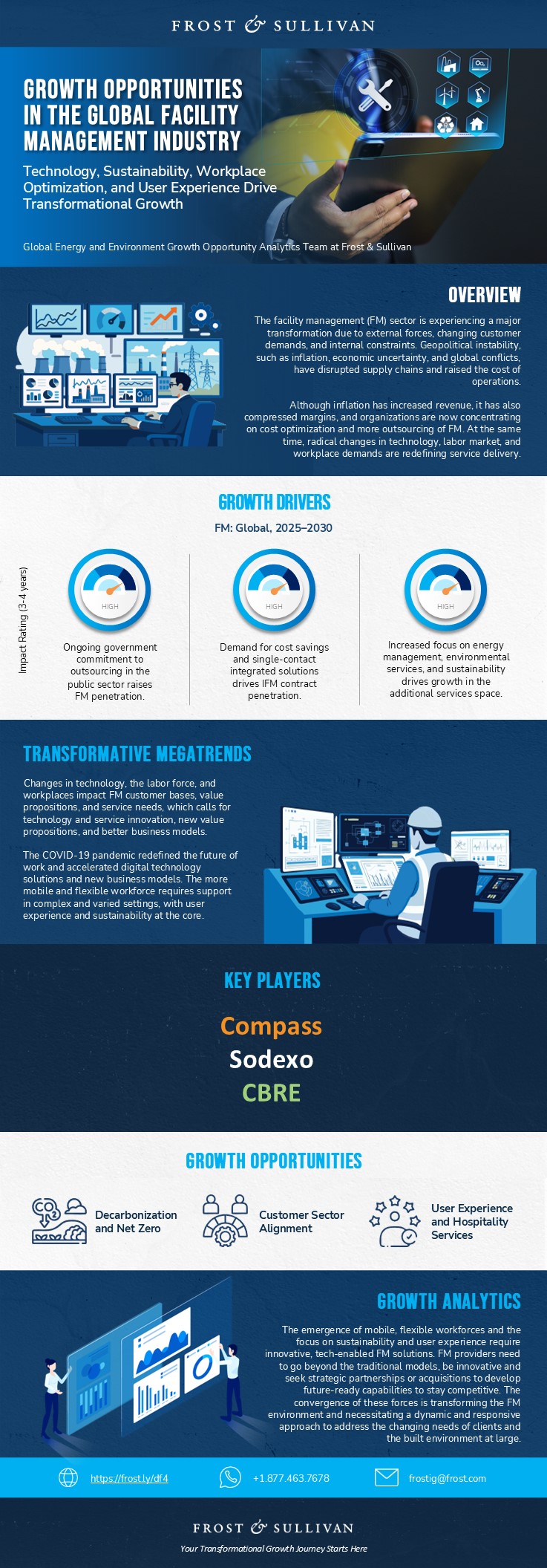
The global facility management market size was valued at USD 1,001.0 billion in 2024 and is projected to reach USD 1,360.3 billion by 2030, expanding at a CAGR of approximately 5.2% from 2025 to 2030. Growth is primarily driven by increasing outsourcing of non-core operations, rising complexity of building portfolios, and growing adoption of integrated and technology-enabled facility services across public and private sectors.
Key Market Trends & Insights
- North America accounted for the largest share of the global facility management (FM) market in 2024, supported by high outsourcing maturity and large commercial real estate portfolios.
- Asia Pacific is expected to register the fastest growth over the forecast period, driven by rapid urbanization, infrastructure development, and rising acceptance of outsourced FM services.
- Integrated Facility Management (IFM) models are gaining traction as organizations consolidate vendors to improve cost efficiency, accountability, and service performance.
- Energy management, sustainability services, and performance-based contracts are increasingly influencing FM procurement decisions.
- The FM industry remains highly fragmented, with strong competition from regional and local service providers.
Market Size & Forecast
- 2024 Market Size: USD 1,001.0 Billion
- 2030 Projected Market Size: USD 1,360.3 Billion
- CAGR (2025–2030): ~5.2%
- Largest Market (2024): North America
- Fastest-Growing Region: Asia Pacific
The continued shift toward outsourcing, combined with digitalization and sustainability imperatives, is expected to sustain long-term growth across the global facility management (FM) market.
Market Overview & Trends: Facility Management (FM) Market
The facility management market encompasses outsourced services that support the operation, maintenance, and optimization of built environments, including commercial, industrial, and public infrastructure. These services span hard services, soft services, and additional value-added offerings delivered through single-service, bundled, or integrated contracts. The market primarily reflects outsourced FM activities and excludes capital construction and purely in-house service delivery.
A defining trend shaping the facility management (FM) market is the accelerating shift toward integrated service models. End users are increasingly consolidating multiple service contracts into IFM agreements to improve operational efficiency, reduce vendor complexity, and enhance service accountability. This transition is particularly evident among large enterprises, healthcare networks, and public-sector organizations managing multi-site portfolios.
Technology adoption is another critical structural trend within the FM industry. Digital work order platforms, building management systems, energy analytics, and data-driven performance monitoring are becoming standard components of FM contracts. While technology alone is no longer a differentiator, providers with strong digital integration capabilities are better positioned to support outcome-based and sustainability-linked service models.
Sustainability and energy efficiency are emerging as central procurement criteria. Organizations are under increasing regulatory and stakeholder pressure to reduce energy consumption, lower emissions, and improve ESG performance. As a result, energy management and environmental services are gaining prominence within the broader facility management market, particularly in mature regions.
Macroeconomic uncertainty continues to influence purchasing behavior. Inflation and labor cost pressures are driving price sensitivity, especially in commoditized service segments. However, these same pressures are also reinforcing outsourcing decisions as organizations seek predictable costs and operational resilience. Together, these trends are redefining competitive dynamics and long-term growth pathways in the global facility management (FM) market.
Scope of Analysis: Facility Management (FM) Market
This study analyzes the global facility management market with a focus on outsourced FM services delivered across public and private sector end users. The scope includes hard services, soft services, and additional services provided under single-service, bundled, and integrated facility management contracts. Capital works, construction activities, and purely in-house FM delivery are excluded from market sizing.
The analysis covers the historical period from 2018 to 2024, with 2024 as the base year, and provides forecasts for the period 2025 to 2030. Market values are presented in US dollars, reflecting revenues generated from end-user FM contracts.
Geographically, the study evaluates four major regions: North America, Europe, Asia Pacific, and Rest of the World (RoW). Each region is assessed based on outsourcing maturity, regulatory environment, labor dynamics, and adoption of integrated service models within the facility management (FM) market.
Customer segmentation includes public sector and private sector end users, spanning healthcare, government, education, professional services, financial services, industrial facilities, and other commercial environments. The methodology combines secondary research, contract analysis, industry benchmarking, and expert validation to ensure consistency and comparability across regions within the global FM industry.
Market Segmentation Analysis: Facility Management (FM) Market
The global facility management market is segmented across four primary dimensions: service type, customer sector, geography, and contract structure, reflecting the diverse operating environments and procurement models within the FM industry. This segmentation highlights how service complexity, outsourcing maturity, and regional characteristics influence demand patterns across the facility management (FM) market.
Segmentation by Service Type
By service type, the facility management market comprises hard services, soft services, and additional services. Hard services form the technical core of FM delivery and include building operations and maintenance, mechanical and electrical services, HVAC, plumbing, fire protection, and building systems management. Demand for these services is driven by asset reliability requirements, regulatory compliance, and the increasing technical sophistication of buildings.
Soft services focus on workplace support and occupant experience, including cleaning, catering, security, and hospitality-related services such as reception, landscaping, and pest control. While highly price-sensitive and commoditized, soft services remain essential components of bundled and integrated contracts within the FM industry. Additional services—such as property management, energy management, environmental services, and IT-related support—are gaining importance as organizations seek sustainability improvements and data-driven facility optimization.
Segmentation by Customer Sector
From a customer perspective, the facility management (FM) market is divided into public and private sectors. Public sector demand is driven by healthcare, government, education, and other civic infrastructure, where outsourcing supports cost control, compliance, and service standardization. The private sector spans professional services, financial services, industrial and manufacturing facilities, retail, hospitality, and leisure, each with distinct service intensity and performance requirements.
Segmentation by Geography
Geographically, the market is analyzed across North America, Europe, Asia Pacific, and Rest of the World. North America and Europe represent mature outsourcing markets, while Asia Pacific is characterized by rapid adoption driven by urbanization and infrastructure growth. Emerging regions remain earlier in the outsourcing cycle but offer long-term expansion potential for the facility management market.
Segmentation by Contract Type
By contract structure, the market includes single-service contracts, bundled services, and integrated facility management (IFM). While single-service delivery remains common, IFM adoption is steadily increasing as end users prioritize vendor consolidation, accountability, and operational efficiency across the global FM industry.
Revenue & Spending Forecast: Facility Management (FM) Market
The global facility management market generated revenues of approximately USD 1,001.0 billion in 2024 and is projected to reach USD 1,360.3 billion by 2030, reflecting a CAGR of around 5.2% during the forecast period. Growth is expected to remain steady rather than cyclical, supported by long-term outsourcing contracts and recurring service demand.

Short-term spending patterns are influenced by inflation-driven price adjustments and labor cost pressures, which have elevated nominal revenue growth in several regions. However, real growth is increasingly tied to contract integration, service scope expansion, and adoption of value-added offerings within the facility management (FM) market.
Over the medium to long term, spending growth is expected to be led by IFM contracts, energy management services, and sustainability-focused solutions. Public sector outsourcing and industrial facility optimization will remain key demand contributors, while commercial office spending will be shaped by hybrid work trends.
Despite pricing pressure in commoditized segments, the FM industry is expected to maintain revenue resilience due to the essential nature of facility services and the increasing complexity of building operations across global markets.
Growth Drivers: Facility Management (FM) Market
A primary growth driver for the facility management market is the continued expansion of outsourcing across public sector organizations. Governments and public institutions are increasingly outsourcing FM services to improve cost predictability, regulatory compliance, and operational efficiency.
Rising demand for integrated, single-point service delivery is accelerating IFM adoption. Organizations are consolidating multiple vendors to reduce administrative burden and improve service coordination, directly supporting growth in the facility management (FM) market.
Energy efficiency and sustainability initiatives are also driving demand. Energy management, environmental services, and performance-based contracts are becoming integral to FM strategies as organizations pursue ESG objectives.
Industrial and commercial facilities are generating sustained demand for technically complex hard services, particularly in manufacturing, logistics, and critical infrastructure environments. Additionally, economic uncertainty is indirectly boosting outsourcing as organizations prioritize core activities and operational flexibility.
Together, these factors are reinforcing long-term growth momentum across the global FM industry.
Growth Restraints: Facility Management (FM) Market
The facility management market faces persistent challenges related to service commoditization and intense price competition, particularly in soft services. This limits margin expansion and reduces incentives for value-added service differentiation.
Labor shortages remain a structural constraint, especially for skilled technical roles required in hard and additional services. Workforce availability directly affects service quality and scalability within the facility management (FM) market.
In certain customer segments, a strong preference for in-house FM delivery continues to slow outsourcing penetration. Additionally, uneven maturity of IFM offerings and limited customer awareness in some regions restrict faster adoption.
Complex public sector procurement processes and long contract award cycles can also discourage participation by some suppliers, further constraining near-term growth in the FM industry.
Competitive Landscape: Facility Management (FM) Market
The global facility management market is highly fragmented, with more than 4,500 service providers generating annual revenues exceeding USD 10 million. Despite the presence of several large multinational players, the FM industry remains characterized by low revenue concentration, with the top five competitors accounting for only about 10.6% of total market revenue. This structure reflects low entry barriers, strong regional specialization, and the localized nature of many FM contracts.
Competition in the facility management (FM) market is primarily driven by cost competitiveness, service performance quality, energy efficiency capabilities, contractor reliability, and long-term customer relationships. Increasingly, sustainability credentials and the ability to deliver integrated facility management (IFM) solutions are emerging as key differentiators, particularly for large, multi-site contracts.
Leading global providers—including Compass, Sodexo, CBRE, Aramark, ISS, JLL, ABM, and Allied Universal—leverage scale, geographic reach, and bundled service portfolios to secure large public and private sector contracts. However, regional and niche players continue to compete effectively in single-service and bundled delivery models, sustaining pricing pressure across the FM industry.
The market’s distribution structure has historically favored self-delivery models, but subcontracting is gaining acceptance as providers seek flexibility, cost optimization, and access to specialized capabilities. Strategic mergers and acquisitions remain a core growth strategy, enabling providers to expand geographic presence, strengthen IFM offerings, and enhance technical and sustainability-related capabilities.
Overall, while consolidation activity is increasing, the facility management market is expected to remain structurally fragmented, with competitive intensity continuing to shape pricing, margins, and service innovation over the forecast period.
Scope of Analysis
Segmentation by Service Type
Segmentation by Customer Sector
Segmentation by Geography
Segmentation by Contract Type
FM Service Spectrum by Contract Type
FM Market Analysis Methodology
Why is it Increasingly Difficult to Grow?
The Strategic Imperative 8
The Impact of the Top 3 Strategic Imperatives on the Global Facility Management FM Industry
CEO’s 360-degree Perspectives
Global FM Market Highlights in Numbers
Global FM Market Segmentation
Global FM Market Growth by Segment
5 Main Pillars of FM Transformation
Predictions and Conclusions
Competitive Environment
Competitive Summary by Region
Key Competitors by Region
Key Competitors by Service Background/Heritage
Competitive Outlook for the Global FM Market
Revenue Market Share
Leading FM Suppliers by Region
Summary of the Global FM Market Growth Outlook
Top 5 FM Developments, 2024–2030
Key FM Market Trends
Global FM Market Evolution
Top Transformational FM Trends, 2025-2030
High Impact Trends and Influencing Factors in 2025
Global FM Universe: Total Addressable Market
Global FM Universe: Benchmarking Regions
Growth Metrics
Key Growth Metrics by Region
Growth Drivers
Growth Restraints
Revenue Forecast
Revenue Forecast Analysis
Revenue Forecast by Contract Type
Revenue Forecast Analysis by Contract Type
Revenue by Service Type
Revenue Forecast by Service Type
Revenue Forecast Analysis by Service Type
Revenue by Service Sub-type
Revenue Forecast Analysis by Service Type
Market Growth Outlook by Service Type
FM Market by Customer Type
Revenue Forecast by Customer Type
Revenue Forecast Analysis by Customer Type
Revenue by Customer Sub-type
Revenue Forecast Analysis by Customer Type
Market Growth Outlook by Customer Sector
Revenue Forecast by Region
Revenue by Region by Contract Type
Revenue by Region by Service Type
Revenue by Region by Customer Type
Revenue Forecast Analysis by Region
FM Market Dynamics
Revenue Forecast
Revenue Forecast by Contract Type
Revenue Forecast by Service Type
Revenue Forecast by Customer Type
Revenue Forecast by Country
FM Market Segmentations
FM Market Growth Outlook by Segment
Competitive Environment
Revenue Market Share
FM Market Dynamics
Revenue Forecast
Revenue Forecast by Contract Type
Revenue Forecast by Service Type
Revenue Forecast by Customer Type
Revenue Forecast by Country
FM Market Segmentations
FM Market Growth Outlook by Segment
Competitive Environment
Revenue Market Share
FM Market Dynamics
Revenue Forecast
Revenue Forecast by Contract Type
Revenue Forecast by Service Type
Revenue Forecast by Customer Type
Revenue Forecast by Country
FM Market Segmentations
FM Market Growth Outlook by Segment
Competitive Environment
Revenue Market Share
FM Market Dynamics
Revenue Forecast
Revenue Forecast by Contract Type
Revenue Forecast by Service Type
Revenue Forecast by Customer Type
Revenue Forecast by Country
FM Market Segmentations
FM Market Growth Outlook by Segment
Competitive Environment
Revenue Market Share
Growth Opportunity 1: Decarbonization and Net Zero
Growth Opportunity 2: Customer Sector Alignment
Growth Opportunity 3: User Experience and Hospitality Services
Growth Opportunity 4: Supporting Customers' ESG Strategies
Growth Opportunity 5: Workplace Technology and Analytics
Growth Opportunity 6: Digital Transformation and AI for FM
Growth Opportunity 7: Remote FM Services
Growth Opportunity 8: Healthy and Sustainable Buildings
Growth Opportunity 9: Business Productivity and Organizational Resilience
Growth Opportunity 10: Service Integration and IFM
Benefits and Impacts of Growth Opportunities
Next Steps
Legal Disclaimer
Frequently Asked Questions (FAQ) – Facility Management (FM) Market
1. What is the facility management (FM) market?
2. What factors are driving growth in the facility management market?
3. What services are included in the facility management (FM) market?
4. Which industries are the largest users of facility management services?
5. What is integrated facility management (IFM)?
6. Which region leads the global facility management market?
7. Which region is expected to grow the fastest in the FM industry?
8. What challenges does the facility management market face?
9. How is sustainability influencing the facility management market?
10. What is the future outlook for the facility management (FM) market?
Speak directly with our analytics experts for tailored recommendations.
Recent related Homes and Buildings research
13 Oct 2026 | Asia Pacific | Market Research
Facility Management Market, Malaysia, 2026–2031
Malaysia's facility management (FM) market is one of Southeast Asia's most advanced, anchored by long-term public sector concessions and public-private partnerships in healthcare and government, alongside a mature base of commercial and industrial end users. Three forces are reshaping growth: the sh...
09 Oct 2026 | Global | Frost Radar
Frost Radar™: Smart Building Solutions in Healthcare, 2026
Healthcare facilities are some of the most complex and mission-critical environments in the smart buildings market, and investment priorities now extend beyond energy management to indoor environmental quality, critical infrastructure monitoring, asset visibility, and workflow optimization. Revenue ...
17 Sep 2026 | Asia Pacific | Frost Radar
Frost Radar™: Facility Management in Malaysia, 2026
Malaysia's facility management (FM) market is transitioning from labor-intensive, compliance-driven service delivery to technology-enabled, outcome-oriented, and sustainability-integrated operating models. Competitive differentiation increasingly depends on providers’ ability to combine integrated F...
27 Aug 2026 | Global | Market Research
Smart Building Solutions, Global, 2025–2031
Smart building solutions encompass the integrated suite of hardware, software, and digital services that enable the automation, optimization, and intelligent management of commercial, educational, healthcare, industrial, datacenters and other buildings.The scope includes: Hardware: Automation contro...
07 Aug 2026 | Asia Pacific | Frost Radar
Frost Radar™: Facility Management in Thailand, 2026
Thailand's facility management (FM) market is transitioning from labor-intensive, task-based service delivery to integrated, technology-enabled, and outcome-driven operating models. Customer expectations for operational efficiency, sustainability, resilience, digital visibility, and business outcome...
Purchase includes:
- Report download
- Growth Dialog™ with our experts
Growth Dialog™
A tailored session with you where we identify the:- Strategic Imperatives
- Growth Opportunities
- Best Practices
- Companies to Action
Impacting your company's future growth potential.
The emergence of mobile, flexible workforces and the focus on sustainability and user experience require innovative, tech-enabled FM solutions. However, most companies have been slow to change, and they have been commoditized and their growth stagnated. FM providers need to go beyond the traditional models, be innovative and seek strategic partnerships or acquisitions to develop future-ready capabilities to stay competitive. The convergence of these forces is transforming the FM environment and necessitating a dynamic and responsive approach to address the changing needs of clients and the built environment at large.
Author: John Raspin
| Deliverable Type | Market Research |
|---|---|
| Industries | Environment |
| No Index | No |
| Is Prebook | No |
| Keyword 1 | facility management market |
| Keyword 2 | FM outsourcing services |
| Keyword 3 | IoT facility management |
| Podcast | No |
| Predecessor | MGBF-01-00-00-00 |
| WIP Number | MHCF-01-00-00-00 |