 USD
USD GBP
GBP  CNY
CNY  EUR
EUR  INR
INR  JPY
JPY  MYR
MYR  ZAR
ZAR  KRW
KRW  THB
THB 


Commercial Companies and Service Providers will Increasingly Enter the Market as Low Costs Drive the Rapid Development of Commercial Technologies
01-Oct-2021
North America
Market Research
MG3A-01-00-00-00
AE01502-NA-MT_25820
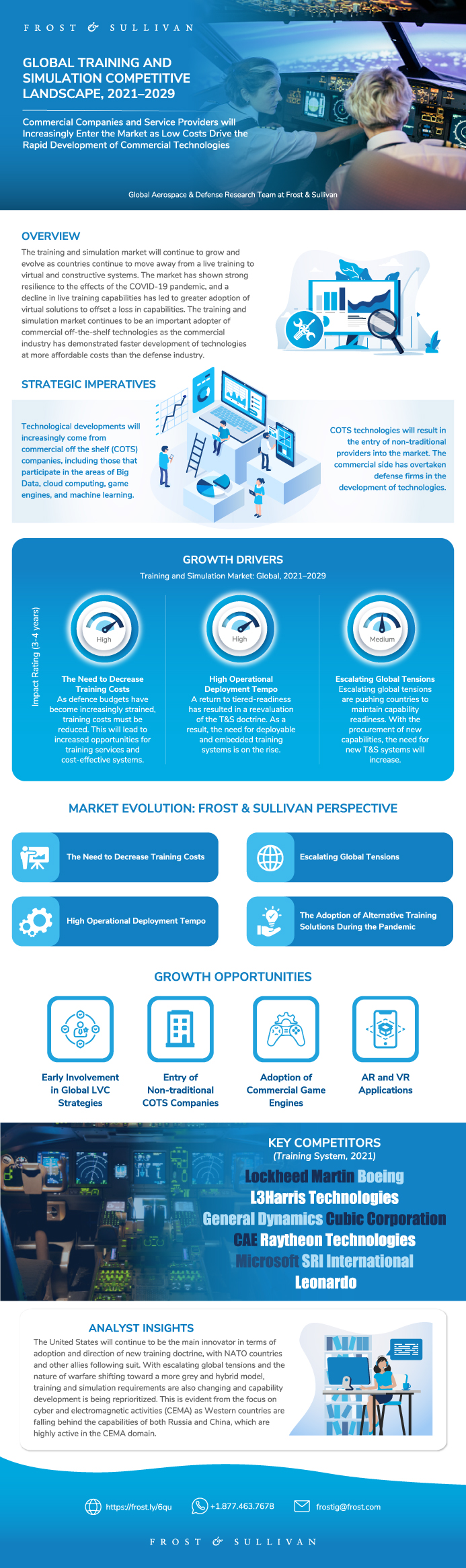
The training and simulation market will continue to grow and evolve as countries continue to move away from live training to virtual and constructive systems. The market has shown strong resilience to the effects of the COVID-19 pandemic, and a decline in live training capabilities has led to greater adoption of virtual solutions to offset a loss in capabilities. The training and simulation market continues to be an important adopter of commercial off-the-shelf technologies as the commercial industry has demonstrated faster development of technologies at more affordable costs than the defense industry. As a result, non-traditional companies such as Microsoft have entered the market (it provides the Hololens virtual reality headset system for US Army training purposes). Commercial gaming technologies are also seeing increased uptake to enhance planning and training capabilities; for instance, the UK Defense Science and Technology Laboratory (DSTL)'s use of Slitherine Software's commercial video games.
This Frost & Sullivan study briefly explores changing trends in the training and simulation market; it analyzes the impact of the changing geopolitical landscape, the economic turbulence, and the evolving military doctrine on the market. The study focuses on the global market and its growth over the next 10 years. It is broken down into regions and segments of training system and training service. The study covers these changes at a macro global level. The market is further investigated in terms of key competitors and their shares.
Future expectations covered in the study include the prioritization of rapid prototyping and development cycles with upgrades through software packages to reduce the overhead costs of upgrading physical training systems. The gradual adoption of live, virtual, and constructive (LVC) architectures and strategies, with an emphasis on the upgrade and the integration of legacy training systems, is also examined. The United States will continue to be the main innovator in terms of adoption and direction of new training doctrine, with NATO countries and other allies following suit. With escalating global tensions and the nature of warfare shifting toward a more grey and hybrid model, training and simulation requirements are also changing and capability development is being reprioritized. This is evident from the focus on cyber and electromagnetic activities (CEMA) as Western countries are falling behind the capabilities of both Russia and China, which are highly active in the CEMA domain. As a result, training and simulation systems must include these capabilities and keep pace with developments within military organizations.
Why Is It Increasingly Difficult to Grow?
The Strategic Imperative 8™
The Impact of the Top Three Strategic Imperatives on the Training and Simulation Market
Growth Opportunities Fuel the Growth Pipeline Engine™
Analysis Factsheet
Market Overview
Market Evolution
Demand Overview: 2020–2029
Key Programs: 2020–2021
Research Scope
Segmentation
Key Questions This Study Answers
Forecasting Approach
Market Dashboard
Market Dashboard (continued)
Key Growth Metrics
Growth Drivers
Growth Driver Analysis
Growth Driver Analysis (continued)
Growth Restraints
Growth Restraint Analysis
Growth Restraint Analysis (continued)
Growth Restraint Analysis (continued)
Total Market Analysis
Revenue Forecast by Region
Revenue Forecast by Domain
Global Driving Contracts and Programs
Revenue Forecast Analysis by Region
Revenue Forecast Analysis by Region (continued)
Competitive Environment
Revenue Share
Market Share Analysis
Key Competitors
Supplier Landscape
Global Supply Chain—Market Penetration
Global Market Share
Key Growth Metrics
Regional Considerations
Geopolitical Trends and Issues
Conflicts and Threats
Market Dashboard
Competitive Environment
Notable Opportunities
Regional Market—Top 5 Countries
Strategic Conclusions
Key Growth Metrics
Regional Considerations
Geopolitical Trends and Issues
Conflicts and Threats
Market Dashboard
Competitive Environment
Notable Opportunities
Regional Market—Top 5 Countries
Strategic Conclusions
Key Growth Metrics
Regional Considerations
Geopolitical Trends and Issues
Conflicts and Threats
Market Dashboard
Competitive Environment
Notable Opportunities
Regional Market—Top 5 Countries
Strategic Conclusions
Key Growth Metrics
Regional Considerations
Geopolitical Trends and Issues
Conflicts and Threats
Market Dashboard
Competitive Environment
Notable Opportunities
Regional Market—Top 5 Countries
Strategic Conclusions
Key Growth Metrics
Regional Considerations
Geopolitical Trends and Issues
Conflicts and Threats
Market Dashboard
Competitive Environment
Notable Opportunities
Regional Market—Top 5 Countries
Strategic Conclusions
Key Growth Metrics
Regional Considerations
Geopolitical Trends and Issues
Conflicts and Threats
Market Dashboard
Competitive Environment
Notable Opportunities
Regional Market—Top 3 Countries
Strategic Conclusions
Key Growth Metrics
Regional Considerations
Geopolitical Trends and Issues
Conflicts and Threats
Market Dashboard
Competitive Environment
Notable Opportunities
Regional Market—Top 5 Countries
Strategic Conclusions
Growth Opportunity 1—Early Involvement in Global LVC Strategies
Growth Opportunity 1—Early Involvement in Global LVC Strategies (continued)
Growth Opportunity 2—Entry of Non-traditional COTS Companies
Growth Opportunity 2—Entry of Non-traditional COTS Companies (continued)
Growth Opportunity 3—Adoption of Commercial Game Engines
Growth Opportunity 3—Adoption of Commercial Game Engines (continued)
Growth Opportunity 4—AR and VR Applications
Growth Opportunity 4—AR and VR Applications (continued)
Strategic Imperatives for Success and Growth
The Last Word—3 Big Predictions
Additional Frost & Sullivan Sources of Information on Training and Simulation
Abbreviations
Abbreviations (continued)
List of Exhibits
List of Exhibits (continued)
List of Exhibits (continued)
List of Exhibits (continued)
List of Exhibits (continued)
Legal Disclaimer
Speak directly with our analytics experts for tailored recommendations.
Recent related Defense research
07 Oct 2026 | North America | Frost Radar
Frost Radar™: US Military Intelligence Analytics, 2026
The US military intelligence (MILINT) analytics industry is undergoing a structural transformation as defense and intelligence agencies transition from platform-centric architectures to AI-native, data-centric, and decision-driven operational models. Intelligence systems are no longer confined to po...
30 Sep 2026 | Global | Market Research
Total Airport Management (TAM) Market, Global, 2025–2034
Total airport management (TAM) represents a high-potential convergence market that integrates enterprise architecture, data management, resource and capacity planning, collaborative decision-making, passenger management, and airport simulation/digital twin into a unified operational framework. TAM r...
24 Sep 2026 | North America | Market Research
Military Aviation Maintenance, Repair, and Overhaul Industry, US, 2025–2030
This research service provides a comprehensive overview of the US military aviation maintenance, repair, and overhaul (MRO) industry. The study segments the industry into six platform categories: 1. Fighter, Attack, & Bomber 2. Rotorcraft 3. Transport & Tanker 4. Training & Utility 5. Intelligence, ...
03 Sep 2026 | Global | Technology Research
Photonic and Optical Computing Chips for AI and Data Center Acceleration
The study evaluates photonic and optical computing technologies as critical enablers of next-generation AI infrastructure, addressing growing bandwidth, latency, power consumption, and scalability constraints associated with copper-based interconnects. The analysis covers photonic integrated circuit...
25 Aug 2026 | North America | Market Research
US Military Intelligence Analytics Industry Growth Opportunities, 2025–2028
The US military intelligence (MILINT) analytics market is undergoing rapid transformation driven by the convergence of AI, big data analytics, and next-generation sensing. As the DoW and the wider intelligence community (IC) face increasingly complex multi-domain threats, the demand for scalable, re...
Purchase includes:
- Report download
- Growth Dialog™ with our experts
Growth Dialog™
A tailored session with you where we identify the:- Strategic Imperatives
- Growth Opportunities
- Best Practices
- Companies to Action
Impacting your company's future growth potential.
| Deliverable Type | Market Research |
|---|---|
| No Index | No |
| Podcast | No |
| Author | Alexander Clark |
| Industries | Aerospace, Defence and Security |
| WIP Number | MG3A-01-00-00-00 |
| Is Prebook | No |
| GPS Codes | 9000-A1 |
Global Training and Simulation Competitive Landscape, 2021–2029
$2,450.00
Special Price $1,837.50 save 25 %