 USD
USD GBP
GBP  CNY
CNY  EUR
EUR  INR
INR  JPY
JPY  MYR
MYR  ZAR
ZAR  KRW
KRW  THB
THB 


Simulator‑Based Training Is Experiencing Transformational Growth Due to Pilot Shortages and Rising Training Demand
14-May-2026
Global
Market Research
PL4E-01-00-00-00
AE_2026_34568
Report Summary: Commercial Pilot Training Market
The global commercial pilot training market is experiencing sustained expansion as airlines accelerate fleet modernization, passenger traffic rebounds, and pilot shortages intensify across major aviation regions. The market is increasingly shifting toward simulator-based training models that improve operational efficiency, regulatory compliance, and pilot competency while reducing training costs and aircraft downtime. Airlines and aviation training organizations are investing heavily in advanced full-flight simulators, competency-based training and assessment (CBTA), evidence-based training (EBT), and cloud-enabled digital learning ecosystems to strengthen pilot readiness and scalability.
The commercial pilot training market was valued at approximately USD 6.82 billion in 2025 and is projected to reach nearly USD 8.37 billion by 2030, registering a CAGR of 4.2% during the forecast period. Growing aircraft deliveries, rising global passenger traffic, and increasing retirement of experienced pilots are accelerating demand for recurrent training, type-rating programs, and technologically advanced simulator infrastructure.
Key Market Trends & Insights
- Simulator-based pilot training is becoming the preferred model for airlines globally.
- AI, XR, and cloud-based learning platforms are improving training efficiency and analytics.
- Asia-Pacific is emerging as a major aviation training hub due to rapid airline expansion.
- CBTA and EBT frameworks are reshaping pilot certification and recurrent training standards.
- Airline partnerships with training providers are increasing to address pilot pipeline shortages.
Market Size & Forecast
- 2025 Market Size: USD 6.82 Billion
- 2030 Projected Market Size: USD 8.37 Billion
- CAGR (2025–2030): 4.2%
Market Overview & Trends: Commercial Pilot Training Market
The commercial pilot training market is undergoing structural transformation driven by expanding airline fleets, rising passenger volumes, and widening global pilot supply-demand imbalances. Airlines are increasingly prioritizing scalable, simulator-based training ecosystems that can accelerate pilot qualification timelines while maintaining strict operational safety and regulatory standards. This transition is reshaping the aviation training industry across North America, Europe, Asia-Pacific, the Middle East, and emerging aviation economies.
Simulator-based training remains central to market expansion as airlines seek efficient alternatives to aircraft-based pilot instruction. Full-flight simulators (FFS) and flight simulation training devices (FSTDs) are increasingly integrated into recurrent training, type-rating certification, and transition programs for new-generation aircraft fleets. The growing adoption of competency-based training and assessment (CBTA) and evidence-based training (EBT) frameworks is improving pilot proficiency measurement through data-driven operational scenarios and performance analytics.
Technology integration is becoming a defining trend across the commercial pilot training market. Artificial intelligence, extended reality (XR), adaptive learning software, cloud-enabled training management systems, and predictive analytics are improving pilot evaluation, scheduling optimization, and training throughput. Airlines and training providers are leveraging digital platforms to reduce operational inefficiencies while expanding access to remote and hybrid learning modules.
The market is also benefiting from long-term aviation growth fundamentals. Global passenger traffic is projected to rise significantly through 2030, creating sustained demand for new pilots, recurrent certification programs, and cross-regional aviation training hubs. Asia-Pacific currently represents the fastest-growing aviation training environment due to rapid fleet expansion and increasing aircraft deliveries across China, India, and Southeast Asia.
Despite positive momentum, the industry faces several operational challenges. Limited simulator availability, shortages of qualified instructors, and high capital expenditure requirements for full-flight simulator deployment continue to constrain market scalability. Regulatory variations across countries also create certification complexity and increase training standardization challenges for multinational operators.
Scope of Analysis: Commercial Pilot Training Market
This study evaluates the global commercial pilot training market with a primary focus on simulator-based airline pilot training ecosystems, advanced flight simulation technologies, and aviation competency development frameworks. The research examines how airlines, training organizations, and simulator providers are adapting to rising pilot demand, evolving regulatory standards, and digital transformation across certified aviation training environments.
The analysis covers competency-based training and assessment (CBTA), evidence-based training (EBT), recurrent pilot training, type-rating programs, and next-generation digital training platforms powered by AI, XR, and cloud-enabled technologies. The report also explores the role of full-flight simulators, flight simulation training devices, and scalable airline training infrastructure in improving operational readiness and pilot certification efficiency.
Geographically, the commercial pilot training market is analyzed across North America, Europe, Asia-Pacific, the Middle East, and the Rest of the World, including Latin America and Africa. The study focuses exclusively on fixed-wing commercial airline pilot training and excludes private aviation, rotorcraft, and business jet training operations.
The research period spans 2025 to 2030, with 2025 considered the base year for revenue forecasting and market analysis.
Revenue & Spending Forecast: Commercial Pilot Training Market
The commercial pilot training market is projected to maintain stable long-term growth as global airlines continue expanding fleets, increasing pilot recruitment, and modernizing training infrastructure. Simulator-based pilot training is expected to account for the majority of aviation training investments due to its scalability, operational efficiency, and compliance advantages.
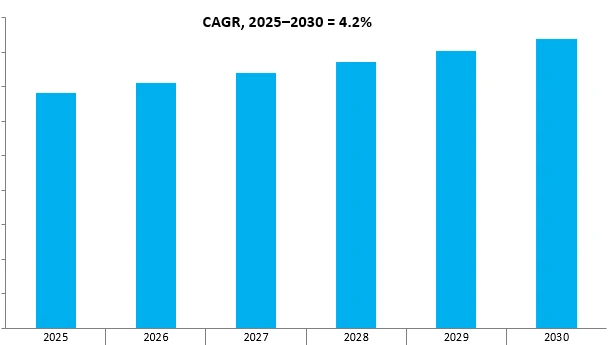
The market was valued at approximately USD 6.82 billion in 2025 and is forecast to reach nearly USD 8.37 billion by 2030, growing at a CAGR of 4.2%. Rising global passenger traffic, increasing aircraft deliveries, and persistent pilot shortages are driving sustained investment in recurrent pilot certification, type-rating programs, and advanced training technologies.
Airlines are increasingly allocating capital toward full-flight simulators, AI-enabled pilot assessment systems, cloud-based learning platforms, and digital training ecosystems that improve operational readiness while reducing scheduling inefficiencies. Aviation training providers are also expanding simulator networks and regional training hubs to address rising airline outsourcing demand.
Long-term market spending will continue to be influenced by pilot retirement cycles, regulatory modernization, airline fleet expansion strategies, and increasing adoption of competency-based pilot training models.
Market Segmentation Analysis: Commercial Pilot Training Market
The commercial pilot training market is segmented based on training delivery models, technology adoption, provider ecosystems, and regional aviation demand patterns. Simulator-based pilot training dominates the market due to its ability to improve operational safety, optimize fuel efficiency, and support scalable pilot qualification programs across airline fleets.
By training methodology, the market includes type-rating programs, recurrent training, cadet pilot training, transition training, and competency-based training frameworks. Recurrent and simulator-based training account for a significant share of industry demand as airlines prioritize continuous pilot certification and operational compliance. CBTA and EBT frameworks are increasingly integrated into commercial airline operations to improve data-driven pilot evaluation and scenario-based competency development.
From a technology perspective, the industry is rapidly incorporating full-flight simulators, virtual reality environments, AI-enabled analytics, adaptive learning systems, and cloud-based pilot training platforms. Advanced simulator ecosystems allow airlines to increase training throughput while reducing dependency on aircraft-based instruction.
The market ecosystem consists of integrated simulation providers, airline-affiliated training organizations, OEM-linked training centers, and independent aviation academies. Major participants include CAE, FlightSafety International, Boeing Training Solutions, Airbus, Thales Group, and TRU Simulation + Training. Strategic acquisitions and consolidation activities continue to strengthen competitive positioning among large training network operators.
Regionally, Asia-Pacific represents the fastest-growing market due to strong aircraft deliveries and increasing pilot demand, while North America and Europe maintain mature training infrastructure supported by established airline networks and regulatory systems. The Middle East is also emerging as a regional aviation training hub supported by airline expansion and long-haul fleet growth.
Growth Drivers: Commercial Pilot Training Market
The primary growth driver for the commercial pilot training market is the sustained expansion of global airline fleets combined with rising passenger traffic demand. Airlines are accelerating aircraft deliveries and route expansion strategies, creating continuous demand for newly certified pilots, recurrent training programs, and simulator-based type-rating solutions.
Persistent pilot shortages across major aviation regions are also driving market growth. Retirement of experienced pilots and growing aviation workforce gaps are forcing airlines to invest in scalable training ecosystems capable of increasing pilot throughput while maintaining regulatory compliance and operational safety standards.
Technological advancement is another major industry catalyst. The integration of AI-driven analytics, extended reality (XR), adaptive learning systems, and cloud-enabled pilot training platforms is transforming aviation training efficiency. These technologies improve pilot performance monitoring, scenario-based learning, and training personalization while reducing operational costs.
The adoption of competency-based training and assessment (CBTA) and evidence-based training (EBT) frameworks is further strengthening demand for advanced simulation infrastructure. Airlines increasingly require data-driven training methodologies that align pilot development with real-world operational scenarios and safety management objectives.
Growing airline outsourcing partnerships with aviation training providers are also supporting industry expansion. Many carriers are relying on external simulator networks and regional training hubs to improve scalability, reduce infrastructure investment burdens, and accelerate pilot qualification timelines.
Growth Restraints: Commercial Pilot Training Market
Despite strong long-term growth potential, the commercial pilot training market faces several operational and financial challenges that may limit expansion. One of the most significant restraints is the global shortage of qualified flight instructors and limited simulator availability in high-demand aviation regions. These constraints reduce training capacity and extend pilot certification timelines.
High infrastructure and capital investment requirements also remain major barriers. Acquiring, certifying, and maintaining full-flight simulators requires substantial financial resources, limiting participation for smaller aviation training organizations and regional operators. Simulator deployment costs can significantly increase operational expenditures and trainee pricing structures.
Regulatory fragmentation across international aviation markets creates additional complexity for training providers and airlines. Different certification standards, approval procedures, and competency requirements increase compliance costs and complicate multinational pilot training operations.
Technology integration challenges may also slow adoption rates in certain regions. While AI-enabled training platforms and XR-based simulation systems offer operational advantages, implementation requires advanced digital infrastructure, regulatory alignment, and workforce adaptation capabilities.
The market additionally faces pressure from fluctuating airline profitability cycles, economic uncertainty, and operational disruptions that can temporarily delay aviation workforce expansion and pilot recruitment programs.
Competitive Landscape: Commercial Pilot Training Market
The commercial pilot training market remains moderately concentrated, with a limited number of large integrated training providers operating extensive global simulator networks. Market competition is primarily shaped by simulator infrastructure scale, airline partnerships, regulatory expertise, training technology capabilities, and geographic training accessibility.
Major integrated training and simulation providers include CAE and Acron Aviation, while OEM-linked aviation training participants include Boeing Training Solutions and Airbus. Specialized training providers such as FlightSafety International continue to maintain strong positions within advanced pilot certification and simulator-based airline training ecosystems. Simulator and technology manufacturers including Thales Group and TRU Simulation + Training also play a critical role in supporting industry modernization.
Strategic acquisitions and consolidation activities are increasingly shaping the competitive environment. Large training providers are expanding simulator capacity, strengthening regional training hubs, and integrating advanced digital learning technologies to improve operational scalability and competitive differentiation.
Technology-driven innovation is becoming a key competitive factor across the commercial pilot training market. Companies are investing in AI-powered pilot analytics, adaptive simulation systems, cloud-based training management platforms, and XR-enabled learning environments to improve training efficiency and customer retention.
Long-term competitive advantage will increasingly depend on simulator network expansion, regulatory certification capabilities, airline outsourcing partnerships, and the ability to deliver scalable, technology-enabled pilot training solutions across high-growth aviation markets.
Scope of Analysis
Why Is It Increasingly Difficult to Grow?
The Strategic Imperative 8™
The Impact of the Top 3 Strategic Imperatives on the Global Commercial Pilot Training Industry
Global Market Overview
Global Commercial Pilot Training: Market Evolution and Technology Adoption
Growth Metrics
Growth Drivers
Growth Restraints
Forecast Considerations
Revenue Forecast
Competitive Landscape
Geographic Mismatch: Demand Rising, Revenue Concentrated
North America
Europe
Asia-Pacific
The Middle East
Latin America and Africa
Growth Opportunity 1: Technology Evolution
Growth Opportunity 2: Training Evolution
Growth Opportunity 3: Cross-Regional Training Hubs
Benefits and Impacts of Growth Opportunities
Next Steps
List of Exhibits
Legal Disclaimer
Frequently Asked Questions (FAQ) – Commercial Pilot Training Market
1. What is the commercial pilot training market?
The commercial pilot training market includes simulator-based and aircraft-based pilot training services designed to prepare commercial airline pilots for certification, recurrent training, type-rating programs, and operational competency requirements across the global aviation industry.
2. What is driving growth in the commercial pilot training market?
Growth in the commercial pilot training market is driven by rising global passenger traffic, increasing aircraft deliveries, expanding airline fleets, persistent pilot shortages, and growing demand for simulator-based pilot certification and recurrent training programs.
3. Why is simulator-based training becoming important in commercial aviation?
Simulator-based training improves pilot competency, operational safety, fuel efficiency, and training scalability while reducing aircraft downtime and operational costs. Airlines increasingly rely on full-flight simulators for recurrent training and type-rating certification.
4. What technologies are influencing the commercial pilot training market?
Key technologies shaping the commercial pilot training market include artificial intelligence (AI), extended reality (XR), cloud-based learning platforms, adaptive analytics, competency-based training systems, and advanced flight simulation devices.
5. What are CBTA and EBT in pilot training?
Competency-Based Training and Assessment (CBTA) and Evidence-Based Training (EBT) are modern aviation training frameworks that evaluate pilot skills using operational performance data, real-world flight scenarios, and competency-focused learning methodologies.
6. Which regions are leading the commercial pilot training market?
North America and Europe maintain mature aviation training ecosystems, while Asia-Pacific is emerging as the fastest-growing region due to rapid airline expansion, increasing aircraft orders, and rising pilot demand across China, India, and Southeast Asia.
7. What challenges affect the commercial pilot training market?
Major challenges include shortages of qualified instructors, limited simulator availability, high infrastructure investment costs, regulatory complexity, and varying pilot certification standards across international aviation markets.
8. Who are the major companies operating in the commercial pilot training market?
Leading participants in the commercial pilot training market include CAE, FlightSafety International, Boeing Training Solutions, Airbus, Thales Group, TRU Simulation + Training, and Acron Aviation.
9. How are airlines addressing global pilot shortages?
Airlines are expanding cadet pilot programs, increasing partnerships with aviation training providers, investing in simulator networks, and adopting digital training technologies to accelerate pilot qualification and improve training throughput.
10. What is the revenue forecast for the commercial pilot training market?
The commercial pilot training market is projected to grow from approximately USD 6.82 billion in 2025 to nearly USD 8.37 billion by 2030, supported by rising airline fleet expansion, increasing simulator-based training demand, and ongoing global pilot shortages.
Speak directly with our analytics experts for tailored recommendations.
Recent related Defense research
07 Oct 2026 | North America | Frost Radar
Frost Radar™: US Military Intelligence Analytics, 2026
The US military intelligence (MILINT) analytics industry is undergoing a structural transformation as defense and intelligence agencies transition from platform-centric architectures to AI-native, data-centric, and decision-driven operational models. Intelligence systems are no longer confined to po...
30 Sep 2026 | Global | Market Research
Total Airport Management (TAM) Market, Global, 2025–2034
Total airport management (TAM) represents a high-potential convergence market that integrates enterprise architecture, data management, resource and capacity planning, collaborative decision-making, passenger management, and airport simulation/digital twin into a unified operational framework. TAM r...
24 Sep 2026 | North America | Market Research
Military Aviation Maintenance, Repair, and Overhaul Industry, US, 2025–2030
This research service provides a comprehensive overview of the US military aviation maintenance, repair, and overhaul (MRO) industry. The study segments the industry into six platform categories: 1. Fighter, Attack, & Bomber 2. Rotorcraft 3. Transport & Tanker 4. Training & Utility 5. Intelligence, ...
03 Sep 2026 | Global | Technology Research
Photonic and Optical Computing Chips for AI and Data Center Acceleration
The study evaluates photonic and optical computing technologies as critical enablers of next-generation AI infrastructure, addressing growing bandwidth, latency, power consumption, and scalability constraints associated with copper-based interconnects. The analysis covers photonic integrated circuit...
25 Aug 2026 | North America | Market Research
US Military Intelligence Analytics Industry Growth Opportunities, 2025–2028
The US military intelligence (MILINT) analytics market is undergoing rapid transformation driven by the convergence of AI, big data analytics, and next-generation sensing. As the DoW and the wider intelligence community (IC) face increasingly complex multi-domain threats, the demand for scalable, re...
Purchase includes:
- Report download
- Growth Dialog™ with our experts
Growth Dialog™
A tailored session with you where we identify the:- Strategic Imperatives
- Growth Opportunities
- Best Practices
- Companies to Action
Impacting your company's future growth potential.
The study examines the role of flight simulation training devices (FSTDs) in supporting type-rating and recurrent training and evaluates the market through the lens of competency-based training and assessment (CBTA) and the evolving adoption of evidence-based training (EBT) frameworks. It also assesses the integration of advanced technologies, including XR, AI-driven training analytics, and cloud-enabled digital learning platforms within certified training environments.
The market is segmented regionally across North America, Europe, Asia-Pacific, the Middle East, and the rest of the world (Latin America and Africa).
Global commercial pilot training is undergoing a structural transition driven by sustained passenger traffic growth, accelerating aircraft deliveries, and widening pilot supply–demand imbalances. In response, airlines and training providers are increasingly adopting performance- and competency-based training models supported by advanced simulation technologies and the emergence of cross-regional training hubs.
| Deliverable Type | Market Research |
|---|---|
| Industries | Aerospace, Defence and Security |
| No Index | No |
| Is Prebook | No |
| Keyword 1 | Commercial pilot training market |
| Keyword 2 | Aviation flight simulators |
| Keyword 3 | Pilot shortage solutions |
| Podcast | No |
| Predecessor | None |
| WIP Number | PL4E-01-00-00-00 |