 USD
USD GBP
GBP  CNY
CNY  EUR
EUR  INR
INR  JPY
JPY  MYR
MYR  ZAR
ZAR  KRW
KRW  THB
THB 


Precision and Stealth: The Next Era of the Military Covert Operations Industry
18-May-2026
Global
Market Research
M1J0-01-00-00-00
AE_2026_34591
Report Summary: Special Operations Forces (SOF) Market
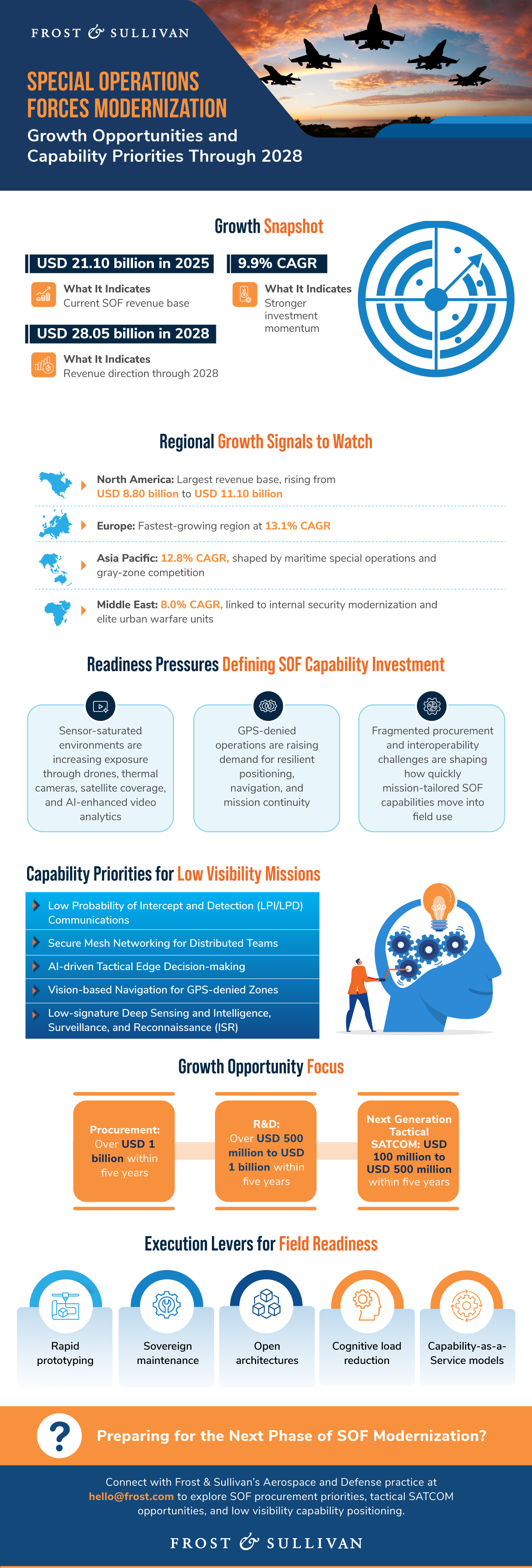
The global Special Operations Forces (SOF) Market size was valued at approximately USD 21.10 billion in 2025 and is projected to reach nearly USD 28.05 billion by 2028, expanding at a CAGR of 9.9% during the forecast period. Rising geopolitical instability, increasing grey-zone conflicts, and growing demand for low-visibility military operations are accelerating investments in next-generation SOF modernization programs worldwide. Governments are increasingly prioritizing elite tactical units equipped with advanced ISR systems, autonomous technologies, resilient communications, and precision mission capabilities.
Key Market Trends & Insights
- The Special Operations Forces (SOF) Market is increasingly focused on AI-enabled ISR, autonomous systems, and multi-domain tactical operations.
- Growing demand for stealth mobility, deniable operations, and precision engagement is driving procurement of specialized SOF platforms and lethality systems.
- Modernization of tactical networking, SATCOM infrastructure, and resilient battlefield communications is becoming a major investment priority.
- SOF training ecosystems are evolving toward immersive simulation, AI-enhanced mission rehearsal, and live virtual constructive (LVC) environments.
- Defense agencies are expanding multinational SOF partnerships, readiness programs, and joint operational interoperability initiatives.
Market Size & Forecast
- 2025 Market Size: USD 21.10 Billion
- 2028 Projected Market Size: USD 28.05 Billion
- CAGR (2025–2028): 9.9%
- North America: Largest Market in 2025
- Asia-Pacific and Europe: Increasing SOF Modernization Investments
The Special Operations Forces (SOF) Market continues evolving through rapid integration of advanced surveillance systems, human-machine teaming, resilient communications, and mission-specific mobility technologies designed for contested and sensor-saturated operational environments.
Market Overview & Trends: Special Operations Forces (SOF) Market
The Special Operations Forces (SOF) Market is undergoing substantial transformation as military forces worldwide increasingly rely on elite units capable of conducting precision, low-visibility, and politically calibrated operations across contested environments. SOF units are becoming central to modern defense doctrines focused on counterterrorism, hybrid warfare, grey-zone conflict management, strategic reconnaissance, hostage rescue, cyber-enabled operations, and multi-domain tactical missions.
Modern battlefields characterized by dense ISR coverage, AI-enabled surveillance, electronic warfare systems, and GPS-denied operational conditions are reshaping procurement priorities across the Special Operations Forces (SOF) Market. Governments are investing heavily in stealth mobility platforms, autonomous systems, resilient communications, advanced lethality systems, and signature-management technologies that improve mission survivability and operational flexibility.
One of the most important market trends involves the growing integration of artificial intelligence, autonomous ISR systems, tactical robotics, and data-driven mission planning tools into SOF modernization programs. AI-enabled situational awareness, autonomous navigation, predictive analytics, and human-machine teaming capabilities are increasingly improving mission execution across highly dynamic operational environments.
The market is also witnessing strong demand for advanced tactical networking and assured SATCOM systems that support uninterrupted battlefield communication in contested environments. Militaries are prioritizing resilient data transport pathways, secure communication nodes, and interoperable networking architectures capable of supporting rapid deployment and real-time intelligence sharing during covert operations.
SOF training and simulation technologies are evolving rapidly through immersive virtual environments, AI-enhanced mission rehearsal systems, and live virtual constructive (LVC) training platforms. These systems allow elite operators to simulate urban warfare, maritime interdiction, and cross-domain missions within cost-efficient and scalable digital training ecosystems.
Geopolitical tensions across Eastern Europe, the Indo-Pacific, the Middle East, and border-sensitive regions continue strengthening long-term investment momentum within the Special Operations Forces (SOF) Market. Defense modernization initiatives increasingly emphasize rapid-response tactical units capable of executing strategic objectives below the threshold of conventional warfare escalation.
Scope of Analysis: Special Operations Forces (SOF) Market
This study analyzes the global Special Operations Forces (SOF) Market across evolving military modernization and elite tactical operations ecosystems. The report evaluates defense spending trends, procurement strategies, operational requirements, technology advancements, and mission-specific modernization programs shaping SOF investments between 2025 and 2028.
The scope of analysis includes five major application categories: weapons, ammunition, and lethality systems; protection, survivability, and human performance technologies; mobility and tactical platforms; assured SATCOM and tactical networking systems; and training, simulation, and mission support solutions. The study examines advancements in autonomous systems, AI-enabled ISR, tactical robotics, stealth mobility platforms, resilient battlefield communications, and immersive simulation environments supporting next-generation SOF operational capabilities.
The report evaluates military procurement activities and modernization priorities across North America, Europe, Asia-Pacific, the Middle East, Latin America, and Africa. Regional analysis includes defense budget allocation trends, multinational readiness programs, cross-border interoperability initiatives, counterterrorism modernization efforts, and strategic investments in covert operational capabilities.
Revenue estimates are presented in US dollars and are based on publicly announced defense contracts, modernization programs, and military procurement activities. Classified programs and undisclosed operational expenditures are excluded from the forecast scope. Research methodology combines primary interviews with defense industry stakeholders, secondary defense intelligence analysis, military budget assessments, vendor benchmarking, and technology trend evaluation across the global Special Operations Forces (SOF) Market.
Revenue & Spending Forecast: Special Operations Forces (SOF) Market
The global Special Operations Forces (SOF) Market generated approximately USD 21.10 billion in 2025 and is projected to reach nearly USD 28.05 billion by 2028, registering a CAGR of 9.9% during the forecast period. Rising geopolitical instability, expanding grey-zone competition, and increasing demand for agile low-visibility military operations continue driving sustained procurement and modernization spending worldwide.
Defense agencies are significantly increasing investments in elite tactical capabilities including ISR systems, autonomous platforms, advanced communications, survivability technologies, precision lethality systems, and AI-enabled mission support tools. Governments increasingly view SOF modernization as essential for executing politically sensitive operations below the threshold of conventional warfare escalation.
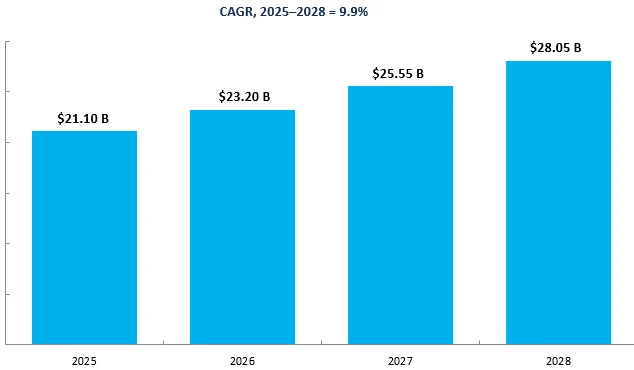
The Special Operations Forces (SOF) Market is also benefiting from rising adoption of tactical robotics, resilient networking architectures, immersive simulation platforms, and next-generation mobility systems optimized for contested operational environments. Procurement programs increasingly prioritize rapid deployment capability, mission adaptability, and multi-domain interoperability across specialized tactical units.
Modernization of SOF training ecosystems, multinational readiness exercises, and intelligence-sharing partnerships is further accelerating defense expenditure across the market. Growing emphasis on counterterrorism operations, border security missions, maritime interdiction, and strategic reconnaissance activities continues strengthening long-term spending momentum across global defense organizations.
Market Segmentation Analysis: Special Operations Forces (SOF) Market
The Special Operations Forces (SOF) Market is segmented into weapons and lethality systems, survivability and human performance solutions, mobility and tactical platforms, assured SATCOM and tactical networking systems, and training and mission support technologies.
Weapons, ammunition, and lethality systems include advanced firearms, modular weapon platforms, precision-guided munitions, and integrated targeting systems designed to maximize tactical effectiveness while minimizing operator exposure. This segment increasingly focuses on lightweight weapon architectures, reduced signature technologies, and advanced fire-control systems integrated with ISR-enabled operational frameworks.
Protection, survivability, and human performance technologies include advanced tactical gear, body armor, survivability enhancement systems, medical support equipment, and cognitive performance optimization solutions designed for prolonged operations within hostile environments. Demand for mission endurance and operator resilience technologies continues increasing across modern SOF modernization programs.
Mobility and tactical platforms represent another critical segment within the Special Operations Forces (SOF) Market. These platforms include specialized ground vehicles, rotary-wing assets, autonomous systems, maritime insertion capabilities, and mission-adaptable transport solutions optimized for infiltration, exfiltration, and low-visibility tactical deployment.
Assured SATCOM and tactical networking systems are becoming increasingly important as SOF operations rely heavily on resilient battlefield communications, secure intelligence-sharing networks, and uninterrupted command-and-control capabilities within contested environments.
Training, simulation, and mission support systems continue evolving through AI-driven mission rehearsal, immersive virtual environments, LVC simulation ecosystems, and distributed digital training architectures supporting advanced tactical preparedness across multinational SOF operations.
Growth Drivers: Special Operations Forces (SOF) Market
Rising demand for low-visibility and sub-threshold military operations is one of the primary growth drivers for the Special Operations Forces (SOF) Market. Modern battlefields increasingly require elite tactical units capable of executing covert reconnaissance, precision engagement, strategic disruption, and politically calibrated missions within contested environments.
Expansion of SOF-specific technology ecosystems is significantly accelerating market growth. Defense organizations are investing heavily in AI-enabled ISR systems, autonomous tactical robotics, resilient communication technologies, advanced propulsion systems, and signature-managed mobility platforms designed specifically for elite operational units.
Growing multinational SOF training and interoperability programs are also supporting procurement activity worldwide. Increasing joint exercises, intelligence-sharing frameworks, and multinational readiness initiatives continue driving demand for mission-specific tactical equipment, simulation systems, and advanced communication infrastructure.
Rapid advancement in immersive simulation and AI-enhanced mission rehearsal platforms is transforming tactical training methodologies. Modern SOF units increasingly require digital battlefield simulation, live virtual constructive (LVC) training environments, and adaptive scenario modeling to improve mission preparedness across urban, maritime, and cross-domain operations.
The increasing complexity of modern warfare, including electronic warfare, cyber threats, and AI-enabled surveillance systems, is further strengthening long-term modernization demand within the Special Operations Forces (SOF) Market.
Growth Restraints: Special Operations Forces (SOF) Market
Increasing operational risk in GPS-denied and sensor-saturated environments remains a major restraint affecting the Special Operations Forces (SOF) Market. Modern ISR networks, AI-powered surveillance systems, biometric monitoring technologies, and persistent satellite coverage are reducing traditional tactical advantages associated with stealth and covert movement.
Budget pressures and competing military modernization priorities also continue constraining procurement timelines. Defense ministries balancing expenditures across missile defense, cyber operations, conventional force recapitalization, and space resilience programs may delay certain SOF modernization initiatives.
Fragmented procurement frameworks and interoperability challenges represent another critical market restraint. Multinational coalition operations often face inconsistent acquisition standards, classified system integration barriers, and differing operational requirements that complicate rapid deployment and modernization efforts.
The specialized nature of SOF systems also increases development and procurement complexity. Customized tactical platforms, mission-specific technologies, and advanced survivability systems frequently require longer development cycles and higher per-unit acquisition costs compared with conventional military equipment.
Additionally, growing dependence on advanced electronics, AI software, resilient communications, and autonomous technologies exposes the Special Operations Forces (SOF) Market to semiconductor shortages, cybersecurity risks, and supply chain vulnerabilities affecting long-term production scalability.
Competitive Landscape: Special Operations Forces (SOF) Market
The global Special Operations Forces (SOF) Market is highly specialized and technologically intensive, with competition driven by advanced mission capabilities, survivability enhancement, ISR integration, autonomous systems development, tactical networking performance, and operator-centric platform design. Defense contractors increasingly compete through specialized modernization programs tailored for elite military operations.
Major industry participants include Lockheed Martin, RTX, Boeing, L3Harris, Northrop Grumman, Collins Aerospace, Anduril, Elbit Systems, Saab, Rheinmetall, General Dynamics, AeroVironment, Honeywell, Cubic Mission & Performance Solutions, and SpaceX. These companies operate across tactical networking, mobility platforms, simulation systems, precision lethality technologies, and autonomous ISR ecosystems within the Special Operations Forces (SOF) Market.
Competition increasingly centers on AI-enabled ISR integration, tactical autonomy, stealth mobility systems, resilient communications, immersive simulation platforms, and modular mission adaptability. Vendors are investing heavily in lightweight tactical robotics, secure SATCOM infrastructure, operator survivability systems, and multi-domain mission technologies optimized for highly dynamic operational conditions.
Strategic defense partnerships, multinational modernization programs, classified procurement contracts, and joint tactical readiness initiatives continue shaping competitive dynamics across the market. Companies capable of delivering interoperable, mission-adaptable, and low-signature tactical solutions are expected to strengthen long-term competitive positioning within global SOF modernization ecosystems.
Scope of Analysis
Industry Segmentation
Why is it Increasingly Difficult to Grow?
The Strategic Imperative 8™
The Impact of the Top 3 Strategic Imperatives on the Global SOF Industry
Research Methodology
Purpose and Overview
Growth Drivers
Growth Restraints
Forecast Assumptions
Revenue Forecast
Revenue Forecast by Region
Market Forecast Analysis
Regional Analysis
Key SOF Vendors by Segment
SOF Emerging Concepts of Operation
SOF Systems Prime Military Programs, US, 2025–2028
SOF Systems Prime Military Programs, Global, 2025–2028
SOF Systems Prime Contracts, US, 2025–2028
SOF Systems Prime Contracts, EU and NATO, 2025–2028
SOF Systems Prime Contracts, Rest of World, 2025–2028
Partial List of Abbreviations Used in the Study
Growth Opportunity 1: Procurement
Growth Opportunity 2: R&D
Growth Opportunity 3: Next-Generation Tactical SATCOM
Benefits and Impacts of Growth Opportunities
Next Steps
List of Exhibits
Legal Disclaimer
Frequently Asked Questions (FAQ) – Special Operations Forces (SOF) Market
1. What is the Special Operations Forces (SOF) Market?
The Special Operations Forces (SOF) Market includes advanced military technologies, tactical systems, mobility platforms, communications infrastructure, survivability equipment, and mission support solutions designed specifically for elite covert and precision military operations.
2. What is driving growth in the Special Operations Forces (SOF) Market?
Growth in the Special Operations Forces (SOF) Market is driven by rising geopolitical tensions, increasing grey-zone warfare, demand for covert operations, AI-enabled ISR systems, tactical autonomy, and modernization of elite military units worldwide.
3. What is the projected revenue forecast for the Special Operations Forces (SOF) Market?
The global Special Operations Forces (SOF) Market was valued at approximately USD 21.10 billion in 2025 and is projected to reach nearly USD 28.05 billion by 2028, growing at a CAGR of 9.9% during the forecast period.
4. What technologies are shaping the Special Operations Forces (SOF) Market?
Key technologies shaping the Special Operations Forces (SOF) Market include AI-enabled intelligence systems, tactical robotics, resilient communications, autonomous platforms, immersive simulation systems, tactical networking, and advanced surveillance technologies.
5. What are the major segments in the Special Operations Forces (SOF) Market?
Major segments include weapons and lethality systems, survivability and human performance solutions, mobility platforms, assured SATCOM and tactical networking systems, and training and simulation technologies.
6. Why are resilient communications important in SOF operations?
Resilient communications are critical for SOF operations because elite units frequently operate in contested and GPS-denied environments where uninterrupted tactical networking, secure intelligence sharing, and real-time coordination are essential.
7. Which regions are leading the Special Operations Forces (SOF) Market?
North America currently leads the Special Operations Forces (SOF) Market due to high defense spending and advanced modernization programs, while Europe and Asia-Pacific are increasing investments in tactical readiness and covert operational capabilities.
8. What challenges are affecting the Special Operations Forces (SOF) Market?
Major challenges affecting the Special Operations Forces (SOF) Market include operational risks in sensor-saturated environments, budget constraints, procurement complexity, interoperability issues, cybersecurity threats, and supply chain disruptions.
9. How is AI influencing the Special Operations Forces (SOF) Market?
Artificial intelligence is improving mission planning, target identification, ISR analysis, autonomous navigation, predictive decision-making, and tactical coordination capabilities across modern SOF operational environments.
10. What is the future outlook for the Special Operations Forces (SOF) Market?
The future outlook for the Special Operations Forces (SOF) Market remains strong due to growing investment in covert operational technologies, AI-enabled warfare systems, autonomous mobility platforms, resilient tactical communications, and immersive mission training ecosystems.
Speak directly with our analytics experts for tailored recommendations.
Recent related Defense research
07 Oct 2026 | North America | Frost Radar
Frost Radar™: US Military Intelligence Analytics, 2026
The US military intelligence (MILINT) analytics industry is undergoing a structural transformation as defense and intelligence agencies transition from platform-centric architectures to AI-native, data-centric, and decision-driven operational models. Intelligence systems are no longer confined to po...
30 Sep 2026 | Global | Market Research
Total Airport Management (TAM) Market, Global, 2025–2034
Total airport management (TAM) represents a high-potential convergence market that integrates enterprise architecture, data management, resource and capacity planning, collaborative decision-making, passenger management, and airport simulation/digital twin into a unified operational framework. TAM r...
24 Sep 2026 | North America | Market Research
Military Aviation Maintenance, Repair, and Overhaul Industry, US, 2025–2030
This research service provides a comprehensive overview of the US military aviation maintenance, repair, and overhaul (MRO) industry. The study segments the industry into six platform categories: 1. Fighter, Attack, & Bomber 2. Rotorcraft 3. Transport & Tanker 4. Training & Utility 5. Intelligence, ...
03 Sep 2026 | Global | Technology Research
Photonic and Optical Computing Chips for AI and Data Center Acceleration
The study evaluates photonic and optical computing technologies as critical enablers of next-generation AI infrastructure, addressing growing bandwidth, latency, power consumption, and scalability constraints associated with copper-based interconnects. The analysis covers photonic integrated circuit...
25 Aug 2026 | North America | Market Research
US Military Intelligence Analytics Industry Growth Opportunities, 2025–2028
The US military intelligence (MILINT) analytics market is undergoing rapid transformation driven by the convergence of AI, big data analytics, and next-generation sensing. As the DoW and the wider intelligence community (IC) face increasingly complex multi-domain threats, the demand for scalable, re...
Purchase includes:
- Report download
- Growth Dialog™ with our experts
Growth Dialog™
A tailored session with you where we identify the:- Strategic Imperatives
- Growth Opportunities
- Best Practices
- Companies to Action
Impacting your company's future growth potential.
This research service provides an in-depth examination of the evolving operational foundations of SOF modernization and includes a comprehensive budgetary analysis of major programs across key global regions for the 2025–2028 period. The study evaluates procurement activities, multi-year programmatic trends, emerging requirements, and strategic priorities that shape SOF readiness and modernization trajectories worldwide.
Key growth drivers include the rising need for deniable, precise, and politically calibrated mission effects; expansion of SOF-specific technology ecosystems; and growing multinational training, readiness, and partnership frameworks. SOF units are increasingly required to operate in GPS-denied, sensor-saturated theaters, demanding systems with enhanced autonomy, advanced signature management, multi-domain mobility, and seamless C4ISR integration. At the same time, immersive simulation, data-driven mission rehearsal, and live virtual constructive (LVC) environments are reshaping training methodologies.
Constraints persist, particularly operational risks posed by proliferated ISR networks, fiscal pressures that slow prototype-to-fielding cycles, and interoperability barriers across multinational coalitions. Fragmented procurement processes and the bespoke nature of SOF requirements further complicate modernization timelines.
This report analyzes regional dynamics across North America, Europe, Asia-Pacific, the Middle East, Latin America, and Africa. Each region reflects distinct doctrinal shifts—from counterterrorism toward high-intensity multi-domain operations, maritime and littoral SOF missions, counter A2/AD requirements, and technology-enabled low-visibility force projection.
Collectively, the findings indicate that SOF modernization remains a global strategic priority. The convergence of autonomy, AI-enabled ISR, loitering munition evolution, resilient networking, and advanced training ecosystems will define the future competitive landscape and shape investment priorities through 2028.
| Deliverable Type | Market Research |
|---|---|
| Industries | Aerospace, Defence and Security |
| No Index | No |
| Is Prebook | No |
| Keyword 1 | Special operations forces market |
| Keyword 2 | Tactical C4ISR systems |
| Keyword 3 | Military procurement trends |
| Podcast | No |
| Predecessor | None |
| WIP Number | M1J0-01-00-00-00 |