 USD
USD GBP
GBP  CNY
CNY  EUR
EUR  INR
INR  JPY
JPY  MYR
MYR  ZAR
ZAR  KRW
KRW  THB
THB 


Growth Opportunities in Global Hospital Command Centers, 2024–2029
Hospital Command Centers Experiencing Transformational Growth Due to AI Advancements and Acceptance
05-Sep-2025
Global
Market Research
KB9B-01-00-00-00
HC_2025_33792
Report Summary: Hospital Command Centers Market
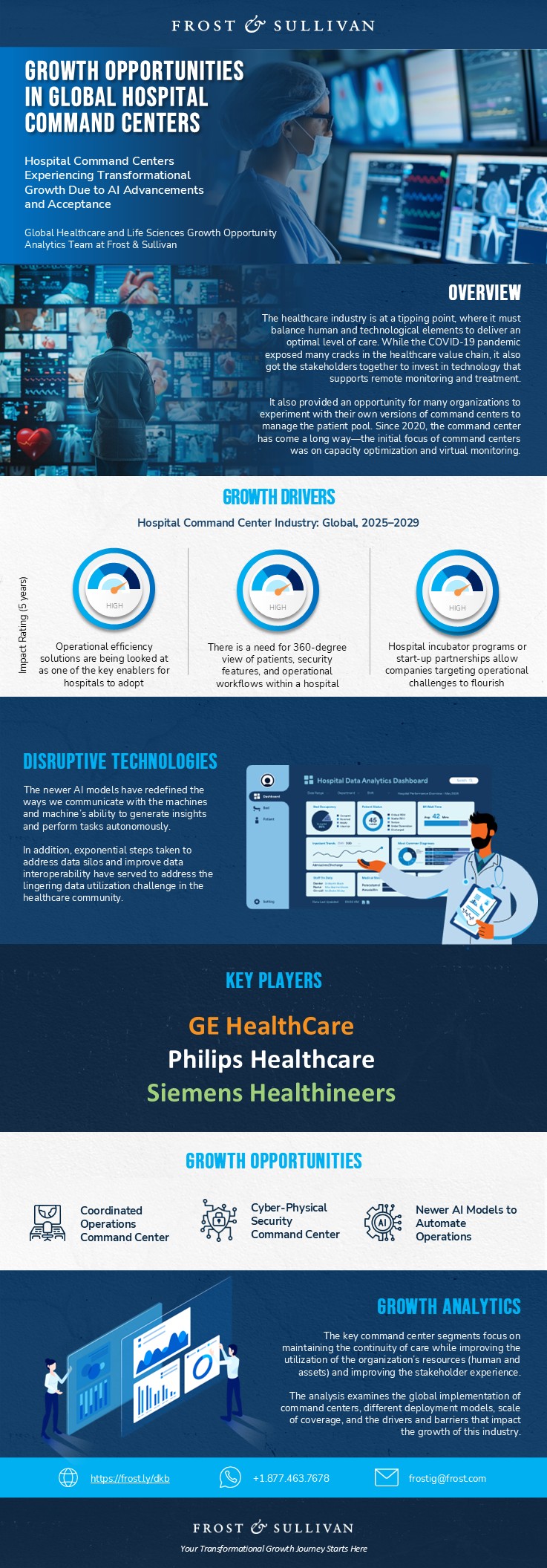
The global hospital command center market was valued at USD 36.77 billion in 2024 and is projected to reach USD 65.62 billion by 2029, growing at a CAGR of 12.3%. This strong growth reflects the increasing need for real-time operational visibility, improved patient flow management, and data-driven decision-making across healthcare systems. As hospitals continue to digitize, the Hospital Command Centers Market is becoming a core component of modern care delivery.
The evolution of intelligent platforms is accelerating adoption, particularly within the hospital command center platforms market, where integrated solutions combine clinical, operational, and administrative data into a unified interface. These platforms are enabling healthcare providers to enhance efficiency, reduce bottlenecks, and improve patient outcomes. At the same time, the Hospital Command Center Platforms Market is benefiting from advancements in AI, predictive analytics, and cloud-based infrastructure.
Key Market Trends & Insights
- North America leads the hospital command center market due to mature healthcare IT infrastructure.
- Asia-Pacific is emerging as a high-growth region within the Hospital Command Centers Market.
- AI-powered analytics and automation are transforming hospital command center platforms market capabilities.
- Clinical operations and patient flow optimization remain central use cases.
- Interoperability and real-time data integration are shaping the Hospital Command Center Platforms Market.
Market Size & Forecast
- 2024 Market Size: USD 36.77 Billion
- 2029 Projected Market Size: USD 65.62 Billion
- CAGR (2024–2029): 12.3%
The hospital command center market is expected to maintain strong momentum as healthcare systems prioritize efficiency, scalability, and patient-centric operations within the broader Hospital Command Centers Market landscape.
Market Overview & Trends: Hospital Command Centers Market
The hospital command center market is undergoing a structural shift toward centralized, intelligence-driven healthcare operations. A key trend is the adoption of AI-enabled decision-support systems, which allow hospitals to anticipate patient demand, manage capacity, and optimize workflows. This is strengthening the role of the Hospital Command Centers Market in improving both clinical and operational performance.
Another major trend is the rise of unified digital ecosystems. Within the hospital command center platforms market, healthcare organizations are integrating data from multiple sources—clinical systems, administrative tools, and connected devices—into a single platform. This approach enhances real-time visibility and supports faster decision-making.
Technologies such as IoT, real-time location systems, and cloud computing are also playing a crucial role. These innovations are expanding the capabilities of the Hospital Command Center Platforms Market, enabling seamless coordination across departments.
Patient engagement is becoming an increasingly important focus. Beyond operations, the hospital command center market now supports communication, scheduling, and remote consultations, improving overall care experiences.
Additionally, platform-based solutions are gaining traction, allowing providers to scale efficiently. This shift is reinforcing the importance of the hospital command center platforms market as a foundational layer in digital healthcare transformation.
Scope of Analysis: Hospital Command Centers Market
The hospital command center market analysis covers the global landscape from 2023 to 2029, with 2024 as the base year. It evaluates the key factors shaping the Hospital Command Centers Market, including technological innovation, adoption trends, and operational challenges.
The scope includes applications such as clinical operations, facility management, security, and patient engagement. These areas collectively define how the hospital command center platforms market delivers value across healthcare systems.
From a geographic perspective, the hospital command center market spans North America, Europe, Asia-Pacific, Latin America, and the Middle East & Africa. This provides a comprehensive view of regional adoption patterns and growth opportunities within the Hospital Command Center Platforms Market.
The analysis also explores the role of emerging technologies such as AI, cloud computing, and advanced analytics. These innovations are reshaping the Hospital Command Centers Market by enabling smarter, more connected healthcare environments.
Overall, the study delivers a holistic understanding of the hospital command center platforms market, helping stakeholders identify opportunities and align strategies with evolving healthcare needs.
Market Segmentation Analysis: Hospital Command Centers Market
The hospital command center market is segmented by application and region, reflecting the diverse functionalities within the Hospital Command Centers Market.
By application, the hospital command center platforms market includes clinical operations, facility operations, security, and patient engagement. Clinical operations remain the largest segment, focusing on patient flow, monitoring, compliance, and staffing. Facility operations address asset and building management, while security includes both physical and cybersecurity functions. Patient engagement covers communication, scheduling, and remote care services.
Regionally, North America dominates the hospital command center market, supported by strong digital infrastructure and early adoption of advanced technologies. Europe follows with steady growth, while Asia-Pacific is rapidly expanding within the Hospital Command Centers Market due to increasing healthcare investments.
The shift toward integrated solutions is a defining characteristic of the Hospital Command Center Platforms Market. Organizations are adopting platforms that unify multiple functions, improving efficiency and scalability across the hospital command center market.
Revenue & Spending Forecast: Hospital Command Centers Market
The hospital command center market is projected to grow significantly, with global revenue increasing from USD 36.77 billion in 2024 to USD 65.62 billion by 2029, at a CAGR of 12.3%.

This growth reflects rising investments in digital healthcare infrastructure and the increasing adoption of centralized operational systems. The Hospital Command Centers Market is benefiting from the need to improve patient outcomes while optimizing resource utilization.
Spending within the hospital command center platforms market is also increasing as healthcare providers invest in AI-driven analytics, automation, and cloud-based solutions. These technologies are enhancing the capabilities of the Hospital Command Center Platforms Market and supporting long-term scalability.
Overall, the hospital command center market is positioned for sustained expansion, driven by continuous innovation and the growing importance of data-driven healthcare operations.
Growth Drivers: Hospital Command Centers Market
Several factors are driving the growth of the hospital command center market and shaping the Hospital Command Centers Market landscape.
One major driver is the increasing demand for operational efficiency. Hospitals are adopting centralized systems within the hospital command center platforms market to streamline workflows and reduce costs.
Advancements in AI and predictive analytics are also playing a critical role. These technologies are enhancing decision-making and enabling real-time insights across the Hospital Command Center Platforms Market.
The growing focus on patient-centered care is another key driver. The hospital command center market supports improved coordination and communication, leading to better outcomes.
Additionally, expanding digital health infrastructure and interoperability requirements are accelerating adoption across the Hospital Command Centers Market. Strategic partnerships and innovation initiatives are further strengthening the hospital command center platforms market.
Growth Restraints: Hospital Command Centers Market
Despite strong growth potential, the hospital command center market faces several challenges. High implementation costs remain a key barrier, particularly for smaller healthcare organizations within the Hospital Command Centers Market.
Integration complexity is another issue. Combining multiple systems and data sources can be difficult, impacting the efficiency of the hospital command center platforms market.
Workforce limitations also pose challenges, as skilled professionals are required to manage advanced technologies within the Hospital Command Center Platforms Market.
Data privacy and regulatory compliance concerns further affect adoption, especially with increasing reliance on patient data.
Addressing these challenges is essential for ensuring sustainable growth in the hospital command center market and maximizing the value of the Hospital Command Centers Market.
Competitive Landscape: Hospital Command Centers Market
The hospital command center market is highly competitive, with both established companies and emerging players contributing to innovation in the Hospital Command Centers Market.
Leading organizations such as GE Healthcare, Philips Healthcare, Siemens Healthineers, and Honeywell are key players in the Hospital Command Center Platforms Market, offering advanced and scalable solutions.
Other companies, including LeanTaaS, Qventus, and Stryker, are also strengthening the hospital command center platforms market through innovative technologies and specialized offerings.
The market is characterized by strategic collaborations, mergers, and acquisitions aimed at expanding capabilities and enhancing market presence. Vendors are focusing on AI-driven platforms and cloud-based solutions to remain competitive within the Hospital Command Centers Market.
Overall, the hospital command center market continues to evolve rapidly, with innovation and integration driving competition across the Hospital Command Center Platforms Market.
Scope of Analysis
Segmentation
Segment Definition
Why is it Increasingly Difficult to Grow?
The Strategic Imperative 8™
The Impact of the Top 3 Strategic Imperatives on the Global Hospital Command Center Industry
Key Challenge for Providers
Key Challenges for the Healthcare Organization
Impact of Key Challenges on Workflows and Stakeholders
Hospital Needs and Eligibility Assessment
Command Center as a Step to Smart Hospitals
Evolution of Command Centers
Command Center Elements
Command Center Models
Contractual Models for Command Center Adoption
Command Center: Current State
Command Center: Future State
Competitive Environment
Key Competitors
Requisite Vendor Capabilities
Growth Metrics
Growth Drivers
Growth Restraints
Forecast Considerations
Revenue Forecast
Revenue Forecast by Vertical
Revenue Forecast by Region
Revenue Forecast Analysis
Revenue Share
Revenue Share Analysis
Vendor Profile: GE Healthcare
Vendor Profile: Siemens Healthineers
Vendor Profile: HID Global
Vendor Profile: RingCentral
Growth Metrics
Revenue Forecast
Revenue Forecast by Region
Forecast Analysis
Operational Command Centers Model: Clinical Operations
Growth Metrics
Revenue Forecast
Revenue Forecast by Region
Forecast Analysis
Smart Healthcare Systems Need to be Environmentally Smarter
Operational Command Centers Model: Building Operations
Need for Synchronized Clinical and Facility Operations for Greener Smarter Facilities
Connected Applications to Increase Throughput and Improve Experience
Voice of Customer: What Provider Wants
Growth Metrics
Revenue Forecast
Revenue Forecast by Region
Forecast Analysis
Security Command Center Model: Physical
Growth Metrics
Revenue Forecast
Revenue Forecast by Region
Forecast Analysis
Patient Engagement Command Center Model
Voice of Customer: What Provider Wants
Growth Opportunity 1: Coordinated Operations Command Center
Growth Opportunity 2: Cyber-Physical Security Command Center
Growth Opportunity 3: Newer AI Models to Automate Operations
Growth Opportunity 4: UCaaS/CPaaS to Integrate Patient Education
Benefits and Impacts of Growth Opportunities
Next Steps
List of Exhibits
Legal Disclaimer
Frequently Asked Questions (FAQ) – Hospital Command Centers Market
1. What is the hospital command center market?
The hospital command center market refers to centralized digital platforms used by healthcare organizations to monitor, manage, and optimize clinical and operational workflows in real time.
2. What is the size of the Hospital Command Centers Market?
The Hospital Command Centers Market was valued at USD 36.77 billion in 2024 and is projected to reach USD 65.62 billion by 2029, growing at a CAGR of 12.3%.
3. What is the hospital command center platforms market?
The hospital command center platforms market includes integrated software and analytics systems that enable hospitals to unify data, improve decision-making, and enhance operational efficiency.
4. What technologies are used in the Hospital Command Center Platforms Market?
Technologies include artificial intelligence, predictive analytics, cloud computing, IoT devices, and real-time location systems that support data-driven healthcare operations.
5. Which region leads the hospital command center market?
North America leads due to advanced healthcare infrastructure, strong digital adoption, and high investment in healthcare IT systems.
6. Which region is growing fastest in the Hospital Command Centers Market?
Asia-Pacific is the fastest-growing region due to increasing healthcare investments and rapid digital transformation.
7. What are the key applications in the hospital command center platforms market?
Key applications include clinical operations, facility management, security, and patient engagement.
8. What are the main drivers of the hospital command center market?
Drivers include the need for operational efficiency, AI adoption, increasing patient volumes, and demand for improved healthcare outcomes.
9. What challenges affect the Hospital Command Center Platforms Market?
Challenges include high implementation costs, integration complexity, data privacy concerns, and IT skill shortages.
10. Who are the key players in the hospital command center market?
Key players include GE Healthcare, Philips Healthcare, Siemens Healthineers, Honeywell, LeanTaaS, Qventus, and Stryker.
Speak directly with our analytics experts for tailored recommendations.
Recent related Digital Health research
16 Oct 2026 | Global | Market Research
Public Sector Healthcare Cloud Market, North America and Europe, 2026
Public healthcare organizations across North America and Europe are using cloud technologies to support modernization efforts that extend beyond infrastructure replacement. Cloud is increasingly being adopted to improve interoperability, enable secure data sharing, support analytics and AI initiativ...
16 Oct 2026 | Global | Technology Research
Innovations and Growth Opportunities in Precision Therapeutics, AI-Enabled Discovery and Bioengineering, Regenerative Medicine, and Next-Generation Vaccine Platforms
This edition of the Life Science, Health & Wellness Technology Opportunity Engine (TOE) provides a comprehensive overview of breakthrough innovations transforming precision therapeutics, regenerative medicine, AI-enabled discovery, laboratory automation, targeted delivery, vaccines, and biomanufactu...
06 Oct 2026 | Global | Technology Research
Trends in Laboratory Automation, Global, 2021–2025
This research study provides a comprehensive assessment of the recent trends, technological advancements, and strategic developments shaping the global laboratory automation industry. The analysis traces the evolution of laboratory automation from task-specific automation systems to integrated, inte...
25 Sep 2026 | North America | Frost Radar
Frost Radar™: Conversational AI in Patient Engagement in North America, 2026
This Frost Radar™ analyzes conversational AI vendors in the patient engagement space that enable healthcare organizations to improve their efficiency, efficacy, and engagement of one of their significant cost centers. The market is evolving from focal performance capability either in administrative ...
21 Sep 2026 | Europe | Market Research
HLTH Europe 2026: Five Key Takeaways and Growth Opportunities
HLTH Europe 2026, held in Amsterdam, brought together more than 5,000 stakeholders spanning providers, payers, health systems, technology vendors, start-ups, investors, and policymakers, providing a comprehensive view of the evolving European digital health landscape. Across conference sessions and ...
Purchase includes:
- Report download
- Growth Dialog™ with our experts
Growth Dialog™
A tailored session with you where we identify the:- Strategic Imperatives
- Growth Opportunities
- Best Practices
- Companies to Action
Impacting your company's future growth potential.