 USD
USD GBP
GBP  CNY
CNY  EUR
EUR  INR
INR  JPY
JPY  MYR
MYR  ZAR
ZAR  KRW
KRW  THB
THB 


Growth Opportunities in the Industrial Heat Pump Industry, Global, 2025–2035
Industrial Heat Pumps Are Transitioning from Decarbonization Assets to Industrial Energy Orchestrators
09-Sep-2026
Global
Market Research
KCA4-01-00-00-00
EG_2026_34876
Key Takeaways: Industrial Heat Pump Market
- The Industrial Heat Pump Market reached $5.28 billion in 2025 and is projected to approach $9.07 billion by 2035, representing a 5.6% CAGR.
- Industrial heat pumps are transitioning from standalone decarbonization assets into integrated energy orchestration systems that coordinate heat, electricity, thermal storage, and operational flexibility.
- The Industrial HP market is primarily focused on electrically driven and heat-activated systems of ?200 kW thermal, operating mainly between 40°C and 160°C.
- Revenue and unit shipments are forecast to grow at the same 5.6% CAGR, with unit shipments increasing from approximately 8,800 units in 2025 to 15,133 units in 2035.
- Food and beverage, chemicals, pulp and paper, pharmaceuticals, and metals are major demand sectors, while carbon capture, data centers, and grid-related services represent emerging applications.
- Decarbonization policies, carbon pricing, fuel-switching economics, energy-cost risk management, and waste-heat recovery are key growth drivers.
- Grid connection capacity, permitting, high upfront CAPEX, integration complexity, limited engineering resources, and electricity-price volatility remain major adoption restraints.
- Europe remains the global benchmark for deployment, while North America is gaining traction through IRA tax credits and DOE programs. China and East Asia also offer significant opportunities.
- The competitive landscape includes 35 active players, with the top five accounting for 38.5% of revenue in 2025, indicating a fragmented market with gradual consolidation.
Report Summary: Industrial Heat Pump Market
The global Industrial Heat Pump Market is undergoing a structural transition from standalone decarbonization equipment toward integrated energy assets capable of coordinating industrial heat, electricity, thermal storage, and operational flexibility. The study covers 2025–2035 and focuses on electrically driven and heat-activated systems with thermal capacity of at least 200 kW, primarily operating in the 40°C–160°C range.
The market generated $5.28 billion in revenue in 2025, equivalent to approximately 8,800 units, and is projected to reach $9.07 billion by 2035, growing at a 5.6% CAGR. Adoption is supported by operational flexibility, energy-cost risk management, fuel switching, electricity price arbitrage, waste-heat recovery, and service-based delivery models such as Heat-as-a-Service.
Food and beverage, chemicals, pulp and paper, pharmaceuticals, and metals represent important end-use sectors. Emerging applications include carbon capture, data centers, and grid-related services. Europe remains the benchmark market, supported by EU ETS, REPowerEU, and F-gas regulation, while North America benefits from IRA tax credits and DOE programs.
Investment decisions are increasingly shifting from simple payback calculations toward lifecycle value, operational optionality, risk mitigation, and performance-based contracting. Consequently, the Industrial HP market is evolving into a broader energy-management opportunity rather than simply a boiler-replacement market.
Analyst Words: Industrial Heat Pump Market
Agustin Claret, Industry Analyst for Energy & Environment, Buenos Aires, Argentina, emphasizes that the electricity-to-gas price ratio remains a decisive economic filter for industrial heat pump adoption. In his assessment, policy support can improve project viability by narrowing the effective spark gap between electricity and gas economics.
His perspective also highlights the importance of designing projects around volatile energy markets rather than evaluating heat pumps solely through conventional equipment payback. Integration strategies, temperature-lift optimization, and operational flexibility can strengthen business cases by allowing industrial users to manage changing energy inputs and costs. As the Industrial HP market develops, project economics will increasingly depend on the relationship between energy prices, system performance, policy support, and the ability to extract multiple operational benefits from integrated thermal systems.
Market Overview & Trends: Industrial Heat Pump Market
The Industrial Heat Pump Market is moving beyond the traditional concept of replacing fossil-fuel boilers with electric heating equipment. Industrial heat pumps are increasingly being deployed as components of integrated energy architectures that combine process heat, waste-heat recovery, thermal storage, electrification, digital controls, and flexible load management.
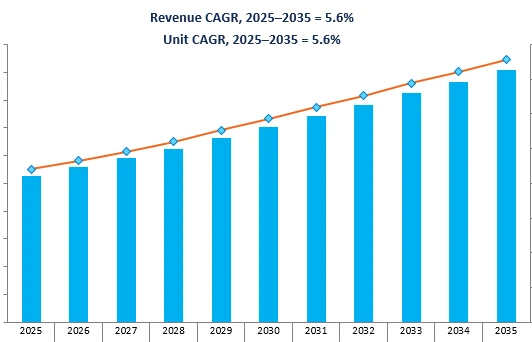
The market reached $5.28 billion in 2025 and is forecast to approach $9.07 billion by 2035, growing at a 5.6% CAGR. Unit shipments are expected to increase from approximately 8,800 units in 2025 to 15,133 units in 2035, also representing a 5.6% CAGR. This indicates relatively steady, volume-led market expansion.
The commercially mature core of the market is concentrated in the 120°C–160°C temperature range, particularly across food and beverage, pulp and paper, and chemicals. Systems above 160°C remain more selective because they generally involve higher integration complexity, project-specific engineering, and greater capital requirements.
A major trend shaping the Industrial HP market is the increasing value placed on energy flexibility. Heat pumps can respond to variable electricity prices, renewable generation, thermal storage opportunities, and changing production schedules. This transforms industrial heat from a relatively fixed fossil-fuel cost into a more controllable and optimizable energy input.
Waste-heat recovery is another important opportunity. Industrial facilities can upgrade low-grade or waste heat and reuse it for process requirements, improving overall system efficiency. Carbon capture, data centers, and grid-related services are also emerging applications.
Service-based models such as Heat-as-a-Service (HaaS) can reduce adoption barriers by shifting expenditure from upfront CAPEX toward managed operating expenditure. Meanwhile, digital controls, monitoring, predictive maintenance, and performance optimization are becoming increasingly important to system value.
Scope of Analysis: Industrial Heat Pump Market
The study covers the global Industrial Heat Pump Market for the 2025–2035 period, using 2025 as the base year and 2026–2035 as the forecast period. The analysis focuses on industrial process heating applications and defines the market around industrial heat pumps with thermal capacity of ?200 kW.
Technology Scope
The study includes electrically driven and heat-activated industrial heat pumps designed primarily for industrial process heat, waste-heat recovery, steam generation, and industrial heat reuse. The core operating range is 40°C–160°C, with selected applications approaching 200°C.
The expanded scope covers systems from approximately 200 kW to 40 MW, with coefficient of performance (COP) ranging from approximately 1.4 to 10.3 at maximum values, depending on application and system configuration.
Applications Covered
The analysis includes:
- Industrial process heating
- Waste-heat recovery
- Temperature lift
- Low- and medium-pressure steam generation
- Industrial heat reuse
- Integrated industrial energy systems
End-Use Sectors
The study covers food and beverage, pulp and paper, chemicals and petrochemicals, pharmaceuticals, metals, and data centers where industrial heat recovery is applicable.
Exclusions
The scope excludes residential heat pumps, commercial HVAC heat pumps, building comfort heating, standard district-heating heat pumps unrelated to industrial uses, chillers primarily designed for cooling without heat-upgrade functionality, and electric boilers without heat-pump thermodynamic cycles.
High-temperature heat pumps operating from approximately 160°C–200°C and ultra-high-temperature systems above 200°C are excluded where they remain first-of-a-kind, project-specific, or commercially limited.
Market Segmentation Analysis: Industrial Heat Pump Market
The Industrial Heat Pump Market can be assessed through temperature range, capacity, application, end-use sector, technology configuration, and geography. The segmentation reflects significant differences in commercial maturity, integration requirements, economics, and adoption potential.
By Temperature
The 120°C–160°C segment represents the commercial core of the market. These systems provide repeatable solutions for industrial applications where process heat requirements are sufficiently high to justify heat-pump integration but remain within commercially established operating conditions.
Applications above 160°C are more selective because they generally require specialized equipment, greater engineering effort, and more complex integration. The report identifies high-temperature systems approaching 200°C as commercially limited or project-specific.
By Capacity
The market covers industrial heat pumps ranging from 200 kW to 40 MW. Smaller systems can serve individual industrial processes, while larger installations can become integrated energy assets serving multiple processes or industrial clusters.
Large-scale systems increasingly require integration with electrical infrastructure, thermal storage, process controls, and waste-heat sources. This increases the importance of EPC capabilities and system engineering.
By Application
Major applications include industrial process heating, waste-heat recovery and temperature lift, low- and medium-pressure steam generation, and industrial heat reuse. Waste-heat recovery is particularly important because it can convert previously unused thermal energy into useful process heat.
The market is also expanding toward integrated energy-system applications in which heat pumps dynamically interact with electricity markets, renewable generation, thermal storage, and industrial loads.
By End-Use Sector
Food and beverage is a major application area because of its recurring process-heat requirements and opportunities for heat recovery.
Pulp and paper offers significant potential because of large thermal loads and opportunities to recover and upgrade waste heat.
Chemicals and petrochemicals provide applications across temperature-lift and process-heating requirements, with increasing interest in electrification and energy-cost management.
Pharmaceuticals represent another important industrial segment where controlled process conditions and energy efficiency can support heat-pump deployment.
Metals offer opportunities primarily in selected low- and medium-temperature processes rather than the highest-temperature applications.
Emerging demand is also coming from data centers, carbon capture, and grid-related services, where heat recovery and thermal-energy integration can provide additional value.
By Geography
Europe remains the global benchmark for industrial heat-pump deployment. Its position is supported by the EU ETS, REPowerEU, F-gas regulation, mature industrial applications, and relatively high deployment density in the 120°C–160°C range.
North America is gaining momentum through IRA tax credits and DOE programs. However, less favorable electricity-to-gas price ratios compared with Europe can influence project economics.
East Asia, particularly Japan and South Korea, has strong engineering and technology capabilities and is developing applications in the 120°C–160°C range.
China benefits from national decarbonization objectives, a large compressor manufacturing base, industrial clusters, and growing demand across food and beverage, chemicals, textiles, and other sectors.
The Rest of the World remains comparatively early-stage, with opportunities in Latin America, the Middle East, and Southeast Asia but constraints related to local engineering capacity, service infrastructure, and reliance on imported technology and EPC partnerships.
Revenue & Spending Forecast: Industrial Heat Pump Market
The Industrial Heat Pump Market is projected to grow steadily from $5.28 billion in 2025 to $9.08 billion by 2035, representing a 5.6% CAGR during the forecast period. In parallel, unit shipments are forecast to increase from approximately 8,800 units in 2025 to 15,133 units in 2035, also recording a 5.6% CAGR. This synchronized growth indicates volume-led expansion with relatively stable system value. Growth is supported by industrial electrification, waste-heat recovery, decarbonization investments, energy-cost optimization, and increasing adoption of integrated energy systems. The Industrial HP market is also moving toward service-based models, including Heat-as-a-Service, which can reduce upfront investment barriers and shift customer spending toward performance-based operating models.
Growth Drivers: Industrial Heat Pump Market
1. Decarbonization Policy and Carbon Pricing
Carbon pricing, compliance obligations, and capital subsidies are converting fossil-based industrial heat costs into more visible economic liabilities. Where carbon pricing and capital grants coexist, heat-pump payback can become more competitive, supporting adoption in industrial applications.
2. Fuel-Switching Economics
The electricity-to-gas price ratio is one of the most important filters for industrial heat-pump project viability. Projects become more attractive when electricity economics, COP performance, and policy support narrow the effective spark gap.
3. Energy-Cost Risk Management
Industrial heat pumps provide opportunities for fuel switching, electricity-price arbitrage, demand shifting, and waste-heat valorization. These capabilities allow industrial users to transform energy costs from relatively fixed fossil exposure into more controllable operating variables.
4. Waste-Heat Recovery
The ability to recover and upgrade low-grade or waste heat provides a major system-level value proposition. Heat pumps can raise the temperature of recovered heat so it can be reused in industrial processes, improving overall energy utilization.
5. Industrial Electrification
Growing electrification of industrial processes is creating demand for flexible thermal assets. Heat pumps can operate alongside renewable electricity, thermal storage, and digital controls, allowing facilities to respond to variable energy availability and pricing.
6. Integrated Energy Architectures
The Industrial HP market is increasingly benefiting from integrated site-level systems that combine heat recovery, thermal storage, electrification, and controls. This expands the value proposition beyond simple boiler replacement.
7. Service-Based Delivery Models
Heat-as-a-Service and outcome-based contracting can reduce upfront CAPEX and transfer operational or performance risks to solution providers. This can make adoption more accessible for industrial customers that are hesitant to make large technology investments.
Growth Restraints: Industrial Heat Pump Market
1. Grid Connection Capacity and Permitting
Insufficient grid capacity, multi-year interconnection queues, and network upgrade requirements can delay electrification projects. In constrained networks, grid availability can become a greater deployment barrier than the heat-pump technology itself.
2. High Upfront CAPEX
Industrial heat pumps require significant initial investment, particularly when projects include electrical infrastructure, controls, thermal storage, and process integration. Higher CAPEX than conventional boilers can delay adoption in capital-constrained or risk-averse industrial environments.
3. Integration Complexity
Successful deployment requires careful engineering around existing processes, waste-heat streams, control systems, and production schedules. Integration complexity increases project-design effort, execution risk, and decision-making time.
4. Limited Skilled Engineering and EPC Resources
The Industrial Heat Pump Market requires multidisciplinary expertise spanning thermodynamics, process integration, controls, energy optimization, engineering, procurement, and commissioning. Limited availability of these skills can constrain near-term project deployment.
5. Electricity-Price Volatility
Unstable electricity prices or unfavorable industrial tariffs can weaken investment cases in regions where electricity does not provide sufficient economic advantages over gas. This makes local energy-market structures critical to project economics.
6. Immature High-Temperature Applications
Systems operating above approximately 160°C remain relatively project-specific and capital-intensive. Their technical and operational complexity limits scalability and reinforces the market's concentration on commercially mature mid-temperature applications.
Competitive Landscape: Industrial Heat Pump Market
The global Industrial Heat Pump Market includes approximately 35 active players, creating a fragmented competitive environment that is gradually moving toward consolidation. The top five competitors accounted for 38.5% of revenue in 2025, indicating that leading companies possess meaningful scale while a substantial portion of the market remains distributed among other participants.
Leading Competitors
The leading competitors identified in the study include:
- GEA
- Johnson Controls
- Mayekawa
- Mitsubishi Heavy Industries
- Bosch
Other notable participants include Carrier, Trane, Hitachi, Emerson, Fuji Electric, Armstrong International, LG Electronics, Atlas Copco, Danfoss, Everllence, ENGIE Refrigeration, Siemens Energy, Thermax, Heatlift, and ECOP.
Key Competitive Factors
Competition is increasingly determined by system integration and EPC capability, lifecycle performance, service execution, application-specific expertise, digital control and optimization, industrial reference bases, financial structure, global service footprint, manufacturing scale, supply-chain depth, component availability, installed base, and performance guarantees.
The market is therefore shifting away from a purely equipment-centric model. Companies that can design, integrate, commission, monitor, and service complete industrial energy systems have an advantage in large and complex projects.
OEMs and System Integrators
Established OEMs retain structural advantages through manufacturing scale, installed bases, component supply, and field-proven references. System integrators compete through application expertise and project execution. The study indicates that specialists increasingly compete on integration and delivery rather than solely on thermodynamic technology.
Distribution Structure
The market uses several routes to customers:
- Direct sales through OEMs and system integrators
- EPC contractors and industrial engineering companies
- Energy service companies and Heat-as-a-Service providers
- Strategic partnerships with utilities and industrial operators
These channels reflect the increasing complexity of industrial heat-pump projects and the need for engineering and long-term service support.
Mergers and Acquisitions
The competitive environment is also being influenced by acquisitions focused on manufacturing scale, HVAC and heat-pump capabilities, and digital energy optimization. The report highlights Carrier's acquisition of Viessmann Climate Solutions, Bosch's acquisition of Johnson Controls' residential and light commercial HVAC business, and Johnson Controls' acquisitions related to digital and energy optimization.
Overall, M&A activity indicates that established companies are seeking scale, manufacturing footprint, and digital-control capabilities. This favors consolidated providers capable of combining equipment manufacturing with system integration, controls, EPC execution, and long-term service.
Scope of Analysis
Key Insights
Segmentation
Why Is It Increasingly Difficult to Grow?
The Strategic Imperative 8™
The Impact of the Top 3 Strategic Imperatives on the Industrial Heat Pumps Industry
Growth Metrics
Growth Metrics Analysis
Growth Drivers
Growth Driver Analysis
Growth Restraints
Growth Restraint Analysis
Competitive Environment: Tier Analysis
Competitive Environment
Industrial Heat Pumps: The Global Opportunity
Target Sectors and IHP Deployment Potential
Key Technology Developments
The Importance of Government Support
Policies Across Regions: European Union
When Electricity Beats Gas: The Price Ratio Driving IHP Adoption
Why Europe is the Global Benchmark for IHP Deployment
Policies Across Regions: North America
Policies Across Regions: China
Policies Across Regions: East Asia
From Decarbonization Asset to Industrial Energy Orchestrator
Redefining the Role of Industrial Heat Pumps
From Standalone Equipment to System Integration
Integration Economics of Peak Temperature
Flexibility as a Core Value Driver
Service-Based Models Reshape Adoption
A New Basis of Competition Is Emerging
Forecast Assumptions
Forecasts & Market Outlook
Forecast Analysis
Revenue and Unit Shipments Forecast
Unit Shipment Forecast by Region
Revenue and Unit Shipment Forecast Analysis
Revenue Share
Revenue Share Analysis
Case Study 1: HP Reciprocating Compressor with Ammonia
Case Study 2: Turbo Compressor Large Steam Generating HP
Case Study 3: Combined Heating & Cooling in a Meat-Processing Plant
Reframing Economics Strategically
Redefining Competitive Analysis
Growth Opportunity 1: Winning with Integrated Industrial Solutions
Growth Opportunity 2: Targeting High-Value Markets—Where Power Beats Gas
Growth Opportunity 3: Beyond Europe—Capturing the Next Wave of Electrification
Growth Opportunity 4: 120–160°C—The Immediate Scaling Window for IHPs
Growth Opportunity 5: Heat + Storage—The Backbone of Flexible Industrial Energy Systems
Growth Opportunity 6: Energy Volatility Accelerates Electrification Momentum
Benefits and Impacts of Growth Opportunities
Next Steps
List of Exhibits
Legal Disclaimer
Frequently Asked Questions (FAQs) – Industrial Heat Pump Market
1. What is the Industrial Heat Pump Market?
The Industrial Heat Pump Market comprises electrically driven and heat-activated heat-pump systems used primarily for industrial process heating, waste-heat recovery, temperature lift, steam generation, and industrial heat reuse. The study focuses on systems with thermal capacity of at least 200 kW, primarily operating in the 40°C–160°C range.
2. What is the size of the Industrial Heat Pump Market?
The Industrial Heat Pump Market reached approximately $5.28 billion in 2025 and is projected to approach $9.07 billion by 2035, growing at a CAGR of approximately 5.6% during 2025–2035.
3. What is the forecast growth rate of the Industrial HP market?
The Industrial HP market is forecast to grow at approximately 5.6% CAGR from 2025 to 2035. Unit shipments are also projected to grow at approximately 5.6% CAGR, increasing from about 8,800 units in 2025 to 15,133 units by 2035.
4. What are the major applications of industrial heat pumps?
Major applications include industrial process heating, waste-heat recovery, temperature lift, low- and medium-pressure steam generation, and industrial heat reuse. Emerging applications include carbon capture, data centers, and grid-related energy services.
5. Which industries are major users of industrial heat pumps?
Major end-use sectors include food and beverage, pulp and paper, chemicals and petrochemicals, pharmaceuticals, and metals. Data centers, carbon capture, and other industrial energy applications represent emerging opportunities for the Industrial Heat Pump Market.
6. Which temperature range represents the commercial core of the Industrial Heat Pump Market?
The 120°C–160°C temperature range represents the commercial core of the market. This range supports relatively mature and repeatable applications across sectors such as food and beverage, pulp and paper, and chemicals. Higher-temperature systems remain more selective and project-specific.
7. What are the key growth drivers for the Industrial HP market?
Key growth drivers include decarbonization policies, carbon pricing, fuel-switching economics, energy-cost risk management, waste-heat recovery, industrial electrification, integrated energy architectures, and Heat-as-a-Service models. These factors increase the value of industrial heat pumps beyond conventional boiler replacement.
8. What are the main restraints affecting the Industrial Heat Pump Market?
Major restraints include grid connection constraints, permitting delays, high upfront CAPEX, integration complexity, limited skilled engineering and EPC resources, electricity-price volatility, and immature high-temperature applications. These factors can increase project timelines, investment requirements, and deployment risk.
9. Which region leads the Industrial Heat Pump Market?
Europe is the global benchmark for industrial heat-pump deployment. Its leadership is supported by policies and regulations including the EU ETS, REPowerEU, and F-gas regulation. North America is gaining traction through IRA tax credits and DOE programs, while China and East Asia offer significant opportunities.
10. Who are the key players in the Industrial Heat Pump Market?
Key players include GEA, Johnson Controls, Mayekawa, Mitsubishi Heavy Industries, and Bosch. Other notable competitors include Carrier, Trane, Hitachi, Emerson, Fuji Electric, Armstrong International, LG Electronics, Atlas Copco, Danfoss, Everllence, ENGIE Refrigeration, Siemens Energy, Thermax, Heatlift, and ECOP.
Speak directly with our analytics experts for tailored recommendations.
Recent related Power Generation research
16 Oct 2026 | Global | Technology Research
Innovations in Wind Energy, Flow Batteries, Water Electrolysis, Mechanical Energy Storage, Thermal Batteries, and Nuclear Power
This edition of the Energy & Power Systems (EPS) TOE features information about the innovations in wind turbine blade technology, organic flow batteries, electrolyzers, waste heat recovery solutions, solar thermal heaters, flywheel energy storage and mechanical energy storage systems, among others.T...
12 Oct 2026 | Global | Market Research
Growth Opportunities in the Global Nuclear Power Industry, 2025–2035
The Growth Opportunities in the Global Nuclear Power Industry study examines global commercial nuclear power development from 2025 to 2035, covering reactors above 10 MWe and the life cycle services supporting the installed fleet. Global installed capacity is projected to grow 23.8%, reaching approx...
09 Oct 2026 | Global | Technology Research
Innovations in Enhanced Oil Recovery, Continuous Emission Monitoring, Infrared Gas Detection, and Reservoir Optimization
This edition of the Oil and Gas (O&G) Technology Opportunity Engines features information on enhanced oil recovery, crude oil separation, leak detection, distributed gas monitoring, real-time monitoring of distributed fuel operations, among others.The Oil and Gas TOE provides intelligence on innovat...
28 Sep 2026 | Global | Technology Research
CO₂ Gas Injection for Enhanced Oil Recovery and Carbon Utilization
CO₂ gas injection for enhanced oil recovery (CO₂-EOR) is a mature tertiary recovery technology that improves oil production from depleted reservoirs while enabling long-term geological carbon storage. This report provides a fundamental overview of oil recovery, covering primary, secondary, and terti...
28 Sep 2026 | Global | Technology Research
CO₂ Gas Injection for Enhanced Oil Recovery and Carbon Utilization
CO₂ gas injection for enhanced oil recovery (CO₂-EOR) is a mature tertiary recovery technology that improves oil production from depleted reservoirs while enabling long-term geological carbon storage. This report provides a fundamental overview of oil recovery, covering primary, secondary, and terti...
Purchase includes:
- Report download
- Growth Dialog™ with our experts
Growth Dialog™
A tailored session with you where we identify the:- Strategic Imperatives
- Growth Opportunities
- Best Practices
- Companies to Action
Impacting your company's future growth potential.
Covering the 2025 to 2035 period at a global level, the analysis focuses on electrically driven and heat-activated systems ≥200 kWth, primarily operating within the 40°C to 160°C range, with select high-temperature applications approaching 200°C.
The market reached $5.28 billion in 2025, representing approximately 8,800 units, and is projected to approach $9.07 billion by 2035 (growing at a 5.6% CAGR). Adoption is driven by three converging forces: operational flexibility, enabling efficient management of variable loads and energy inputs; energy cost risk management, through fuel switching, electricity price arbitrage, and waste-heat valorization; and the emergence of service-based delivery models, such as Heat-as-a-Service (HaaS), which reduce adoption barriers by shifting CAPEX to managed OPEX.
Key demand sectors include food and beverage, chemicals, pulp and paper, pharmaceuticals, and metals, alongside emerging applications in carbon capture, data centers, and grid-related services. The competitive landscape comprises 35 active players, with the top five accounting for 38.5% of revenue, indicating a fragmented yet gradually consolidating market. Europe leads as the global benchmark for deployment, supported by initiatives such as the EU ETS, REPowerEU, and F-gas regulation, while North America is gaining traction through IRA tax credits and DOE programs.
Overall, industrial heat pumps are evolving into integrated energy platforms that coordinate heat, electricity, and operational flexibility, positioning them as critical enablers of adaptive and resilient industrial energy systems. As a result, investment logic is shifting from simple payback metrics toward life cycle value, operational optionality, risk mitigation, and performance-based contracting models.
Author: Agustin Claret
| Deliverable Type | Market Research |
|---|---|
| Industries | Energy |
| No Index | No |
| Is Prebook | No |
| Podcast | No |
| Predecessor | PFK1-01-00-00-00 |
| WIP Number | KCA4-01-00-00-00 |