 USD
USD GBP
GBP  CNY
CNY  EUR
EUR  INR
INR  JPY
JPY  MYR
MYR  ZAR
ZAR  KRW
KRW  THB
THB 


Strong Demand for Grid Products Globally Drives Switchgear Demand
23-Jul-2026
Global
Market Research
PG9W-01-00-00-00
EG_2026_34757
Key Takeaways: High Voltage Switchgear Market
- The high voltage (HV) switchgear market is experiencing strong growth supported by grid upgrades, renewable energy integration, urbanization, decarbonization, and expanding transmission infrastructure.
- Global HV switchgear market revenue is projected to increase from $17.9 billion in 2025 to $38.6 billion by 2035, representing a 7.99% CAGR during 2025–2035.
- The high voltage switchgear market covers equipment operating from 42 kV to above 250 kV, segmented into 42–100 kV, 100.1–249.9 kV, and above 250 kV.
- Utilities represent a major demand center, while industrial applications and renewable-energy projects are creating additional opportunities for HV switchgear deployments.
- Asia-Pacific, particularly China and India, is supported by transmission expansion, renewable evacuation, urbanization, industrial development, and HVDC/UHVDC infrastructure.
- The market is transitioning toward digitalized substations, predictive maintenance, smart-grid monitoring, and more sustainable switchgear technologies.
- Air-insulated switchgear (AIS) and gas-insulated switchgear (GIS) remain the two principal technology categories within the high voltage switchgear market.
- Supply-chain volatility, high upfront investment, environmental regulations, skilled-labor shortages, and long equipment lifecycles remain important constraints for the HV switchgear market.
Report Summary: High Voltage Switchgear Market
The global high voltage (HV) switchgear market is expanding as utilities, transmission operators, industries, and governments invest in modernizing electricity networks and integrating renewable generation. According to the provided Frost & Sullivan research, the market generated $17.9 billion in revenue in 2025 and is projected to reach $38.6 billion by 2035, reflecting a 7.99% CAGR.
The HV switchgear market includes complete switchgear assemblies used for switching, interrupting, protecting, controlling, metering, and regulating electrical circuits. The study covers equipment from 42 kV to above 250 kV and divides the market into air-insulated switchgear (AIS) and gas-insulated switchgear (GIS).
Demand is being supported by growing power consumption, improved grid connectivity, renewable-energy integration, grid modernization, HVDC and UHVDC expansion, and increasing investment in transmission and distribution infrastructure. The high voltage switchgear market is also benefiting from data-center expansion and rising power requirements associated with cloud computing, GPU workloads, and hyperscale facilities.
The research identifies supply-chain vulnerabilities, high upfront costs, environmental regulations, skilled-workforce shortages, complex retrofitting, and long equipment replacement cycles as key restraints. Meanwhile, digital substations, predictive maintenance, smart-grid technologies, renewable integration, and sustainable switchgear architectures are creating opportunities across the HV switchgear market.
Market Overview & Trends: High Voltage Switchgear Market
The global high voltage switchgear market is entering a sustained infrastructure investment cycle driven by the transformation of electricity-generation and transmission systems. Growing power demand, urbanization, industrialization, renewable-energy deployment, and decarbonization are increasing the need for reliable high-voltage equipment capable of managing expanding transmission networks.
Utilities remain an important demand center for the HV switchgear market, particularly as transmission and distribution operators upgrade aging infrastructure and expand network capacity. The replacement of older equipment is occurring alongside new transmission projects designed to connect renewable-generation resources with population and industrial centers.
Renewable-energy integration is another major trend. Wind and solar projects require grid infrastructure capable of managing changing generation patterns and transferring electricity across longer distances. The research specifically identifies renewable integration, offshore wind development, HVDC lines, and high-voltage interconnection systems as important sources of demand for high voltage switchgear.
Asia-Pacific is an important growth region, with China representing the largest market in the study and India and ASEAN identified as high-growth areas. Expansion of HVDC and UHVDC infrastructure in Asia is supporting demand for high-voltage equipment. Europe is experiencing continued investment associated with aging grid assets, grid hardening, low-emission requirements, and cross-border interconnections.
Another significant trend is the digitalization of substations. Utilities are increasingly adopting sensor-based monitoring, predictive maintenance, automation, and smart-grid technologies. These developments are changing the requirements for HV switchgear, with equipment increasingly expected to support improved asset visibility, reliability, and operational efficiency.
Data-center expansion is also emerging as a demand catalyst. Cloud computing, GPU workloads, hyperscale facilities, and increasingly dense computing environments are increasing electricity requirements and creating demand for resilient high-voltage infrastructure.
Scope of Analysis: High Voltage Switchgear Market
The high voltage switchgear market study provides a global analysis covering 2025–2035, with 2025 as the base year and 2026–2035 as the forecast period. The analysis measures market revenue in US dollars and focuses on switchgear assemblies used for switching, interrupting, controlling, protecting, metering, and regulating electrical circuits. The study defines the high-voltage range as equipment operating from 42 kV to above 250 kV.
The HV switchgear market is segmented into three voltage ranges: 42–100 kV, 100.1–249.9 kV, and above 250 kV. Revenue is measured at the manufacturer level based on earnings from regional HV switchgear demand. The study excludes additional revenue generated by distributors and panel builders through installation, commissioning, and other value-added services. Local-company export revenues are not separately considered; instead, market sizes are calculated for the respective constituent countries.
The research measures revenue for the complete switchgear assembly, rather than individual components forming part of the assembly. Within the high voltage switchgear market, Frost & Sullivan divides the technology landscape into air-insulated switchgear (AIS) and gas-insulated switchgear (GIS). AIS uses air as the primary insulating medium, while GIS uses a gas-based insulating medium such as sulfur hexafluoride (SF6).
The research provides a global perspective and references 11 regions and 30 countries for more detailed country-level analysis. The scope also evaluates market drivers, restraints, technology developments, regional dynamics, and factors affecting demand throughout the forecast period.
Market Segmentation Analysis: High Voltage Switchgear Market
The high voltage switchgear market is primarily segmented by voltage rating and switchgear technology. Based on voltage, the study divides the market into 42–100 kV, 100.1–249.9 kV, and above 250 kV. These categories represent different levels of transmission and grid infrastructure requirements, with higher-voltage equipment particularly relevant to long-distance power transmission and major interconnection projects.
The technology segmentation of the HV switchgear market comprises air-insulated switchgear (AIS) and gas-insulated switchgear (GIS). AIS uses air as the primary insulating medium to protect, control, and isolate electrical circuits. GIS uses a gas-based insulating medium, including SF6 in the equipment covered by the study. Technology selection can vary according to installation requirements, network configuration, space considerations, project specifications, and environmental requirements.
In 2025, the total high voltage switchgear market generated approximately $17.9 billion in revenue. The revenue forecast shown in the research indicates that the market will reach $38.6 billion by 2035. The accompanying forecast identifies AIS and GIS as the two technology categories contributing to this expansion.
The AIS segment increases from approximately $4.5 billion in 2025 to $8.1 billion in 2035. GIS represents the larger portion of the market throughout the forecast, increasing from approximately $13.4 billion in 2025 to $30.5 billion in 2035. This indicates that GIS accounts for a substantial share of the HV switchgear market across the forecast period.
From an application perspective, utilities are identified as a particularly important demand segment. Power-generation companies and transmission and distribution operators are investing in network upgrades, renewable-energy evacuation, grid expansion, and aging-asset replacement. Industrial customers also contribute to demand as electrification and industrial megaprojects increase high-voltage power requirements.
Renewable-energy infrastructure represents another important application area for high voltage switchgear. Offshore wind, renewable-energy interconnection, HVDC, and UHVDC transmission projects require high-voltage systems capable of supporting long-distance power movement and network stability.
Regional segmentation further differentiates the HV switchgear market. China remains the largest market identified in the research, while India and ASEAN are associated with strong growth. North America and Europe are supported by grid modernization, aging-asset replacement, resilience investments, and renewable integration. Asia-Pacific is particularly significant because of transmission expansion, industrialization, urbanization, and renewable-energy infrastructure development.
Revenue & Spending Forecast: High Voltage Switchgear Market
The global high voltage switchgear market is forecast to expand from $17.9 billion in 2025 to $38.6 billion in 2035, representing a 7.99% CAGR. The forecast demonstrates sustained revenue growth throughout the study period, supported by renewable integration, HV/UHV grid expansion, aging infrastructure replacement, and large-scale transmission investment.
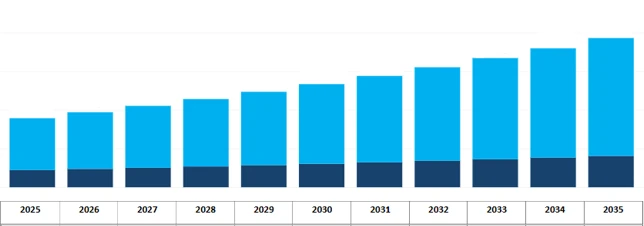
The forecast indicates an increase of approximately $20.7 billion in annual market revenue between 2025 and 2035. GIS revenue increases from approximately $13.4 billion in 2025 to $30.5 billion in 2035, while AIS revenue increases from $4.5 billion to $8.1 billion over the same period.
The HV switchgear market is therefore positioned around multi-billion-dollar infrastructure investment cycles involving grid modernization, renewable-energy evacuation, transmission expansion, and aging-asset replacement.
Growth Drivers: High Voltage Switchgear Market
Growing electricity demand and improved grid connectivity are fundamental drivers of the high voltage switchgear market. Population growth, urbanization, industrialization, and electrification are increasing requirements for reliable transmission infrastructure. Developing markets across Asia, Africa, and Latin America are expanding electricity networks, while industrial electrification is increasing demand for high-capacity electrical infrastructure.
Renewable-energy deployment is another major growth driver for the HV switchgear market. Increasing wind and solar capacity requires transmission infrastructure capable of connecting generation assets to demand centers. Offshore wind development and high-voltage interconnection projects are further expanding the requirement for advanced switchgear.
HVDC and UHVDC expansion is particularly important. The research identifies growing deployment of high-voltage transmission corridors in Asia, particularly China and India, as a source of demand. These systems facilitate long-distance transmission and renewable-energy evacuation while supporting network development.
Grid modernization is also accelerating demand for high voltage switchgear. Aging grid assets require replacement or refurbishment, while utilities are increasingly incorporating smart-grid technologies, sensors, automation, and monitoring capabilities. The research notes that global grid investment is expected to increase significantly, supporting demand for modern switchgear with digital capabilities.
Data-center growth represents an emerging demand catalyst. Cloud computing, GPU workloads, hyperscale facilities, and AI-related computing requirements are increasing power densities and creating demand for resilient high-voltage infrastructure. This trend expands the application base of the HV switchgear market beyond conventional utility projects.
Growth Restraints: High Voltage Switchgear Market
Supply-chain vulnerability represents an important restraint for the high voltage switchgear market. Trade restrictions, tariffs, raw-material constraints, and disruptions involving semiconductors and electronic components can increase production costs and extend equipment lead times. Volatility in materials and logistics can therefore affect project schedules and procurement decisions.
High upfront investment is another constraint. Advanced HV switchgear requires significant capital expenditure, which can make projects challenging for smaller industrial and utility participants. Long project cycles and payment delays can further affect cash flow and investment decisions.
Environmental regulations are also reshaping the HV switchgear market. Requirements to reduce greenhouse-gas emissions are encouraging the industry to move away from SF6-based gas-insulated technologies toward lower-emission alternatives. This transition can increase compliance requirements, R&D spending, equipment redesign costs, and replacement expenditure.
A shortage of skilled personnel presents another challenge. Next-generation high voltage switchgear increasingly incorporates IoT sensors, predictive maintenance, digital monitoring, arc-flash protection, and renewable-grid integration. Installation, commissioning, monitoring, and maintenance therefore require personnel with both electrical and digital expertise.
Complex installation and retrofitting can also delay modernization projects. Replacing equipment in existing substations can require extensive planning and coordination with older infrastructure. The long operating life of HV equipment—often 20 to 30 years—also reduces replacement frequency and can encourage utilities to extend the life of existing systems rather than immediately invest in complete replacements.
Competitive Landscape: High Voltage Switchgear Market
The global high voltage switchgear market is characterized by a large and geographically distributed competitive ecosystem. The provided research identifies more than 200 competitors in 2025, indicating a fragmented market structure despite the presence of major international manufacturers. The study reports that the top 10 companies account for 60.5% of market revenue, demonstrating meaningful concentration among leading participants.
Competition in the HV switchgear market is shaped by long-standing utility relationships, manufacturing and servicing capabilities, delivery reliability, localized support, cost control, and the ability to manage extended project lead times. Equipment qualification and reliability are particularly important because HV switchgear forms part of critical electricity infrastructure and is typically deployed for long operating periods.
The market includes major Western, Chinese, and Japanese participants with established manufacturing footprints and service networks. Leading suppliers compete through global manufacturing capacity, regional warehouses, technical support, local partnerships, and relationships with utilities and transmission operators. Partnerships with local companies can provide product support, spare-parts availability, installation assistance, and market access.
The competitive environment is also being reshaped by technology. Digital substations, smart-grid integration, predictive maintenance, sensor-based monitoring, and automation are creating new differentiation opportunities within the high voltage switchgear market. Manufacturers increasingly need to combine conventional protection and switching capabilities with digital monitoring and asset-management functions.
Sustainability is becoming another important competitive dimension. Environmental requirements associated with SF6 and greenhouse-gas emissions are encouraging suppliers to develop alternative insulation technologies and lower-emission equipment. This creates opportunities for vendors that can provide compliant solutions without compromising system reliability.
The analyst perspective emphasizes that utilities and industries remain important growth segments, while competition is intensifying, including from Asian players. Innovation is increasingly expected to address substation digitalization, grid modernization, predictive maintenance, safety, asset performance, and overall system efficiency.
Partnerships, collaboration, and co-creation are also identified as important strategic themes. Utilities increasingly require suppliers to support broader objectives involving grid resilience, renewable integration, sustainability, and technology adoption. Consequently, the competitive environment of the HV switchgear market is moving beyond equipment supply toward integrated technology, lifecycle support, and long-term customer relationships.
Scope of Analysis
Segmentation
Regional Segmentation
Key Competitors
Why is it Increasingly Difficult to Grow?
The Strategic Imperative 8™
The Impact of the Top 3 Strategic Imperatives on the HV Switchgear Industry
Key Findings
Growth Metrics
Growth Drivers
Growth Restraints
Major Trends Shaping the HV Switchgear Industry
Rise of Renewable Energy
Global Power Generation Investment Forecast by Region
Global T&D Investment Forecast by Region
Commodity Price Increases
Global Data Center Investment
SF6 Regulations—Timeline
Forecast Assumptions
Total HV Switchgear Revenue Forecast
Total HV Switchgear Revenue Forecast by Region
Total Unit Forecast by Region
Global Revenue and Unit Forecast Discussion
Europe Revenue Forecast Discussion
North America Revenue Forecast Discussion
China Revenue Forecast Discussion
India & South Asia Revenue Forecast Discussion
East Asia Revenue Forecast Discussion
ASEAN Revenue Forecast Discussion
Latin America Revenue Forecast Discussion
MENA Revenue Forecast Discussion
Sub-Saharan Africa Revenue Forecast Discussion
ANZ & Pacific Revenue Forecast Discussion
Russia & CIS Revenue Forecast Discussion
Revenue Forecast by End User
Revenue Forecast Discussion by End User
Total HV AIS Switchgear Revenue Forecast by Region
Total HV AIS Switchgear Revenue Forecast by Voltage Type
Total HV AIS Switchgear Unit forecast by Voltage
Total HV AIS Switchgear Revenue Forecast by End User
Global AIS Revenue, Unit, and End-User Forecast Discussion
Total HV GIS Switchgear Revenue Forecast by Region
Total HV GIS Switchgear Unit Forecast by Region
Total HV GIS Switchgear Revenue Forecast by Voltage Type
HV GIS Switchgear Revenue Forecast by End User
Global GIS Revenue, Unit, and End-User Forecast Discussion
Competitive Environment
Revenue Share
Revenue Share Analysis
Growth Opportunity 1: Digitalization
Growth Opportunity 2: Organic Expansion and M&A
Growth Opportunity 3: As-a-service Business Model
Growth Opportunity 4: Next-Generation High Voltage T&D
Growth Opportunity 5: Services and Aftermarket
Benefits and Impacts of Growth Opportunities
Next Steps
List of Exhibits
Legal Disclaimer
Frequently Asked Questions: High Voltage Switchgear Market
1. What is the high voltage switchgear market?
The high voltage switchgear market covers complete switchgear assemblies used for switching, interrupting, controlling, protecting, metering, and regulating electrical circuits. The study covers high-voltage equipment from 42 kV to above 250 kV and includes air-insulated switchgear (AIS) and gas-insulated switchgear (GIS).
2. What is the size of the HV switchgear market in 2025?
The global HV switchgear market generated approximately $17.9 billion in revenue in 2025, according to the provided Frost & Sullivan research.
3. What is the forecast for the high voltage switchgear market by 2035?
The high voltage switchgear market is forecast to reach approximately $38.6 billion by 2035, increasing from $17.9 billion in 2025.
4. What is the CAGR of the HV switchgear market?
The global HV switchgear market is projected to grow at a compound annual growth rate of approximately 7.99% between 2025 and 2035.
5. What are the main technologies in the high voltage switchgear market?
The main technologies covered in the high voltage switchgear market are air-insulated switchgear (AIS) and gas-insulated switchgear (GIS). AIS primarily uses air as the insulating medium, while GIS uses a gas-based insulating medium.
6. What are the key growth drivers for the HV switchgear market?
Key growth drivers for the HV switchgear market include grid modernization, growing electricity demand, renewable-energy integration, HVDC and UHVDC expansion, urbanization, industrial electrification, aging-grid replacement, and increasing investment in transmission infrastructure.
7. What are the major restraints affecting the high voltage switchgear market?
Major restraints affecting the high voltage switchgear market include supply-chain disruptions, raw-material price volatility, high upfront investment, environmental regulations, skilled-labor shortages, complex installation and retrofitting, and long equipment replacement cycles.
8. Which regions are important in the HV switchgear market?
The global HV switchgear market includes multiple regions, with China identified as the largest market in the study. India and ASEAN are highlighted for strong growth, while North America and Europe benefit from grid modernization, aging infrastructure replacement, renewable integration, and resilience investments.
9. What applications are driving demand for high voltage switchgear?
Demand for high voltage switchgear is supported by utility transmission and distribution projects, renewable-energy integration, HVDC and UHVDC systems, industrial electrification, grid modernization, aging-asset replacement, offshore wind, and high-power infrastructure such as data centers.
10. How is digitalization affecting the high voltage switchgear market?
Digitalization is changing the high voltage switchgear market through sensor-based monitoring, predictive maintenance, automation, smart-grid integration, and digital substations. These technologies can improve asset visibility, maintenance planning, reliability, safety, and operational efficiency.
Speak directly with our analytics experts for tailored recommendations.
Recent related Power Generation research
09 Oct 2026 | Global | Technology Research
Innovations in Enhanced Oil Recovery, Continuous Emission Monitoring, Infrared Gas Detection, and Reservoir Optimization
This edition of the Oil and Gas (O&G) Technology Opportunity Engines features information on enhanced oil recovery, crude oil separation, leak detection, distributed gas monitoring, real-time monitoring of distributed fuel operations, among others.The Oil and Gas TOE provides intelligence on innovat...
28 Sep 2026 | Global | Technology Research
CO₂ Gas Injection for Enhanced Oil Recovery and Carbon Utilization
CO₂ gas injection for enhanced oil recovery (CO₂-EOR) is a mature tertiary recovery technology that improves oil production from depleted reservoirs while enabling long-term geological carbon storage. This report provides a fundamental overview of oil recovery, covering primary, secondary, and terti...
28 Sep 2026 | Global | Technology Research
CO₂ Gas Injection for Enhanced Oil Recovery and Carbon Utilization
CO₂ gas injection for enhanced oil recovery (CO₂-EOR) is a mature tertiary recovery technology that improves oil production from depleted reservoirs while enabling long-term geological carbon storage. This report provides a fundamental overview of oil recovery, covering primary, secondary, and terti...
28 Sep 2026 | Global | Technology Research
Quasi-Solid-State Batteries: Key Innovations Transforming Electrochemical Energy Storage Systems
Quasi-solid-state batteries (QSSBs) are emerging as a promising next-generation lithium battery technology that bridges the gap between conventional lithium-ion batteries (LIBs) and all-solid-state batteries (ASSBs). By integrating a confined liquid electrolyte within a polymer, inorganic, or hybrid...
18 Sep 2026 | Global | Technology Research
Innovations in Electrolyzers, Process Heat Electrification, LDES, Thermal Energy Conversion, Tidal Energy, Superconducting Materials, and Solid Oxide Fuel Cells
This edition of the Energy & Power Systems (EPS) TOE features information about the innovations in AEM electrolyzer technology, data center power delivery, alkaline electrolyzer, process heat electrification, LDES, tidal energy, superconducting energy storage, among others.The Energy and Power Syste...
Purchase includes:
- Report download
- Growth Dialog™ with our experts
Growth Dialog™
A tailored session with you where we identify the:- Strategic Imperatives
- Growth Opportunities
- Best Practices
- Companies to Action
Impacting your company's future growth potential.
Regionally, China remains the largest market, while India, North America, and ASEAN post the fastest growth in transmission expansion for renewables evacuation, urbanization, industrial mega-loads, and resilience upgrades. Europe sustains steady momentum driven by aging fleet replacement, grid hardening, low emissions regulations, and cross-border interconnection projects that support renewable integration and energy security.
The market is dominated by Western, Chinese, and Japanese players who maintain a large manufacturing base globally, along with vast servicing and warehousing facilities in key regions. This, in addition to partnerships with local companies for product support and spare supply, drives OEM strategy. Success factors are long-standing utility relationships, localized manufacturing/service, proven delivery reliability, cost control under volatile input prices, and extended lead times.
| Deliverable Type | Market Research |
|---|---|
| Industries | Energy |
| No Index | No |
| Is Prebook | No |
| Keyword 1 | HV Switchgear Market Report |
| Keyword 2 | High Voltage Switchgear Analysis |
| Keyword 3 | HV Switchgear Market Forecast |
| Podcast | No |
| Predecessor | PCEC-01-00-00-00 |
| WIP Number | PG9W-01-00-00-00 |