 USD
USD GBP
GBP  CNY
CNY  EUR
EUR  INR
INR  JPY
JPY  MYR
MYR  ZAR
ZAR  KRW
KRW  THB
THB 


Machine Vision Market, Global, 2024–2029
Machine Vision Market Is Driving Transformational Growth Due to the Rising Demand in the Semiconductor and Electronics Sector
24-Nov-2025
Global
Market Research
PG2X-01-00-00-00
TM_2025_34124
Report Summary: Machine Vision Market
The global machine vision market was valued at USD 11.10 billion in 2024 and is expected to reach USD 13.99 billion by 2029, expanding at a CAGR of 4.7% during the forecast period. Growing automation, rising quality requirements, and the integration of AI-driven vision systems are key factors accelerating market growth.
Key Market Trends & Insights
- Increasing adoption of automation and robotics across manufacturing plants is strengthening demand within the industrial machine vision market.
- AI- and deep-learning–based inspection systems are replacing rule-based vision to handle complex product variations and micro-scale defects.
- 3D vision, high-resolution sensors, and embedded vision platforms are gaining traction in high-speed production environments.
- The factory automation machine vision market is benefiting from rapid deployment of collaborative robots, automated packaging systems, and high-throughput assembly lines.
- Electronics, automotive, pharmaceuticals, and semiconductors remain the largest adopters of advanced machine vision technologies.
- Edge-vision processing and real-time analytics are becoming essential for applications requiring ultra-low latency and continuous inspection.
Market Size & Forecast:
- 2024 Market Size: USD 11.10 Billion
- 2029 Market Size: USD 13.99 Billion
- CAGR (2024–2029): 4.7%
- Asia-Pacific: Largest deployment region
- North America: Strong adoption in high-value precision manufacturing
The increasing complexity of manufactured products, stringent regulatory expectations, and the need for zero-defect production are driving accelerated investments in machine vision systems. As industries modernize through robotics, digital manufacturing, and smart-factory initiatives, the machine vision market will continue to play a critical role in enabling high-speed inspection, process optimization, predictive quality control, and enhanced production intelligence across global industrial operations.
Market Overview & Trends: Machine Vision Market
The machine vision market is at a pivotal stage where automation, robotics, AI, and data-driven production systems converge. In modern manufacturing, machine vision has become the “eyes” of automated systems, enabling real-time analysis, inspection, measurement, and classification at speeds far beyond human capability. From assembly lines to packaging floors, the technology ensures precision, reduces operational errors, enhances quality assurance, and supports continuous production cycles. As industries pursue zero-defect manufacturing standards, machine vision systems are increasingly embedded into robotic cells, conveyors, pick-and-place systems, and autonomous workstations.
AI-driven analytics and deep-learning capabilities are redefining expectations within the industrial machine vision market. Unlike rule-based vision systems, AI-enabled models can learn from sample images, adapt to product variations, and classify complex patterns, making them suitable for industries such as semiconductors, pharmaceuticals, and food processing. This transition from rule-based to learning-based vision marks a significant structural shift, allowing manufacturers to automate inspections previously considered too difficult for conventional machine vision.
Hardware innovation remains a strong trend. Advancements in CMOS sensors, 3D vision modules, hyperspectral imaging, and high-speed cameras allow for deeper inspection accuracy and broader application scope. Embedded and edge-vision systems—where processing occurs locally rather than in the cloud—enable faster cycle times and reduced latency. These capabilities are essential for the factory automation machine vision market, where robotic systems rely heavily on real-time visual feedback for guidance, alignment, picking, palletizing, and navigation.
Another major market trend is interoperability. As smart factories integrate PLCs, robots, conveyors, and digital twins, machine vision vendors focus on open standards, industrial Ethernet, and multi-camera synchronization to ensure seamless communication across ecosystems. This supports Industry 4.0 initiatives and improves system-level intelligence.
Global manufacturing shifts also shape the market. Asia-Pacific continues to make substantial investments in electronics, automotive, and semiconductor manufacturing, driving high-volume machine vision deployments. In Europe, strong regulatory pressures for quality and traceability accelerate adoption in pharmaceuticals, food safety, and automotive segments. North American industries prioritize automation due to rising labor costs, workforce shortages, and the need for high-mix, low-volume production flexibility.
Overall, the machine vision market is transitioning from standalone inspection systems to integrated, intelligent, and adaptive automation platforms that enhance productivity, operational visibility, and manufacturing competitiveness across every major industrial vertical.
Revenue & Spending Forecast: Machine Vision Market
The global machine vision market demonstrates a steady growth trajectory as industries deepen their reliance on automation, visual intelligence, and high-speed inspection. In 2024, the total market size stood at USD 11.10 billion, driven by robust demand for quality control, advanced imaging, and robotics-based manufacturing. By 2029, the market is projected to reach USD 13.99 billion, representing a CAGR of approximately 4.7% over the forecast period.
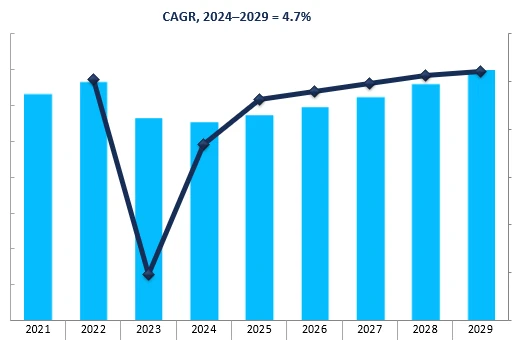
Market growth is supported by several structural factors. Manufacturing industries are confronting workforce shortages, rising labor costs, and increasing complexity in product variants. These pressures accelerate the shift toward automated inspection and robotic intelligence across the industrial machine vision market. The transition from manual or semi-automated inspection to AI-enabled vision systems allows companies to maintain speed, accuracy, and consistency across multi-shift operations.
Increasing deployment of collaborative robots, high-speed assembly systems, and automated packaging lines boosts investments in the factory automation machine vision market. As industrial plants modernize, machine vision becomes integral to predictive maintenance, inline measurement, and closed-loop quality control.
With the global push for smart manufacturing, real-time monitoring, and end-to-end traceability, the machine vision market will continue expanding across every major region. The expected increase from USD 11.10 billion to USD 13.99 billion signifies that machine vision is becoming one of the core technologies powering next-generation production systems.
Scope of Analysis: Machine Vision Market
This study examines the global machine vision market, covering all major technologies, hardware components, software solutions, and industrial applications that contribute to automated visual inspection and perception-driven automation. The scope includes both 2D and 3D systems, smart cameras, PC-based vision platforms, vision sensors, image-processing software, embedded vision units, deep-learning vision software, and integrated inspection systems.
The industrial machine vision market—which dominates the landscape—is assessed across a wide range of applications including defect detection, measurement, assembly verification, robotics guidance, code reading, predictive maintenance, and process optimization. The analysis incorporates traditional manufacturing industries such as automotive, electronics, semiconductors, packaging, metals, plastics, pharmaceuticals, and food & beverage. The factory automation machine vision market is evaluated in relation to modern production ecosystems, smart manufacturing, robotics integration, and advanced material-handling systems.
The study period covers 2024 as the base year with forecasts through 2029. Only top-level revenue values for the total market are included; no segment-level or region-level revenue values are presented. The geographic scope includes North America, Europe, Asia-Pacific, and emerging regions.
The analysis integrates industry trends, structural shifts, technology adoption cycles, robotics evolution, AI/ML integration, and standardization efforts relevant to machine vision. It focuses on how vision systems interact with automation infrastructure, digital manufacturing platforms, and smart-factory environments.
Market Segmentation Analysis: Machine Vision Market
The machine vision market is broadly segmented by component, product type, application, and end-user industry. Although revenue values are excluded for each segment, the structural breakdown highlights the market’s diverse adoption landscape.
1. By Component
The ecosystem includes hardware (cameras, sensors, lenses, lighting, frame grabbers, embedded vision processors) and software (image acquisition, deep-learning vision platforms, analytics engines). Hardware forms the foundation of visual capture, while software increasingly determines system flexibility, accuracy, and scalability. AI-based training tools and cloud-enabled platforms are transforming how inspection data is analyzed.
2. By Product Type
Machine vision platforms fall into two main categories:
- PC-based machine vision systems, offering high processing power, multi-camera capabilities, and extensive customization for complex manufacturing environments.
- Smart-camera and embedded-vision systems, which integrate processing power directly within the camera, reducing footprint, cost, and latency. These are expanding rapidly in the factory automation machine vision market.
3. By Application
Machine vision is used for inspection, measurement, positioning, code reading, surface analysis, robot guidance, and assembly verification. Growth is strong in AI-driven inspection, 3D measurement, high-speed sorting, and robotic picking applications. Industries such as semiconductors, automotive, electronics, packaging, and pharmaceuticals rely heavily on advanced imaging to meet stringent quality and compliance requirements.
4. By Industry
End users range widely across sectors including automotive, electronics, FMCG, pharmaceuticals, metals, semiconductors, plastics, food and beverage, logistics, and medical devices. In the industrial machine vision market, electronics and semiconductor manufacturing remain among the largest adopters due to micro-scale inspection needs, while automotive and pharmaceuticals require consistent precision and regulatory traceability.
Together, these segments illustrate the diversity and depth of machine vision adoption across modern manufacturing environments.
Growth Drivers: Machine Vision Market
Several fundamental forces are shaping the expansion of the machine vision market across global industries. First, the rising need for precision manufacturing, quality consistency, and defect minimization is compelling companies to replace manual inspection with automated vision systems. High-resolution sensors and AI-driven imaging enable detection of micro-defects and subtle anomalies that human operators often miss.
Second, automation is accelerating across the industrial machine vision market. Robotics, autonomous material-handling systems, and smart assembly lines require rapid, reliable visual feedback. Machine vision systems provide the perception layer for these automated workflows, guiding robotic arms, confirming part orientation, verifying assembly sequences, and ensuring the accuracy of high-speed pick-and-place operations.
Third, deep learning and AI are transforming what machine vision can achieve. AI-based models learn from image datasets, adapt to variations in shape or texture, and deliver better decision-making without extensive rule programming. This increases deployment flexibility across diverse industries.
Fourth, Industry 4.0 initiatives emphasize operational visibility, continuous optimization, and predictive quality management. Machine vision, when integrated with MES, SCADA, or ERP platforms, enables real-time quality analytics and closed-loop process control.
Finally, growth in the factory automation machine vision market is supported by rising labor shortages, higher production throughput targets, and increasing regulatory scrutiny in sectors such as pharmaceuticals and food processing.
Growth Restraints: Machine Vision Market
Despite strong momentum, several challenges affect adoption in the machine vision market. One significant barrier is the high initial cost of advanced systems. While long-term ROI is typically strong, small and mid-sized manufacturers may struggle with upfront expenses related to high-performance cameras, lighting, sensors, and integration.
A second restraint is system complexity. Vision systems require calibration, lighting optimization, algorithm tuning, and environmental control. In dynamic production environments, changes in part design, lighting conditions, or line speed can necessitate frequent system adjustments. This is particularly challenging for factories lacking dedicated automation or data-science talent.
Third, deep-learning systems demand high-quality image datasets for training. In industries with rapidly changing product lines, collecting and labeling imagery can be time-consuming.
Fourth, some industrial sectors still rely on legacy equipment, making it difficult to integrate modern machine vision systems without broader process modifications. Connectivity issues, compatibility with existing control systems, and limited network bandwidth can slow adoption across the industrial machine vision market.
Cybersecurity concerns also emerge as more vision systems connect to factory networks or cloud platforms. Manufacturers must ensure secure data transmission, access control, and system integrity.
These restraints highlight the importance of vendor support, training, and flexible deployment models as adoption expands across global industries.
Competitive Landscape: Machine Vision Market
The global machine vision market is highly competitive, featuring established industrial automation leaders, specialized vision-system manufacturers, camera and sensor innovators, and emerging AI-driven solution providers. Companies differentiate themselves through imaging capabilities, software intelligence, integration services, and industry-specific expertise.
Key players include major automation firms, camera specialists, and integrated vision-solution vendors offering advanced hardware, deep-learning software, embedded vision platforms, and system integration. Many competitors provide turnkey solutions, combining lighting, optics, cameras, compute units, vision software, and custom inspection algorithms tailored to automotive, electronics, pharmaceutical, and packaging environments.
The industrial machine vision market is increasingly shaped by partnerships between vision providers and robotics companies. Collaborative robots rely heavily on real-time visual perception, driving strong integration between robotic arms and embedded or smart-camera systems. Suppliers also form alliances with industrial automation platforms, MES providers, and PLC manufacturers to create interoperable systems for smart factories.
Software capability has become a key differentiator. Vendors offering deep-learning toolkits, low-code inspection builders, or cloud-based analytics platforms enable faster deployment and more adaptable inspection workflows. In the factory automation machine vision market, vendors focus on high-speed processing, deterministic latency, and seamless integration with conveyors, pick-and-place units, and material-handling robots.
The landscape is also influenced by regional competitors specializing in cost-effective hardware for high-volume manufacturing, particularly in Asia-Pacific. Global leaders emphasize innovation, reliability, and compliance with international standards to maintain competitive advantage.
Scope of Analysis
Why Is It Increasingly Difficult to Grow?
The Strategic Imperative 8
The Impact of the Top 3 Strategic Imperatives on the Machine Vision Industry
Value-Chain Analysis
Competitive Environment
Key Competitors
Growth Metrics
Growth Drivers
Growth Driver Analysis
Growth Restraints
Growth Restraint Analysis
Trends
Forecast Considerations
Revenue Forecast
Revenue Forecast by Product
Revenue Forecast by Industry Vertical
Revenue Forecast by Region
Revenue Forecast by Country, Americas
Revenue Forecast by Country, Europe
Revenue Forecast by Country, APAC
Forecast Analysis
Pricing Trends and Forecast Analysis
Revenue Share
Growth Metrics
Revenue Forecast
Revenue Forecast by Industry Vertical
Revenue Forecast by Region
Forecast Analysis
Growth Metrics
Revenue Forecast
Revenue Forecast by Industry Vertical
Revenue Forecast by Region
Forecast Analysis
Growth Metrics
Revenue Forecast
Revenue Forecast by Industry Vertical
Revenue Forecast by Region
Forecast Analysis
Growth Metrics
Revenue Forecast
Revenue Forecast by Industry Vertical
Revenue Forecast by Region
Forecast Analysis
Growth Opportunity 1: AI and Machine Learning
Growth Opportunity 2: Innovative Business Models
Growth Opportunity 3: Up-Skilling Workforce
Benefits and Impacts of Growth Opportunities
Next Steps
List of Exhibits
Legal Disclaimer
Frequently Asked Questions – Machine Vision Market
1. What is the global machine vision market?
2. What was the market size in the base year?
3. What is the forecast value for 2029?
4. What drives growth in the industrial machine vision market?
5. Which industries use machine vision most widely?
6. What technologies are shaping the factory automation machine vision market?
7. What are the main challenges limiting adoption?
8. Which regions lead market adoption?
9. How does machine vision improve manufacturing quality?
10. What is the long-term outlook for the machine vision industry?
Speak directly with our analytics experts for tailored recommendations.
Recent related Electronic Measurement research
05 Oct 2026 | Global | Market Research
Calibration and Repair Services Market, Global, 2025–2030
The global calibration and repair services market reached $4,096.8 million in 2025, driven by the increasing digitalization of calibration and repair services, integration with existing connected systems, real-time monitoring capabilities, and predictive analytics. Third-party service companies are ...
02 Oct 2026 | Global | Technology Research
Growth Opportunities in Contact-Rich Robot Skill AI, High-Speed Photopolymer 3D Printing, Industrial Interoperability, Vision AI, Pallet Shuttle Automation, In-Situ AM Inspection, and Composite 3D Printing
The Advanced Manufacturing Technology Opportunity Engine provides profiles of innovations related to simulation-trained contact skills enabling industrial robots to perform complex physical interactions and manipulation tasks; hybrid laser-DLP 3D printing systems combining additive technologies for ...
18 Sep 2026 | Global | Frost Radar
Frost Radar™: Laboratory Information Management Systems in Industrial Applications, 2026
Digitalization is transforming laboratory operations, resulting in a demand for cloud-based and AI-integrated laboratory information management systems (LIMS) to manage complex data and high volumes from automated systems. By combining these tools with software-as-a-service (SaaS) models, providers ...
11 Sep 2026 | Global | Market Research
Growth Impact of AI on the Communication Test Equipment Market, 2025–2030
Artificial intelligence (AI) is reshaping the global communication test equipment market by transforming product development, enabling intelligent and automated testing, and driving demand through next-generation communication infrastructure. This Frost & Sullivan analysis examines AI's impact acros...
04 Sep 2026 | Global | Technology Research
Growth Opportunities in Intralogistics Automation, Embodied Robotic Arms, Physical AI Training, Industrial AI, Service Robotics, Precision Farming Robots, and Laboratory Automation
The Advanced Manufacturing Technology Opportunity Engine provides profiles of innovations related to autonomous mobile robots (AMRs) enabling pallet and trolley transportation across dynamic intralogistics environments; compact 6-axis robotic systems supporting modular and flexible laboratory automa...
Purchase includes:
- Report download
- Growth Dialog™ with our experts
Growth Dialog™
A tailored session with you where we identify the:- Strategic Imperatives
- Growth Opportunities
- Best Practices
- Companies to Action
Impacting your company's future growth potential.