 USD
USD GBP
GBP  CNY
CNY  EUR
EUR  INR
INR  JPY
JPY  MYR
MYR  ZAR
ZAR  KRW
KRW  THB
THB 


Non-Human Identity is Experiencing Transformational Growth Due to Rapid Digitalization and AI-Driven Transformation
14-Nov-2025
Global
Market Research
KBCE-01-00-00-00
AE_2025_34097
Report Summary: Non-Human Identity Solutions Market
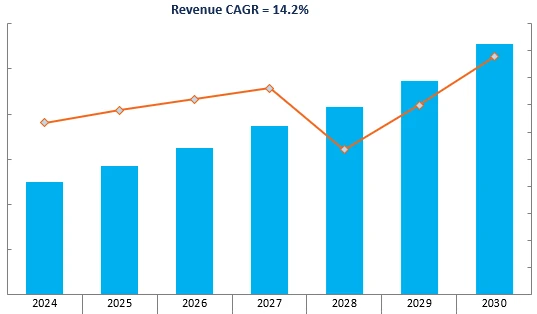
The global Non-Human Identity Solutions market was valued at approximately USD 5.0 billion in 2024 and is projected to reach nearly USD 11.1 billion by 2030, growing at a compound annual growth rate of about 14.2% during the forecast period. Growth in the Non-Human Identity Solutions market is driven by the rapid proliferation of machine identities across cloud environments, automation pipelines, APIs, containers, IoT devices, and agentic AI systems operating without human intervention.
As enterprises accelerate digital transformation, non-human identities now far exceed human identities in large organizations, creating a rapidly expanding attack surface. The Non-Human Identity Solutions market has therefore emerged as a board-level security priority, as unmanaged service accounts, tokens, certificates, and workloads are increasingly exploited in cyberattacks. Organizations are shifting toward automation-first identity platforms that enable discovery, governance, protection, and secure access for non-human identities at scale.
North America leads adoption due to advanced cloud maturity and zero-trust initiatives, while Europe follows with compliance-driven deployment. Asia-Pacific is the fastest-growing region, supported by cloud-native development and automation investments. Overall, the Non-Human Identity Solutions market is transitioning from a niche identity function to a foundational pillar of identity-first cybersecurity strategies.
Market Overview: Non-Human Identity Solutions Market
The Non-Human Identity Solutions market focuses on technologies that identify, authenticate, govern, and protect digital identities associated with machines rather than people. These identities include service accounts, APIs, workloads, bots, containers, certificates, and automation scripts that operate continuously across enterprise environments.
Unlike human identities, non-human identities are highly dynamic, short-lived, and created at massive scale through CI/CD pipelines, cloud orchestration tools, and automation frameworks. As a result, traditional IAM and PAM solutions struggle to provide adequate visibility and governance, accelerating demand within the Non-Human Identity Solutions market.
Growth in the Non-Human Identity Solutions market is tightly linked to cloud adoption, microservices architectures, DevOps automation, and AI-driven workloads. Security teams are increasingly prioritizing non-human identity discovery, credential lifecycle management, secrets rotation, and least-privilege enforcement to reduce credential misuse and lateral movement risks. These dynamics position the Non-Human Identity Solutions market as a critical enabler of secure digital operations.
Scope of Analysis: Non-Human Identity Solutions Market
This analysis of the Non-Human Identity Solutions market covers software platforms and solutions designed to manage non-human identities across cloud, hybrid, and on-premise environments. The scope includes discovery, lifecycle management, protection, and protocol-based access for identities associated with applications, APIs, service accounts, containers, IoT devices, and automated workloads.
The study provides a global view covering North America, Europe, Asia-Pacific, Latin America, and the Middle East & Africa. 2024 is the base year, with forecasts extending from 2025 to 2030, and revenues expressed in U.S. dollars.
Human IAM solutions are excluded from this analysis to maintain focus on non-human identity governance and security. The scope reflects how enterprises are addressing identity sprawl, compliance requirements, and operational risk within the Non-Human Identity Solutions market.
Market Segmentation Analysis: Non-Human Identity Solutions Market
The Non-Human Identity Solutions market is segmented by technology capability and deployment environment. Core solution areas include identity discovery, governance and lifecycle management, protection of credentials and secrets, and protocol-based access control for machine interactions.
Cloud-native environments account for the highest adoption, driven by containerized workloads, Kubernetes orchestration, and microservices-based architectures. Enterprises increasingly prefer unified platforms that provide centralized visibility and automated remediation across diverse non-human identity types.
Use cases span DevSecOps, cloud security posture management, compliance enforcement, and threat detection. Across all segments, organizations are moving away from manual processes toward automated, policy-driven platforms within the Non-Human Identity Solutions market.
Revenue & Spending Forecast: Non-Human Identity Solutions Market
Revenue in the Non-Human Identity Solutions market is projected to grow from approximately USD 5.0 billion in 2024 to nearly USD 11.1 billion by 2030, reflecting a CAGR of about 14.2%. Enterprise spending is increasingly driven by the need to secure expanding machine identity footprints across hybrid and multi-cloud environments.
Investments are focused on reducing breach risks associated with unmanaged credentials, meeting regulatory compliance requirements, and enabling secure automation. As identity-based attacks increasingly target non-human identities, spending momentum in the Non-Human Identity Solutions market is expected to remain strong through the forecast period.
Growth Drivers: Non-Human Identity Solutions Market
Growth in the Non-Human Identity Solutions market is strongly driven by the rapid expansion of robotic process automation (RPA), APIs, CI/CD pipelines, and IoT deployments, which has led to a surge in machine and service accounts across enterprise environments. As automated systems increasingly operate without human intervention, securing and authenticating non-human identities has become mission-critical, sustaining high growth impact across short-, medium-, and long-term horizons.
The widespread adoption of cloud-native architectures—including microservices, containers, and ephemeral workloads—is further accelerating demand within the Non-Human Identity Solutions market. Multi-cloud and hybrid environments require consistent governance of non-human identities across platforms such as AWS, Azure, and GCP, driving enterprises toward centralized, automation-first identity solutions.
Regulatory and compliance pressures are also emerging as a key growth catalyst. Frameworks such as NIST, ISO, and industry-specific regulations increasingly mandate stronger identity governance, including visibility and control over non-human identities. As these identities become a blind spot in zero-trust architectures, compliance-driven investments are expected to intensify over the medium to long term.
Additionally, the growing exploitation of unmanaged or overprivileged machine identities by attackers is elevating non-human identity security as a core risk mitigation priority. As organizations adopt shift-left security models, embedding non-human identity protection into development pipelines is becoming essential, reinforcing sustained demand in the Non-Human Identity Solutions market.
Growth Restraints: Non-Human Identity Solutions Market
Despite strong growth potential, the Non-Human Identity Solutions market faces several adoption barriers. Many organizations continue to underestimate the scale, complexity, and risk associated with non-human identities compared to human identities. As a result, non-human identities often remain invisible within traditional IAM programs, limiting investment urgency and slowing adoption across all time horizons.
The lack of universal standards for non-human identity governance presents another significant restraint. Service accounts, secrets, API keys, and certificates are frequently managed across disconnected tools and platforms, complicating integration and increasing operational overhead for enterprises adopting new solutions within the Non-Human Identity Solutions market.
Technical complexity also acts as a constraint, as non-human identities span cloud, on-premise, containerized, IoT, and legacy environments. Implementing a unified governance layer across heterogeneous systems requires advanced integration capabilities, which can delay deployment and realization of value.
Finally, budget limitations and organizational resistance slow adoption. Managing lifecycle governance, policy enforcement, and monitoring for millions of non-human identities can be resource-intensive. Enterprises relying on legacy IAM, PAM, or manual processes may face internal pushback from IT, DevOps, and compliance teams concerned about workflow disruption, particularly in regulated or production environments. These factors collectively temper short-term adoption, even as long-term demand for Non-Human Identity Solutions remains strong.
Competitive Environment: Non-Human Identity Solutions Market
The Non-Human Identity Solutions market features a moderately fragmented competitive landscape, with approximately 100 active vendors generating annual revenues exceeding USD 1.0 million. Market participants range from specialized pure-play providers to established cybersecurity and identity management vendors expanding their portfolios to address non-human identity risks.
Competition in the Non-Human Identity Solutions market is primarily driven by cost efficiency, ease of implementation, and depth of integration across complex enterprise environments. Key differentiation factors include advanced automation capabilities, identity discovery accuracy, lifecycle management depth, protocol-based access control, scalability across hybrid and multi-cloud infrastructures, and the ability to deliver measurable security and compliance benefits across IT, security, marketing, and regulatory functions.
Demand is concentrated across highly regulated and digitally intensive sectors, including financial services and banking, healthcare, government and public sector, telecommunications, energy, and retail. These industries require strong non-human identity governance to support automation, regulatory compliance, and zero-trust security models.
Leading vendors in the Non-Human Identity Solutions market include Veza, Saviynt, Entro Security, Andromeda Security, and Fingerprint, while other notable participants such as P0, Permiso, Nevis, Grip Security, FusionAuth, Corsha, and IndyKite continue to gain traction through specialized capabilities. Distribution strategies span direct enterprise sales, technology partnerships, system integrators, value-added resellers, and managed security service providers (MSSPs).
Strategic mergers and acquisitions are shaping competitive dynamics, as evidenced by Okta’s acquisition of Axiom Security in August 2025 and Palo Alto Networks’ acquisition of CyberArk in July 2025. These moves highlight growing consolidation and reinforce the strategic importance of non-human identity capabilities within broader cybersecurity platforms.
Scope of Analysis
Segmentation
Why is it Increasingly Difficult to Grow?
The Strategic Imperative 8
The Impact of the Top 3 Strategic Imperatives on the NHI Solutions Industry
Competitive Environment
Market Introduction: What is NHI?
Technology Sub-Segments of the NHI Solutions Market
Key Competitors by Technology
Key Competitors by Region
Growth Metrics
Growth Drivers
Growth Restraints
Forecast Considerations
Revenue Forecast
Revenue Forecast by Region
Revenue Forecast by Technology
Revenue Forecast Analysis
Revenue Forecast Analysis by Technology
Growth Metrics
Revenue Forecast
Revenue Forecast by Technology
Forecast Analysis
Growth Metrics
Revenue Forecast
Revenue Forecast by Technology
Forecast Analysis
Growth Metrics
Revenue Forecast
Revenue Forecast by Technology
Forecast Analysis
Growth Metrics
Revenue Forecast
Revenue Forecast by Technology
Forecast Analysis
Growth Metrics
Revenue Forecast
Revenue Forecast by Technology
Forecast Analysis
Growth Opportunity 1: Identity Threat Detection and Response ITDR for NHIs
Growth Opportunity 2: Market Convergence and Ecosystem Expansion
Growth Opportunity 3: AI and Automation Integration
Growth Opportunity 4: Cloud-Native Workload Identity Management
Benefits and Impacts of Growth Opportunities
Next Steps
List of Exhibits
Legal Disclaimer
Frequently Asked Questions (FAQ) – Non-Human Identity Solutions Market
1. What is the Non-Human Identity Solutions market?
2. Why are non-human identities important in cybersecurity?
3. How large is the Non-Human Identity Solutions market?
4. What is driving growth in the Non-Human Identity Solutions market?
5. What types of identities are considered non-human?
6. Which industries use non-human identity solutions the most?
7. How do Non-Human Identity Solutions improve security?
8. What challenges exist in managing non-human identities?
9. How does cloud computing impact the Non-Human Identity Solutions market?
10. What is the future outlook for the Non-Human Identity Solutions market?
Speak directly with our analytics experts for tailored recommendations.
Recent related Security research
05 Oct 2026 | Global | Market Research
Workforce IAM and IGA, Global, 2025–2030
The workforce identity and access management (IAM) and identity governance and administration (IGA) market is a critical component of modern cybersecurity and digital transformation strategies. As organizations continue to adopt cloud services, hybrid work models, artificial intelligence, and increa...
24 Sep 2026 | Global | Market Research
Insights for CISOs: Securing Software Supply Chains in the Age of AI
Software supply chain security (SSCS) is increasingly a strategic business imperative as organizations rely more on open-source software, cloud-native architectures, AI-driven development, and autonomous development workflows. Modern software supply chains now extend beyond traditional code reposito...
22 Sep 2026 | Global | Market Research
AI Usage for Cybersecurity Operations, 2026–2030
Artificial intelligence is fundamentally transforming cybersecurity operations from reactive, analyst-driven monitoring into intelligent, adaptive, and increasingly autonomous security ecosystems. As organizations face escalating cyber threats, expanding attack surfaces, and persistent security tale...
18 Sep 2026 | Global | Market Research
Environmental Security Technologies, Global, 2026–2030
Environmental risks are expanding the role of security technologies beyond traditional asset and perimeter protection. Climate-related disasters, pollution, environmental crime, biodiversity loss, infrastructure disruption, and growing sustainability requirements are increasing the demand for techno...
15 Sep 2026 | Global | Market Research
Total Cloud Security Market, Global, 2025–2031
Although the cloud security market remains driven by CNAPP, the definition of cloud security is expanding into a broader and more integrated platform. CNAPP remains the foundation of enterprise cloud security, with core capabilities such as posture management, workload protection, identity security ...
Purchase includes:
- Report download
- Growth Dialog™ with our experts
Growth Dialog™
A tailored session with you where we identify the:- Strategic Imperatives
- Growth Opportunities
- Best Practices
- Companies to Action
Impacting your company's future growth potential.
As organizations embrace digital transformation at scale, the demand for advanced and efficient NHI solutions is growing rapidly. To ensure resilience and compliance, enterprises must discover, govern, and protect millions of service accounts, tokens, certificates, and workloads without slowing innovation. This has led to the adoption of automation-first platforms, AI-powered anomaly detection, and integration into CI/CD pipelines, which are now playing an increasingly vital role in enabling secure and seamless enterprise operations.
This study offers a concise overview of the significance of securing NHIs, outlining the potential risks and vulnerabilities faced by enterprises, critical industries, and national infrastructures as machine identities proliferate. It also emphasizes the evolving regulatory and compliance frameworks—such as GDPR, HIPAA, PCI, and NIS2—that are beginning to address the governance of NHIs across global markets.
The study explores regional variations in adoption and growth dynamics, providing quantitative and qualitative insights into developments in North America, Europe, Asia-Pacific, Latin America, the Middle East, and Africa, with market projections from 2025 to 2030.
To ensure a comprehensive technical analysis, this research categorizes NHI technologies into 4 primary segments: discovery, management, protection, and protocol access. Each segment is examined through both numerical data and qualitative assessment, highlighting its role in helping enterprises reduce risk, comply with regulations, and secure the future of identity-first security.
Analyst: Dolores Alemán
| Deliverable Type | Market Research |
|---|---|
| Industries | Aerospace, Defence and Security |
| No Index | No |
| Is Prebook | No |
| Keyword 1 | non human identity solutions market |
| Keyword 2 | machine identity security |
| Keyword 3 | identity automation market |
| Podcast | No |
| Predecessor | None |
| WIP Number | KBCE-01-00-00-00 |