 USD
 GBP
 CNY
 EUR
 INR
 JPY
 MYR
 ZAR
 KRW
 THB


North American Technology Benchmarking for OE Compliance for Fuel Economy, Growth Opportunity
Regulations Must Stabilize to Allow Effective Technology Strategies among OEMs for Improved Fuel Economy and Emissions
24-Dec-2020
North America
Market Research
K587-01-00-00-00
AU02104-NA-MT_25113
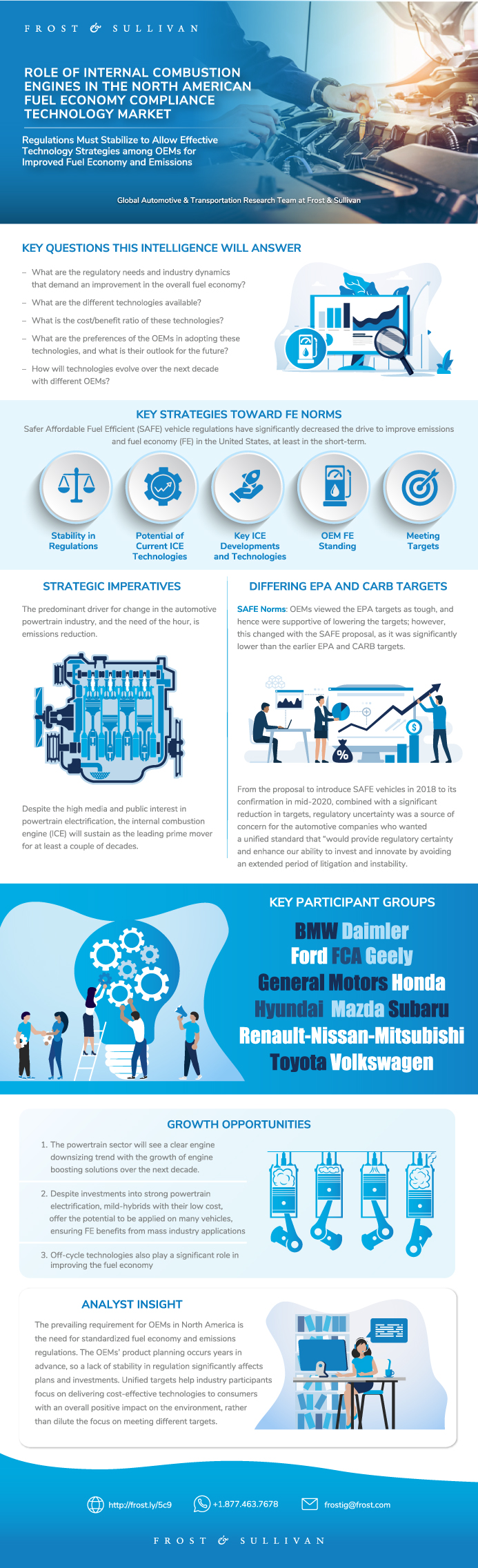
The predominant driver of change in the automotive powertrain industry, and the need of the hour, is emissions reduction. Despite the social interest in powertrain electrification, the internal combustion engine (ICE) will remain the leading powertrain for at least 2 decades. Nonetheless, this primary propulsion unit offers scope for improvement, making it essential that technologies are evaluated and applied to boost fuel economy and emissions reduction, especially in North America, one of the world’s largest markets, where engine displacement and CO2 emissions remain high.
While the Obama-era EPA norms were intended to increase fuel economy mpg and reduce emissions, increasing adoption of sport utility vehicles (SUVs) and crossover utility vehicles (CUVs), which have a large footprint and thus lower mpg and higher emission levels, has proven counter-productive. Moreover, with the Trump Administration’s rollback of Obama-era fuel economy and emissions regulations, the more lenient Safer Affordable Fuel Efficient (SAFE) rules have placed the North American automotive industry is in a state of flux from a fuel economy and emissions perspective.
Where the previous targets were certainly tough and had original equipment manufacturers (OEMs) requesting a reduction, the near freezing of regulations has created a massive difference between the SAFE and California Air Resources Board (CARB) expectations, essentially asking OEMs to meet 2 different targets in the United States.
Despite the instability in regulations slowing technology adoption and the need for electrification, such as battery electric vehicles (BEVs) or plug-in hybrid electric vehicles (PHEVs), the role of conventional IC engine technologies is still pivotal for improving overall fuel economy in the North American automotive market.
Given these circumstances, this study explores technologies that do not offer major electrification but are used in conjunction with conventional IC engines, their impact on overall fuel economy/emissions, and their associated costs. Additionally, with each OEM having its own technology profile, this study identifies the overall market penetration of these technologies based on OEM preferences. The study period is 2018 to 2030.
Key Issues Addressed
- What are the regulations and market dynamics that demand an improvement in overall fuel economy?
- What different technologies are available?
- What is the cost/benefit ratio of these technologies?
- What preferences do OEMs have in adopting these technologies, and what is their outlook for the future?
- How will technologies evolve in the next decade among different OEMs?
Author: Bharath Kumar Srinivasan
Executive Summary—Key Strategies Toward FE Norms
Executive Summary—Key Powertrain Technologies
Global CO2 Emissions Legislation
Actual Fleet Average MPG vs Weight by OEM
Fleet-wide Delta-to-target MPG
Fuel Economy Improvement—Focus Areas
Technology Impact on Fuel Economy Improvement
Technology Penetration Overview
Research Scope
Research Aims and Objectives
Key Questions this Study will Answer
Research Methodology
Key Participant Groups and Associated Brands Compared in this Study
Research Background
CO2 Emissions Legislation
Average MPG Target vs Year
Average MPG Target vs Year, by Footprint Area
SAFE Vehicles
Differing EPA and CARB Targets
Actual Fleet Average MPG vs Weight by OEM
Fleet-wide Delta-to-target MPG
Fleet-wide ICE MPG Improvement Projection
Technology Penetration Overview
OEM Powertrain Positioning
Technology Roadmap—Powertrain Development Trends
Fuel Economy Improvement—Focus Areas
Technology Impact on Fuel Economy Improvement
Engine Downsizing—VVT/VVL, GDI, Boosting
Electric Boosting—e-Compressor and e-Turbo
Atkinson/Miller Cycle
Exhaust Gas Recirculation (EGR)
Water Injection (WI) Systems
Cylinder Deactivation (CD)
Variable Compression Ratio (VCR)
Friction Reduction—Surface Coatings and Lubricants
Mild Hybrid (mHEV) Systems—48V
Electric/Variable Fead
Transmissions
Exhaust Energy Recovery Systems
Credits for Other Technologies in the United States
Fuel Economy Improvement vs Cost
BMW Group
BMW Group—Powertrain Distribution by Model
BMW Group—Technology Adoption Indices
BMW Group—Powertrain Technology Forecasts
BMW Group—FE Improvement Projection
Daimler Group
Daimler Group—Powertrain Distribution by Model
Daimler Group—Technology Adoption Indices
Daimler Group—Powertrain Technology Forecasts
Daimler Group—FE Improvement Projection
FCA Group
FCA Group—Powertrain Distribution by Model
FCA Group—Technology Adoption Indices
FCA Group—Powertrain Technology Forecasts
FCA Group—FE Improvement Projection
Ford Group
Ford Group—Powertrain Distribution by Model
Ford Group—Technology Adoption Indices
Ford Group—Powertrain Technology Forecasts
Ford Group—FE Improvement Projection
GM Group
GM Group—Powertrain Distribution by Model
GM Group—Technology Adoption Indices
GM Group—Powertrain Technology Forecasts
GM Group—FE Improvement Projection
Honda Group
Honda Group—Powertrain Distribution by Model
Honda Group—Technology Adoption Indices
Honda Group—Powertrain Technology Forecasts
Honda Group—FE Improvement Projection
Hyundai Group
Hyundai Group—Powertrain Distribution by Model
Hyundai Group—Technology Adoption Indices
Hyundai Group—Powertrain Technology Forecasts
Hyundai Group—FE Improvement Projection
Mazda
Mazda—Powertrain Distribution by Model
Mazda—Technology Adoption Indices
Mazda—Powertrain Technology Forecasts
Mazda—FE Improvement Projection
Nissan
Nissan—Powertrain Distribution by Model
Nissan—Technology Adoption Indices
Nissan—Powertrain Technology Forecasts
Nissan—FE Improvement Projection
Subaru
Subaru—Powertrain Distribution by Model
Subaru—Technology Adoption Indices
Subaru—Powertrain Technology Forecasts
Subaru—FE Improvement Projection
Toyota Group
Toyota Group—Powertrain Distribution by Model
Toyota Group—Technology Adoption Indices
Toyota Group—Powertrain Technology Forecasts
Toyota Group—FE Improvement Projection
Volkswagen Group
Volkswagen Group—Powertrain Distribution by Model
Volkswagen Group—Technology Adoption Indices
Volkswagen Group—Powertrain Technology Forecasts
Volkswagen Group—FE Improvement Projection
Growth Opportunity—Electrification of Line-up Likely Game-changer for Compliance
Strategic Imperatives
Conclusions and Outlook
Abbreviations and Acronyms Used
Your Next Steps
Why Frost, Why Now?
List of Exhibits
List of Exhibits (continued)
List of Exhibits (continued)
List of Exhibits (continued)
List of Exhibits (continued)
List of Exhibits (continued)
Legal Disclaimer
Speak directly with our analytics experts for tailored recommendations.
Recent related Automotive research
16 Nov 2026 | Global | Market Research
Car Accessories Market, GCC, 2022–2030
This study assesses the Gulf Cooperation Council (GCC) car accessories market across Saudi Arabia, the UAE, Kuwait, Oman, and Qatar, covering seven product families—from transportation and wheels to personalization and performance.In 2025, the market was valued at $411.1 million, and it is forecast ...
06 Nov 2026 | Europe | Market Research
Strategic Analysis of Value Line Parts and Lubricants for MHCVs in Europe
This study provides an in-depth assessment of the European medium- and heavy-duty commercial vehicle (MHCV) value line parts and lubricants aftermarket from 2025 to 2030. The market is experiencing a period of rapid evolution as fleet operators face increasing pressure to reduce maintenance costs, e...
05 Nov 2026 | Global | Market Research
Shift to Affordable Cars, Global, 2025–2035
The global affordable passenger car market is undergoing significant transformation, driven by evolving consumer needs, regulatory pressures, urban mobility trends, and rapid advances in vehicle technology. This study examines the global affordable passenger car segment, defined as vehicles priced a...
04 Nov 2026 | Global | Frost Radar
Frost Radar™: Multimodal Perception Technology Ecosystem for Automotive and Robotics, 2026
Multimodal perception is transforming robotics and automotive systems by combining cameras, lidar, radar, event-based vision, and other sensing technologies through AI-driven sensor fusion. These advances enhance environmental perception, localization, and real-time decision-making. This Frost Radar...
04 Nov 2026 | Europe | Frost Radar
Frost Radar™: Public Transit Digitization and Ticketing in Europe, 2026
Europe’s public-transit fare systems are moving away from cash, paper tickets, and closed-loop cards. Riders now hold an account, and the system works out the best fare after the journey, whether they pay with a bank card, a phone, or an app. Three forces drive demand: aging equipment that needs rep...
Purchase includes:
- Report download
- Growth Dialog™ with our experts
Growth Dialog™
A tailored session with you where we identify the:- Strategic Imperatives
- Growth Opportunities
- Best Practices
- Companies to Action
Impacting your company's future growth potential.