 USD
USD GBP
GBP  CNY
CNY  EUR
EUR  INR
INR  JPY
JPY  MYR
MYR  ZAR
ZAR  KRW
KRW  THB
THB 


OT Cybersecurity Market is Driving Transformational Growth Due to Expanding Attack Surfaces and Geopolitical Tensions
20-Nov-2025
Global
Market Research
KB84-01-00-00-00
AE_2025_34113
Report Summary: OT Cybersecurity Market
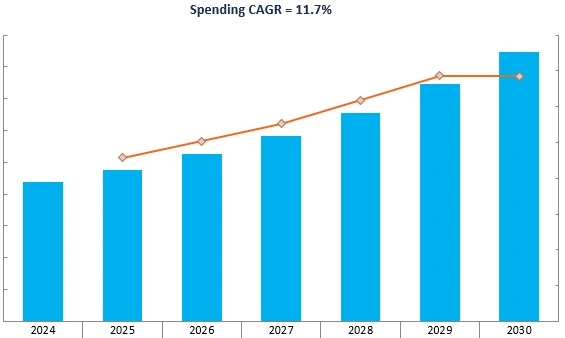
The OT cybersecurity market continues to expand rapidly as industrial sectors prioritize protection against escalating cyber-physical threats. The global market was valued at USD 4.37 billion in 2024 and is projected to reach USD 8.47 billion by 2030, growing at a CAGR of 11.7% from 2025 to 2030.
Rising attacks targeting operational technology, legacy system vulnerabilities, and convergence of IT–OT environments are accelerating investments across manufacturing, utilities, transportation, and critical infrastructure.
Key Market Trends & Insights
- Manufacturing represents the largest contributor, driven by advanced automation and highly distributed OT assets.
- Utilities—especially power generation & distribution—remain among the top targets for cyberattacks, pushing adoption of industrial OT cybersecurity solutions.
- Transportation & logistics are scaling protection due to connected vehicles, ports, and rail signaling system vulnerabilities.
- Network & endpoint security, threat detection, asset visibility, and zero-trust architecture integrations are shaping the next wave of modernization.
- Regulations and compliance mandates—NERC CIP, IEC 62443, TSA directives—continue to influence spending patterns.
Market Size & Forecast
- 2024 Market Size: USD 4.37 Billion
- 2030 Market Size: USD 8.47 Billion
- CAGR (2025–2030): 11.7%
- Fastest Growth Year: 2027 (due to automation expansion and increasing attack surface)
Growing digitalization of industrial ecosystems and threat sophistication ensure strong long-term demand for industrial OT cybersecurity solutions, making the market a high-priority investment area for asset-intensive industries.
Market Overview: OT Cybersecurity Market
The OT cybersecurity market is undergoing a structural shift as enterprises confront unprecedented cyber-physical risks across manufacturing, critical infrastructure, and connected industrial ecosystems. Operational technology—historically isolated from external networks—has become more interconnected due to digital transformation, cloud adoption, edge computing, and the integration of smart sensors and industrial IoT systems. This increased connectivity amplifies exposure to ransomware, state-sponsored attacks, insider threats, and supply-chain vulnerabilities.
The industrial sector is experiencing a surge in targeted attacks that specifically aim to disrupt production, manipulate physical processes, or compromise safety systems. Attackers increasingly exploit weak authentication, outdated firmware, flat networks, and legacy SCADA architectures. As a result, organizations are shifting to purpose-built industrial OT cybersecurity solutions that can safeguard programmable logic controllers (PLCs), distributed control systems (DCS), industrial robots, remote terminal units (RTUs), and connected assets spread across multiple sites.
A defining trend is the convergence of IT and OT cybersecurity programs. Enterprises now recognize that traditional IT tools are insufficient for real-time industrial environments where latency, downtime, and system behavior differ significantly. Modern OT security platforms integrate asset discovery, real-time monitoring, anomaly detection, threat intelligence, and incident response tailored for industrial protocols such as Modbus, OPC-UA, Ethernet/IP, and Profinet.
Regulatory pressure further accelerates adoption. Utilities must comply with NERC CIP, TSA guidelines, and national critical infrastructure protection frameworks. Manufacturing sectors adhere to IEC 62443, ISO/IEC 27019, and sector-specific national mandates. These requirements push enterprises to deploy centralized governance models, structured risk assessments, continuous monitoring, and dedicated OT SOC (Security Operations Center) strategies.
As organizations pursue Industry 4.0, the need to unify security across edge devices, IIoT sensors, robotics, AI-driven automation, and remote access pathways becomes critical. Supply-chain integration, workforce mobility, ecosystem collaborations, and cloud-managed industrial platforms continue to expand the attack surface, fueling strong long-term growth for the OT cybersecurity market.
Scope of Analysis: OT Cybersecurity Market
This analysis covers global adoption of OT security technologies across asset-intensive industries, including manufacturing, utilities, transportation, logistics, energy, and critical infrastructure. The scope includes:
Included
- Asset visibility and threat detection solutions
- Industrial firewalls and secure remote access tools
- Vulnerability management for OT systems
- Zero-trust architecture for industrial networks
- Threat intelligence platforms specialized for operational technology
- Compliance and governance solutions
- OT SOC and managed security services
Excluded
- Consumer cybersecurity
- General IT security solutions that do not address industrial protocols
- Physical security monitoring solutions
- Generic cloud security tools not adapted for OT environments
The focus remains on industrial OT cybersecurity solutions explicitly designed for monitoring, securing, and managing industrial control systems and real-time operational networks.
Revenue Forecast: OT Cybersecurity Market
The OT cybersecurity market demonstrates strong momentum as cybersecurity becomes integral to operational continuity. Based strictly on the provided data:
- 2024 Global Spending: USD 4.37 Billion
- 2030 Global Spending: USD 8.47 Billion
- CAGR (2024–2030): 11.7%
Interpretation
- Industrial OT cybersecurity solutions are experiencing rising adoption due to digitization across energy, utilities, and advanced manufacturing.
- Strongest year-over-year acceleration is projected from 2026–2028 as enterprises complete foundational security modernization efforts and scale analytics, segmentation, and identity-centric OT controls.
Segmentation Analysis: OT Cybersecurity Market
A. By Industry
1. Manufacturing – Largest Market
Manufacturing accounted for the highest share in 2024, driven by automation, robotics expansion, and distributed production lines. Ransomware targeting smart factories remains a critical concern, making manufacturing the highest-spending vertical in the OT cybersecurity market.
2. Utilities – Power, Water & Gas
Utilities remain one of the most vulnerable and regulated segments. Power grids continue to experience persistent cyber intrusions, pushing significant investment into network segmentation, real-time anomaly detection, and industrial threat intelligence.
3. Transportation & Logistics
Rail, aviation ground systems, connected fleets, ports, and maritime vessels increasingly rely on digital control systems, increasing adoption of industrial OT cybersecurity solutions to protect safety-critical operations.
4. Oil & Gas / Chemicals
Pipeline operations, refinery automation, and hazardous chemical manufacturing rely heavily on ICS and require strong endpoint and network protection.
B. By Solution Type
- Asset Discovery & Visibility Platforms – Provide foundational mapping of legacy and modern OT assets.
- Network Security for OT – Industrial firewalls, segmentation gateways, and intrusion detection.
- Endpoint Security for OT Devices – Protection for PLCs, HMIs, sensors, and controllers.
- Threat Detection & Incident Response – Behavior-based and AI-enabled anomaly detection.
- Identity & Access Management for OT – Secure remote access, privileged access controls.
- Compliance & Risk Assessment Tools – Enable regulatory reporting and policy enforcement.
Growth Drivers: OT Cybersecurity Market
1. Rising Frequency & Sophistication of Cyber-Physical Attacks
Industrial ransomware, supply-chain intrusions, and targeted ICS exploits continue to increase. Attacks on manufacturing, utilities, and transportation systems highlight the urgency of adopting dedicated industrial OT cybersecurity solutions.
2. IT–OT Convergence Creating Bigger Attack Surfaces
Enterprises integrating cloud platforms, IoT sensors, and remote access workflows expose previously isolated OT networks to external threats, driving higher security investments.
3. Regulatory & Compliance Pressure
NERC CIP, TSA Security Directives, IEC 62443, and cyber-resilience frameworks push organizations to formalize OT risk management, monitoring, and incident response protocols.
4. Digital Transformation & Industrial Automation Growth
Industry 4.0, AI-enabled automation, robotics, and distributed IIoT networks generate the need for stronger endpoint protection, segmentation, and real-time threat detection.
5. Legacy Systems with High Vulnerability
Aging SCADA infrastructure, outdated protocols, and long patching cycles require additional layers of protection, accelerating market demand.
6. Increased Remote Workforce & Cloud-Connected Operations
Remote maintenance, vendor access, and cloud-managed industrial platforms contribute to growing adoption of secure access and identity control solutions.
Growth Restraints: OT Cybersecurity Market
1. Fragmented OT Environments & Legacy Complexity
Industries run multiple generations of hardware, proprietary protocols, and vendor-specific systems, making it difficult to implement standardized security controls.
2. High Cost of Deployment & Limited Cyber Budget
Many organizations, particularly mid-sized manufacturers and public utility agencies, struggle to fund comprehensive OT security upgrades.
3. Shortage of Skilled OT Cybersecurity Professionals
The market faces severe workforce challenges, with limited availability of ICS-certified cybersecurity experts.
4. Limited Downtime Tolerance
Industrial systems cannot afford extended downtime, complicating security patching, updates, and deployment of new monitoring solutions.
5. Low Awareness in Emerging Economies
In developing regions, industrial cyber-risk awareness and budget availability remain low, slowing widespread adoption.
Competitive Landscape: OT Cybersecurity Market
Leading Solution Providers
Vendors specialize in asset discovery, threat detection, network segmentation, and SOC enablement for operational technology. Key players increasingly integrate AI-based detection, zero-trust frameworks, and cloud-native analytics for industrial environments.
Competitive Differentiators
- Support for multi-vendor ICS environments
- Depth of protocol visibility and anomaly detection
- Integration with IT SOC tools and SIEM solutions
- Real-time behavioral analytics
- OT-specific incident response playbooks
- Compliance reporting modules
Competition is intensifying as IT security vendors expand into the OT cybersecurity market, while OT-native providers grow across verticals such as energy, manufacturing, and transportation.
Regional Insights: OT Cybersecurity Market
North America – Largest Market
High concentration of critical infrastructure, aggressive regulatory mandates, and increasing cyber threats position North America as the largest regional market.
Europe – Strong Compliance-Driven Growth
GDPR alignment, NIS2 Directive, and industrial modernization programs make Europe a fast-adopting region for industrial OT cybersecurity solutions.
Asia-Pacific – Fastest Growing Region
Rapid industrialization, smart manufacturing expansion, and increased government cybersecurity investments support strong growth.
Latin America & Middle East – Emerging Adoption
Energy, oil & gas, and utilities drive early-stage adoption of standardized OT security frameworks.
Scope of Analysis
Vertical Segmentation
Regional Segmentation
Why is it Increasingly Difficult to Grow?
The Strategic Imperative 8™
The Impact of the Top 3 Strategic Imperatives on the OT Cybersecurity Industry
Competitive Environment
Key Competitors by Segment
Key Competitors by Region
Growth Metrics
Growth Drivers
Growth Restraints
Forecast Considerations
Spending and Growth Forecast
Spending Forecast by Industry Vertical
Spending Forecast by Region
Spending Forecast Analysis
Pricing Trends and Forecast Analysis
Recent Global Regulations Impacting OT Cybersecurity
Forecast Analysis by Region
Growth Metrics
Spending and Growth Forecast
Spending Forecast by Region
Spending Forecast by Sub-Vertical
Forecast Analysis
Forecast Analysis by Region
OT Cybersecurity Feature Priorities: Utilities Vertical
Growth Metrics
Spending and Growth Forecast
Spending Forecast by Region
Spending Forecast by Sub-Vertical
Forecast Analysis
Forecast Analysis by Region
OT Cybersecurity Feature Priorities: Transportation and Aviation Vertical
Growth Metrics
Spending and Growth Forecast
Spending Forecast by Region
Spending Forecast by Sub-Vertical
Forecast Analysis
Forecast Analysis by Region
OT Cybersecurity Feature Priorities: Manufacturing Vertical
Growth Metrics
Spending and Growth Forecast
Spending Forecast by Region
Spending Forecast by Sub-Vertical
Forecast Analysis
Forecast Analysis by Region
OT Cybersecurity Feature Priorities: Industrial Vertical
Growth Opportunity 1: Consolidation of Vendors Through Integrated OT Security Platforms
Growth Opportunity 2: Operational Roadmaps for OT Cybersecurity Deployment
Growth Opportunity 3: Development of Targeted AI Features Within OT Security Platforms
Growth Opportunity 4: AI Enablement Through OT Specific Data
Growth Opportunity 5: OT Cybersecurity Response Teams
Benefits and Impacts of Growth Opportunities
Next Steps
List of Exhibits
Legal Disclaimer
Frequently Asked Questions – OT Cybersecurity Market
1. What does the OT cybersecurity market include?
2. What was the global OT cybersecurity spending in 2024?
3. What is the projected OT cybersecurity market size for 2030?
4. What is the CAGR of the OT cybersecurity market from 2024 to 2030?
5. Why are industrial OT cybersecurity solutions becoming essential?
6. Which industries invest the most in OT cybersecurity?
7. What are the biggest challenges to securing OT environments?
8. How does OT cybersecurity differ from IT cybersecurity?
9. What technologies are most commonly used in OT cybersecurity?
10. Who are the major players in the OT cybersecurity market?
Speak directly with our analytics experts for tailored recommendations.
Recent related Security research
07 Oct 2026 | Global | Frost Radar
Frost Radar™: Network Detection and Response, 2026
The rapid evolution of enterprise IT environments, driven by cloud adoption, connected devices, and hybrid infrastructure, has rendered legacy perimeter defenses inadequate. Network detection and response (NDR) has become a strategic imperative, providing continuous visibility across network traffi...
05 Oct 2026 | Global | Market Research
Workforce IAM and IGA, Global, 2025–2030
The workforce identity and access management (IAM) and identity governance and administration (IGA) market is a critical component of modern cybersecurity and digital transformation strategies. As organizations continue to adopt cloud services, hybrid work models, artificial intelligence, and increa...
24 Sep 2026 | Global | Market Research
Insights for CISOs: Securing Software Supply Chains in the Age of AI
Software supply chain security (SSCS) is increasingly a strategic business imperative as organizations rely more on open-source software, cloud-native architectures, AI-driven development, and autonomous development workflows. Modern software supply chains now extend beyond traditional code reposito...
22 Sep 2026 | Global | Market Research
AI Usage for Cybersecurity Operations, 2026–2030
Artificial intelligence is fundamentally transforming cybersecurity operations from reactive, analyst-driven monitoring into intelligent, adaptive, and increasingly autonomous security ecosystems. As organizations face escalating cyber threats, expanding attack surfaces, and persistent security tale...
18 Sep 2026 | Global | Market Research
Environmental Security Technologies, Global, 2026–2030
Environmental risks are expanding the role of security technologies beyond traditional asset and perimeter protection. Climate-related disasters, pollution, environmental crime, biodiversity loss, infrastructure disruption, and growing sustainability requirements are increasing the demand for techno...
Purchase includes:
- Report download
- Growth Dialog™ with our experts
Growth Dialog™
A tailored session with you where we identify the:- Strategic Imperatives
- Growth Opportunities
- Best Practices
- Companies to Action
Impacting your company's future growth potential.
The study examines the evolving growth environment shaped by geopolitical tensions, disruptive technologies, and increasing regulatory pressure. It evaluates the competitive landscape, highlighting key vendors, market positioning, and core metrics such as market size, forecasts, and growth rates through 2030. Drivers and restraints are assessed alongside global spending forecasts by region and vertical, with analysis of how modernization cycles, regulatory mandates, and digitalization programs influence adoption.
Vertical deep-dives detail specific growth metrics, regional patterns, and emerging feature priorities. The report also reviews recent global regulations and the most in-demand OT security capabilities. Finally, it identifies the growth opportunity universe, offering strategic insights for industry participants, investors, and decision-makers.
| Deliverable Type | Market Research |
|---|---|
| Industries | Aerospace, Defence and Security |
| No Index | No |
| Is Prebook | No |
| Keyword 1 | ot cybersecurity market |
| Keyword 2 | industrial cybersecurity solutions |
| Keyword 3 | ot security products |
| Podcast | No |
| Predecessor | K7EA-01-00-00-00 |
| WIP Number | KB84-01-00-00-00 |