 USD
USD GBP
GBP  CNY
CNY  EUR
EUR  INR
INR  JPY
JPY  MYR
MYR  ZAR
ZAR  KRW
KRW  THB
THB 


Circular Economy, Electrification, and the Need for Biodegradable, Non-Toxic Products are Driving Transformational Growth
17-Sep-2025
Global
Market Research
MH76-01-00-00-00
CM_2025_33878
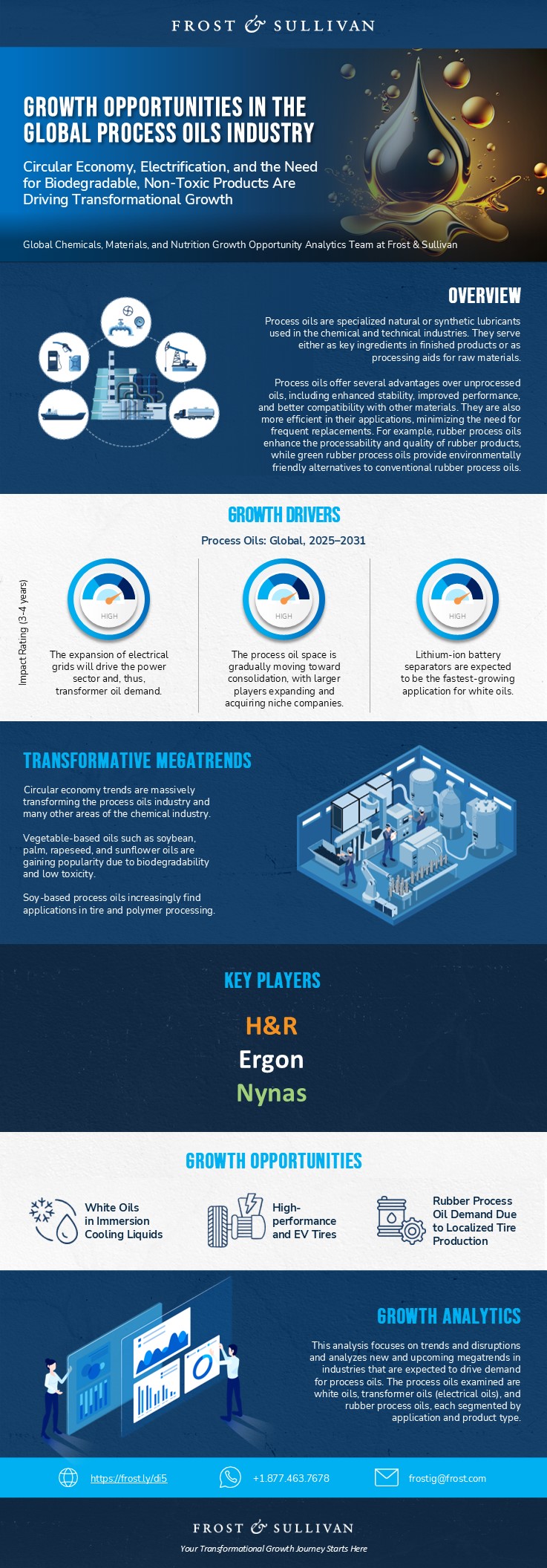
Process oils are specialized natural or synthetic lubricants used in the chemical and technical industries. They serve either as key ingredients in finished products or as processing aids for raw materials.
Process oils offer several advantages over unprocessed oils, including enhanced stability, improved performance, and better compatibility with other materials. They are also more efficient in their applications, minimizing the need for frequent replacements. For example, rubber process oils enhance the processability and quality of rubber products, while green rubber process oils provide environmentally friendly alternatives to conventional rubber process oils.
This report focuses on trends and disruptions and analyzes new and upcoming trends in industries that are expected to drive demand for process oils. The study will complement our recent market forecast report on the global lubricants market.
The study period is 2022–2031, with 2024 as the base year and 2025–2031 as the forecast period. The process oils examined are white oils, transformer oils (electrical oils), and rubber process oils, each segmented by application and product type.
Author: Anwesha Banerjee
The Impact of the Top 3 Strategic Imperatives on the Process Oil Industry
Transformative Megatrends
- Why:
- Circular economy trends are massively transforming the process oils industry and many other areas of the chemical industry.
- Vegetable-based oils such as soybean, palm, rapeseed, and sunflower oils are gaining popularity due to biodegradability and low toxicity.
- Soy-based process oils increasingly find applications in tire and polymer processing.
- Frost Perspective:
- Investing in the development of process oils with a lower carbon footprint and improved sustainability is imperative to remain significant in the market. In the past, banning distillate aromatic extract (DAE) in Europe forced the manufacturers worldwide to shift away from DAE. Similar regulations, driven by environmental impact, will shape the industry in the future.
- Tire and rubber manufacturers are leading the transition toward eco-friendly process oils.
- While the growth in end applications, especially in industrial and automotive applications, during the forecast period, will impact process oil demand, it will also transform into a more sustainable industry.
Geopolitical Chaos
- Why:
- The process oils market is susceptible to geopolitical instability, which affects raw material availability, pricing, trade policies, and supply chain efficiency.
- Sanctions on Russian crude oil and petrochemicals have caused shortages in crucial feedstocks for process oils, especially in Europe, which is home to leading manufacturers.
- In addition, US-China tensions and policies of the new US government could result in uncertain tariffs and trade restrictions affecting the import/export of feedstock and end products, such as tires.
- Frost Perspective:
- Heavy reliance on Middle Eastern or Russian crude oil makes companies vulnerable to sanctions, OPEC decisions, and regional conflicts. To avoid this, diversifying feedstock sources and local supply can be advantageous.
- Companies like ExxonMobil, Chevron, and TotalEnergies are increasing sourcing from the Americas and APAC.
- Efficient inventory management will also be essential, allowing manufacturers to adjust strategies to secure feedstock availability.
Competitive Intensity
- Why:
- The process oils market is experiencing increasing competition from both established players and new entrants focusing on sustainability, innovation, and regional expansion.
- New players such as Novvi LLC, Biosynthetic Technologies, and Kraton are disrupting the market with biobased, food-grade, and non-toxic products.
- Simultaneously, Asian players such as Petronas (Malaysia) and SK Lubricants (South Korea) have penetrated the specialty process oils market.
- Frost Perspective:
- New competition and aggressive expansion of Asian players pose challenges for traditional oil manufacturers by potentially making the market highly competitive. APAC, especially China and India, is a high-growth market, intensifying competition.
- As a result, oil majors such as ExxonMobil, Shell, Chevron, TotalEnergies, and Nynas are shifting toward low-aromatic, high-performance, and bio-based process oils.
- Innovation, investment in sustainable products, and a strengthened supply chain, and presence in high-growth regions are essential considerations for market participants.
Scope of Analysis
- Process oils are specialized natural or synthetic lubricants used in the chemical and technical industries. They serve either as key ingredients in finished products or as processing aids for raw materials.
- Process oils offer several advantages over unprocessed oils, including enhanced stability, improved performance, and better compatibility with other materials. They are also more efficient in their applications, minimizing the need for frequent replacements. For example, rubber process oils enhance the processability and quality of rubber products, while green rubber process oils provide environmentally friendly alternatives to conventional rubber process oils.
- This report will focus on trends and disruptions and analyze new and upcoming trends in industries that are expected to drive demand for process oils.
- The study will complement Frost & Sullivan's recent market forecast report on the global lubricants market, which can be accessed through this link.
| Scope | Details |
|---|---|
| Geographic Coverage | Global |
| Study Period | 2022–2031 |
| Base Year | 2024 |
| Forecast Period | 2025–2031 |
| Volume | Liters |
| Revenue | US Dollars |
| Conversion Rate | €1 = $1.1 (as of December 31, 2024) |
Competitive Environment
| Number of Competitors | 50+ |
| Competitive Factors | Customer sales support; proximity and/or consistency in supply; consistency in specifications; adherence to quality tests specified by end users, including quality tests for aromatic content and viscosity |
| Key End-user Industry Verticals | Rubber processors and tire manufacturers, plastic manufacturers, pharmaceutical manufacturers, personal and home care producers, power companies, distributors |
| Leading Competitors | H&R, Ergon, Nynas, Shell, Sinopec, Calumet, ExxonMobil |
| Revenue Share of Top 5 Competitors (2024) | 25% |
| Other Notable Competitors | IRPC, NX Nippon, Repsol, Gandhar Oil, IOCL, HPCL, Apar, Chevron, Phillips66, HollyFrontier (HF Sinclair) |
| Distribution Structure | Direct sales and distributors |
| Notable Acquisitions and Mergers | Please see next page |
Key Competitors
| White Oils | Rubber Process Oils | Transformer Oils |
| Nynas | H&R Group | Nynas |
| Shell | Nynas | Shell |
| H&R Group | Shell | Ergon |
| ExxonMobil | Ergon | ExxonMobil |
| Chevron Corporation | ExxonMobil | Calumet |
| Calumet | TotalEnergies | Cargill |
| Apar Industries | Calumet | Apar Industries |
| Gandhar Oil | Chevron Corporation | Gandhar Oil |
| Raj Petro | Repsol | PetroChina |
| PetroChina | PetroChina | Valvoline Inc |
| Sinopec | IOCL | Sinopec |
| Petro Canada | HPCL | San Joaquin Refining Co. Inc. |
| Sasol | ENEOS Xplora Inc. | IOCL |
| BP | HollyFrontier (HF Sinclair) | Engen Petroleum |
| BPCL | ||
| Sonnenborn | ||
| Savita Oil | ||
| HollyFrontier (HF Sinclair) |
Growth Drivers
- The expansion of electrical grids will drive the power sector and, thus, transformer oil demand.
- The process oil market is gradually moving toward consolidation, with larger players expanding and acquiring niche companies.
- The global plastic market is forecast to record a 5.2% CAGR between 2021 and 2026 to reach $753.1 billion by 2026.
- Lithium-ion battery separators are expected to be the fastest-growing application for white oils.
- Developments in the tire industry, driven by high-performance tires and new materials, including natural rubber (latex) in tires, along with lower rolling resistance silica fillers, are a growth driver.
Growth Restraints
- Regulatory pressure and adherence to norms across end industries restrain the market.
- High investment costs, including product approval costs, for new entrants restrain the market.
- Technological advancements hamper the demand for conventional grades, especially for transformer oils.
- Rising focus on renewable power generation across regions, especially in Europe and North America, restrains the process oil market.
Scope of Analysis
Segmentation by Application and Product Type
Geographic Scope
Why is it Increasingly Difficult to Grow?
The Strategic Imperative 8™
The Impact of the Top 3 Strategic Imperatives on the Process Oil Industry
Value Chain
Value Chain Analysis
Competitive Environment
M&As in the Global Process Oils Industry
Key Competitors
Growth Metrics
Growth Drivers
Growth Driver Analysis
Growth Restraints
Growth Restraint Analysis
Revenue and Volume Forecast
Revenue and Volume Forecast Analysis
Average Price Forecast
Pricing Trends and Forecast Analysis
Volume Forecast by Product Segment
Revenue Forecast by Product Segment
Volume Forecast by End User
Revenue Forecast by End User
Volume Forecast by Region
Revenue Forecast by Region
Regulations on Process Oils: Major Decision-Makers
Regulations Governing Process Oils
Other Major Regulations: Specific Regulations Affecting Industries and Environmental Regulations for Process Oils
Revenue Share
Revenue Share Analysis
Segment Characteristics and Overview
Segment Characteristics and Applications
Growth Metrics
Forecast Assumptions: White Oil Applications
Revenue and Volume Forecast
Revenue and Volume Forecast Analysis
Revenue Share by Grade
Volume Forecast by Region
Revenue Forecast by Region
Volume and Revenue Forecast Analysis by Region
Segment Characteristics and Overview
Growth Metrics
Forecast Assumptions: Rubber Process Oil Applications
Revenue and Volume Forecast
Revenue and Volume Forecast Analysis
Volume Forecast by Region
Revenue Forecast by Region
Volume and Revenue Forecast Analysis by Region
Segment Characteristics and Overview
Segment Characteristics and Requirements
Growth Metrics
Forecast Assumptions: Transformer Oil Applications
Revenue and Volume Forecast
Revenue and Volume Forecast Analysis
Volume Forecast by Region
Revenue Forecast by Region
Volume and Revenue Forecast Analysis by Region
Growth Opportunity 1: White Oils in Immersion Cooling Liquids
Growth Opportunity 2: High-Performance and EV Tires
Growth Opportunity 3: Rubber Process Oil Demand Due to Localized Tire Production
Benefits and Impacts of Growth Opportunities
Next Steps
List of Exhibits
Legal Disclaimer
Speak directly with our analytics experts for tailored recommendations.
Recent related Specialty Chemicals research
09 Oct 2026 | Global | Technology Research
Innovations in Transparent Ceramics, Biomaterials, Compostable Bioplastics, Graphite, Silica Foam, Aerogels, and Other Advanced Materials for Diverse Applications
This issue of High-Tech Materials Technology Opportunity Engine (TOE) profiles significant advances in high-tech materials for various industrial applications. The featured innovations include Large-sized Transparent and Bonded Ceramics for High-Power Laser Systems, High-Strength Transparent Alumina...
08 Oct 2026 | South Asia, Middle East & North Africa | Market Research
Growth Opportunities for Sulphur Derivatives in MENA, 2025–2030
The MENA region plays a critical role in global sulphur supply; however, a significant share of value creation remains concentrated in exports and commodity derivatives. As global demand evolves and advanced applications for sulphur-based products gain momentum, the region’s competitive advantage li...
02 Oct 2026 | Global | Technology Research
Innovations in Nanotechnology Including Nanocoatings, Nanolithography, Carbon Nanotubes, Nanofluids, Graphene, Ceramic Aerogels, Nanocatalysts, and Nanocomposites
This issue of the Nanotechnology Opportunity Engine profiles significant advances in nanotechnology for various industrial applications. The featured innovations include Sulfate-Free CNCs for Versatile Applications, Contact-Active Antimicrobial Nanocoating With Broad-Spectrum Protection, Nanoimprint...
29 Sep 2026 | Global | Market Research
Electronic Chemical Market, Global, 2025–2032
Electronic chemicals constitute a foundational input to semiconductor, printed circuit board (PCB), and flat panel display (FPD) manufacturing, underpinning the precision, purity, and performance requirements of increasingly sophisticated electronic devices. This study presents a comprehensive analy...
18 Sep 2026 | Global | Technology Research
Innovations in Surface Technologies for Automotive Coatings, Protective Coatings, Oleophobic Coatings, Plasma Coatings, Icephobic Coatings, and Others
This edition of the Advanced Coating & Surface Technology Opportunity Engine profiles significant advances in advanced coatings and surface treatments for various industrial applications. The featured innovations include Ultra-Black Nanocarbon Coatings for Next-Generation Automotive Surface Finishes...
Purchase includes:
- Report download
- Growth Dialog™ with our experts
Growth Dialog™
A tailored session with you where we identify the:- Strategic Imperatives
- Growth Opportunities
- Best Practices
- Companies to Action
Impacting your company's future growth potential.
Process oils offer several advantages over unprocessed oils, including enhanced stability, improved performance, and better compatibility with other materials. They are also more efficient in their applications, minimizing the need for frequent replacements. For example, rubber process oils enhance the processability and quality of rubber products, while green rubber process oils provide environmentally friendly alternatives to conventional rubber process oils.
This report focuses on trends and disruptions and analyzes new and upcoming trends in industries that are expected to drive demand for process oils. The study will complement our recent market forecast report on the global lubricants market.
The study period is 2022–2031, with 2024 as the base year and 2025–2031 as the forecast period. The process oils examined are white oils, transformer oils (electrical oils), and rubber process oils, each segmented by application and product type.
Author: Anwesha Banerjee
| Deliverable Type | Market Research |
|---|---|
| Industries | Chemicals and Materials |
| No Index | No |
| Is Prebook | No |
| Keyword 1 | process oils market report |
| Keyword 2 | industrial oils growth forecast |
| Keyword 3 | global process oils industry |
| Podcast | No |
| Predecessor | None |
| WIP Number | MH76-01-00-00-00 |