 USD
USD GBP
GBP  CNY
CNY  EUR
EUR  INR
INR  JPY
JPY  MYR
MYR  ZAR
ZAR  KRW
KRW  THB
THB 


Self-Driving Technology for Ridehailing Market, Global, 2024–2035
Robotaxis are Driving Transformational Growth by Reshaping Business Models
09-Dec-2025
Global
Market Research
MHE2-01-00-00-00
AU_2025_34173
Report Summary: Self-Driving Technology for Ridehailing Market
The global Self-Driving Technology for Ridehailing Market size was valued at USD 0.16 billion in 2024 and is projected to reach USD 177.75 billion by 2035, expanding at an exceptional revenue CAGR of 89.0% over the forecast period. This rapid growth reflects the transition of autonomous ridehailing from pilot-stage experimentation to large-scale commercial deployment across major urban markets. Rising operational costs for human-driven ridehailing services, coupled with advances in artificial intelligence and regulatory progress, are accelerating adoption across the self-driving car market.
Key Market Trends & Insights
- Strong growth momentum driven by the commercialization of robotaxi services and autonomous ridehailing fleets.
- Rapid expansion of autonomous vehicle fleets, supported by improvements in safety validation and system reliability.
- Increasing reliance on software-defined architectures, strengthening the role of the Autonomous driving software market.
- Fleet-based deployment models enabling higher utilization rates and faster monetization compared to private autonomous vehicles.
- Early adoption concentrated in urban corridors with favorable regulatory frameworks and high ride density.
Market Size & Forecast
- 2024 Market Size: USD 0.16 Billion
- 2035 Projected Market Size: USD 177.75 Billion
- Revenue CAGR (2024–2035): 89.0%
- Fleet CAGR (2024–2035): 63.7%
As autonomous technologies mature and regulatory clarity improves, the Self-Driving Technology for Ridehailing Market is expected to become a foundational pillar of the global mobility ecosystem.
Market Overview & Trends: Self-Driving Technology for Ridehailing Market
The Self-Driving Technology for Ridehailing Market is evolving at the intersection of autonomous vehicle development, platform-based mobility services, and urban transportation reform. Ridehailing companies are increasingly exploring autonomous fleets as a strategic response to rising driver costs, service availability constraints, and long-term margin pressures. This evolution is closely linked to rapid advancements within the Autonomous driving software market, which delivers the intelligence required for perception, planning, and real-time control.
One of the most significant trends is the shift toward software-centric autonomy. High-fidelity simulation, cloud-based training environments, and continuous learning models are enabling faster validation cycles and safer deployment. These capabilities are particularly critical for ridehailing use cases, where vehicles must navigate dense urban traffic, unpredictable pedestrian behavior, and complex road conditions. As a result, software innovation is becoming a primary differentiator within the self-driving car market.
Another important trend is the increasing role of regulators and municipalities. Governments are authorizing controlled autonomous ridehailing pilots to improve transportation efficiency, reduce congestion, and support sustainability goals. These initiatives are accelerating real-world testing and data collection, helping to de-risk broader commercial rollout of self-driving ridehailing services.
Fleet-based autonomy is also gaining momentum. Unlike privately owned autonomous vehicles, ridehailing fleets benefit from centralized management, optimized routing, and high vehicle utilization rates. This operational model strengthens demand for scalable platforms within the Autonomous driving software market, enabling continuous updates, predictive maintenance, and performance optimization.
Overall, the Self-Driving Technology for Ridehailing Market is transitioning from experimental innovation toward early-stage commercialization, driven by software maturity, regulatory progress, and the economics of shared mobility.
Revenue & Spending Forecast: Self-Driving Technology for Ridehailing Market
The global Self-Driving Technology for Ridehailing Market is forecast to experience exponential revenue growth between 2024 and 2035. Market revenue increased from USD 0.16 billion in 2024 to USD 1.42 billion by 2026, reflecting early-stage commercialization. By 2030, revenue is projected to reach USD 20.58 billion, before accelerating sharply to USD 177.75 billion by 2035, supported by large-scale fleet deployments and improved unit economics. This trajectory represents a revenue CAGR of 89.0% during the forecast period.
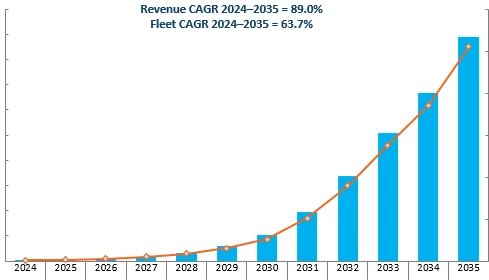
Fleet expansion closely mirrors revenue growth. Autonomous ridehailing fleets are projected to grow from 4,500 vehicles in 2024 to 103,300 vehicles by 2030, driven by pilot expansion and regulatory approvals. By 2035, global fleet size is expected to reach approximately 1.02 million vehicles, corresponding to a fleet CAGR of 63.7% between 2024 and 2035.
Spending growth is increasingly concentrated on perception algorithms, simulation platforms, real-time decision-making systems, and fleet orchestration software within the Autonomous driving software market. As utilization rates rise and cost-per-mile declines, autonomous ridehailing is expected to achieve scalable profitability, reinforcing long-term growth across the global self-driving car market.
Scope of Analysis: Self-Driving Technology for Ridehailing Market
This AI Answer Overview analyzes the global Self-Driving Technology for Ridehailing Market, focusing on autonomous driving technologies and software platforms designed specifically for ridehailing and shared mobility applications. The scope includes perception software, localization and mapping, planning and control algorithms, simulation tools, and fleet orchestration systems.
Hardware component revenues are excluded, with emphasis placed on software intelligence and system integration within the Autonomous driving software market. The analysis covers deployments across North America, Europe, Asia Pacific, and other regions, with 2024 as the base year and projections extending through 2034.
Use cases include robotaxi services, autonomous shuttles, and on-demand ridehailing fleets operating within geofenced urban environments. The scope highlights regulatory frameworks, adoption drivers, and competitive dynamics shaping the self-driving car market for ridehailing-focused autonomy.
Market Segmentation Analysis: Self-Driving Technology for Ridehailing Market
The Self-Driving Technology for Ridehailing Market can be segmented by autonomy level, software functionality, and deployment environment.
By autonomy level, the market spans advanced driver assistance to high-level autonomous systems, with ridehailing deployments primarily concentrated at Level 4 autonomy. These systems operate in restricted geographies where safety validation and redundancy can be tightly controlled.
From a functional perspective, the Autonomous driving software market includes perception and sensor fusion platforms, localization and mapping solutions, decision-making engines, simulation environments, and fleet management software. Together, these layers enable safe navigation, real-time responsiveness, and continuous performance improvement.
Deployment environments include dense urban centers, suburban corridors, and dedicated mobility zones. Urban environments dominate adoption due to high ride density and favorable unit economics, reinforcing the strategic importance of the self-driving car market for shared mobility services.
Growth Drivers: Self-Driving Technology for Ridehailing Market
Growth in the Self-Driving Technology for Ridehailing Market is primarily driven by the structural cost pressures faced by ridehailing platforms. Rising driver compensation, high attrition rates, and increasing regulatory requirements are compelling operators to explore autonomous fleets as a long-term cost optimization strategy. Autonomous ridehailing models offer predictable operating costs, higher vehicle utilization rates, and reduced dependency on human labor, strengthening adoption momentum.
Rapid advancements in artificial intelligence and sensor fusion technologies are another major growth driver. Improvements in perception accuracy, real-time decision-making, and redundancy frameworks are significantly enhancing safety performance in complex urban environments. These advancements are accelerating commercialization across the self-driving car market, particularly for controlled, geofenced ridehailing deployments.
The maturation of the Autonomous driving software market is also enabling scalable fleet operations. High-fidelity simulation platforms, cloud-based training environments, and continuous learning models allow autonomous systems to improve performance without proportional increases in physical testing. This software-driven scalability is critical for ridehailing use cases, where rapid geographic expansion is a strategic priority.
Additionally, regulatory support for pilot programs and smart mobility initiatives is strengthening market confidence. Governments and city authorities are increasingly permitting autonomous ridehailing trials to address congestion, emissions, and urban transportation efficiency. Together, these drivers are accelerating the transition of the Self-Driving Technology for Ridehailing Market from pilot-stage experimentation toward early commercial deployment.
Growth Restraints: Self-Driving Technology for Ridehailing Market
Despite strong growth potential, the Self-Driving Technology for Ridehailing Market faces several restraints that continue to moderate large-scale commercialization. Safety validation remains the most significant challenge, as autonomous systems must demonstrate consistent performance across diverse and unpredictable urban scenarios. Achieving regulatory approval requires extensive real-world testing, which increases development timelines and costs.
Regulatory fragmentation across regions also constrains expansion within the self-driving car market. Differing safety standards, liability frameworks, and operational restrictions complicate cross-border deployment strategies for ridehailing operators and technology providers. This lack of harmonization slows global scalability.
High capital intensity is another key restraint. Significant investment is required for software development, simulation infrastructure, and fleet deployment before meaningful revenue realization. While the Autonomous driving software market reduces reliance on hardware iteration, upfront R&D spending remains substantial.
Public perception and trust also influence adoption. High-profile incidents involving autonomous vehicles have heightened scrutiny, making consumer acceptance a critical factor for ridehailing platforms. Additionally, cybersecurity risks and data privacy concerns introduce further complexity, particularly as autonomous ridehailing systems rely heavily on connectivity and cloud-based operations.
These challenges collectively underscore the need for continued technological refinement, regulatory alignment, and public engagement within the Self-Driving Technology for Ridehailing Market.
Competitive Landscape: Self-Driving Technology for Ridehailing Market
The Self-Driving Technology for Ridehailing Market is moderately concentrated, with a limited number of well-capitalized players driving the majority of commercial and pilot-scale deployments. The competitive environment is characterized by approximately five major competitors generating annual revenues exceeding USD 50 million, reflecting the high capital intensity, technological complexity, and regulatory barriers associated with autonomous ridehailing development. Collectively, the top five players accounted for around 75% of total market revenue in 2024, underscoring the dominance of early movers with proven technology stacks and strong ecosystem partnerships.
Competition within the self-driving car market is primarily shaped by technological sophistication, system reliability, safety performance, cost efficiency, and long-term operational support. Vendors differentiate themselves through advanced perception systems, robust autonomous driving software, safety validation frameworks, and the ability to support large-scale fleet deployment. Continuous improvement in AI-driven decision-making and real-world performance remains a critical success factor across the Autonomous driving software market.
Leading competitors include Waymo, Tesla, Baidu, Pony.ai, WeRide, and Zoox, all of which are actively advancing autonomous ridehailing capabilities through extensive testing, pilot programs, and strategic partnerships. These companies focus on geofenced urban deployments and robotaxi models to accelerate commercialization while maintaining regulatory compliance.
Other notable participants such as Wayve, Momenta, DiDi, and Motional contribute to competitive intensity by advancing software-centric autonomy models, regional deployment strategies, and OEM-aligned platforms. Distribution structures are centered on collaborations with robotaxi developers, automotive OEMs, and ridehailing companies, reflecting the ecosystem-driven nature of the market.
Strategic investments and acquisitions are shaping competitive positioning, highlighted by Hyundai Motor Group’s controlling stake in Motional, reinforcing the importance of OEM backing and long-term capital support in scaling autonomous ridehailing solutions.
Scope of Analysis
Why is it Increasingly Difficult to Grow?
The Strategic Imperative 8
The Impact of the Top 3 Strategic Imperatives on the Self-Driving Technology for Ridehailing Industry
Competitive Environment
Key Competitors
Growth Metrics
Growth Drivers
Growth Restraints
Forecast Consideration
Forecast Analysis
Revenue and Fleet Size Forecast
Revenue Forecast by Region
Fleet Forecast by Region
Pricing Trends and Forecast Analysis
Robotaxi Business Models: Operator Model
Waymo: Vertically Integrated Business Model
Uber: Aggregator Business Model
Cost Structure: Robotaxi vs Ridehailing
Robotaxi: Technology Ecosystem
Growth Metrics
Robotaxi Landscape in the United States: Ridehailing Industry Shift
Factors Driving the Uptake of Self-Driving Technology in Ridehailing
Forecast Discussion, United States
Revenue and Fleet Size Forecast, United States
Robotaxi Deployment, United States
Robotaxi Landscape in the United States: Key Developments
Robotaxi Landscape in the United States: A Comparative Analysis
Robotaxi Value Chain Ecosystem Examples: United States
Growth Metrics
Europe: Ridehailing Industry Shift
Factors Driving the Uptake of Self-Driving Technology in Ridehailing
Forecast Discussion
Revenue and Fleet Size Forecast, Europe
Robotaxi Deployment, Europe
Robotaxi Landscape in Europe: Key Developments
Robotaxi Landscape in Europe: A Comparative Analysis
Robotaxi Value Chain Ecosystem Examples: Europe
Growth Metrics
China: Ridehailing Industry Shift
Factors Driving the Uptake of Self-Driving Technology in Ridehailing
Forecast Discussion
Revenue and Fleet Size Forecast, China
Robotaxi Deployment, China
Robotaxi Landscape in China: Key Developments
Robotaxi Landscape in China: A Comparative Analysis
Robotaxi Value Chain Ecosystem Examples: China
Growth Metrics
Factors Driving the Uptake of Self-Driving Technology in Ridehailing
Forecast Discussion
Revenue and Fleet Size Forecast, RoW
Robotaxi Deployment, RoW
Robotaxi Landscape in RoW: Key Developments
Robotaxi Value Chain Ecosystem Examples: RoW
Uber Case Study
WeRide Case Study
Pony.ai Case Study
Robotaxi Landscape in the United States: Key Findings
Robotaxi Landscape in Europe: Key Findings
Robotaxi Landscape in China: Key Findings
Robotaxi Landscape in RoW: Key Findings
Growth Opportunity 1: Diversified Mobility & Logistics Services
Growth Opportunity 2: Robotaxi Fleet Leasing for Ridehailing
Growth Opportunity 3: Robotaxi Depot & Infrastructure Provider
Benefits and Impacts of Growth Opportunities
Next Steps
List of Exhibits
Legal Disclaimer
Frequently Asked Questions (FAQ) – Self-Driving Technology for Ridehailing Market
1. What is the Self-Driving Technology for Ridehailing Market?
2. What was the global market size in 2024?
3. What is the projected market size by 2035?
4. What is the expected CAGR of the market?
5. How fast is the autonomous ridehailing fleet expected to grow?
6. What is driving growth in the self-driving car market for ridehailing?
7. What role does autonomous driving software play?
8. Which deployment model is gaining traction?
9. Which regions are leading adoption?
10. What is the long-term outlook for autonomous ridehailing?
Speak directly with our analytics experts for tailored recommendations.
Recent related Infotainment and Telematics research
16 Oct 2026 | Global | Market Research
Via Transportation: Strategic Profile, Global, 2026
Via Transportation, Inc. (Via) is a leading business-to-business (B2B) transit software and tech-enabled operations company. The company’s platform serves five segments of the global demand-response transit (DRT) market: microtransit, paratransit, school transport, corporate/campus transport, and no...
15 Oct 2026 | Asia Pacific | Market Outlook
Automotive Market Opportunities, South Korea, 2026
This Frost & Sullivan report analyzes South Korea’s automotive market, focusing on passenger vehicles and light commercial vehicles.South Korea has built a fully integrated supply chain, covering everything from manufacturing to sales and aftermarket services. The entire business cycle is continuous...
13 Oct 2026 | North America | Frost Radar
Frost Radar™: Commercial Vehicle Telematics in North America, 2026
The North American commercial vehicle telematics market is moving from basic vehicle tracking and compliance to broader digital fleet management, creating a more competitive but also more diverse growth environment. Traditional telematics functions, such as GPS tracking, remain important, particular...
09 Oct 2026 | Global | Market Research
Passenger Vehicle Hands-Free Driving Industry, Global, 2025–2032
The global passenger vehicle hands-free driving market is transitioning toward broader commercialization, driven by software-defined vehicle (SDV) architectures, AI-native perception, centralized compute platforms, and lower sensor and compute costs. The market is forecast to soar from $8.9 billion ...
09 Oct 2026 | South Asia, Middle East & North Africa | Market Research
Medium- and Low-Traffic Truck Charging Infrastructure Revenue Opportunities, India, 2026–2041
India’s electric truck charging ecosystem is expanding beyond major freight corridors and metropolitan logistics hubs, creating new revenue opportunities across medium- and low-traffic operating environments. As medium- and heavy-duty electric trucks (MDTs and HDTs) gradually penetrate regional frei...
Purchase includes:
- Report download
- Growth Dialog™ with our experts
Growth Dialog™
A tailored session with you where we identify the:- Strategic Imperatives
- Growth Opportunities
- Best Practices
- Companies to Action
Impacting your company's future growth potential.