 USD
USD GBP
GBP  CNY
CNY  EUR
EUR  INR
INR  JPY
JPY  MYR
MYR  ZAR
ZAR  KRW
KRW  THB
THB 


TMD Friction is Driving Transformational Growth through Advanced Friction Materials and EV-Centric Innovation to Lead the Future of Sustainable Braking
07-Oct-2025
Global
Market Research
MHDF-01-00-00-00
AU_2025_33925
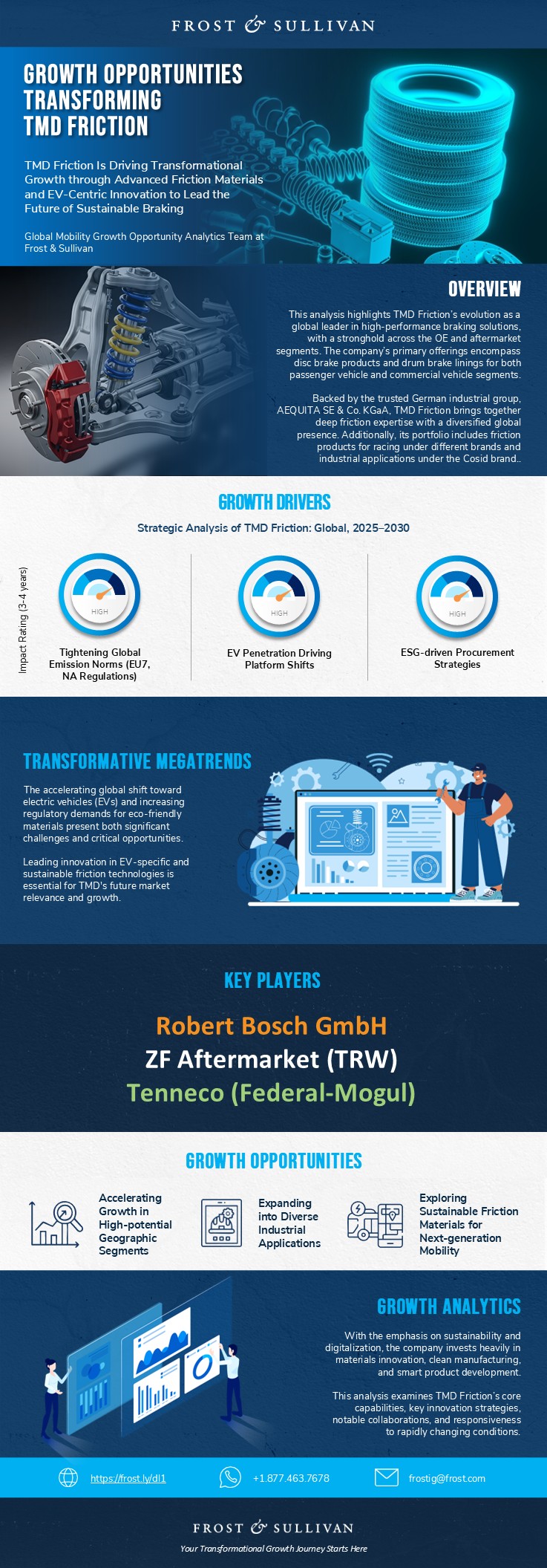
This profiling study highlights TMD Friction’s evolution as a global leader in high-performance braking solutions, with a stronghold across the OE and aftermarket segments. The company’s primary offerings encompass disc brake products and drum brake linings for both passenger vehicle and commercial vehicle segments. Backed by the trusted German industrial group, AEQUITA SE & Co. KGaA, TMD Friction brings together deep friction expertise with a diversified global presence. Additionally, its portfolio includes friction products for racing under different brands and industrial applications under the Cosid brand.
TMD Friction proactively addresses emerging industry needs by developing copper-free and low-emission pads, contributing to Euro 7 standards, and advancing EV-specific friction materials for regenerative braking. With the emphasis on sustainability and digitalization, the company invests heavily in materials innovation, clean manufacturing, and smart product development. This study examines TMD Friction’s core capabilities, key innovation strategies, notable collaborations, and responsiveness to rapidly changing market conditions. As demand grows for sustainable and next-generation braking systems, TMD Friction’s strong foundation and strategic direction position it well to capture value across the evolving mobility ecosystem.
Author: Dorothy Amy
Scope of Analysis
- This study investigates TMD Friction’s key business strategies in the automotive market.
- The study explores TMD Friction’s key business models, revenue streams, technology partnerships, growth partnerships, and market strategies in the global market.
- The research examines TMD Friction’s product portfolio and provides a comparative analysis with market competitors.
- The study contains an in-depth analysis of current and potential challenges and the company’s strategies for handling those challenges.
- The study analyzes potential growth opportunities for TMD Friction.
| Scope | |
| Geographic Coverage | Global |
| Study Period | 2024–2030 |
| Base Year | 2024 |
| Monetary Unit | US Dollars |
| Vehicle Segments | Passenger vehicles |
The Impact of the Top 3 Strategic Imperatives on TMD Friction
Transformative Megatrends
- Why: The accelerating global shift toward electric vehicles (EVs) and increasing regulatory demands for eco-friendly materials present both significant challenges and critical opportunities.
- Frost Perspective: This imperative is paramount for TMD Friction's long-term competitive viability. Success hinges on agile R&D cycles, effective commercialization of new materials, and securing deep integration with key original equipment manufacturer (OEM) platforms.
Customer Value Chain Compression
- Why: Digitalization and operational excellence are fundamental to enhancing efficiency, improving customer engagement, and strengthening supply chain resilience in a dynamic global automotive market.
- Frost Perspective: The company is in the process of implementing digitization strategies (e.g., virtual brake sets, Tektar Virtual Academy) and automating global supply chain processes for efficiency and responsiveness.
Innovative Business Models
- Why: Diversifying growth beyond traditional and mature markets into high-potential regions and new applications is vital for long-term revenue stability and reducing reliance on specific segments.
- Frost Perspective: Success will depend on executing nuanced regional strategies, building strong local distribution networks, and adapting products and marketing to varied competitive landscapes and consumer preferences.
Key Competitors
| OEMs | Brake/Friction Systems | Specialized/Industrial | Other Automotive Players |
| Robert Bosch GmbH | Brembo | Cook | Centric |
| ZF Aftermarket (TRW) | Ferodo | ProTec | ZF |
| Tenneco (Federal-Mogul) | ABS Friction | CECO | Aptiv |
| ITT Corporation | Raicam | ALL Frictions | Hella Pagid |
| MAT Holdings | American Friction | EBC | |
| Hitachi | |||
| Nisshinbo | |||
| Sangsin Brake | |||
| ADVICS | |||
| Shandong Gold Phoenix | |||
| GM (ACDelco) | |||
| Brake Parts Inc | |||
| BorgWarner (Delphi) | |||
| Fras-leAkebono | |||
| Continental (ATE) | |||
| Brembo |
Competitive Environment
| Number of Competitors | 15+ competitors |
| Competitive Factors | Quality, coverage, innovation, price, reliability, brand, locality |
| Key End-User Industry Verticals | Passenger vehicles, commercial vehicles, racing and high performance vehicles, industrial applications |
| Leading Competitors | Robert Bosch GmbH, ZF Aftermarket (TRW), Tenneco (Federal-Mogul), ITT, MAT Holdings, Hitachi, Nisshinbo, ADVICS, Brembo, ABS Friction, and BorgWarner (Delphi)* |
| Revenue Share of Top 5 Competitors (2024) | 38% |
| Other Notable Competitors | ABS Friction (Canada), Fras-Le (Brazil), Sangsin Brake (Korea), Shandong Gold Phoenix (China), and Brake Parts Inc |
| Distribution Structure | Wholesale aftermarket distributors, OEM spares, racing teams, fleets |
| Notable Acquisitions and Mergers | On 1 July 2025, TMD sold its Industrial Friction Materials division (including COSID®) to INNO FRICTION GmbH. |
Growth Drivers
- Tightening Global Emission Norms (EU7, NA Regulations): Regulatory crackdowns on particulate emissions from brakes are accelerating OEM demand for copper-free, low-dust, and eco-compliant pads. TMD’s R&D edge in green formulations positions it as a preferred partner.
- EV Penetration Driving Platform Shifts: Electrification is disrupting brake load cycles, requiring low-noise, corrosion-resistant, and thermally stable materials. TMD’s EV-centric product innovation aligns with OEM shifts toward regenerative and hybrid braking systems.
- ESG-driven Procurement Strategies: Major OEMs are embedding environmental, social, and governance (ESG) metrics into their supplier selection processes. TMD’s circularity initiatives (e.g., recycled backing plates, eco pads) enhance its appeal in an increasingly sustainability-driven procurement environment.
- Aftermarket Formalization in Emerging Markets: With increasing urban fleet density and tightening safety standards, aftermarket players are shifting toward branded, certified components—boosting demand for TMD’s established product reliability and reach.
Growth Restraints
- Intensifying Price Competition: The aftermarket sector faces aggressive pricing pressures from both established competitors and low-cost new entrants that could erode company profit margins.
- CapEx-intensive R&D & Scaling: Development of copper-free, noise-reducing, and high-performance pads requires significant R&D investment and pilot testing infrastructure, which may constrain agility in responding to new demand trends.
- Supply Chain Disruptions: Unpredictable global logistics, geopolitical instability, and material shortages can delay production, impact customer satisfaction, and hinder growth objectives.
- Electrification/EV Adoption: The increasing market share of EVs reduces demand for traditional friction products due to regenerative braking systems, which could be a threat to brake friction suppliers such as TMD Friction.
Scope of Analysis
Why Is It Increasingly Difficult to Grow?
The Strategic Imperative 8
The Impact of the Top 3 Strategic Imperatives on TMD Friction
Competitive Environment
Key Competitors
Growth Drivers
Growth Restraints
Key Takeaways
TMD Friction: Braking Products Portfolio Analysis
SWOT Analysis
TMD Friction: 2024 Revenue Analysis
Current vs Future Outlook of TMD Friction
TMD Friction: Future Growth Opportunities
TMD Friction: Introduction
TMD Friction: Evolution
TMD Friction: Ownership Structure and Governance
Organizational Structure
TMD Friction: Purpose
TMD Friction: Global Reach and Innovation Hubs
Core Business Segments
TMD Friction: Aftermarket Brand Portfolio
Product Mapping Analysis
TMD Friction: Market Landscape
TMD Friction: 2024 Revenue Analysis
TMD Friction: Regional Analysis
Competitive Landscape
Comparative Analysis: TMD Friction and Competitors
Key Challenges for TMD Friction
Multi-Brand Strategy and Market Segmentation
Key Innovations Strategy
Strategic Backing and Key Collaborations
Electrification Strategy
Strategic Market Positioning and Durable Advantages
Growth Opportunity 1: Accelerating Growth in High-Potential Geographic Markets
Growth Opportunity 2: Expanding into Diverse Industrial Applications
Growth Opportunity 3: Exploring Sustainable Friction Materials for Next-Generation Mobility
Benefits and Impacts of Growth Opportunities
Next Steps
List of Exhibits
Legal Disclaimer
Speak directly with our analytics experts for tailored recommendations.
Recent related Infotainment and Telematics research
25 Sep 2026 | Global | Technology Research
Growth Opportunities in Next-Gen Wireless EV charging, Automotive Grade IoT module, Autonomous driving, E-bike Platform, UAVs, and 4D Radars
The Mobility Technology Opportunity Engine (TOE) covers innovations pertaining to EV charging, Automotive Grade IoT module, Autonomous driving, E-bike Platform, UAVs, and 4D Radars.The purpose of the Mobility Technology TOE is to raise awareness of global technology innovations in self-propelled gro...
22 Sep 2026 | Global | Market Research
Growth Opportunities in the Global EV Power Electronics Market, 2025–2032
The rapid push toward e-mobility is accelerating adoption of advanced power electronics by major OEMs. Power electronics underpin electric vehicle reliability, efficiency, and performance. Core systems, including traction inverters, onboard chargers, and DC-DC converters, are gaining strategic impor...
10 Sep 2026 | Global | Market Research
Global Robobus Market, 2026–2032
The global robobus market is at an inflection point. Large autonomous buses are no longer a concept—they are running as paid public services in China, South Korea, Norway, Switzerland, Finland, and the Netherlands. Europe is in its first wave of real deployment, with active L4 commercial service acr...
03 Sep 2026 | Global | Technology Research
Photonic and Optical Computing Chips for AI and Data Center Acceleration
The study evaluates photonic and optical computing technologies as critical enablers of next-generation AI infrastructure, addressing growing bandwidth, latency, power consumption, and scalability constraints associated with copper-based interconnects. The analysis covers photonic integrated circuit...
02 Sep 2026 | Global | Frost Radar
Frost Radar™: In-Vehicle Audio Technology Stacks, 2026
The in-vehicle entertainment industry is going through a dynamic shift. Audio entertainment in the passenger vehicle is no longer limited to music playback through multiple sources. The rise of ADAS/AD and SDVs have made audio a critical part of the passenger vehicle. Audio developers must now cater...
Purchase includes:
- Report download
- Growth Dialog™ with our experts
Growth Dialog™
A tailored session with you where we identify the:- Strategic Imperatives
- Growth Opportunities
- Best Practices
- Companies to Action
Impacting your company's future growth potential.
TMD Friction proactively addresses emerging industry needs by developing copper-free and low-emission pads, contributing to Euro 7 standards, and advancing EV-specific friction materials for regenerative braking. With the emphasis on sustainability and digitalization, the company invests heavily in materials innovation, clean manufacturing, and smart product development. This study examines TMD Friction’s core capabilities, key innovation strategies, notable collaborations, and responsiveness to rapidly changing market conditions. As demand grows for sustainable and next-generation braking systems, TMD Friction’s strong foundation and strategic direction position it well to capture value across the evolving mobility ecosystem.
Author: Dorothy Amy
| Deliverable Type | Market Research |
|---|---|
| Industries | Automotive |
| No Index | No |
| Is Prebook | No |
| Keyword 1 | TMD friction market |
| Keyword 2 | braking materials |
| Keyword 3 | automotive friction 2030 |
| Podcast | No |
| Predecessor | None |
| WIP Number | MHDF-01-00-00-00 |