 USD
USD GBP
GBP  CNY
CNY  EUR
EUR  INR
INR  JPY
JPY  MYR
MYR  ZAR
ZAR  KRW
KRW  THB
THB 


Regulations Must Stabilize to Allow Effective Technology Strategies among OEMs for Improved Fuel Economy and Emissions
24-Dec-2020
North America
Market Research
K587-01-00-00-00
AU02104-NA-MT_25113
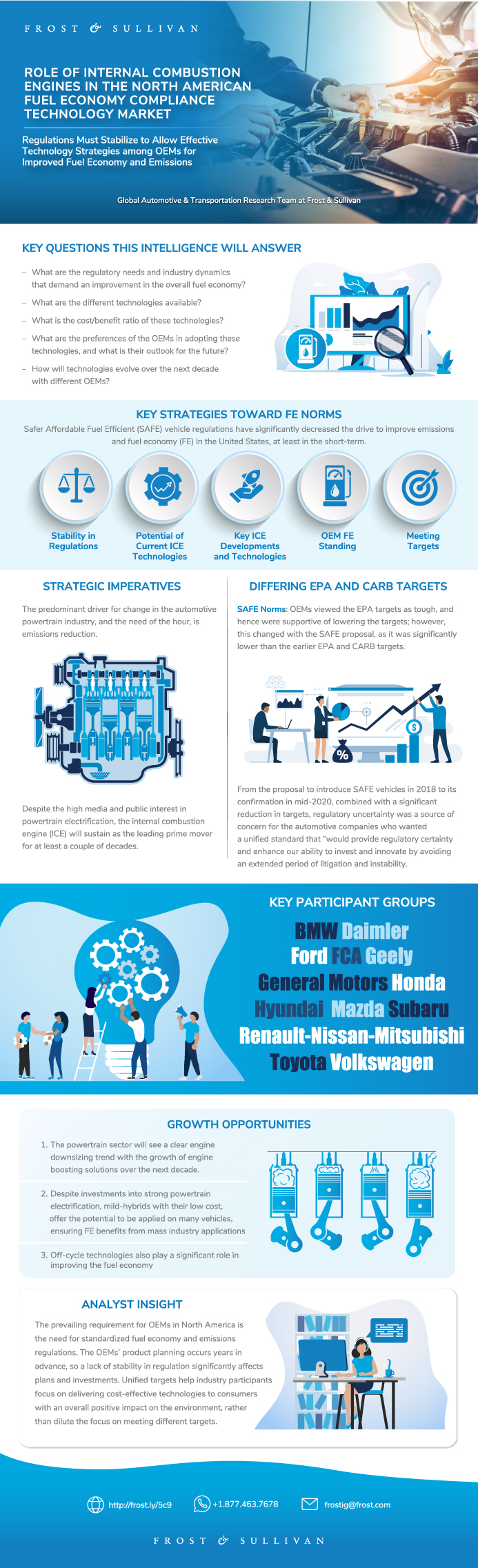
The predominant driver of change in the automotive powertrain industry, and the need of the hour, is emissions reduction. Despite the social interest in powertrain electrification, the internal combustion engine (ICE) will remain the leading powertrain for at least 2 decades. Nonetheless, this primary propulsion unit offers scope for improvement, making it essential that technologies are evaluated and applied to boost fuel economy and emissions reduction, especially in North America, one of the world’s largest markets, where engine displacement and CO2 emissions remain high.
While the Obama-era EPA norms were intended to increase fuel economy mpg and reduce emissions, increasing adoption of sport utility vehicles (SUVs) and crossover utility vehicles (CUVs), which have a large footprint and thus lower mpg and higher emission levels, has proven counter-productive. Moreover, with the Trump Administration’s rollback of Obama-era fuel economy and emissions regulations, the more lenient Safer Affordable Fuel Efficient (SAFE) rules have placed the North American automotive industry is in a state of flux from a fuel economy and emissions perspective.
Where the previous targets were certainly tough and had original equipment manufacturers (OEMs) requesting a reduction, the near freezing of regulations has created a massive difference between the SAFE and California Air Resources Board (CARB) expectations, essentially asking OEMs to meet 2 different targets in the United States.
Despite the instability in regulations slowing technology adoption and the need for electrification, such as battery electric vehicles (BEVs) or plug-in hybrid electric vehicles (PHEVs), the role of conventional IC engine technologies is still pivotal for improving overall fuel economy in the North American automotive market.
Given these circumstances, this study explores technologies that do not offer major electrification but are used in conjunction with conventional IC engines, their impact on overall fuel economy/emissions, and their associated costs. Additionally, with each OEM having its own technology profile, this study identifies the overall market penetration of these technologies based on OEM preferences. The study period is 2018 to 2030.
Key Issues Addressed
- What are the regulations and market dynamics that demand an improvement in overall fuel economy?
- What different technologies are available?
- What is the cost/benefit ratio of these technologies?
- What preferences do OEMs have in adopting these technologies, and what is their outlook for the future?
- How will technologies evolve in the next decade among different OEMs?
Author: Bharath Kumar Srinivasan
Executive Summary—Key Strategies Toward FE Norms
Executive Summary—Key Powertrain Technologies
Global CO2 Emissions Legislation
Actual Fleet Average MPG vs Weight by OEM
Fleet-wide Delta-to-target MPG
Fuel Economy Improvement—Focus Areas
Technology Impact on Fuel Economy Improvement
Technology Penetration Overview
Research Scope
Research Aims and Objectives
Key Questions this Study will Answer
Research Methodology
Key Participant Groups and Associated Brands Compared in this Study
Research Background
CO2 Emissions Legislation
Average MPG Target vs Year
Average MPG Target vs Year, by Footprint Area
SAFE Vehicles
Differing EPA and CARB Targets
Actual Fleet Average MPG vs Weight by OEM
Fleet-wide Delta-to-target MPG
Fleet-wide ICE MPG Improvement Projection
Technology Penetration Overview
OEM Powertrain Positioning
Technology Roadmap—Powertrain Development Trends
Fuel Economy Improvement—Focus Areas
Technology Impact on Fuel Economy Improvement
Engine Downsizing—VVT/VVL, GDI, Boosting
Electric Boosting—e-Compressor and e-Turbo
Atkinson/Miller Cycle
Exhaust Gas Recirculation (EGR)
Water Injection (WI) Systems
Cylinder Deactivation (CD)
Variable Compression Ratio (VCR)
Friction Reduction—Surface Coatings and Lubricants
Mild Hybrid (mHEV) Systems—48V
Electric/Variable Fead
Transmissions
Exhaust Energy Recovery Systems
Credits for Other Technologies in the United States
Fuel Economy Improvement vs Cost
BMW Group
BMW Group—Powertrain Distribution by Model
BMW Group—Technology Adoption Indices
BMW Group—Powertrain Technology Forecasts
BMW Group—FE Improvement Projection
Daimler Group
Daimler Group—Powertrain Distribution by Model
Daimler Group—Technology Adoption Indices
Daimler Group—Powertrain Technology Forecasts
Daimler Group—FE Improvement Projection
FCA Group
FCA Group—Powertrain Distribution by Model
FCA Group—Technology Adoption Indices
FCA Group—Powertrain Technology Forecasts
FCA Group—FE Improvement Projection
Ford Group
Ford Group—Powertrain Distribution by Model
Ford Group—Technology Adoption Indices
Ford Group—Powertrain Technology Forecasts
Ford Group—FE Improvement Projection
GM Group
GM Group—Powertrain Distribution by Model
GM Group—Technology Adoption Indices
GM Group—Powertrain Technology Forecasts
GM Group—FE Improvement Projection
Honda Group
Honda Group—Powertrain Distribution by Model
Honda Group—Technology Adoption Indices
Honda Group—Powertrain Technology Forecasts
Honda Group—FE Improvement Projection
Hyundai Group
Hyundai Group—Powertrain Distribution by Model
Hyundai Group—Technology Adoption Indices
Hyundai Group—Powertrain Technology Forecasts
Hyundai Group—FE Improvement Projection
Mazda
Mazda—Powertrain Distribution by Model
Mazda—Technology Adoption Indices
Mazda—Powertrain Technology Forecasts
Mazda—FE Improvement Projection
Nissan
Nissan—Powertrain Distribution by Model
Nissan—Technology Adoption Indices
Nissan—Powertrain Technology Forecasts
Nissan—FE Improvement Projection
Subaru
Subaru—Powertrain Distribution by Model
Subaru—Technology Adoption Indices
Subaru—Powertrain Technology Forecasts
Subaru—FE Improvement Projection
Toyota Group
Toyota Group—Powertrain Distribution by Model
Toyota Group—Technology Adoption Indices
Toyota Group—Powertrain Technology Forecasts
Toyota Group—FE Improvement Projection
Volkswagen Group
Volkswagen Group—Powertrain Distribution by Model
Volkswagen Group—Technology Adoption Indices
Volkswagen Group—Powertrain Technology Forecasts
Volkswagen Group—FE Improvement Projection
Growth Opportunity—Electrification of Line-up Likely Game-changer for Compliance
Strategic Imperatives
Conclusions and Outlook
Abbreviations and Acronyms Used
Your Next Steps
Why Frost, Why Now?
List of Exhibits
List of Exhibits (continued)
List of Exhibits (continued)
List of Exhibits (continued)
List of Exhibits (continued)
List of Exhibits (continued)
Legal Disclaimer
Speak directly with our analytics experts for tailored recommendations.
Recent related Automotive research
16 Sep 2026 | North America | Customer Research
US Automotive Technicians’ Choice Survey, 2025
The 2025 US Automotive Technicians’ Choice study is an insightful voice-of-customer survey that highlights the tool preferences of automotive aftermarket service technicians. The survey of 400 automotive technicians across the United States used a combination of computer-assisted telephone and compu...
10 Sep 2026 | Global | Market Research
Global Robobus Market, 2026–2032
The global robobus market is at an inflection point. Large autonomous buses are no longer a concept—they are running as paid public services in China, South Korea, Norway, Switzerland, Finland, and the Netherlands. Europe is in its first wave of real deployment, with active L4 commercial service acr...
03 Sep 2026 | Global | Technology Research
Photonic and Optical Computing Chips for AI and Data Center Acceleration
The study evaluates photonic and optical computing technologies as critical enablers of next-generation AI infrastructure, addressing growing bandwidth, latency, power consumption, and scalability constraints associated with copper-based interconnects. The analysis covers photonic integrated circuit...
02 Sep 2026 | Global | Frost Radar
Frost Radar™: In-Vehicle Audio Technology Stacks, 2026
The in-vehicle entertainment industry is going through a dynamic shift. Audio entertainment in the passenger vehicle is no longer limited to music playback through multiple sources. The rise of ADAS/AD and SDVs have made audio a critical part of the passenger vehicle. Audio developers must now cater...
31 Aug 2026 | Global | Market Outlook
Off-Highway Equipment Market Predictions and Growth Opportunities, Global, 2026
The global off-highway (OHW) equipment industry enters 2026 amid a complex and evolving macroeconomic environment characterized by geopolitical uncertainty, energy price volatility, and shifting trade dynamics. While the baseline outlook suggests moderate global GDP growth of about 3%, downside scen...
Purchase includes:
- Report download
- Growth Dialog™ with our experts
Growth Dialog™
A tailored session with you where we identify the:- Strategic Imperatives
- Growth Opportunities
- Best Practices
- Companies to Action
Impacting your company's future growth potential.
Key Issues Addressed
- What are the regulations and market dynamics that demand an improvement in overall fuel economy?
- What different technologies are available?
- What is the cost/benefit ratio of these technologies?
- What preferences do OEMs have in adopting these technologies, and what is their outlook for the future?
- How will technologies evolve in the next decade among different OEMs?
Author: Bharath Kumar Srinivasan
| Deliverable Type | Market Research |
|---|---|
| No Index | No |
| Podcast | No |
| Author | Bharath Srinivasan |
| Industries | Automotive |
| WIP Number | K587-01-00-00-00 |
| Is Prebook | No |
| GPS Codes | 9800-A6,9813-A6,9882-A6 |
North American Technology Benchmarking for OE Compliance for Fuel Economy, Growth Opportunity
$4,950.00
Special Price $3,712.50 save 25 %