 USD
USD GBP
GBP  CNY
CNY  EUR
EUR  INR
INR  JPY
JPY  MYR
MYR  ZAR
ZAR  KRW
KRW  THB
THB 


Technological Advancements Are Driving Transformational Growth
18-Aug-2025
Global
Market Research
PFUM-01-00-00-00
AE_2025_33731
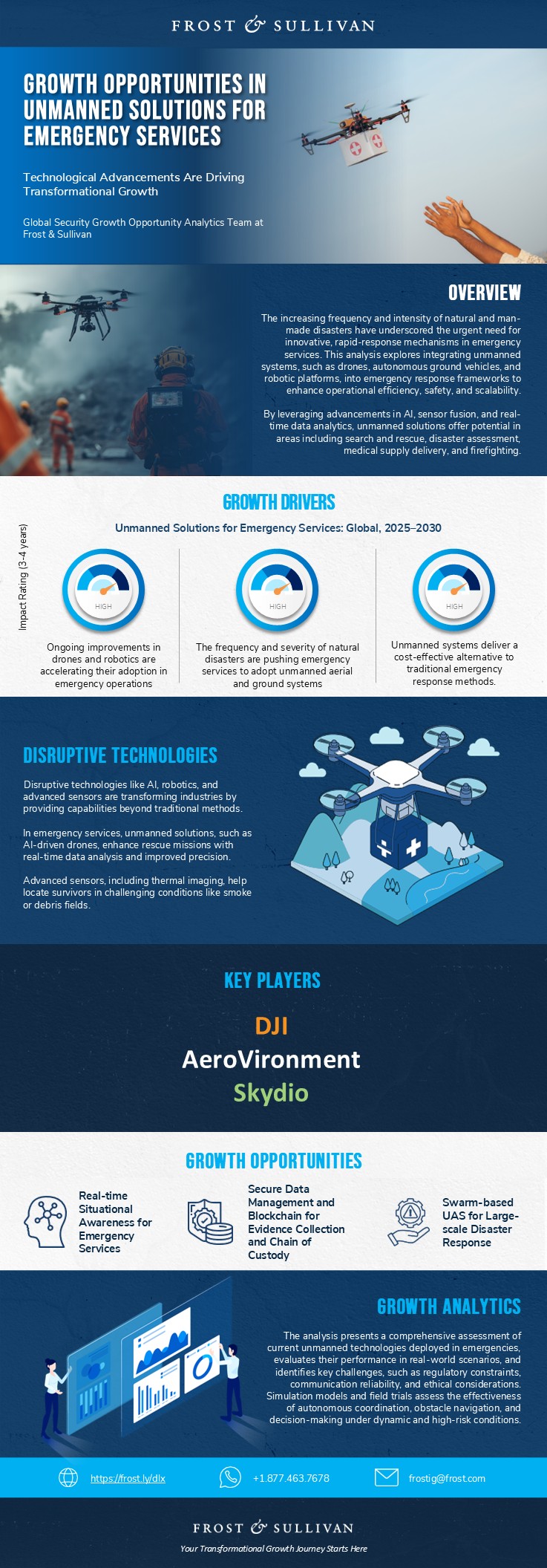
The increasing frequency and intensity of natural and man-made disasters have underscored the urgent need for innovative, rapid-response mechanisms in emergency services. This research explores integrating unmanned systems, such as drones, autonomous ground vehicles, and robotic platforms, into emergency response frameworks to enhance operational efficiency, safety, and scalability. By leveraging advancements in artificial intelligence, sensor fusion, and real-time data analytics, unmanned solutions offer transformative potential in areas including search and rescue, disaster assessment, medical supply delivery, and firefighting.
This study presents a comprehensive analysis of current unmanned technologies deployed in emergencies, evaluates their performance in real-world scenarios, and identifies key challenges, such as regulatory constraints, communication reliability, and ethical considerations. Simulation models and field trials assess the effectiveness of autonomous coordination, obstacle navigation, and decision-making under dynamic and high-risk conditions.
The research proposes a modular architecture for integrating unmanned systems with existing emergency infrastructure, emphasizing interoperability, scalability, and resilience. Case studies from recent disaster events illustrate the practical benefits and limitations of these technologies.
The findings aim to inform policymakers, emergency planners, and technology developers about the strategic deployment of unmanned systems, ultimately contributing to faster, safer, and more effective emergency responses. This work lays the foundation for a future where human responders are supported and, in some cases, safeguarded by intelligent, unmanned allies in the field.
Author: Pranav Sahai
Scope of Analysis
The unmanned solutions for emergency services market centers on technologies like drones and autonomous robots that support law enforcement and first responders in managing critical situations. These systems are vital for tasks such as aerial surveillance, hazardous material handling, search and rescue, and rapid crisis response. The market is expanding, driven by the need for greater safety, speed, and operational efficiency in emergency scenarios.
Recent advancements include the integration of AI, advanced sensors, and machine learning algorithms, serve to enhance first responders’ technical autonomy, decision-making, and situational awareness. Units in this market refers to individual unmanned device, no matter the vehicle type. However, the broader market also includes software platforms, maintenance services, and training programs, sold either independently or as part of bundled solutions.
For hardware, unit sales are generally measured per device. For services, metrics may include missions completed, hours of operation, or active subscriptions, depending on the delivery model.
This market sits at the intersection of the broader emergency services technology and autonomous robotics industry, driving innovation in autonomous navigation, sensor integration, and AI-powered decision systems. As adoption grows, the market will likely shape emerging standards, regulations, and best practices for unmanned systems use in public safety, setting a precedent that could influence other industries.
The analysis will cover key global regions: the Americas, Europe, Asia, the Middle East, and Africa. Focus countries include the United States, Canada, United Kingdom, Germany, France, Italy, China, Japan, and Australia—selected for their strong investments in unmanned systems, mature technology infrastructure, and high adoption rates within emergency services.
Revenue is calculated using a channel-specific approach, accounting for factors such as threat levels, network readiness (4G/LTE/5G), regional police and emergency service funding, and natural disaster risk rankings. This methodology ensures the market sizing reflects initial spending points, particularly within the public sector. While government procurement processes may influence how revenues are structured, the analysis maintains a consistent lens focused on emergency services spending.
| Scope | |
|---|---|
| Geographic Coverage | Global |
| Study Period | 2024–2030 |
| Base Year | 2024 |
| Forecast Period | 2025–2030 |
| Monetary Unit | US dollar |
The Impact of the Top 3 Strategic Imperatives on the Unmanned Solutions for Emergency Services Industry
Transformative Megatrends
- Why
- Transformative megatrends like urbanization, climate change, and population growth are reshaping societies and increasing the demand for unmanned solutions in emergency services.
- Urbanization leads to densely populated areas where traditional emergency responses are challenged, necessitating the use of drones and autonomous systems for aerial surveillance and rapid supply delivery.
- Climate change raises the frequency and severity of natural disasters, creating a need for scalable disaster management tools capable of accessing remote or hazardous locations.
- Frost Perspective
- Frost & Sullivan identifies transformative megatrends as pivotal drivers accelerating the adoption of unmanned solutions in emergency services. These global shifts are expected to fuel market growth by fostering the development of technologies aligned with smart city initiatives and sustainable crisis management.
- Specifically, Frost & Sullivan forecasts that by 2030, 60% of emergency response operations in urban areas will incorporate unmanned systems, up from 25% in 2023, reflecting an compound annual growth rate (CAGR) of approximately 11.5% in adoption.
- Unmanned systems are poised to become essential for enhancing emergency resilience and preparedness.
Disruptive Technologies
- Why
- Disruptive technologies like AI, robotics, and advanced sensors are transforming industries by providing capabilities beyond traditional methods.
- In emergency services, unmanned solutions, such as AI-driven drones, enhance rescue missions with real-time data analysis and improved precision.
- Advanced sensors, including thermal imaging, help locate survivors in challenging conditions like smoke or debris fields.
- Frost Perspective
- Frost & Sullivan views disruptive technologies as a transformative force in the emergency services industry, driving the evolution of unmanned solutions. The firm expects that continued innovation in AI, robotics, and sensor technologies will spur significant research and development (R&D) investments, with the market for these technologies for emergency services projected to grow at a CAGR of 16.5% annually.
- The firm predicts that governmental and non-governmental organizations (NGOs) will ramp up procurement of unmanned systems, with global spending on these technologies for emergency preparedness projected to reach $5.0 billion annually by 2027, a 46% increase from today, translating to a CAGR of roughly 13.1%.
Geopolitical Chaos
- Why
- Geopolitical chaos, including political instability and natural disasters, challenges traditional emergency response systems, creating a need for innovative solutions. Unmanned technologies, such as drones and autonomous robots, enhance operational resilience in high-risk situations where human responders may be compromised.
- Drones can deliver medical supplies to conflict zones, monitor disaster areas, and support pandemic responses by minimizing human contact. Autonomous robots provide vital surveillance and aid distribution during crises, ensuring emergency services remain functional amid uncertainties.
- Frost Perspective
- Frost & Sullivan expects geopolitical chaos to significantly increase reliance on unmanned solutions, as they provide enhanced flexibility and resilience in crisis situations.
- The firm predicts that governmental and non-governmental organizations (NGOs) will ramp up procurement of unmanned systems, with global spending on these technologies for emergency preparedness projected to reach $5.0 billion annually by 2027, reflecting a CAGR of roughly 13.1%.
- This trend will drive market expansion and adoption of unmanned solutions in enhancing global security and stability, particularly in regions prone to geopolitical disruptions.
Competitive Environment
| Number of Competitors | 25 companies with revenue greater than $1 million |
|---|---|
| Competitive Factors | Innovation, pricing, after-sales, regulatory compliance, marketing, partnerships |
| Key End-User Verticals | Law enforcement, firefighting, EMS, search and rescue, hazardous material response |
| Leading Competitors | DJI, AeroVironment, Skydio, Parrot SA, Karaus Hamdani Aerospace, Mesodyne and Action Drone |
| Other Notable Competitors | Autel Robotics, Flyability, Lockheed Martin, Thales Group, Dragonfly, Insitu, Delair, Yuneec, PrecisionHawk, HoverFly, Tekever, BRINC |
| Distribution Structure | Direct sales, value-added resellers, distributers/resellers |
| Notable Acquisitions and Mergers | Thales acquired AstraUTM (March 2024); Shield AI acquired Sentient Vision Systems (April 2024); Delair acquired with Squadron Systems (October 2024). |
Key Competitors
| Global | Americas | Europe | Asia | Middle-East & Africa |
| DJI | SKYDIO | PARROT | DJI | DJI |
| SKYDIO | TELEDYNE FLIR | DELAIR | AUTEL ROBOTICS | PARROT |
| PARROT | AUTEL ROBOTICS | AIRBUS DEFENSE & SPACE | YUNEEC | TELEDYNE FLIR |
| TELEDYNE FLIR | DRAGAFLY | ELBIT SYSTEMS | IDEAFORGE | DELAIR |
| AUTEL ROBOTICS | INSITU | FOLIO3 SOFTWARE | ASTRIA AEROSPACE | TEKEVER |
| DRAGANFLY | PRECISIONHAWK | SAIWA | SKYLARK DRONES | ISRAEL AEROSPACE INDUSTRIES |
| INSITU | HOVERFLY TECHNOLOGIES | SHIELD AI | AYAAN AUTONOMOUS SYSTEMS | BLUEBIRD AERO SYSTEM |
| DELAIR | BRINC DRONES, INC. | PERCEPTO | AI AERIAL SYSTEMS | BAYKAR |
| YUNEEC | INSPIRED FLIGHT | THALES | NEARTHLAB | TUSAS |
| PRECISIONHAWK | FREEFLY SYSTEMS | LEONARDO | MARIS-TECH | DENEL DYNAMICS |
| HOVERFLY TECHNOLOGIES | ASCENT AEROSYSTEMS | UAV NAVIGATION | BLUE BEAR SYSTEMS RESEARCH | GLOBAL INDUSTRIAL & DEFENCE SOLUTIONS |
| TEKEVER | UNUSUAL MACHINES | KOREAN AIR AEROSPACE BUSINESS DIVISION | FALCONVIZ | |
| BRINC DRONES, INC. | GADFIN |
Growth Drivers
- The rising frequency and severity of natural disasters are pushing emergency services to adopt unmanned aerial and ground systems that can access hazardous or hard-to-reach areas more safely and efficiently.
- Ongoing improvements in autonomy, flight endurance, and sensor integration are making drones and robotics more capable, reliable, and mission-ready—accelerating their adoption in emergency operations.
- Unmanned systems offer rapid deployment, wide-area coverage, and reduced risk to personnel, delivering a cost-effective alternative to traditional emergency response methods.
- More permissive regulatory environments, with clearer guidelines for emergency deployments and operator training, are enabling wider integration of UAS into official response protocols.
- Governments and NGOs are investing heavily in public safety infrastructure, channeling funds toward innovative technologies like unmanned systems to strengthen emergency preparedness.
- Incorporating AI, IoT, and big data analytics is enhancing the autonomy and intelligence of unmanned systems, allowing for real-time decision-making, predictive insights, and smarter operations.
- Growing urban populations and infrastructure density are creating challenges that UAS are well-suited to address, such as aerial surveillance, traffic monitoring, and rapid medical supply delivery.
- As the benefits of drones in emergency scenarios become more visible, public perception is shifting positively, fostering greater societal support and institutional adoption.
Growth Restraints
- Stricter and continuously evolving regulations around airspace usage, flight permissions, and data privacy are creating barriers to the widespread deployment of unmanned systems in emergency services.
- Advanced UAS platforms come with steep upfront costs and the added expenses of personnel training, certification, and ongoing maintenance can strain the budgets of emergency service agencies, especially in smaller or underfunded regions.
- Short battery life and limited operational range reduces the effectiveness of unmanned systems in extended or large-scale emergency scenarios, hindering their adoption in standard response protocols.
- Limited support infrastructure—such as charging stations, data processing hubs, and integration with existing emergency systems—restricts scalability, particularly in rural or developing regions.
- Public apprehension around drones operating in populated areas—especially related to surveillance and safety—continues to slow societal acceptance and create resistance to their use in emergency contexts.
- The absence of uniform training programs and certification frameworks leads to inconsistent operational practices, increasing safety risks and reducing confidence in unmanned deployments among first responders.
- Concerns over hacking, data breaches, and system vulnerabilities are prompting caution among emergency service providers who fear disruptions to critical operations and data integrity.
Scope of Analysis
Industry Vertical Segmentation
Regional Segmentation
Introducing UAS Solutions Beyond Military Applications
How UAV Advances in the Defense Sector Impacts Emergency Services
Key Technology Innovations
Types of Unmanned Systems by Vehicle
Types of Unmanned Aerial Vehicles by Design
Types of Unmanned Aerial Vehicles by Size
Applications within Emergency Services
Mission Functions Accomplished with UAS Solutions
Benefits of UAS Solution Adoption
Challenges to UAS Adoption
UAS Regulations
Why Is It Increasingly Difficult to Grow?
The Strategic Imperative 8
The Impact of the Top 3 Strategic Imperatives on the Unmanned Solutions for Emergency Services Industry
Value Chain
Competitive Environment
Key Competitors
Growth Metrics
Growth Drivers
Growth Restraints
Spending Forecast Considerations
Spending and Growth Forecast
Spending Forecast by Region
Spending Forecast by Industry Vertical
Spending Forecast Analysis, UAS for Emergency Services
Pricing Trends and Analysis
Growth Metrics
Spending and Growth Forecast
Spending Forecast by Region
Key Findings
Spending Forecast Analysis
Ongoing Mission Challenges and Solutions
Case Study 1: Drone-Powered Search and Rescue Operations
Case Study 2: Enhancing Urban Situational Awareness
Case Study 3: Improving High-Risk Tactical Response Operations
Growth Metrics
Spending and Growth Forecast
Spending Forecast by Region
Key Findings
Spending Forecast Analysis
Ongoing Mission Challenges and Solutions
Case Study 1: Percepto’s Drone-in-a-Box Offering
Case Study 2: Zipline’s Focus on Supply Delivery
Case Study 3: ScanEagle as an ISR-based Aerial Solution
Growth Opportunity 1: Real-Time Situational Awareness for Emergency Services
Growth Opportunity 2: Secure Data Management and Blockchain for Evidence Collection and Chain of Custody
Growth Opportunity 3: Swarm-Based UAS for Large-Scale Disaster Response
Benefits and Impacts of Growth Opportunities
Next Steps
List of Exhibits
Legal Disclaimer
Speak directly with our analytics experts for tailored recommendations.
Recent related Aerospace Systems research
30 Sep 2026 | Global | Market Research
Total Airport Management (TAM) Market, Global, 2025–2034
Total airport management (TAM) represents a high-potential convergence market that integrates enterprise architecture, data management, resource and capacity planning, collaborative decision-making, passenger management, and airport simulation/digital twin into a unified operational framework. TAM r...
28 Sep 2026 | South Asia, Middle East & North Africa | Market Research
Aerospace Engineering Services, India, 2025–2030
India's aerospace engineering services market is evolving from cost-led engineering delivery to higher-value, strategic aerospace engineering participation. The market comprises outsourced engineering services delivered from India by third-party engineering and digital service providers that support...
24 Sep 2026 | North America | Market Research
Military Aviation Maintenance, Repair, and Overhaul Industry, US, 2025–2030
This research service provides a comprehensive overview of the US military aviation maintenance, repair, and overhaul (MRO) industry. The study segments the industry into six platform categories: 1. Fighter, Attack, & Bomber 2. Rotorcraft 3. Transport & Tanker 4. Training & Utility 5. Intelligence, ...
03 Sep 2026 | Global | Technology Research
Photonic and Optical Computing Chips for AI and Data Center Acceleration
The study evaluates photonic and optical computing technologies as critical enablers of next-generation AI infrastructure, addressing growing bandwidth, latency, power consumption, and scalability constraints associated with copper-based interconnects. The analysis covers photonic integrated circuit...
31 Jul 2026 | Global | Market Research
UAV Navigation Systems and Solutions, Global, 2025–2035
This study provides a comprehensive assessment of the global UAV navigation systems and solutions market through a multidimensional framework encompassing geographies, technologies, and applications. The market sizing and competitive assessment use a triangulated methodology that combines demand-sid...
Purchase includes:
- Report download
- Growth Dialog™ with our experts
Growth Dialog™
A tailored session with you where we identify the:- Strategic Imperatives
- Growth Opportunities
- Best Practices
- Companies to Action
Impacting your company's future growth potential.
This study presents a comprehensive analysis of current unmanned technologies deployed in emergencies, evaluates their performance in real-world scenarios, and identifies key challenges, such as regulatory constraints, communication reliability, and ethical considerations. Simulation models and field trials assess the effectiveness of autonomous coordination, obstacle navigation, and decision-making under dynamic and high-risk conditions.
The research proposes a modular architecture for integrating unmanned systems with existing emergency infrastructure, emphasizing interoperability, scalability, and resilience. Case studies from recent disaster events illustrate the practical benefits and limitations of these technologies.
The findings aim to inform policymakers, emergency planners, and technology developers about the strategic deployment of unmanned systems, ultimately contributing to faster, safer, and more effective emergency responses. This work lays the foundation for a future where human responders are supported and, in some cases, safeguarded by intelligent, unmanned allies in the field.
Author: Pranav Sahai
| Deliverable Type | Market Research |
|---|---|
| Industries | Aerospace, Defence and Security |
| No Index | No |
| Is Prebook | No |
| Keyword 1 | emergency service drones |
| Keyword 2 | unmanned ground vehicles |
| Keyword 3 | AI-enabled emergency systems |
| Podcast | No |
| Predecessor | None |
| WIP Number | PFUM-01-00-00-00 |