 USD
 GBP
 CNY
 EUR
 INR
 JPY
 MYR
 ZAR
 KRW
 THB


Web Application Firewall Market, Greater China, 2024–2029
The Web Application Firewall (WAF) Market is Experiencing Transformational Growth Due to Stricter Data Security Regulatory Requirements and the Enforcement of Cybersecurity Regulations
18-Jun-2025
Asia Pacific
Market Research
PFS7-01-00-00-00
AE_2025_33578
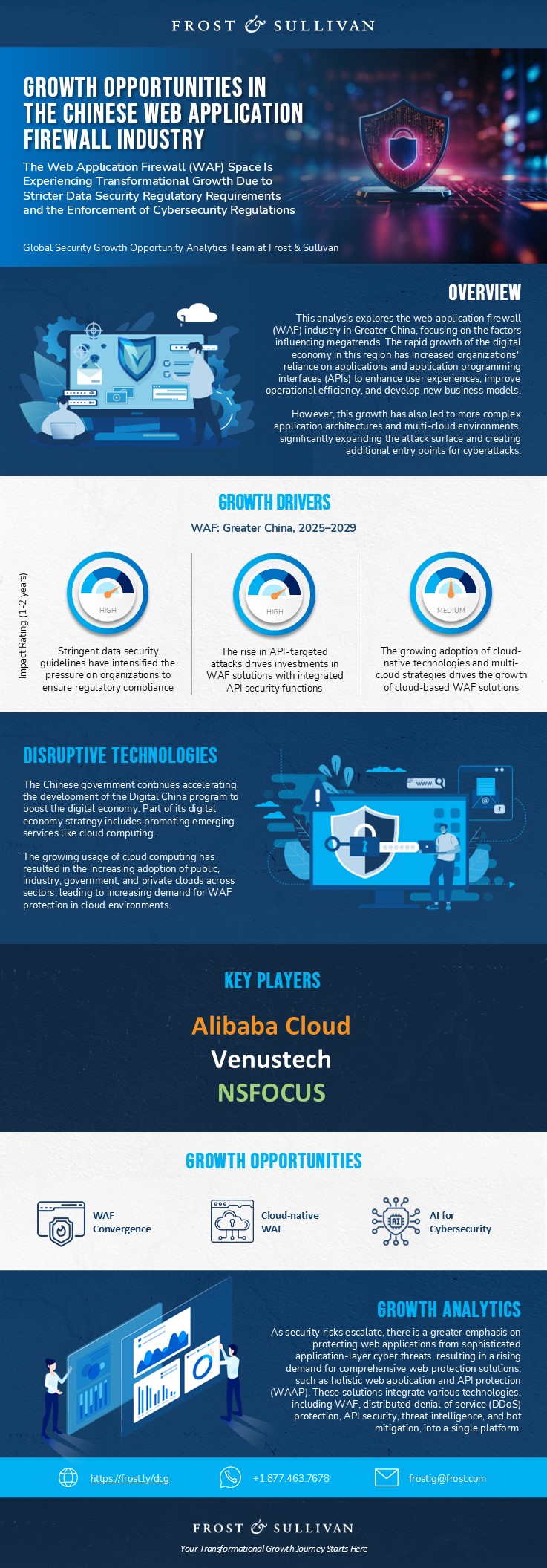
This Frost & Sullivan report provides a comprehensive analysis of the web application firewall (WAF) industry in Greater China, focusing on the factors influencing market trends. The rapid growth of the digital economy in this region has increased organizations' reliance on applications and application programming interfaces (APIs) to enhance user experiences, improve operational efficiency, and develop new business models. However, this growth has also led to more complex application architectures and multi-cloud environments, significantly expanding the attack surface and creating additional entry points for cyberattacks. As security risks escalate, there is a greater emphasis on protecting web applications from sophisticated application-layer cyber threats, resulting in a rising demand for comprehensive web protection solutions, such as holistic web application and API protection (WAAP). These solutions integrate various technologies, including WAF, distributed denial of service (DDoS) protection, API security, threat intelligence, and bot mitigation, into a single platform. With the increased adoption of artificial intelligence (AI) and machine learning (ML), organizations are seeking WAF solutions that utilize these technologies for better threat detection, automated configuration, policy and rule management, real-time threat intelligence updates, and predictive analytics to identify unknown vulnerabilities. This report analyzes the key drivers for and barriers to WAF adoption in Greater China, examines forecast trends and pricing dynamics, and provides an overview of the competitive landscape along with regional insights. The report also identifies the growth opportunities emerging from this space for stakeholders and key players to leverage. The base year for this analysis is 2024, and the forecast period is from 2025 to 2029.
Author: Vivien Pua
Scope of Analysis
- WAF comprises hardware, software, or services that organizations deploy at the front of a web server. A WAF analyzes open systems’ interconnection with layer-7 traffic to protect applications from attacks that aim to exploit vulnerabilities.
- The study provides insights into the Greater China WAF solutions industry by market: China, Hong Kong, and Taiwan.
- The market size is based on sales revenues from WAF hardware, software/virtual appliances, and cloud-delivered WAF services.
- The study uses information and insights from Frost & Sullivan’s secondary research, vendors, channel partners, and other industry stakeholders. However, all revenue estimates and forecasts are based on Frost & Sullivan’s analysis and modeling.
- As customers embrace hybrid and multi-cloud strategies, WAF solutions increasingly support hybrid and multi-cloud environments. This study will only include vendors that provide dedicated and cloud-agnostic WAFs that support these environments.
- The study excludes revenues from product maintenance service charges; professional services, such as deployment, consulting, maintenance, and managed security; and add-on modules on other platforms, including unified threat management and application delivery controller.
| Scope | |
|---|---|
| Geographic Coverage | Greater China |
| Study Period | 2023–2029 |
| Base Year | 2024 |
| Forecast Period | 2025–2029 |
| Monetary Unit | US Dollars |
Key Competitors
| AKAMAI |
| ALIBABA CLOUD |
| BARRACUDA NETWORKS |
| CDNETWORKS |
| CITRIX |
| CLOUDFLARE |
| DBAPPSecurity |
| EDGIO |
| F5 |
| FASTLY |
| FORTINET |
| IMPERVA |
| NEXUSGUARD |
| NSFOCUS |
| PENTA SECURITY |
| QUALYS |
| RADWARE |
| SANGFOR |
| TOPSEC |
| UBIKA |
| VENUSTECH |
Growth Drivers
| Driver | 1–2 Years | 3–4 Years | 5th Year |
|---|---|---|---|
| The growing emphasis on domestically developing China’s IT infrastructure is accelerating the adoption and replacement of cybersecurity products with made-in-China alternatives. | High | High | High |
| Stringent data security guidelines have intensified the pressure on organizations to manage data within web applications and ensure regulatory compliance. | High | High | High |
| The rise in API-targeted attacks drives investments in WAF solutions with integrated API security functions to protect web applications and APIs from evolving web threats and vulnerabilities. | High | High | Medium |
| The growing adoption of cloud-native technologies and multi-cloud strategies drives the growth of cloud-based WAF solutions to secure today’s modern, distributed applications. | Medium | High | High |
Growth Restraints
| Restraint | 1–2 Years | 3–4 Years | 5th Year |
|---|---|---|---|
| Global economic uncertainty and the slowdown of China's economy have led to budget constraints for organizations, thereby hindering the growth of the WAF market. | High | High | Medium |
| Intense price competition in the WAF market could negatively affect its long-term profitability and growth prospects. | High | Medium | Medium |
| The complex deployment process, high upfront costs, and ongoing maintenance requirements of WAF solutions may discourage organizations from adopting comprehensive WAF solutions. | High | Medium | Medium |
Competitive Environment
| Attribute | Details |
|---|---|
| Number of Competitors | More than 20 |
| Competitive Factors | Performance, user experience, cost, branding, unified management, technology integration, multi-cloud interoperability, reliability, professional services, sales support, channel partners, long-term viability of vendor |
| Key End-user Industry Verticals | BFSI, government, eCommerce, service providers |
| Leading Competitors | Alibaba Cloud, Venustech, NSFOCUS |
| Market Share of Top 5 Competitors in 2024 | 62.6% |
| Other Notable Competitors | TOPSEC, DBAPPSecurity, Imperva |
| Distribution Structure | Distributors, resellers, system integrators, service providers |
Industry Convergence
- Why
- The increasing reliance on application programming interfaces (APIs) for digital interactions has streamlined operations and enhanced customer experiences, but it has also led to a rise in cyberattacks. These include automated bot attacks and distributed denial of service (DDoS) attacks targeting APIs, exploiting their vulnerabilities.
- As web applications and APIs remain primary targets for attackers, the growing sophistication of these threats necessitates a more robust and comprehensive security approach to effectively protect web systems.
- Frost Perspective
- In the next 3 years, organizations will continue to demand a holistic web protection solution that integrates WAF, DDoS protection, API security, and bot mitigation for more effective security outcomes.
- WAF vendors in China will place greater emphasis on integrating their WAF solutions with complementary security tools, as mentioned above, to deliver more comprehensive protection in securing web applications and APIs from various modern security threats.
Disruptive Technologies
- Why
- The Chinese government continues accelerating the development of the Digital China program to boost the digital economy. Part of its digital economy strategy includes promoting emerging services like cloud computing.
- The growing usage of cloud computing has resulted in the increasing adoption of public, industry, government, and private clouds across sectors, leading to increasing demand for WAF protection in cloud environments.
- Frost Perspective
- In the next 3 years, it is crucial for WAF vendors to enhance their offerings, positioning them as organizations across various complex cloud environments.
- While organizations continue to move their workload to multi-cloud environments, they will need to ensure that WAFs that can provide robust protection to their dynamic cloud environment.
Transformative Megatrends
- Why
- With the growing sophistication of the threat landscape, WAF solutions have evolved from solely focusing on signature-based detection to a more advanced detection that combines machine learning (ML) and artificial intelligence (AI).
- The integration of AI technology with WAF transforms the approach to web application security, enhances web threat detection, reduces false positives that lead to operational disruptions, and facilitates real-time threat intelligence.
- Frost Perspective
- In the next 3 years, WAF vendors will increasingly integrate AI and ML technologies into their solutions, fostering a more proactive, adaptive, and intelligent defense against both known and unknown web attacks.
- By continuously enhancing AI and ML models, WAF solutions leveraging these technologies help organizations stay resilient while addressing challenges posed by rapidly evolving threat landscapes.
Why is it Increasingly Difficult to Grow?
The Strategic Imperative 8™
The Impact of the Top 3 Strategic Imperatives on the WAF Industry
Scope of Analysis
Revenue and Forecast Estimate Disclaimer
Market Segmentation
Customer Segmentation
Research Methodology
Key Competitors
Growth Metrics
Growth Drivers
Growth Driver Analysis
Growth Restraints
Growth Restraint Analysis
Revenue Forecast
Revenue Forecast Analysis
Revenue Forecast by Product
Revenue Share by Vertical and Horizontal
Revenue Share—Greater China
Revenue Share—China
Competitive Environment
Growth Opportunity 1: WAF Convergence
Growth Opportunity 2: Cloud-native WAF
Growth Opportunity 3: AI for Cybersecurity
Key Trends
CISO Concerns
Recommendations
Benefits and Impacts of Growth Opportunities
Next Steps
List of Exhibits
Legal Disclaimer
Speak directly with our analytics experts for tailored recommendations.
Recent related Security research
21 Oct 2026 | Global | Market Research
Insights for CISOs: The Transition to Quantum-Safe
The emergence of post-quantum cryptography (PQC) reflects a significant problem: powerful quantum computers may soon compromise the cryptographic algorithms underpinning today’s digital economy, threatening the confidentiality and integrity of sensitive data and communications. Addressing this risk ...
16 Oct 2026 | Global | Market Research
Customer Transformation Journeys External Risk Mitigation and Management: BitSight
This report explores how organizations are accelerating cyber risk reduction and remediation through Bitsight’s intelligent External Risk Management and Mitigation (ERMM) solution. It examines customer transformation journeys, highlighting how continuous visibility, contextualized risk intelligence,...
15 Oct 2026 | Global | Market Research
Network Detection and Response (NDR) Sector, Global, 2026–2030
This study examines the global NDR market over the 2022–2030 forecast period. It finds that rising investment reflects NDR's evolution from a discretionary security enhancement into a foundational component of enterprise cyber defense, underscoring stronger buyer commitment and heightened vendor com...
09 Oct 2026 | Global | Technology Research
Growth Opportunities in SiC MOSFET, Photodiodes, RISC-Vs, and Advanced Memory
The Microelectronics Technology Opportunity Engine covers innovations pertaining to SiC MOSFET, Photodiodes, RISC-Vs, and Advanced Memory.The Microelectronics Technology Opportunity Engine captures global electronics-related innovations and developments on a weekly basis. Developments are centered o...
09 Oct 2026 | Global | Frost Radar
Frost Radar™: Workforce Identity and Access Management, 2026
Hybrid work and software as a service have shifted security enforcement from the network perimeter to identity, transforming it into a control plane. Workforce identity and access management (IAM) now determines whether every user, device, and session should retain access based on context, risk, and...
Purchase includes:
- Report download
- Growth Dialog™ with our experts
Growth Dialog™
A tailored session with you where we identify the:- Strategic Imperatives
- Growth Opportunities
- Best Practices
- Companies to Action
Impacting your company's future growth potential.