 USD
USD GBP
GBP  CNY
CNY  EUR
EUR  INR
INR  JPY
JPY  MYR
MYR  ZAR
ZAR  KRW
KRW  THB
THB 


Analysis of European UCaaS Market, 2024-2030
Enhanced Business Value Will Drive Continued UCaaS Adoption
03-Jan-2025
Global
Market Research
KAA1-01-00-00-00
TE_2025_1245
Report Summary: European UCaaS Market
The European unified communications as a service (UCaaS) market size was estimated at USD 11.12 billion in 2024 and is projected to reach USD 17.50 billion by 2030, expanding at a CAGR of 7.8% from 2024 to 2030. Installed seats also continue to grow rapidly, increasing from 49.1 million in 2024 to 78.5 million by 2030, supported by an 8.3% CAGR. This acceleration reflects the region’s shift away from on-premises PBX systems toward flexible, cloud-delivered communication platforms that support hybrid work, mobility, and AI-enabled collaboration experiences.
Key Market Trends & Insights
- AI-powered features such as transcription, noise removal, meeting summaries, and analytics are influencing enterprise adoption patterns.
- The rise of hybrid and remote work continues to accelerate cloud telephony and UC modernization cycles.
- Convergence between UCaaS and CPaaS is enabling programmable workflows and embedded communication capabilities.
- SMB and mid-market organizations drive the highest seat growth, while large enterprises migrate gradually due to legacy complexity.
- RWEI (Rest of Western Europe & Iberia) remains the fastest-growing subregion, while Nordic markets expand steadily.
Market Size & Forecast
- 2024 Market Size: USD 11.12 Billion
- 2030 Projected Market Size: USD 17.50 Billion
- Revenue CAGR (2024–2030): 7.8%
- Installed Seats CAGR (2024–2030): 8.3%
- RWEI: Largest contributor to incremental seat growth
- Nordics: Mature, high-value but slower-growth region
The continued shift toward cloud-native communication architectures, combined with rising demand for AI-driven collaboration, centralized management, and integrated workflows, positions the European UCaaS market for sustained, long-term expansion. As organizations modernize legacy telephony and adopt mobile-first communication models, UCaaS will remain a core enabler of digital workplace transformation across Europe.
Market Overview: European UCaaS Market
The european ucaas market is undergoing a multi-year transformation shaped by digitalization mandates, enterprise mobility strategies, and rising expectations for seamless collaboration experiences. Businesses increasingly seek unified platforms that integrate voice, video, chat, meetings, file collaboration, analytics, and AI-driven productivity tools. This demand is accelerating the shift from siloed communication tools toward consolidated unified communications as a service (ucaas) market ecosystems.
Hybrid Work Institutionalization
One of the most influential forces redefining communication adoption is the normalization of hybrid work. Organizations no longer view remote work as a temporary adaptation—it is now a structural element of workforce strategy. This creates a high dependency on UCaaS platforms that ensure secure, high-quality communication from any device or location. UCaaS delivers consistent performance across desktops, softphones, mobile devices, and browsers, enabling seamless transitions between office and remote environments.
AI and Automation as Core Differentiators
AI is rapidly reshaping the ucaas market, evolving from an optional add-on to a competitive necessity. Vendors now embed AI into meeting transcription, real-time translation, noise suppression, conversational analytics, scheduling automation, and contextual meeting summaries. AI-enhanced virtual assistants improve user productivity by eliminating repetitive tasks, while advanced analytics engines help organizations measure employee engagement and communication efficiency.
CPaaS Integration Deepens UCaaS Value
An emerging shift is the convergence of UCaaS with communications platform as a service (CPaaS). Through programmable APIs, organizations embed communication capabilities directly into business applications such as CRM, ERP, logistics management, digital healthcare platforms, and customer engagement tools. This integration streamlines workflows, minimizes app switching, and supports automation at scale.
Legacy Infrastructure Replacement Cycle
Across Europe, large volumes of ageing PBX systems are reaching end-of-support. Enterprises—particularly in DACH, UK&I, and France—are now prioritizing migration to cloud-based telephony. Hybrid approaches remain common, especially in regulated industries, but the long-term trajectory favors full-cloud UCaaS as reliability, mobility, and security features mature.
Mobile-First and Browser-Based Adoption
Frontline workers, field technicians, logistics operations, and SMBs are increasingly adopting mobile UCaaS solutions. Browser-based clients also continue rising in popularity due to their ease of deployment and maintenance-free model.
Regional Dynamics
The european ucaas market is highly fragmented, with notable differences across countries:
- RWEI leads growth due to lower legacy PBX penetration and aggressive digital adoption.
- UK & Ireland demonstrate strong enterprise adoption tied to Microsoft Teams Phone.
- Nordics exhibit early cloud maturity and slower incremental expansion.
- Italy and parts of Southern Europe show rapid cloud acceleration from a smaller baseline.
Overall, the European UCaaS landscape is entering a maturation phase characterized by AI-driven experiences, deeper enterprise integration, and an increasing reliance on cloud-native communication ecosystems.
Scope of Analysis: European UCaaS Market
This report assesses the unified communications as a service (ucaas) market across Europe with detailed evaluation of revenue, installed base, growth rates, vendor positioning, and technological evolution. The analytical scope covers:
Geographic Scope
Evaluation includes all major European subregions:
- UK & Ireland
- DACH (Germany, Austria, Switzerland)
- France
- Benelux
- Nordics
- Italy
- RWEI (Rest of Western Europe & Iberia)
Each subregion is evaluated by revenue contribution, installed UCaaS seats, and adoption maturity.
Industry Scope
The analysis spans all major enterprise segments:
- Micro-businesses
- Small and medium enterprises (SMEs)
- Mid-market organizations
- Large enterprises and multinational corporations
Technology Scope
The study covers key solution areas within the ucaas market:
- Cloud PBX and SIP trunking enablement
- Meeting and video collaboration platforms
- Cloud messaging and team collaboration
- Mobile UCaaS clients
- AI-based communication enhancements
- Analytics dashboards and engagement tools
- Hybrid voice enablement for enterprise telephony
Vendor Scope
The report evaluates global SaaS providers, regional telecom operators, cloud-first disruptors, and mobile-first UCaaS vendors, assessing their capabilities, differentiation, and customer adoption patterns.
Forecast Period
All forecasts extend from 2023 to 2030, with 2023 as the base year.
This scope ensures a comprehensive, multi-dimensional understanding of the european ucaas market, covering technical, financial, and regional components influencing UCaaS adoption.
Revenue Forecast: European UCaaS Market
The European UCaaS market is set to maintain a strong and consistent upward trajectory throughout the decade, supported by rapid migration from legacy PBX systems, increased adoption of hybrid work models, and the growing preference for cloud-delivered communication suites that integrate calling, meetings, messaging, and AI-driven collaboration. Market revenues, which stood at USD 10.36 billion in 2023, are projected to expand steadily each year as enterprise communication stacks shift from hardware-led to subscription-based cloud platforms. By 2024, revenue is estimated to reach USD 11.12 billion, rising further to USD 11.92 billion in 2025 as businesses across Europe continue accelerating cloud telephony transformation. Sustained momentum carries through the following years, with the market expected to grow to USD 12.84 billion in 2026, USD 13.89 billion in 2027, and more than USD 15.05 billion by 2028, before advancing to USD 16.21 billion in 2029. By 2030, overall revenue is forecast to reach approximately USD 17.50 billion, reflecting a healthy 7.8% CAGR from 2023 to 2030.
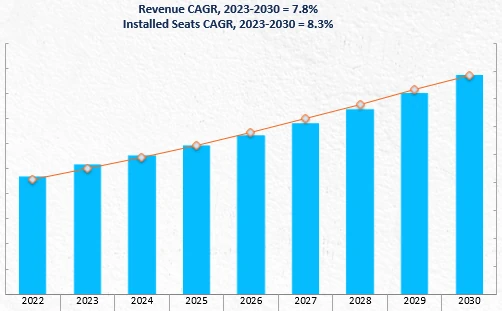
A parallel expansion in installed UCaaS seats reinforces this upward trend, with user penetration increasing from 45 million seats in 2023 to 78.5 million seats in 2030, driven by widespread mobile-UCaaS enablement, stronger wireless coverage, and the retirement of ageing PBX infrastructure. Operator-led UCaaS adoption remains strong in DACH and France, while SaaS-centric UCaaS ecosystems led by Microsoft, Cisco, and Zoom dominate in the UK&I and RWEI regions. Increasing integration of AI-powered features, from intelligent meeting summaries to automated workflow actions, is also pushing enterprises toward higher-tier subscriptions, further strengthening revenue outlook. Collectively, these factors position the UCaaS market in Europe as one of the most resilient and fast-growing communication segments through 2030.
Segmentation Analysis: European UCaaS Market
A. By Subregion
1. RWEI
Fastest-growing due to accelerated SMB migration, strong mobile UCaaS adoption, and low PBX dependency. Expected to maintain rapid seat expansion through 2030.
2. UK & Ireland
Strong enterprise segment driven by Microsoft Teams Phone, supported by a competitive operator ecosystem offering Direct Routing and Operator Connect.
3. DACH
Mature UCaaS adoption with strong operator influence. Migration is deliberate due to regulatory complexity and layered legacy telephony.
4. Nordics
Most mature region; cloud-first adoption stunts growth rates. High expectations for reliability, data protection, and user experience.
5. France
Balanced landscape with strong operator-led UCaaS and growing SaaS-provider presence.
6. Italy
Rapid adoption momentum from a smaller base. Rising demand for cloud-based calling and browser-centric collaboration.
B. By Business Size
Micro & Small Enterprises
Fastest adopters of cloud-based UCaaS due to affordability, ease of deployment, and preference for mobile-first calling.
Mid-Market
Strong adoption due to Microsoft and Cisco ecosystems. Increasing AI usage and integration with CRMs.
Large Enterprises
Gradual migration because of multi-country telephony estates and complex voice infrastructure.
C. By Solution Type
- Cloud PBX: Core driver of seat expansion.
- Meetings & Collaboration: Increased consolidation of standalone video tools into UCaaS bundles.
- Messaging & Presence: Gains prominence in mobile and frontline workflows.
- AI-Enhanced UCaaS: Rapidly adopted for productivity optimization.
This segmentation highlights the diversity of adoption patterns shaping the european ucaas market.
Growth Drivers: European UCaaS Market
1. Hybrid Work Normalization
Demand for seamless communication drives UCaaS adoption across distributed teams.
2. PBX End-of-Life
Aging PBX hardware has become expensive to maintain, pushing businesses toward cloud migration.
3. AI-Enhanced Productivity
AI-powered note-taking, summarization, and sentiment analytics significantly improve meeting efficiency.
4. Increasing Mobile Workforce
Field workers and frontline teams rely on mobile-first UCaaS solutions.
5. UCaaS + CPaaS Convergence
APIs allow embedded communications across customer workflows, enhancing value for enterprises.
6. Multi-Cloud Expansion
Organizations increasingly pursue hybrid cloud architectures, enabling seamless UCaaS scalability.
These forces collectively accelerate the ucaas market trajectory.
Growth Restraints: European UCaaS Market
1. Complex Telephony Migration
Large enterprises face extensive integration challenges when modernizing telephony stacks.
2. Fragmented Regulatory Compliance
Differing telecom regulations require region-specific deployments, increasing project complexity.
3. Market Price Pressure
Competitive pricing compresses margins, particularly for operator-led UCaaS.
4. Security and Data Sovereignty Risks
Regulated sectors move slower due to strict privacy and compliance requirements.
5. Vendor Consolidation
Mergers may reduce customer choice and raise dependency on larger service ecosystems.
6. Overlapping UCaaS and CPaaS Solutions
Functional redundancy creates confusion in procurement and IT planning.
These limitations may slow, though not halt, the expansion of the european ucaas market.
Competitive Landscape: European UCaaS Market
The ucaas market in Europe includes a diverse mix of global SaaS providers, telecom operators, and specialized cloud vendors.
Global SaaS Leaders
- Microsoft (Teams Phone)
- Cisco Webex Calling
- Zoom Phone
These companies dominate seat growth, leveraging cloud collaboration suites and AI-enabled features.
Operator-Led UCaaS Providers
Major regional carriers include:
- Vodafone
- Orange
- Deutsche Telekom
- BT
- Telefónica
Operators maintain PSTN leadership, offering hybrid voice and enterprise-grade resilience.
Cloud-First and Regional Providers
Examples include:
- RingCentral
- 3CX
- NFON
- Wildix
- Mitel (cloud transition focus)
These vendors differentiate through flexible pricing, vertical solutions, and SME specialization.
Competitive Differentiators
- AI and automation depth
- Robust PSTN footprint
- Integration ecosystem (CRM, ERP, CCaaS)
- Security posture and data residency compliance
- Mobile-first capabilities
- Hybrid deployment flexibility
- Partner channel strength
The competitive environment is dynamic, with alliances, operator partnerships, and technology integrations continuously reshaping how enterprises evaluate and adopt UCaaS platforms.

Scope of Analysis
Scope and Market Definitions
Why is it Increasingly Difficult to Grow?
The Strategic Imperative 8™
The Impact of the Top 3 Strategic Imperatives on the European UCaaS Industry
Competitive Environment
Key Competitors
Growth Metrics
Growth Drivers
Growth Restraints
UCC Solution Investment Drivers
Premises-based PBX, Cloud PBX or Mobile PBX Investments
PSTN Calling Plan Investments
Cloud or Mobile PBX Services Adoption
Cloud or Mobile PBX Services Investments Among Current Users
Macro Conditions Impact on Investments in Europe
Current and Future Enterprise Telephony/Business Call Control Environments
Forecast Considerations
Revenue and Installed Seats Forecast
Net New Seats Forecast
Installed Seats and Revenue Forecast Analysis
Installed Users Forecast by Subregion
Installed Users Forecast Analysis by Subregion
Pricing Trends and Forecast
Pricing Trends and Forecast Analysis
Pricing Trends and Forecast Analysis by Subregion
Installed Seat Share by Platform Vendor
Service Provider Market Share Analysis by Installed Users
Current Cloud or Mobile PBX/UCaaS Solutions/Providers
Future Cloud or Mobile PBX/UCaaS Solution Providers
Importance of a Fully Integrated UCaaS Solution
Growth Opportunity 1: Contact Center
Growth Opportunity 2: AI Infusion
Growth Opportunity 3: Cloud-connected Call Enablement
Growth Opportunity 4: Mobile-first UCaaS
Growth Opportunity 5: CPaaS and the API Economy
Growth Opportunity 6: Vertical and Frontline Worker Strategies
Benefits and Impacts of Growth Opportunities
Next Steps
Appendix—Competitors Included in Other Europe UCaaS Providers
List of Exhibits
Legal Disclaimer
 List of Figures
- UCaaS Market: Growth Metrics, Europe, 2023
- UCaaS Market: Growth Drivers, Europe, 2024–2030
- UCaaS Market: Growth Restraints, Europe, 2024–2030
- Importance of UCC Solution Investment Drivers, Europe, 2024–2026
- Expected Change in Premises-based PBX, Cloud PBX or Mobile PBX Investments, Europe, 2024–2026
- Expected Change in PSTN Calling Plan Investments, Europe, 2024–2026
- Cloud or Mobile PBX Services Adoption, Europe, 2024–2026
- Expected Change in Cloud or Mobile PBX Services, Europe, 2024–2026
- Current Political and Macro-economic Conditions Effect on Digital Transformation Strategy and Investments, Europe, 2024
- Current Enterprise Telephony Environment, Europe, 2024
- Expected Enterprise Telephony Environment, Europe, 2027
- UCaaS Market: Revenue and Installed Seats Forecast, Europe, 2022–2030
- UCaaS Market: Net New Seats Forecast, Europe, 2022–2030
- UCaaS Market: Installed Users by Subregion, Europe, 2022–2030
- UCaaS Market: Average Revenue Per User Forecast, Europe, 2023–2030
- Total UCaaS Market: Percent Share of Installed Users, Europe, 2023
- UCaaS Market: Installed Seat Share of Top Platform Vendors, Europe, 2023
- Number of Current Cloud or Mobile PBX Solutions/Providers, Europe, 2024
- Planned Changes in the Number of Cloud or Mobile PBX Solutions/Providers, Europe, 2024–2026
- Importance of a Fully Integrated UCC Solution that Includes Meetings and Messaging, Europe, 2024
Frequently Asked Questions (FAQ)
1. What is the current size of the European UCaaS market?
2. What is the revenue forecast for the European UCaaS market through 2030?
3. How fast is UCaaS seat adoption growing in Europe?
4. Which European subregions are experiencing the fastest UCaaS adoption?
5. What factors are driving UCaaS growth in Europe?
6. What are the main restraints affecting UCaaS adoption?
7. Who are the leading UCaaS providers in Europe?
8. How is AI influencing UCaaS adoption?
9. Which industries are adopting UCaaS the fastest in Europe?
10. What is the long-term outlook for the European UCaaS market?
Speak directly with our analytics experts for tailored recommendations.
Recent related Unified Communications and Collaboration (UCC) research
22 Oct 2026 | Global | Market Research
Governance for Agentic AI
Agentic AI now decides and acts inside live customer interactions, approving a refund, denying a claim, escalating a complaint, or promising a remedy the company must honor. The accountability and control architecture most enterprises rely on was built to review human work after the fact, and it can...
08 Oct 2026 | Global | Customer Research
Growth Opportunities for Communications and Collaboration in the Government Sector
Data from Frost & Sullivan's IT Decision Maker survey shows that government communications are entering a decisive new phase. The research finds that modernization is moving beyond routine technology replacement. Agencies now want communications platforms that improve public services, support employ...
07 Oct 2026 | Global | Market Research
Global Audio-Conferencing Devices Market Forecast to 2032
For years, while cameras drew the attention and budget in meeting rooms, audio was often a second thought. That assumption has expired. Audio now sits at the center of meeting equity and collaboration effectiveness, because even the sharpest image is useless if people cannot be heard and understood ...
28 Sep 2026 | Global | Frost Radar
Frost Radar™: Communications Platform as a Service, 2026
Communications platform as a service (CPaaS) has become foundational infrastructure for digital business, embedding programmable voice, messaging, and video into the applications where customers and employees engage. Enterprises are rearchitecting their communication workflows around programmable in...
24 Sep 2026 | Global | Customer Research
UCC Buyers’ Perspective: Investment Priorities in 2026 and Beyond
This research examines enterprise buyer priorities, investment plans, and purchasing behaviors related to Unified Communications and Collaboration (UCC) technologies through 2029, based on Frost & Sullivan’s 2026 global Information Technology Decision-Maker (ITDM) survey. The study explores how orga...
Purchase includes:
- Report download
- Growth Dialog™ with our experts
Growth Dialog™
A tailored session with you where we identify the:- Strategic Imperatives
- Growth Opportunities
- Best Practices
- Companies to Action
Impacting your company's future growth potential.