 USD
USD GBP
GBP  CNY
CNY  EUR
EUR  INR
INR  JPY
JPY  MYR
MYR  ZAR
ZAR  KRW
KRW  THB
THB 


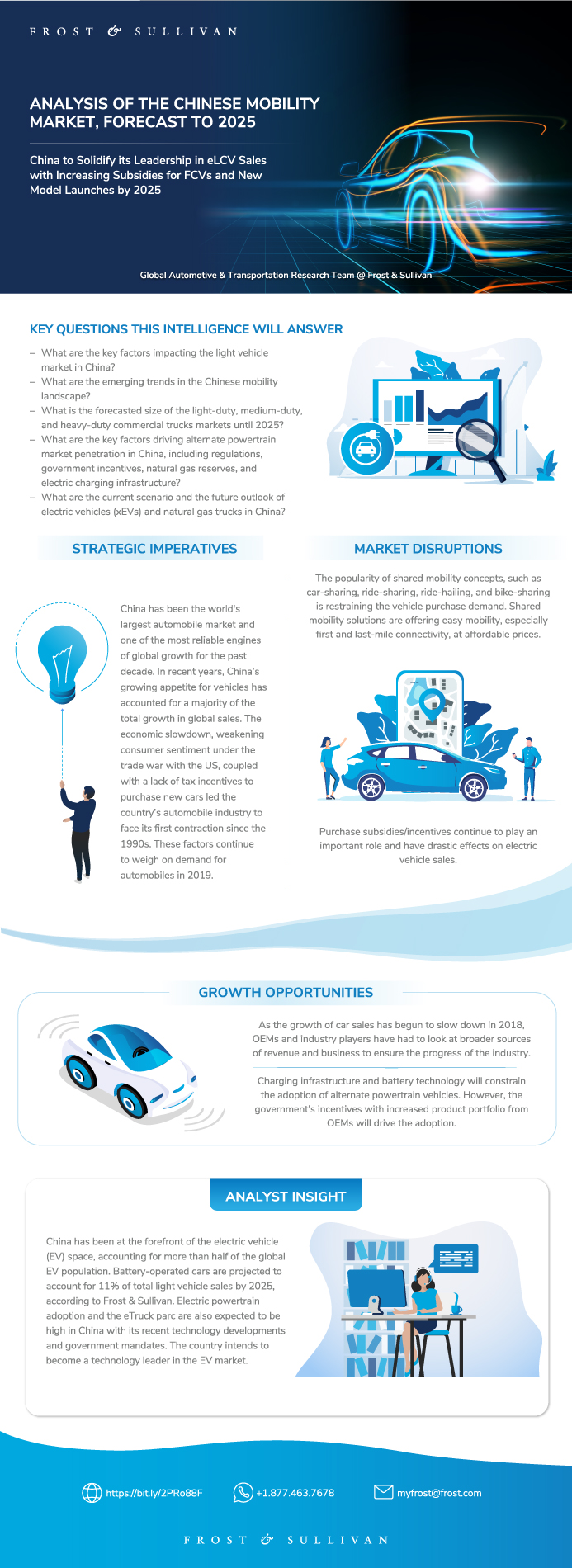
China to Solidify Its Leadership in eLCV Sales with Increasing Subsidies for FCVs and New Model Launches by 2025
The global automotive industry is currently facing several cyclical and structural challenges, and China is no exception to these changes, as its automotive market has been experiencing prolonged negative growth since 2018.
China has been the world's largest automobile market and one of the most reliable engines of global growth for the past decade. In recent years, China’s growing appetite for vehicles has accounted for the majority all growth in global sales. However, the economic slowdown, weakening consumer sentiment arising from the trade war with the United States, and the lack of tax incentives to purchase new cars has led the country’s automobile industry facing its first contraction since the 1990s. Additionally, the popularity of shared mobility concepts, such as car sharing, ride sharing, ride hailing, and bike sharing are restraining vehicle purchase demand, as shared mobility solutions offer easy mobility—especially first and last mile connectivity—at an affordable price. Growth in China’s peer-to-peer market has been mainly driven by dominant market participants, such as AT Zuche, which has expanded its P2P services to approximately 25 cities with over 200,000 vehicles registered on its platform.
China has been at the forefront of the electric vehicle (EV) space, accounting for more than half of the global EV population. Battery-operated cars are projected to account for 11% of total light vehicle sales by 2025, according to Frost & Sullivan. Electric powertrain adoption and the eTruck parc are also expected to be high in China with its recent technology developments and government mandates. The country intends to become a technology leader in the EV market.
The number of original equipment manufacturers of electric light commercial vehicles (eLCVs) is expected to increase from 14 in 2017 to 23 in 2025. Aggressive electrification policies supported by incentives by the Chinese government will lead to a 21% penetration of the eLCV market by 2025 with fully-electric vehicles dominating the market.
Battery Electric Vehicle (BEV) penetration is expected to reach 17.9% in the light-duty (LD) segment, 25.4% in the medium-duty (MD) segment, and 5.5% in the heavy-duty (HD) segment in 2025 in China. Companies such as FAW, CNHTC, Dongfeng, Shaanxi, and CAMC will enter the BEV market by 2020. The Chinese government plans to focus on Fuel-cell Electric Vehicles (FCEVs) by keeping subsidies unchanged until 2020; this will increase penetration in the MD segment to 3.0%.
China, the world’s biggest automobile market by sales, is considering the integration of software and Big Data information to provide smart mobility solutions. Leveraging the application of Beidou Navigation Satellite System, connected services will be helpful in enhancing truck management and developing autonomous trucks in the commercial truck market in the country.
Key Issues Addressed
- What are the key factors impacting the light vehicle market in China?
- What are the emerging trends in the mobility market in China?
- What is the forecasted size of the light-duty, medium-duty, and heavy-duty commercial trucks markets until 2025?
- What are the key factors driving alternate powertrain market penetration in China, including regulations, government incentives, natural-gas reserves, and electric-charging infrastructure?
- How will the Chinese road-freight brokerage market evolve by 2025? What will be the share of key solution types and market revenue opportunities?
- What is the current scenario and the future outlook of electric vehicles (xEVs) and natural-gas trucks in China?
Analyst: Jasmine Bedi
Light Vehicle Market in China—Key Highlights
Commercial Vehicle Market in China—Key Highlights
Electric LCV (eLCV) Market in China—Key Highlights
Car-Sharing Market Trends—Global
Chinese eLCV Market—Adoption Forecast by Type
Chinese MD and HD Commercial Vehicle Market—Powertrain Split
Snapshot of New Mobility Services Offered in Beijing
Research Scope
Vehicle Segmentation
Market Definitions and Segmentation
Research Aims and Objectives
Key Questions this Study will Answer
Research Background
Research Methodology
Automotive Industry Outlook—LV Sales in China
Segment Sales as a Percent of Total LV Sales
Global LV Sales of Top 15 Chinese OEM Groups
Total xEV Market Scenario Analysis in LVs
LVs Market—Global HEV Outlook 2018
Chinese Hybrid and Electric Light Vehicle Sales Mix
Peer-to-Peer Car Sharing Market Analysis—China
Car-Sharing Market Trends—Global
Key Regional LCV Markets—China
Tailpipe and Greenhouse Gas (GHG)/Fuel Efficiency Regulations in China
Chinese eLCV Market—Key Influencing Trends
Chinese eLCV Market—Adoption Forecast by Type
Chinese eLCV Market—Scenario Analysis of eLCVs
Chinese MD and HD Commercial Vehicle Market—Powertrain Split
Tailpipe Emissions and Fuel Efficiency Standards in China
MD and HD Trucks—OEM Sales Performance in China
Global MD and HD Trucks Market Forecast—By Weight Segment
MD and HD Trucks OEM Sales Performance in 2018
Alternative Fuel Powertrain Market Analysis—Global
Electric Truck Market—2025 Outlook of Key Regions
MD and HD Truck Product Portfolio and Launch Roadmap
MD and HD Truck Product Portfolio and Launch Roadmap (continued)
Global Regulations Outlook—GHG and Tailpipe Emissions
Electric Vehicle Charging Stations in Chinese Provinces
Public EV Charging Infrastructure in Chinese Cities
China Digital Brokerage Solution—$1.0 Billion Market by 2025
China On-Demand Solutions—$22.58 Billion Market Potential
Shanghai—Overview
Shanghai—Smart City Attractiveness
Shanghai Transportation Modes—Market Share
Snapshot of Transportation Modes—Motorization Rates and Fares
Technology Trends and Outlook
Snapshot of New Mobility Services Offered in Shanghai
Beijing—Overview
Beijing—Smart City Attractiveness
Beijing Transportation Modes—Market Share
Snapshot of Transportation Modes—Motorization Rates and Fares
Technology Trends and Outlook
Snapshot of New Mobility Services Offered in Beijing
Growth Opportunity—Chinese Mobility Market Analysis
Strategic Imperatives for Success and Growth
Key Conclusions
The Last Word—3 Big Predictions
Legal Disclaimer
Abbreviations and Acronyms Used
Abbreviations and Acronyms Used (continued)
List of Exhibits
List of Exhibits (continued)
List of Exhibits (continued)
List of Exhibits (continued)
The Frost & Sullivan Story
Value Proposition—Future of Your Company & Career
Global Perspective
Industry Convergence
360º Research Perspective
Implementation Excellence
Our Blue Ocean Strategy
Speak directly with our analytics experts for tailored recommendations.
Recent related industry research
08 Oct 2026 | Global | Customer Research
Growth Opportunities for Communications and Collaboration in the Government Sector
Data from Frost & Sullivan's IT Decision Maker survey shows that government communications are entering a decisive new phase. The research finds that modernization is moving beyond routine technology replacement. Agencies now want communications platforms that improve public services, support employ...
08 Oct 2026 | Global | Frost Radar
Frost Radar: Endoscopy Device Technology Ecosystem, 2026
The endoscopy device market is advancing toward higher-quality visualization and improved clinical decision-making, with innovation across 4K ultrahigh-definition display systems, image-enhanced endoscopy, and computer-aided detection systems. Advanced visualization is evolving through improvements ...
09 Oct 2026 | Global | Technology Research
Innovations in Transparent Ceramics, Biomaterials, Compostable Bioplastics, Graphite, Silica Foam, Aerogels, and Other Advanced Materials for Diverse Applications
This issue of High-Tech Materials Technology Opportunity Engine (TOE) profiles significant advances in high-tech materials for various industrial applications. The featured innovations include Large-sized Transparent and Bonded Ceramics for High-Power Laser Systems, High-Strength Transparent Alumina...
08 Oct 2026 | South Asia, Middle East & North Africa | Market Research
Growth Opportunities for Sulphur Derivatives in MENA, 2025–2030
The MENA region plays a critical role in global sulphur supply; however, a significant share of value creation remains concentrated in exports and commodity derivatives. As global demand evolves and advanced applications for sulphur-based products gain momentum, the region’s competitive advantage li...
07 Oct 2026 | North America | Frost Radar
Frost Radar™: US Military Intelligence Analytics, 2026
The US military intelligence (MILINT) analytics industry is undergoing a structural transformation as defense and intelligence agencies transition from platform-centric architectures to AI-native, data-centric, and decision-driven operational models. Intelligence systems are no longer confined to po...
Purchase includes:
- Report download
- Growth Dialog™ with our experts
Growth Dialog™
A tailored session with you where we identify the:- Strategic Imperatives
- Growth Opportunities
- Best Practices
- Companies to Action
Impacting your company's future growth potential.
Key Issues Addressed
- What are the key factors impacting the light vehicle market in China?
- What are the emerging trends in the mobility market in China?
- What is the forecasted size of the light-duty, medium-duty, and heavy-duty commercial trucks markets until 2025?
- What are the key factors driving alternate powertrain market penetration in China, including regulations, government incentives, natural-gas reserves, and electric-charging infrastructure?
- How will the Chinese road-freight brokerage market evolve by 2025? What will be the share of key solution types and market revenue opportunities?
- What is the current scenario and the future outlook of electric vehicles (xEVs) and natural-gas trucks in China?
Analyst: Jasmine Bedi
| Deliverable Type | Market Research |
|---|---|
| No Index | No |
| Podcast | No |
| Author | Naila Govan-Vassen |
| WIP Number | PA30-01-00-00-00 |
| Is Prebook | No |
| GPS Codes | 9673-A6,9800-A6,9B01-A6,9963-A6,9882-A6,9AF6-A6 |
Analysis of the Chinese Mobility Market, Forecast to 2025
$3,000.00
Special Price $2,250.00 save 25 %