 USD
USD GBP
GBP  CNY
CNY  EUR
EUR  INR
INR  JPY
JPY  MYR
MYR  ZAR
ZAR  KRW
KRW  THB
THB 


Color Ingredients in Personal Care and Cosmetics, Global, 2025–2032
Advanced Dispersion and Encapsulation Technologies Drive Transformational Growth in Color Ingredients
07-Sep-2026
Global
Market Research
PLWG-01-00-00-00
CM_2026_34872
Key Takeaways: Cosmetics and Personal Care Color Ingredients Market
- The cosmetics and personal care color ingredients market is projected to grow steadily as beauty brands prioritize high-performance pigments, specialty effects, clean beauty, and sustainable formulations.
- Global market revenue reached $8,534.4 million in 2025, up from $7,739.1 million in 2023.
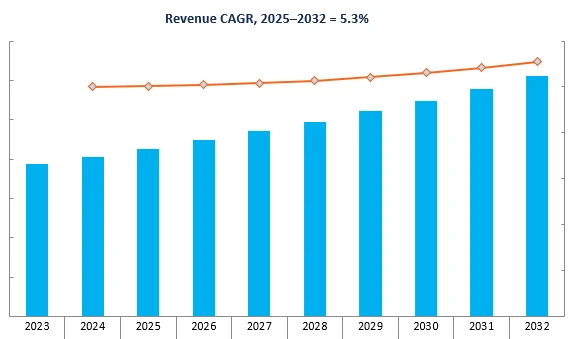
- Revenue is forecast to reach $12,210.8 million by 2032, representing a 5.3% CAGR from 2025 to 2032.
- The Color Ingredients Market is benefiting from increased consumer spending, premiumization, and demand for differentiated cosmetic formulations.
- Specialty pigments, naturally derived colorants, and advanced dispersion, surface-treatment, and encapsulation technologies are expected to be important areas of market development.
- Asia-Pacific remains an important growth region, supported by expanding cosmetics manufacturing and rising beauty consumption, while North America and Europe remain key innovation markets.
- Regulatory fragmentation, formulation stability limitations, and growing safety and toxicity concerns remain important challenges for the Cosmetic Pigments Market.
Report Summary: Cosmetics and Personal Care Color Ingredients Market
The cosmetics and personal care color ingredients market is undergoing transformation as consumer preferences, regulatory requirements, sustainability expectations, and formulation technologies reshape demand. Global market revenue was $8,534.4 million in 2025, compared with $7,739.1 million in 2023, and is forecast to reach $12,210.8 million by 2032, reflecting a 5.3% CAGR from 2025 to 2032.
The Color Ingredients Market includes dyes and pigments used to provide color, opacity, pearlescence, and other aesthetic effects across cosmetics and personal care products. Demand is increasingly shifting toward high-performance pigments, specialty effect pigments, and ingredients offering improved stability, dispersion, and formulation compatibility.
Sustainability is also becoming increasingly important, with clean beauty and ingredient transparency encouraging manufacturers to explore naturally derived, bio-based, and responsibly sourced colorants. Meanwhile, advances in surface treatment, dispersion, and encapsulation technologies are enabling improved performance across modern formulations.
Asia-Pacific is an important growth region because of expanding cosmetics manufacturing and rising beauty consumption, while North America and Europe remain significant hubs for premium, sustainable, and regulatory-compliant technologies. Overall, the Cosmetics Personal Care Ingredients Market is moving toward differentiated, high-performance color systems that combine aesthetic performance, formulation efficiency, regulatory compliance, and sustainability.
Analyst Words: Cosmetics and Personal Care Color Ingredients Market
According to Akheela Dhiman, Senior Industry Analyst, Color Ingredients in Personal Care and Cosmetics Market, the color ingredients industry is moving beyond simply providing color and visual appeal. The next generation of cosmetic colorants is expected to be shaped by the convergence of performance, sustainability, regulatory compliance, and formulation innovation. As beauty brands increasingly differentiate through multifunctionality, clean-label positioning, and enhanced consumer experiences, demand is shifting toward high-performance pigments, naturally derived colorants, and advanced effect pigments. These solutions can provide stronger aesthetic performance while supporting sustainability objectives. The analyst perspective highlights the importance of technology-driven formulation improvements and responsible ingredient development in shaping the future of the Color Ingredients Market.
Market Overview & Trends: Cosmetics and Personal Care Color Ingredients Market
The cosmetics and personal care color ingredients market is evolving alongside the broader transformation of the beauty and personal care industry. Colorants are becoming increasingly important in product differentiation as consumers seek products that combine visual appeal, performance, sustainability, and enhanced functionality.
A major trend is the growing demand for high-performance pigments. Cosmetic manufacturers increasingly require ingredients that provide enhanced color intensity, long-lasting wear, stability, and compatibility with modern formulations. These requirements are particularly relevant in makeup products, where color payoff and visual consistency directly influence consumer experience.
The Cosmetic Pigments Market is also benefiting from the expansion of specialty effect pigments. Pearlescent, metallic, and color-shifting pigments are increasingly being incorporated into premium cosmetics to create distinctive visual effects. These ingredients allow brands to differentiate products and support premium positioning.
Another important trend is the shift toward naturally derived and bio-based colorants. Consumers are showing greater interest in clean beauty, sustainability, ingredient transparency, and responsible sourcing. Consequently, manufacturers are investigating alternatives to conventional synthetic colorants while attempting to maintain adequate stability and formulation performance.
Pigment engineering is becoming another important area of innovation. Surface treatment technologies can improve dispersion, stability, and compatibility with different formulations. Encapsulation technologies can further support controlled performance and protect sensitive color ingredients within cosmetic formulations.
Regional dynamics are also shaping the market. Asia-Pacific is an important growth engine because of expanding cosmetics production and rising beauty consumption. Meanwhile, North America and Europe remain significant innovation hubs, particularly for premium, sustainable, and regulatory-compliant color technologies.
The broader Cosmetics Personal Care Ingredients Market is therefore moving toward higher-value ingredient systems that combine visual performance with sustainability and formulation efficiency.
Scope of Analysis: Cosmetics and Personal Care Color Ingredients Market
The study assesses growth opportunities in the global cosmetics and personal care color ingredients market across the personal care and cosmetics industry. The research covers the global market with a 2023–2032 study period, a 2025 base year, and a 2026–2032 forecast period.
For the purposes of the study, color ingredients are defined as substances incorporated into cosmetic and personal care formulations to provide color, visual appeal, opacity, pearlescence, or other aesthetic enhancement. The scope includes color ingredients such as iron oxides, titanium dioxide, ultramarines, FD&C dyes, mica-based pearlescent pigments, and botanical or naturally derived colorants.
The market is analyzed by type, source, application, and region. By type, the study considers dyes and pigments, with pigments further classified into organic, inorganic, and effect pigments. By source, color ingredients are divided into natural and synthetic categories.
Application analysis covers skin care, hair care, personal hygiene, and color cosmetics. Geographic analysis covers North America, Europe, Asia-Pacific, Latin America, and the Middle East & Africa.
The study excludes functional ingredients that do not primarily serve a coloring purpose, including UV filters, active ingredients, preservatives, emulsifiers, surfactants, and fillers. Packaging colorants and industrial color applications outside cosmetics and personal care are also excluded.
The research differentiates between naturally derived or mineral-derived ingredients and conventionally synthesized color ingredients based on their source.
Market Segmentation Analysis: Cosmetics and Personal Care Color Ingredients Market
The cosmetics and personal care color ingredients market is segmented by type, source, application, and region. These segmentation dimensions highlight differences in ingredient functionality, sourcing, formulation requirements, and regional demand.
By Type
The market is divided into dyes and pigments. Dyes provide soluble coloration and are used where specific color characteristics and formulation requirements are needed. Pigments are insoluble colorants that can deliver color, opacity, visual effects, and enhanced aesthetic properties.
Pigments are further categorized into organic pigments, inorganic pigments, and effect pigments. Organic pigments can provide strong and diverse color characteristics, while inorganic pigments are valued for properties such as stability and opacity. Effect pigments represent an important premium segment because they can create pearlescent, metallic, and color-shifting visual effects.
The increasing demand for distinctive makeup products is supporting opportunities for specialty pigments within the Cosmetic Pigments Market.
By Source
By source, the market is categorized into natural and synthetic color ingredients.
Natural color ingredients are gaining attention as clean beauty and sustainability become increasingly important purchasing considerations. Naturally derived and bio-based colorants can support ingredient-transparency and responsible-sourcing objectives.
Synthetic colorants remain important because manufacturers require consistency, predictable performance, stability, and formulation compatibility. Therefore, the market is expected to maintain demand for both natural and synthetic solutions.
By Application
The market covers skin care, hair care, personal hygiene, and color cosmetics.
Color cosmetics represent a particularly important application because pigments and dyes are fundamental to makeup products. Foundation, lipstick, eye makeup, blush, and other decorative cosmetics require controlled color performance and formulation compatibility.
Skin care applications increasingly incorporate color and visual-enhancement characteristics, while hair care applications use color ingredients in products requiring aesthetic differentiation. Personal hygiene products also represent a market application where color contributes to product appearance and consumer appeal.
By Region
The market is divided into North America, Europe, Asia-Pacific, Latin America, and the Middle East & Africa.
Asia-Pacific is positioned as an important growth market due to expanding cosmetics manufacturing and increasing beauty consumption. The region's expanding production base creates opportunities for both conventional and innovative color ingredients.
Europe remains an important market for premium, sustainable, and regulatory-compliant color technologies. The region's focus on ingredient requirements and sustainability supports continued formulation innovation.
North America is another important innovation center, particularly for premium beauty formulations and advanced pigment technologies.
Latin America and the Middle East & Africa provide additional opportunities as beauty and personal care consumption develops and manufacturers expand product portfolios.
Revenue & Spending Forecast: Cosmetics and Personal Care Color Ingredients Market
The cosmetics and personal care color ingredients market is projected to expand steadily through 2032. According to the provided Frost & Sullivan forecast, global market revenue increased from $7,739.1 million in 2023 to $8,534.4 million in 2025 and is projected to reach $12,210.8 million by 2032. The progression indicates sustained value expansion rather than a short-term spike, supported by rising cosmetic consumption, premiumization, specialty pigments, formulation innovation, and demand for sustainable color systems. Spending opportunities are expected to increasingly favor higher-performance and differentiated ingredients capable of meeting formulation, aesthetic, regulatory, and sustainability requirements.
Growth Drivers: Cosmetics and Personal Care Color Ingredients Market
1. Increased Consumer Spending on Personal Care and Beauty
Rising consumer spending on beauty and personal care products is creating a broader demand base for color ingredients. As product portfolios expand, manufacturers require a wider range of dyes, pigments, and specialty color systems.
2. Product Formulation and Visual-Effect Innovation
Innovation in formulation is strengthening demand for advanced color ingredients. Brands are increasingly using specialty pigments to create distinctive visual effects and differentiated consumer experiences. This trend supports premium applications within the Cosmetic Pigments Market.
3. Clean Beauty and Ingredient Transparency
Consumer interest in clean beauty and transparent ingredient sourcing is encouraging manufacturers to explore naturally derived and bio-based colorants. This transition is creating opportunities for suppliers capable of delivering sustainable ingredients without compromising performance.
4. Regulatory and Sustainability Transformation
Regulatory developments are encouraging manufacturers to reassess ingredient portfolios and invest in compliant formulations. Sustainability requirements are further encouraging innovation in sourcing, pigment development, and formulation technologies.
5. Advanced Pigment Engineering
Surface modification, dispersion, and encapsulation technologies are improving pigment compatibility, stability, and performance. These technologies allow manufacturers to develop color ingredients suitable for increasingly sophisticated cosmetic formulations.
Growth Restraints: Cosmetics and Personal Care Color Ingredients Market
1. Fragmented Regulatory Frameworks
Different regulatory requirements across regions can increase complexity for color ingredient manufacturers. Region-specific approvals and compliance requirements can increase reformulation requirements and lengthen commercialization timelines.
2. Performance and Formulation Stability Challenges
Naturally derived and clean-label colorants can face performance and stability challenges in certain formulations. Maintaining consistent color, dispersion, compatibility, and stability can therefore restrict rapid adoption of some alternative ingredients.
3. Increasing Consumer Safety and Toxicity Concerns
Greater consumer awareness of cosmetic ingredient safety is increasing pressure on manufacturers to demonstrate the safety and suitability of colorants. This can increase testing, compliance, and formulation requirements across the Color Ingredients Market.
4. Formulation Compatibility
Modern cosmetics increasingly involve complex formulations requiring high levels of stability and compatibility. Color ingredients that perform poorly under particular formulation conditions may face limitations even when they offer sustainability benefits.
5. Transition Costs
The shift toward sustainable, naturally derived, or technologically advanced color ingredients can require manufacturers to modify formulations, qualify suppliers, and conduct additional testing. These transition requirements can slow adoption, particularly where established synthetic alternatives remain cost-effective and reliable.
Competitive Landscape: Cosmetics and Personal Care Color Ingredients Market
The cosmetics and personal care color ingredients market is competitive and includes more than 50 competitors. Competition is shaped by cost structure, pricing, regulatory compliance, color performance, formulation compatibility, product portfolio breadth, supply assurance, distribution reach, and technical support.
Key performance factors include color intensity, dispersion properties, UV and light stability, formulation stability, product availability, and scalability. Suppliers with broad portfolios and strong technical capabilities can support cosmetic manufacturers across multiple formulation requirements.
The leading competitors identified in the study include Sun Chemicals, Sensient, Symrise, Neelikon Food Dyes and Chemicals Limited, Sandochem LLC, Kobo Products, Altana (Eckart), and Miyoshi Kasei. Other notable competitors include DIC Corporation, Roelmi HPC, Sudarshan Chemical Industries Limited, Colorcom Inc., Zhejiang Coloray Technology Development Co., Ltd., Nihon Koken Kogyo Co., Ltd., and Ultramarine & Pigments Ltd.
The competitive structure is influenced by the ability to supply differentiated color technologies rather than simply standardized pigments. Manufacturers increasingly need solutions that combine aesthetic performance with formulation compatibility, regulatory compliance, sustainability, and reliable supply.
Direct sales to major personal care and cosmetics manufacturers represent an important distribution route. Suppliers also work through specialty distributors that provide formulation, regulatory, and logistics support. Regional distributors serve smaller brands and contract manufacturers, while direct supply to contract manufacturers and private-label formulators provides another route to market.
Technology is becoming a significant competitive differentiator. Surface modification, advanced dispersion, and encapsulation capabilities can improve pigment performance and create opportunities for suppliers to differentiate their products.
The Cosmetic Pigments Market is also being shaped by premiumization. Specialty effect pigments, including pearlescent, metallic, and color-shifting technologies, allow brands to create distinctive visual effects and justify premium positioning.
Strategic collaboration is expected to remain important. Partnerships among ingredient suppliers, cosmetic manufacturers, biotechnology companies, and regulatory organizations can accelerate development and commercialization of sustainable and compliant color solutions.
Overall, competition is increasingly shifting from commodity color supply toward technology-enabled, sustainable, high-performance color systems. Companies capable of combining technical expertise, regulatory support, reliable supply, and innovation are positioned to capture greater value within the broader Cosmetics Personal Care Ingredients Market.
Scope of Analysis
Scope and Segmentation
Definitions
Why Is It Increasingly Difficult to Grow?
The Strategic Imperative 8™
The Impact of the Top 3 Strategic Imperatives on the Color Ingredients for Personal Care and Cosmetic Industry
Ecosystem
Value Chain Description
Trends in Color Ingredients Industry
Regulations, United States
Regulations, Europe
Regulations, Asia
Regulations, LAMEA
Growth Metrics
Growth Drivers
Growth Restraints
Growth Restraint Analysis
Color Ingredients in Personal Care and Cosmetics Growth Forecast Model
Competitive Environment
Competitive Matrix
Key Market Activities, 2024–2026
Revenue Forecast
Volume Forecast
Revenue and Volume Forecast
Revenue Forecast by Type
Volume Forecast by Type
Revenue Forecast by Type, Pigments
Volume Forecast by Type, Pigments
Revenue and Volume Forecast by Type
Revenue Forecast by Application
Volume Forecast by Application
Revenue and Volume Forecast by Application
Revenue Forecast by Source
Volume Forecast by Source
Revenue and Volume Forecast by Source
Revenue Forecast by Region
Volume Forecast by Region
Revenue and Volume Forecast by Region
Growth Opportunity 1: Natural and Bio-Based Ingredients
Growth Opportunity 2: Meeting Beauty Trends with Effect Pigments
Growth Opportunity 3: Safer Ingredients
Growth Opportunity 4: Partnerships and Acquisition
Growth Opportunity 5: Widening the Palette of Shades
Benefits and Impacts of Growth Opportunities
Next Steps
List of Exhibits
Legal Disclaimer
Frequently Asked Questions (FAQs) – Cosmetics and Personal Care Color Ingredients Market
1. What is the Cosmetics and Personal Care Color Ingredients Market?
The Cosmetics and Personal Care Color Ingredients Market includes dyes and pigments used in personal care and cosmetic formulations to provide color, opacity, pearlescence, visual effects, and aesthetic enhancement across products such as skin care, hair care, personal hygiene, and color cosmetics.
2. What was the revenue of the Color Ingredients Market in 2025?
The global Color Ingredients Market generated approximately $8,534.4 million in revenue in 2025, compared with $7,739.1 million in 2023.
3. What will be the market size of color ingredients by 2032?
The global Cosmetics and Personal Care Color Ingredients Market is forecast to reach approximately $12,210.8 million by 2032, growing at a 5.3% CAGR from 2025 to 2032.
4. What are the major types of color ingredients used in cosmetics and personal care?
The major types include dyes and pigments. Pigments are further classified into organic, inorganic, and effect pigments. Effect pigments include specialty solutions designed to deliver visual characteristics such as pearlescent, metallic, and color-shifting effects.
5. What are the main sources of cosmetic color ingredients?
Color ingredients are segmented by source into natural and synthetic categories. Growing clean-beauty and ingredient-transparency trends are encouraging manufacturers to explore naturally derived, bio-based, and responsibly sourced colorants alongside conventional synthetic ingredients.
6. Which applications are covered in the Cosmetic Pigments Market?
The Cosmetic Pigments Market covers applications including skin care, hair care, personal hygiene, and color cosmetics. These ingredients are used to improve product appearance and provide differentiated visual effects across cosmetic and personal care formulations.
7. What are the key factors driving the Cosmetics Personal Care Ingredients Market?
Key growth factors include increasing consumer spending on personal care and beauty products, innovation in product formulations and visual effects, clean-beauty and ingredient-transparency trends, regulatory transformation, and sustainability-driven reformulation. These factors are increasing demand for high-performance and differentiated color solutions.
8. Which region is expected to support growth in the Color Ingredients Market?
Asia-Pacific is an important growth region, supported by expanding cosmetics manufacturing and rising beauty consumption. North America and Europe also remain significant markets, particularly for premium, sustainable, innovative, and regulatory-compliant color ingredient technologies.
9. What are the major restraints affecting the Cosmetics and Personal Care Color Ingredients Market?
Major restraints include fragmented regulatory frameworks, region-specific colorant approval requirements, performance and formulation stability challenges, and increasing consumer safety and toxicity concerns. These issues can increase reformulation complexity and create additional compliance requirements for manufacturers.
10. Who are the leading companies in the Cosmetics and Personal Care Color Ingredients Market?
Leading competitors identified in the study include Sun Chemicals, Sensient, Symrise, Neelikon Food Dyes and Chemicals Limited, Sandochem LLC, Kobo Products, and Altana (Eckart). Other notable companies include Roelmi HPC, Sudarshan Chemical Industries, Colorcom, Zhejiang Coloray Technology Development, Nihon Koken Kogyo, and Ultramarine & Pigments.
Speak directly with our analytics experts for tailored recommendations.
Recent related Personal Well-being research
18 Sep 2026 | Global | Technology Research
Innovations in Surface Technologies for Automotive Coatings, Protective Coatings, Oleophobic Coatings, Plasma Coatings, Icephobic Coatings, and Others
This edition of the Advanced Coating & Surface Technology Opportunity Engine profiles significant advances in advanced coatings and surface treatments for various industrial applications. The featured innovations include Ultra-Black Nanocarbon Coatings for Next-Generation Automotive Surface Finishes...
14 Aug 2026 | Global | Technology Research
Innovations in Surface Technologies for Optical Coatings, Antifouling Coatings, Protective Coatings, Sustainable Packaging Coatings, and Others
This edition of the Advanced Coating & Surface Technology Opportunity Engine profiles significant advances in advanced coatings and surface treatments for various industrial applications. The featured innovations include Next-Generation Low-Emissivity Coatings for Lightweight Transparent Glazing, Pl...
17 Jul 2026 | Global | Technology Research
Innovations in Surface Technologies for Smart Sensing Coatings, Antifouling Coatings, Medical Device Coatings, Optical Coatings, Battery Coatings, and Others
This edition of the Advanced Coating & Surface Technology Opportunity Engine profiles significant advances in advanced coatings and surface treatments for various industrial applications. The featured innovations include Smart Coatings for Real-Time Surface Sensing, Antifouling Coatings for Commerci...
19 Jun 2026 | Global | Technology Research
Innovations in Coatings and Surface Technologies for Enhanced Performance, Durability, Energy Efficiency, Sustainability, for Various Industrial Applications
This edition of the Advanced Coating & Surface Technology Opportunity Engine profiles significant advances in advanced coatings and surface treatments for various industrial applications. The featured innovations include Plasma-Engineered Polymer Nanocoatings for Multi-Industry Applications, Solvent...
15 May 2026 | Global | Technology Research
Innovations in Coatings & Surface Technologies for Sustainable Packaging, Fire Protection, High-Performance Optics, and Other Industrial Applications
This edition of the Advanced Coating & Surface Technology Opportunity Engine profiles significant advances in advanced coatings and surface treatments for various industrial applications. The featured innovations include Polyurethane-based Lamination System to Improve Packaging Sustainability, Advan...
Purchase includes:
- Report download
- Growth Dialog™ with our experts
Growth Dialog™
A tailored session with you where we identify the:- Strategic Imperatives
- Growth Opportunities
- Best Practices
- Companies to Action
Impacting your company's future growth potential.
Another key trend is the growing use of specialty effect pigments, including pearlescent, metallic, and color-shifting pigments, particularly in premium makeup products. Advances in surface treatment technologies are also improving pigment dispersibility, compatibility with modern formulations, and overall product performance. Regionally, Asia-Pacific continues to drive market growth due to expanding cosmetics manufacturing and rising beauty consumption, while North America and Europe remain innovation hubs for premium, sustainable, and regulatory-compliant color ingredient technologies. These trends are expected to support continued investment in novel pigment chemistries, sustainable sourcing, and advanced formulation solutions across the global cosmetics and personal care industry.
Author: Akheela Dhiman
| Deliverable Type | Market Research |
|---|---|
| Industries | Chemicals and Materials |
| No Index | No |
| Is Prebook | No |
| Podcast | No |
| Predecessor | None |
| WIP Number | PLWG-01-00-00-00 |