 USD
 GBP
 CNY
 EUR
 INR
 JPY
 MYR
 ZAR
 KRW
 THB


Global Battery Market for Wearables
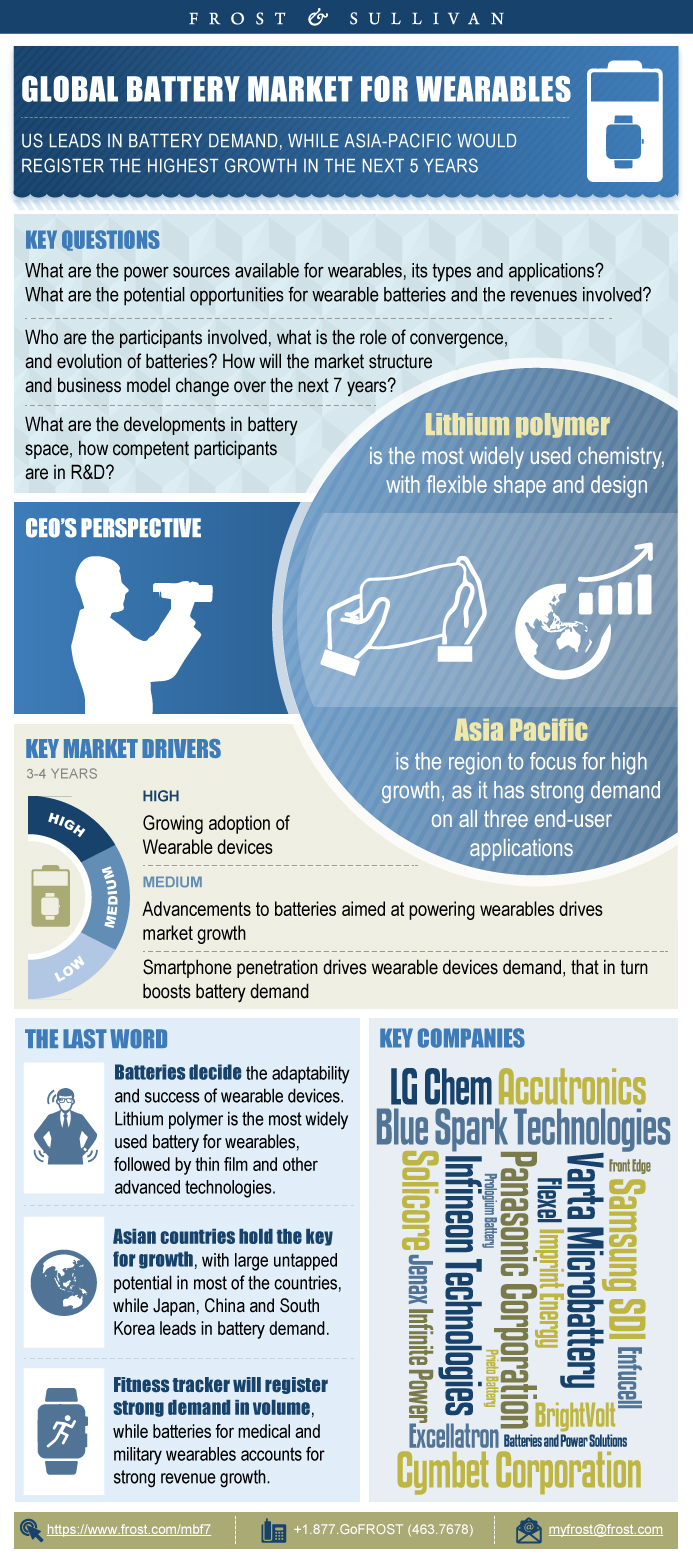
US Leads in Battery Demand, While Asia-Pacific Would Register the Highest Growth in the Next 5 Years
22-Jul-2016
Global
Market Research
MBF7-01-00-00-00
EG01657-GL-MR_18790
This study analyses the potential for batteries powering wearable devices globally. Various battery chemistries such as lithium-ion, lithium polymer, thin film batteries, and emerging technologies are discussed. Major end-user applications include batteries for healthcare wearables, industrial and military wearables, and consumer wearables. The market is likely to be driven by the growth in fitness trackers, smart glasses, smart watches, future soldier wearables, Industrial Internet of Things, and clinical wearables. Globally, US is the pioneer in adopting wearables, driving battery demand, followed by Europe. However, during the forecast period, growth in Asia-Pacific is likely to be strong, with demand from Japan, South Korea, and China.
Key Findings
Market Engineering Measurements
CEO’s Perspective
Batteries for Wearables—Three Essential Considerations for Future Development
Five Key Competitive Aspects for Batteries to Succeed in Wearables
Market Definitions
End-user Application Segments
Evolution of Wearables
Evolution of Batteries for Wearables
Five Key Application Challenges for Smart Wearables
Applications of Wearables
Demand Pattern of Wearables
Wearable Technologies That Complement Batteries
Key Attributes of Wearables
Global Wearable Devices Market
Key Components in Wearable Devices
Global Batteries for Wearables—A Snapshot
Evaluation of Battery Chemistries
Market Segmentation
Market Drivers
Market Restraints
Market Engineering Measurements
Unit Shipment and Revenue Forecast
Batteries for Wearables—Pricing Analysis
Revenues by Region
Revenue Trends by Vertical Market
Key Participants in the Wearables Market by Component
Battery Market in Wearables—Market Structure
Competitive Environment
Competitive Factors and Assessment
Business Models and Procurement Requirement
Key Influencers for Healthcare Wearables
Healthcare Wearables Overview
Battery Requirements
Market Engineering Measurements
Revenue Forecast
Batteries for Healthcare Wearables—Growth Trends
Key Influencers for Industrial and Military Wearables
Industrial and Military Wearables—Battery Requirements
Soldier Modernisation Programmes
Industrial and Military Wearables—Growth Trends by Segment
Industrial Wearables—Overview
Industry 4.0
Key Start-ups Working on Industrial Wearables
Market Engineering Measurements
Revenue Forecast
Consumer Segment Analysis
Key Influencers for Consumer Wearables
Consumer Wearables
Market Engineering Measurements
Revenue Forecast
Lessons From Wearables That Failed
North America
Europe
Asia-Pacific
Rest of World
3 Big Predictions
Legal Disclaimer
Appendix
Market Engineering Methodology
 List of Figures
- 1. Total Battery Market for Wearables: Key Market Drivers, Global, 2016–2022
- 2. Total Battery Market for Wearables: Key Market Restraints, Global, 2016–2022
- 3. Total Battery Market for Wearables: Market Engineering Measurements, Global, 2015
- 4. Total Battery Market for Wearables: Competitive Structure, Global, 2015
- 5. Batteries for Healthcare Wearables Segment: Market Engineering Measurements, Global, 2015
- 6. Batteries for Healthcare Wearables Segment: Growth Trends by Application and Device Type, Global, 2016–2022
- 7. Batteries for Industrial and Military Wearables Segment: Market Growth Potential by and Device Type, Global, 2016–2022
- 8. Batteries for Industrial and Military Wearables Segment: Market Engineering Measurements, Global, 2015
- 9. Batteries for Consumer Wearables Segment: Market Growth Potential by Device Type, Global, 2016–2022
- 10. Batteries for Consumer Wearables Segment: Market Engineering Measurements, Global, 2015
 List of Charts
- 1. Total Battery Market for Wearables: Market Engineering Measurements, Global, 2015
- 2. Total Battery Market for Wearables: Major Segments and Application Areas, Global, 2015
- 3. Total Wearables Market: Percent Unit Breakdown by Device Type, Global, 2015 and 2020
- 4. Smart Wearables Market: Percent Unit Breakdown by Device Type, Global, 2015 and 2020
- 5. Total Wearable Devices Market: Market Share by Volume, Global, 2015
- 6. Total Wearable Devices Market: Revenue Forecast, Global, 2014, 2018, and 2020
- 7. Total Battery Market for Wearables: Percent Revenue Breakdown, Global, 2015
- 8. Total Battery Market for Wearables: Unit Shipment and Revenue Forecast, Global, 2013–2022
- 9. Total Battery Market for Wearables: Average Wearable Device Price by Sector, Global, 2015
- 10. Total Battery Market for Wearables: Revenue Trend by Vertical Market, Global, 2015 and 2022
- 11. Battery Market for Healthcare Wearables: Key Influencers, Global, 2016–2020
- 12. Healthcare Wearables Segment: Revenue Forecast, Global, 2014–2020
- 13. Batteries for Healthcare Wearables Segment: Revenue Forecast, Global, 2013–2022
- 14. Batteries for Healthcare Wearables Segment: Revenue Contribution by Device Type, Global, 2015
Speak directly with our analytics experts for tailored recommendations.
Recent related Energy research
16 Oct 2026 | Global | Technology Research
Innovations in Wind Energy, Flow Batteries, Water Electrolysis, Mechanical Energy Storage, Thermal Batteries, and Nuclear Power
This edition of the Energy & Power Systems (EPS) TOE features information about the innovations in wind turbine blade technology, organic flow batteries, electrolyzers, waste heat recovery solutions, solar thermal heaters, flywheel energy storage and mechanical energy storage systems, among others.T...
12 Oct 2026 | Global | Market Research
Growth Opportunities in the Global Nuclear Power Industry, 2025–2035
The Growth Opportunities in the Global Nuclear Power Industry study examines global commercial nuclear power development from 2025 to 2035, covering reactors above 10 MWe and the life cycle services supporting the installed fleet. Global installed capacity is projected to grow 23.8%, reaching approx...
09 Oct 2026 | Global | Technology Research
Innovations in Enhanced Oil Recovery, Continuous Emission Monitoring, Infrared Gas Detection, and Reservoir Optimization
This edition of the Oil and Gas (O&G) Technology Opportunity Engines features information on enhanced oil recovery, crude oil separation, leak detection, distributed gas monitoring, real-time monitoring of distributed fuel operations, among others.The Oil and Gas TOE provides intelligence on innovat...
28 Sep 2026 | Global | Technology Research
CO₂ Gas Injection for Enhanced Oil Recovery and Carbon Utilization
CO₂ gas injection for enhanced oil recovery (CO₂-EOR) is a mature tertiary recovery technology that improves oil production from depleted reservoirs while enabling long-term geological carbon storage. This report provides a fundamental overview of oil recovery, covering primary, secondary, and terti...
Purchase includes:
- Report download
- Growth Dialog™ with our experts
Growth Dialog™
A tailored session with you where we identify the:- Strategic Imperatives
- Growth Opportunities
- Best Practices
- Companies to Action
Impacting your company's future growth potential.