 USD
USD GBP
GBP  CNY
CNY  EUR
EUR  INR
INR  JPY
JPY  MYR
MYR  ZAR
ZAR  KRW
KRW  THB
THB 


Thriving Amid Disruption: AI, Convergence, and the Shift to Next-Generation Enterprise Voice
12-May-2026
Global
Market Research
M1H5-01-00-00-00
TE_2026_34557
Report Summary: Desktop and Cordless Phone Market
The global desktop and cordless phone market size was valued at approximately USD 2.5 billion in 2024 and is projected to reach nearly USD 1.96 billion by 2032, declining at a CAGR of 2.8% from 2025 to 2032. The market is undergoing structural transformation as enterprises migrate toward cloud-based unified communications, AI-enabled collaboration platforms, and mobile-first communication ecosystems. Despite declining hardware shipments, enterprise demand for secure and workflow-integrated communication endpoints continues across healthcare, manufacturing, logistics, hospitality, and government sectors.
Key Market Trends & Insights
- The desktop and cordless phone market is increasingly shifting from traditional telephony toward AI-enabled and UCaaS-integrated communication ecosystems.
- Hybrid work adoption and reduced assigned desk density are limiting large-scale recovery in enterprise desk-phone deployments.
- The Desktop IP phones market continues evolving through SIP interoperability, AI-powered workflow integration, centralized device management, and compatibility with Microsoft Teams, Zoom Phone, and Cisco Webex.
- The DECT cordless phones market remains resilient in healthcare, hospitality, industrial, and warehouse environments where secure roaming communication and interference-free wireless connectivity are essential.
- Security, compliance, survivability, and centralized endpoint governance remain major purchasing priorities across regulated enterprise sectors.
- Enterprises are increasingly adopting premium communication endpoints with advanced audio quality, noise suppression, transcription support, and AI-assisted productivity features.
Market Size & Forecast
- 2024 Market Size: USD 2.5 Billion
- 2032 Projected Market Size: USD 1.96 Billion
- CAGR (2025–2032): -2.8%
- Unit Shipment CAGR (2025–2032): -2.7%
- North America: Largest Market in 2024
- Asia-Pacific: Emerging Growth Region for Enterprise Wireless Communication Deployments
The global enterprise communication landscape is rapidly transitioning toward software-centric collaboration environments, reducing dependence on traditional hardware-based voice systems. However, the DECT Phone Market continues maintaining strategic importance in industries where operational continuity, mobility, and secure wireless communication remain business-critical requirements. Organizations across hospitals, manufacturing facilities, retail operations, educational institutions, and logistics hubs continue investing in enterprise-grade cordless and IP communication endpoints to support workflow efficiency, employee coordination, and compliance-driven communication infrastructure.
At the same time, enterprise buyers are prioritizing interoperability with UCaaS ecosystems, AI-enhanced communication workflows, and centralized endpoint management capabilities. Vendors operating in the desktop and cordless phone market are responding through ecosystem partnerships, AI-powered productivity enhancements, advanced audio innovation, and cloud-compatible communication platforms designed for hybrid and distributed workplace environments.
Market Overview: Desktop and Cordless Phone Market
The desktop and cordless phone market includes TDM desktop phones, IP desktop phones, DECT devices, and VoWLAN/Wi-Fi enterprise communication endpoints. The market serves organizations seeking secure voice infrastructure, enterprise mobility, and integrated communications across office, frontline, and remote work environments.
The market is transitioning from hardware-centric telephony toward software-integrated communication ecosystems. Enterprises increasingly prioritize AI-assisted collaboration, cloud calling, workflow automation, centralized endpoint management, and interoperability with UCaaS platforms. This shift is redefining the value proposition of enterprise communication devices across global industries.
Despite long-term shipment declines, enterprise demand persists in regulated industries and operationally intensive sectors where dedicated communication endpoints remain necessary. The DECT Phone Market continues to maintain strategic relevance due to dependable wireless performance, roaming capabilities, and operational resilience in healthcare facilities, warehouses, hospitality sites, and manufacturing plants.
Growing integration with Microsoft Teams, Cisco Webex, Zoom Phone, and other collaboration ecosystems is also reshaping procurement decisions across the Desktop IP phones market. Vendors increasingly compete through ecosystem compatibility, audio innovation, AI-driven workflow enhancement, and device security capabilities.
Scope of Analysis: Desktop and Cordless Phone Market
This study analyzes the global desktop and cordless phone market across enterprise communication environments, evaluating the ongoing transition from traditional telephony infrastructure toward IP-based and wireless communication ecosystems. The research focuses on market performance, technology adoption, enterprise mobility trends, workflow integration, and the evolution of unified communications platforms across major commercial and industrial sectors.
The scope of the study includes TDM desktop phones, IP desktop phones, DECT communication devices, and VoWLAN/Wi-Fi enterprise phones. The analysis covers both legacy and next-generation enterprise communication systems deployed across healthcare, education, manufacturing, hospitality, logistics, retail, government, and financial institutions. Particular emphasis is placed on the growing role of the Desktop IP phones market within cloud-based UCaaS ecosystems and the expanding DECT cordless phones market across mobility-intensive operational environments.
The study evaluates shipment volumes based on handset units and measures revenues at the manufacturer level, including sales through distributors, resellers, retailers, service providers, and direct enterprise procurement channels. OEM-related revenues are attributed to organizations owning the branded intellectual property associated with customized communication products.
Geographically, the report covers North America, Europe, Asia-Pacific, Latin America, and the Middle East & Africa. The study period spans from 2024 to 2032, with 2025 considered the base year for market estimation and forecasting. Revenue calculations are presented in US dollars. Research findings are derived through a combination of primary interviews, secondary research, enterprise communication datasets, vendor benchmarking, and industry trend analysis related to the DECT Phone Market and broader enterprise telephony ecosystem.
Revenue Forecast: Desktop and Cordless Phone Market
The global desktop and cordless phone market was valued at approximately USD 2.5 billion in 2024 and is projected to reach nearly USD 1.96 billion by 2032, registering a negative CAGR of 2.8% during the forecast period. Market decline is primarily associated with enterprise migration toward softphones, mobile-first collaboration platforms, and reduced desk-phone deployments in hybrid work environments.
Unit shipments are also expected to decline at a CAGR of 2.7% through 2032 as businesses increasingly standardize cloud communication applications across employee-owned and mobile devices. Despite overall contraction, enterprise demand for premium communication endpoints remains stable in regulated industries and operationally intensive sectors requiring secure and reliable voice infrastructure.
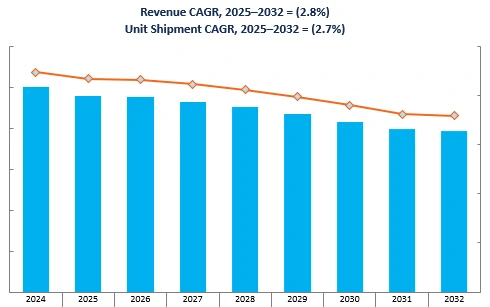
The DECT cordless phones market is expected to maintain relatively resilient demand across healthcare, hospitality, logistics, and industrial environments where uninterrupted wireless mobility and interference-free communication are essential. At the same time, the Desktop IP phones market continues evolving through AI-enabled collaboration features, SIP-based interoperability, workflow integration, and compatibility with leading UCaaS ecosystems including Microsoft Teams, Zoom Phone, and Cisco Webex.
Growth Drivers: Desktop and Cordless Phone Market
Return-to-Office and Hybrid Workplace Investments
Organizations implementing return-to-office strategies and shared-desk environments continue investing in enterprise communication hardware optimized for flexible workplace operations. Shared IP phones, conference room endpoints, and wireless communication systems remain important for maintaining collaboration consistency across hybrid office models.
AI and Workflow Integration
AI-powered communication features are becoming a major driver across the desktop and cordless phone market. Enterprises increasingly demand real-time transcription, noise suppression, sentiment analysis, intelligent routing, and workflow-integrated communication capabilities. Vendors integrating AI-enhanced productivity features into enterprise endpoints are strengthening competitive positioning.
PSTN and ISDN Network Shutdowns
Regulatory retirement of PSTN and ISDN infrastructure across Europe and other global regions is accelerating migration toward IP-based communication systems. This transition is generating replacement demand for SIP-enabled desktop phones and modern DECT communication solutions across enterprise and public-sector deployments.
Demand for Secure and Reliable Enterprise Endpoints
Security, compliance, survivability, and centralized management remain critical purchasing factors across regulated industries. Organizations operating in healthcare, government, manufacturing, and logistics environments continue prioritizing enterprise-grade communication endpoints over unmanaged consumer devices.
Enterprise Mobility Expansion
The DECT cordless phones market benefits from increasing demand for wireless enterprise mobility in warehouses, hospitals, hospitality facilities, and industrial operations. Businesses requiring uninterrupted roaming communication and interference-resistant connectivity continue adopting advanced DECT and VoWLAN solutions.
Growth Restraints: Desktop and Cordless Phone Market
Softphone and Mobile UC Adoption
Rapid adoption of softphones, mobile UC applications, and BYOD communication environments is significantly reducing enterprise dependency on physical desk phones. Many organizations now prioritize app-based communication platforms instead of one-to-one hardware deployments.
Reduced Desk Density in Hybrid Offices
Hybrid work environments and hot-desking models continue reducing the number of permanently assigned workstations within enterprises. This trend directly limits shipment recovery opportunities across the desktop and cordless phone market despite broader growth in UCaaS adoption.
Extended Hardware Replacement Cycles
Organizations are extending hardware refresh timelines as communication platforms become increasingly software-driven. Enterprises often delay replacing functional endpoints unless required for compliance, interoperability, or platform certification upgrades.
Smartphone Substitution in Frontline Operations
Smartphones and rugged Android communication devices are becoming stronger alternatives in frontline enterprise environments. Improvements in enterprise mobility applications and wireless connectivity are increasing competitive pressure on the DECT Phone Market across logistics, retail, and industrial deployments.
Vendor Consolidation and Portfolio Rationalization
Market consolidation and vendor exits are reshaping channel dynamics across enterprise telephony. Buyers are becoming increasingly cautious regarding long-term hardware investments amid changing product roadmaps and platform strategies.
Segmentation Analysis: Desktop and Cordless Phone Market
The desktop and cordless phone market is segmented into TDM desktop phones, IP desktop phones, DECT phones, and VoWLAN/Wi-Fi phones.
TDM desktop phones include traditional analog and digital enterprise communication systems connected to legacy telephony infrastructure. Although declining, these systems remain operational in certain enterprises and public-sector environments with long infrastructure replacement cycles.
The Desktop IP phones market represents one of the largest segments due to broad enterprise migration toward SIP-based communications and UCaaS integration. IP phones increasingly support video collaboration, AI-powered productivity features, and interoperability with cloud collaboration platforms.
The DECT cordless phones market focuses on enterprise wireless mobility solutions designed for secure roaming communication across operational facilities. DECT systems are widely adopted in healthcare, hospitality, manufacturing, and warehouse environments where mobility and reliability are critical.
VoWLAN and Wi-Fi enterprise phones leverage wireless LAN infrastructure to support mobile enterprise communication within large facilities. Adoption remains strongest in organizations with mature wireless communication ecosystems and mobility-focused operations.
Competitive Landscape: Desktop and Cordless Phone Market
The global desktop and cordless phone market remains moderately consolidated, with more than 40 major competitors operating across enterprise communication ecosystems. Leading vendors compete through ecosystem integration, AI-powered communication features, product reliability, endpoint security, audio quality, and centralized device management capabilities.
Major companies operating in the market include Alcatel-Lucent Enterprise, Cisco, Grandstream, Mitel, HP Poly, Yealink, AudioCodes, Ascom, Avaya, Snom, Gigaset, and VTech Phones. Competition is increasingly centered around compatibility with Microsoft Teams, Zoom Phone, and Cisco Webex collaboration environments.
The Desktop IP phones market remains highly competitive due to enterprise demand for certified collaboration devices, advanced audio processing, and AI-enabled workflow functionality. Meanwhile, the DECT Phone Market continues to focus on mobility reliability, roaming efficiency, industrial durability, and secure wireless communication performance.
Distribution strategies remain heavily dependent on channel partners, enterprise resellers, system integrators, and managed service providers. Vendors are also prioritizing software-enabled management platforms and subscription-based support ecosystems to strengthen long-term customer retention.
Scope of Analysis
Segmentation
Why is it Increasingly Difficult to Grow?
The Strategic Imperative 8™
The Impact of the Top 3 Strategic Imperatives on the Desktop and Cordless Phone Industry
Value Chain
Competitive Environment
Key Competitors
Market Overview
Growth Metrics
Growth Drivers
Growth Driver Analysis
Growth Restraints
Growth Restraint Analysis
Forecast Considerations
Revenue and Unit Shipment Forecast
Revenue Forecast by Region
Revenue Forecast by Product
Revenue Contribution by Product
Revenue Forecast Analysis
Unit Shipment Forecast by Region
Unit Shipment Forecast by Product
Unit Shipment Contribution by Product
Pricing Trends and Forecast Analysis
Revenue Share
Revenue Share Analysis
Unit Share
Unit Share Analysis
Growth Metrics
Revenue and Unit Shipment Forecast
Revenue Forecast by Region
Unit Shipment Forecast by Region
Forecast Analysis
Growth Metrics
Revenue and Unit Shipment Forecast
Revenue Forecast by Region
Unit Shipment Forecast by Region
Forecast Analysis
Growth Metrics
Revenue and Unit Shipment Forecast
Revenue Forecast by Region
Unit Shipment Forecast by Region
Forecast Analysis
Growth Metrics
Revenue and Unit Shipment Forecast
Revenue Forecast by Region
Unit Shipment Forecast by Region
Forecast Analysis
Growth Opportunity 1: Developing Communication End-Points for Next-Generation Wi-Fi Networks
Growth Opportunity 2: Unified Endpoint Management Platforms for Hybrid Workforces
Growth Opportunity 3: AI-Driven Personalization for Enterprise Communication Endpoints
Benefits and Impacts of Growth Opportunities
Next Steps
List of Exhibits
Legal Disclaimer
Frequently Asked Questions (FAQ) – Desktop and Cordless Phone Market
1. What is the desktop and cordless phone market?
The desktop and cordless phone market includes enterprise communication devices such as IP desktop phones, TDM phones, DECT cordless phones, and VoWLAN/Wi-Fi phones used across commercial, industrial, healthcare, education, and government environments.
2. What is driving growth in the Desktop IP phones market?
The Desktop IP phones market is driven by enterprise migration toward unified communications, cloud-based collaboration platforms, AI-enabled workflow integration, and increasing adoption of Microsoft Teams, Zoom Phone, and Cisco Webex ecosystems.
3. Why is the DECT cordless phones market still important?
The DECT cordless phones market remains important because enterprises in healthcare, hospitality, logistics, and manufacturing require secure wireless communication, uninterrupted roaming, and interference-resistant voice connectivity for operational continuity.
4. What is the revenue forecast for the desktop and cordless phone market?
The global desktop and cordless phone market was valued at approximately USD 2.5 billion in 2024 and is projected to reach nearly USD 1.96 billion by 2032, declining at a CAGR of 2.8% from 2025 to 2032 due to increasing adoption of softphones, mobile UC applications, and cloud-based communication platforms.
5. Which industries are major users of DECT Phone Market solutions?
Major industries using DECT Phone Market solutions include healthcare, manufacturing, warehousing, hospitality, retail, transportation, education, and government sectors where secure and reliable wireless communication is essential.
6. What are the major challenges affecting the desktop and cordless phone market?
Key market challenges include softphone adoption, hybrid work models, reduced assigned desk density, longer hardware replacement cycles, smartphone substitution, and growing enterprise preference for mobile-first communication environments.
7. What technologies are influencing the Desktop IP phones market?
Technologies influencing the Desktop IP phones market include AI-powered transcription, noise suppression, SIP interoperability, cloud calling integration, centralized endpoint management, workflow automation, and advanced audio collaboration capabilities.
8. Which regions are leading the desktop and cordless phone market?
North America currently leads the desktop and cordless phone market due to strong enterprise UC adoption, while Asia-Pacific is witnessing increasing demand driven by enterprise mobility expansion and digital workplace modernization.
9. Who are the major companies operating in the DECT cordless phones market?
Major companies operating in the DECT cordless phones market include Cisco, Yealink, Mitel, Grandstream, HP Poly, Alcatel-Lucent Enterprise, AudioCodes, Avaya, Snom, Ascom, Gigaset, and VTech Phones.
10. What is the future outlook for the desktop and cordless phone market?
The future outlook for the desktop and cordless phone market centers on AI-enabled communication devices, UCaaS integration, secure enterprise mobility, workflow-driven collaboration endpoints, and premium communication hardware designed for regulated and operationally intensive industries.
Speak directly with our analytics experts for tailored recommendations.
Recent related Unified Communications and Collaboration (UCC) research
08 Oct 2026 | Global | Customer Research
Growth Opportunities for Communications and Collaboration in the Government Sector
Data from Frost & Sullivan's IT Decision Maker survey shows that government communications are entering a decisive new phase. The research finds that modernization is moving beyond routine technology replacement. Agencies now want communications platforms that improve public services, support employ...
07 Oct 2026 | Global | Market Research
Global Audio-Conferencing Devices Market Forecast to 2032
For years, while cameras drew the attention and budget in meeting rooms, audio was often a second thought. That assumption has expired. Audio now sits at the center of meeting equity and collaboration effectiveness, because even the sharpest image is useless if people cannot be heard and understood ...
28 Sep 2026 | Global | Frost Radar
Frost Radar™: Communications Platform as a Service, 2026
Communications platform as a service (CPaaS) has become foundational infrastructure for digital business, embedding programmable voice, messaging, and video into the applications where customers and employees engage. Enterprises are rearchitecting their communication workflows around programmable in...
24 Sep 2026 | Global | Customer Research
UCC Buyers’ Perspective: Investment Priorities in 2026 and Beyond
This research examines enterprise buyer priorities, investment plans, and purchasing behaviors related to Unified Communications and Collaboration (UCC) technologies through 2029, based on Frost & Sullivan’s 2026 global Information Technology Decision-Maker (ITDM) survey. The study explores how orga...
09 Sep 2026 | Global | Technology Research
Unified Cloud Control: The Emergence of Intelligent Multi-Cloud Management Platforms, 2026-2030
This report emerges as the evolution of an integrated cloud manipulation management system as complementary technology for employer cloud manipulation management systems to enable businesses to manage increasingly distributed workloads in public, private, hybrid, edge, and sovereign clouds in one ma...
Purchase includes:
- Report download
- Growth Dialog™ with our experts
Growth Dialog™
A tailored session with you where we identify the:- Strategic Imperatives
- Growth Opportunities
- Best Practices
- Companies to Action
Impacting your company's future growth potential.
Technology and regulatory development are reshaping strategic priorities. AI‑enabled customer‑journey compression, increasing cybersecurity requirements for network‑connected endpoints, industry convergence, and the transition toward workflow‑integrated devices influence design, product roadmaps, and long‑term positioning. At the same time, semiconductor supply constraints, certification dependencies within UCaaS ecosystems, and tightening enterprise IT budgets affect competitive differentiation and channel performance.
Competitive dynamics remain concentrated. Market leaders differentiate through ecosystem alignment, particularly with Microsoft Teams, Cisco Webex, Zoom, and leading UCaaS providers. Vendors are also shifting emphasis toward software‑enabled management capabilities, premium endpoints with advanced audio/video features, and vertical‑specific solutions, areas where buyers continue to recognize value despite declining hardware unit demand.
Viewed as a whole, the market is defined by a decline in traditional desktop telephony, stability where mobility and operational continuity are essential, and growth where wireless infrastructure and enterprise mobility strategies converge.
Author: Chris Pennell
| Deliverable Type | Market Research |
|---|---|
| Industries | Telecom |
| No Index | No |
| Is Prebook | No |
| Keyword 1 | VoWLAN and DECT Phones Market |
| Keyword 2 | Enterprise SIP Endpoints |
| Keyword 3 | Unified Communications Hardware |
| Podcast | No |
| Predecessor | MHAC-01-00-00-00 |
| WIP Number | M1H5-01-00-00-00 |