 USD
USD GBP
GBP  CNY
CNY  EUR
EUR  INR
INR  JPY
JPY  MYR
MYR  ZAR
ZAR  KRW
KRW  THB
THB 


Global Video Conferencing Devices Market, Forecast to 2030
Rapid Advancements in AI and Continued Workplace Modernization Emerge as the Primary Growth Catalysts
15-Jul-2026
Global
Market Research
KC54-01-00-00-00
TE_2026_34734
Key Takeaways – Video Conferencing Devices Market
- The Video Conferencing Devices Market is forecast to grow from $3.94 billion in 2025 to $6.23 billion by 2030, at a 9.6% CAGR.
- Global unit shipments are expected to increase at an 8.9% CAGR, driven by enterprise refresh cycles and hybrid work adoption.
- AI-powered features such as intelligent cameras, speaker tracking, and workplace analytics are becoming key purchasing factors.
- The video conferencing market is shifting from standalone hardware to integrated, cloud-connected collaboration ecosystems.
- Growth is supported by enterprise AI adoption, workplace modernization, and seamless integration with the Video Conferencing Software Market.
Report Summary – Video Conferencing Devices Market
The Video Conferencing Devices Market is transitioning from rapid post-pandemic expansion to a more sustainable and innovation-driven growth cycle. After experiencing moderated demand during 2025 due to enterprise budget optimization, macroeconomic uncertainty, and shifting technology priorities, the market is expected to regain momentum through AI adoption, hybrid workplace investments, and large-scale device replacement cycles.
Revenue increased despite slower shipment growth because enterprises continued investing in premium collaboration technologies that deliver measurable business outcomes. Organizations are increasingly prioritizing intelligent meeting environments equipped with AI-powered cameras, advanced audio processing, workplace analytics, occupancy sensing, and centralized device management.
The video conferencing market is no longer driven solely by hardware purchases. Instead, buyers are selecting complete collaboration ecosystems that integrate seamlessly with cloud platforms, workflow automation, device monitoring, and enterprise communication software. This convergence with the Video Conferencing Software Market is creating stronger demand for integrated room systems and AI-enabled collaboration experiences.
According to Frost & Sullivan, the global Video Conferencing Devices Market is projected to grow from $3.94 billion in 2025 to $6.23 billion by 2030, supported by a 9.6% revenue CAGR. Unit shipments are forecast to expand at an 8.9% CAGR, driven by workplace modernization initiatives, Android operating system refresh cycles, enterprise AI deployment, and increasing investments in intelligent collaboration infrastructure across organizations worldwide.
Market Overview & Trends – Video Conferencing Devices Market
The Video Conferencing Devices Market has evolved into a critical component of enterprise digital transformation, supporting hybrid work, AI-powered collaboration, and workplace modernization. Although the surge in hardware purchases seen during the pandemic has stabilized, organizations continue investing in advanced collaboration technologies to improve productivity and meeting experiences.
In 2025, enterprise spending slowed as IT budgets shifted toward artificial intelligence, cybersecurity, and cloud modernization. Despite this, the Video Conferencing Devices Market maintained steady growth as businesses prioritized premium devices equipped with AI-powered features such as intelligent framing, speaker tracking, noise suppression, and workplace analytics.
A key trend in the video conferencing market is the shift from standalone hardware to integrated collaboration ecosystems. Enterprises increasingly prefer conferencing devices that seamlessly integrate with cloud platforms, centralized device management, workflow automation, and analytics, creating a unified collaboration experience.
Another significant growth opportunity is the enterprise refresh cycle. Organizations that deployed conferencing equipment between 2020 and 2022 are beginning to replace aging systems with next-generation AI-enabled devices. The end of support for older Android operating systems is also accelerating hardware upgrades across meeting rooms.
Hybrid work continues to expand demand for conferencing devices across huddle rooms, conference rooms, classrooms, executive offices, and remote workspaces. At the same time, the Video Conferencing Software Market is influencing purchasing decisions by driving demand for certified hardware that delivers seamless integration with cloud collaboration platforms.
Looking ahead, the Video Conferencing Devices Market is expected to sustain strong growth through 2030, supported by AI innovation, intelligent workplace solutions, integrated collaboration ecosystems, and ongoing enterprise digital transformation initiatives.
Scope of Analysis – Video Conferencing Devices Market
The Video Conferencing Devices Market report provides a comprehensive assessment of the global business and professional video collaboration ecosystem, covering market performance, technology evolution, competitive positioning, and future growth opportunities through 2030. The study evaluates revenue and unit shipment trends while examining how enterprises are adopting intelligent collaboration devices to support hybrid work, workplace modernization, and AI-enabled communication.
The analysis includes two primary product categories: room devices and personal devices. Room devices encompass integrated room endpoints with built-in computing capabilities and USB conference room cameras that connect to external computing systems. Personal devices include professional webcams and all-in-one desktop collaboration systems designed for executives and remote professionals. The report also covers associated conferencing accessories, management software, and related professional services delivered by leading vendors.
The Video Conferencing Devices Market assessment spans North America, Europe, the Middle East & Africa (EMEA), Asia-Pacific (APAC), and Latin America, offering a global perspective on demand patterns and technology adoption. Revenue and shipment forecasts are based on vendor-level net sales, with 2025 serving as the base year and 2026–2030 as the forecast period.
Excluded from the scope are consumer-grade video cameras, audio conferencing-only devices, cloud meeting licenses, on-premises conferencing infrastructure, multimedia phones, and managed services offered exclusively by channel partners. This focused methodology ensures an accurate representation of the enterprise video conferencing market while reflecting its growing convergence with the Video Conferencing Software Market.
Market Segmentation Analysis – Video Conferencing Devices Market
The Video Conferencing Devices Market is segmented according to deployment environment, device type, and workspace requirements, enabling organizations to select collaboration solutions that align with their operational needs and meeting environments. As enterprises expand hybrid work initiatives, demand is increasing across multiple workspace categories, creating opportunities for specialized conferencing devices designed for different room sizes and collaboration scenarios.
The market is broadly divided into Room Devices and Personal Devices. Room devices include integrated room endpoints equipped with built-in computing capabilities that can natively run collaboration platforms, as well as USB conference room cameras that require an external PC or laptop to host meetings. Integrated room systems are increasingly preferred by enterprises because they simplify deployment, improve meeting reliability, and provide centralized device management.
USB conference room cameras remain an important segment within the Video Conferencing Devices Market, particularly for organizations seeking flexible and cost-effective meeting room upgrades. These solutions are widely deployed in bring-your-own-device (BYOD) environments, allowing employees to connect personal laptops while leveraging professional-grade cameras, microphones, and speaker systems.
Personal devices represent another rapidly evolving segment within the video conferencing market. Professional webcams, AI-enhanced desktop cameras, and all-in-one executive collaboration systems continue to gain popularity as remote and hybrid work remain permanent workplace strategies. These solutions offer superior audio and video quality compared with standard laptop webcams while integrating seamlessly with enterprise collaboration platforms and the Video Conferencing Software Market.
Workspace segmentation further illustrates the diversity of enterprise collaboration requirements. Personal workspaces and phone booths typically accommodate single users and require compact, affordable conferencing devices. Small meeting rooms and huddle spaces are designed for two to six participants, emphasizing ease of deployment and collaborative brainstorming. Medium and large conference rooms require more sophisticated AI-enabled cameras, intelligent speaker tracking, advanced microphone arrays, and centralized management capabilities to support larger meetings and executive presentations.
Educational institutions and corporate training environments represent another important segment within the Video Conferencing Devices Market. Large classrooms, lecture halls, and training centers increasingly rely on intelligent video collaboration systems capable of supporting one-to-many communication, remote learning, and interactive presentations.
Beyond physical room categories, enterprises are shifting purchasing priorities from standalone hardware toward integrated collaboration ecosystems. Buyers increasingly evaluate conferencing solutions based on interoperability, cloud integration, analytics, workflow automation, centralized management, sustainability initiatives, and long-term software support. This evolution demonstrates how the video conferencing market is becoming closely interconnected with the Video Conferencing Software Market, where hardware and software work together to deliver secure, intelligent, and scalable enterprise collaboration experiences.
Revenue & Spending Forecast – Video Conferencing Devices Market
The Video Conferencing Devices Market is projected to maintain steady growth throughout the forecast period as enterprises accelerate investments in AI-enabled collaboration technologies, intelligent meeting environments, and workplace modernization initiatives. According to Frost & Sullivan, global market revenue is expected to increase from $3.94 billion in 2025 to $6.23 billion by 2030, representing a compound annual growth rate (CAGR) of 9.6%. During the same period, global unit shipments are forecast to grow at an 8.9% CAGR, reflecting sustained enterprise demand across multiple workplace environments.
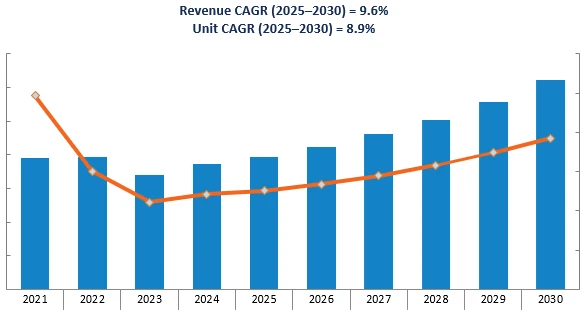
Although spending moderated during 2025 due to economic uncertainty and competing IT priorities, enterprise purchasing is expected to strengthen as organizations begin replacing collaboration devices deployed during the pandemic. The approaching end of support for older Android operating systems will further encourage technology refresh cycles, creating additional opportunities for hardware vendors offering AI-enabled conferencing solutions.
Enterprise spending within the video conferencing market is increasingly focused on premium devices that deliver measurable business value rather than basic conferencing functionality. Investments are shifting toward intelligent cameras, advanced audio processing, workplace analytics, occupancy sensing, cloud-based device management, and integrated collaboration ecosystems that improve productivity and operational efficiency.
The growing convergence between hardware and the Video Conferencing Software Market is also influencing enterprise purchasing behavior. Organizations increasingly prefer certified devices that integrate seamlessly with cloud collaboration platforms while supporting centralized management, security, workflow automation, and analytics. As a result, future revenue growth within the Video Conferencing Devices Market will be driven not only by higher device shipments but also by increasing average selling prices, software-enabled value, and recurring ecosystem services that extend beyond traditional hardware sales.
Growth Drivers – Video Conferencing Devices Market
The Video Conferencing Devices Market is being propelled by a combination of artificial intelligence (AI), hybrid work adoption, workplace modernization, and enterprise technology refresh cycles. As organizations increasingly prioritize digital collaboration, demand is shifting toward intelligent conferencing devices that improve productivity, enhance user experiences, and support data-driven workplace management.
Artificial intelligence has become the most influential growth driver within the Video Conferencing Devices Market. AI-powered cameras with automatic framing, speaker tracking, intelligent zoom, occupancy sensing, and advanced audio processing are transforming traditional meeting rooms into smart collaboration environments. These innovations enable more engaging meetings while generating valuable workplace analytics that help organizations optimize office utilization and collaboration effectiveness.
Another major catalyst is the large installed base of conferencing devices deployed during the pandemic. Many enterprises are entering their first large-scale hardware refresh cycle, creating significant replacement opportunities. Additionally, the approaching end of support for Android 10 and Android 11 is encouraging businesses to upgrade existing room systems with newer AI-enabled devices offering enhanced security, improved performance, and longer lifecycle support.
Hybrid work continues to strengthen the video conferencing market, as organizations require seamless collaboration across executive offices, huddle spaces, conference rooms, classrooms, and remote workstations. Enterprises are investing in integrated collaboration ecosystems rather than standalone hardware, increasing demand for cloud-connected devices that support centralized management, automation, analytics, and interoperability.
The continued expansion of the Video Conferencing Software Market is also accelerating hardware adoption. Businesses increasingly prefer certified conferencing devices that integrate effortlessly with cloud collaboration platforms, enabling simplified deployment, secure communication, and unified user experiences. Together, AI innovation, workplace modernization, ecosystem integration, and enterprise refresh cycles position the Video Conferencing Devices Market for sustained long-term growth through 2030.
Growth Restraints – Video Conferencing Devices Market
Despite its positive long-term outlook, the Video Conferencing Devices Market faces several challenges that may moderate short-term growth. Enterprises continue to balance collaboration technology investments against competing priorities such as cybersecurity, artificial intelligence initiatives, cloud infrastructure, and broader digital transformation projects. These competing budget allocations often delay conferencing hardware purchases and reduce the pace of workplace modernization.
Privacy, security, governance, and compliance concerns remain important barriers within the Video Conferencing Devices Market. Organizations adopting AI-enabled collaboration technologies must ensure that intelligent cameras, workplace analytics, and occupancy monitoring comply with internal governance policies and regional data protection regulations. Demonstrating measurable business value is increasingly essential before enterprises approve large-scale deployments.
Another restraint affecting the video conferencing market is the growing commoditization of conferencing hardware. Basic audio and video capabilities are now widely available across multiple vendors, making it more difficult for manufacturers to differentiate products solely through hardware innovation. Buyers increasingly evaluate long-term software integration, device management, and ecosystem capabilities before making purchasing decisions.
Interoperability challenges also continue to impact enterprise adoption. Organizations operating multiple collaboration platforms often require conferencing devices that function seamlessly across diverse ecosystems. Limited compatibility may increase deployment complexity and discourage investment.
Macroeconomic uncertainty, geopolitical disruptions, rising hardware component costs, and supply chain fluctuations further influence enterprise procurement decisions. Although these factors may slow near-term investment, the continued evolution of the Video Conferencing Software Market, combined with ongoing AI innovation and workplace modernization, is expected to offset many of these restraints over the forecast period.
Competitive Landscape – Video Conferencing Devices Market
The Video Conferencing Devices Market is highly competitive, with global technology vendors competing through product innovation, AI capabilities, cloud ecosystem integration, workplace analytics, and comprehensive collaboration platforms. As hardware becomes increasingly standardized, vendors are differentiating themselves by delivering complete enterprise collaboration ecosystems rather than standalone conferencing devices.
Leading manufacturers are expanding their portfolios with AI-powered room endpoints, intelligent USB conference room cameras, professional webcams, and all-in-one executive collaboration systems. These solutions increasingly incorporate automatic speaker tracking, intelligent framing, background noise suppression, occupancy analytics, and centralized device management to improve enterprise collaboration experiences.
Competition within the Video Conferencing Devices Market has shifted beyond hardware specifications. Vendors are investing heavily in cloud-based device management platforms, workflow automation, sustainability initiatives, interoperability, and advanced analytics to strengthen customer relationships and generate recurring software and service revenue. Organizations now evaluate suppliers based on their ability to deliver scalable collaboration ecosystems that simplify deployment, monitoring, software updates, and lifecycle management across thousands of meeting spaces.
The video conferencing market is also experiencing increased collaboration between hardware manufacturers and software platform providers. Certification programs, native platform integrations, and optimized user experiences have become essential competitive differentiators. Enterprises increasingly prioritize conferencing devices that integrate seamlessly with leading cloud collaboration platforms, reducing implementation complexity while improving productivity and security.
The expanding influence of the Video Conferencing Software Market has further intensified competition by encouraging vendors to develop tightly integrated hardware-software solutions. AI-enabled collaboration experiences, centralized administration, workplace intelligence, and automation capabilities are becoming equally important as traditional camera resolution or audio quality.
Looking ahead, competition within the Video Conferencing Devices Market will increasingly revolve around ecosystem strength rather than individual products. Vendors capable of combining intelligent hardware, AI-driven collaboration, cloud integration, cybersecurity, sustainability initiatives, interoperability, and long-term software innovation will be better positioned to capture enterprise investment. As organizations continue modernizing workplaces and expanding hybrid work strategies, suppliers offering complete collaboration platforms that deliver measurable business outcomes are expected to maintain a significant competitive advantage in the evolving global video conferencing market.
Analyst's Perspective – Video Conferencing Devices Market
According to Roopam Jain, VP of Research, Connected Work, Frost & Sullivan, the Video Conferencing Devices Market is evolving beyond traditional room hardware into intelligent workplace platforms powered by artificial intelligence. As enterprises accelerate AI adoption, conferencing devices are becoming strategic assets that enhance collaboration, automate meeting experiences, and deliver actionable workplace insights. Organizations are shifting their focus from simple occupancy metrics to measurable business outcomes, while vendors compete through integrated ecosystems, cloud connectivity, centralized management, workplace analytics, interoperability, and sustainability initiatives. This transformation positions AI-enabled collaboration as the next major growth engine for the global video conferencing market.
Scope of Analysis
Market Segmentation
Segmentation by Room Size
Why is it Increasingly Difficult to Grow?
The Strategic Imperative 8™
The Impact of the Top 3 Strategic Imperatives on the Video Devices Market
Key Competitors
Target Markets
Deployment Options
Market Outlook
Adoption in 2026 and Beyond
Market Overview
Leading Technology Investment Areas: AI Tops the List
C-suite Influence Grows as AI investments Become a Top Priority
Focus on ESG and Sustainability
Hybrid Work Will Remain the Dominant Model
Office Strategy Shifts Toward Experience and Flexibility
Enterprise AI Deployments Move Beyond Proof-of-Concept Stage
Improving Operational Efficiency is a Key Driver for AI Investments
Ability to Assess ROI and Security Concerns are Key Challenges
AI Deployments Across Business Functions
Importance of AI Features in Collaboration Tools
Communication Device Investment Plans
Top Devices in Meeting Rooms
Top Selection Criteria for Room Video Conferencing Devices
Key Capabilities for Room Video Conferencing Devices
Significance of AI in Meeting Rooms
Total Market—Key Growth Metrics
Growth Drivers
Growth Restraints
Total Market—Revenue and Units
Total Market—Revenue by Device Type
Total Market—Units by Device Type
Total Market—Average Pricing by Device Type
Total Market—Percent of Revenue by Device Type
Total Market—Percent of Units by Device Type
Video Conferencing Room Devices—Key Growth Metrics
Video Conferencing Room Devices—Revenue and Units
Video Conferencing Room Devices—Percent of Revenue by Device Type
Video Conferencing Room Devices—Percent of Units by Device Type
Video Conferencing Room Devices—Pricing Forecast by Device Type
Video Conferencing Room Devices—Revenue Forecast by Meeting Room Size
Video Conferencing Room Devices—Unit Forecast by Meeting Room Size
Meeting Room Count and Penetration Rate
Meeting Room Penetration Rate by Segment
Video Conferencing Room Devices—Percent of Revenue by Room Size
Video Conferencing Room Devices—Percent of Units by Room Size
Video Conferencing Room Devices—Percent of Revenue by Region
Competitive Environment
Video Conferencing Room Endpoints—Revenue Share
Video Conferencing Room Endpoints—Unit Share
USB Conference Room Cameras—Revenue Share
USB Conference Room Cameras—Unit Share
Benefits and Impacts of Growth Opportunities
Next Steps
List of Exhibits
Legal Disclaimer
Frequently Asked Questions (FAQs) – Video Conferencing Devices Market
1. What is the Video Conferencing Devices Market?
The Video Conferencing Devices Market includes enterprise-grade hardware used for virtual meetings, such as room endpoints, USB conference cameras, professional webcams, and all-in-one collaboration systems. These devices enable secure, high-quality video communication for businesses, educational institutions, and government organizations.
2. How large is the global Video Conferencing Devices Market?
According to Frost & Sullivan, the global Video Conferencing Devices Market is expected to grow from approximately $3.94 billion in 2025 to $6.23 billion by 2030, representing a compound annual growth rate (CAGR) of 9.6%.
3. What factors are driving growth in the video conferencing market?
Key growth drivers include enterprise AI adoption, hybrid work models, workplace modernization, collaboration device refresh cycles, cloud integration, and increasing demand for intelligent meeting room experiences powered by advanced video and audio technologies.
4. How is artificial intelligence transforming the Video Conferencing Devices Market?
AI is enhancing conferencing devices with features such as automatic framing, speaker tracking, intelligent audio, occupancy sensing, background noise suppression, and workplace analytics, enabling smarter and more productive meeting environments.
5. What products are included in the Video Conferencing Devices Market?
The market includes room endpoints, USB conference room cameras, professional webcams, all-in-one collaboration devices, executive desktop systems, and related conferencing accessories designed for business and professional communication.
6. How does the Video Conferencing Software Market influence hardware demand?
The Video Conferencing Software Market drives demand for certified conferencing devices that integrate seamlessly with cloud collaboration platforms, offering centralized management, improved security, and a consistent user experience across meeting environments.
7. Which regions are covered in the Video Conferencing Devices Market analysis?
The market analysis covers North America, Europe, the Middle East & Africa (EMEA), Asia-Pacific (APAC), and Latin America, providing insights into regional demand, technology adoption, and growth opportunities.
8. What challenges does the Video Conferencing Devices Market face?
Market growth may be affected by enterprise budget constraints, cybersecurity and privacy concerns, interoperability issues, rising hardware costs, economic uncertainty, and competition from other enterprise technology investment priorities.
9. Which industries are adopting video conferencing devices most rapidly?
Major adopters include corporate enterprises, education providers, healthcare organizations, government agencies, financial institutions, and technology companies seeking secure, AI-enabled collaboration for hybrid work and digital transformation.
10. What is the future outlook for the Video Conferencing Devices Market?
The Video Conferencing Devices Market is expected to experience sustained growth through 2030, driven by AI-powered collaboration, enterprise workplace modernization, cloud-based ecosystems, hybrid work expansion, and stronger integration with the Video Conferencing Software Market.
Speak directly with our analytics experts for tailored recommendations.
Recent related Unified Communications and Collaboration (UCC) research
08 Oct 2026 | Global | Customer Research
Growth Opportunities for Communications and Collaboration in the Government Sector
Data from Frost & Sullivan's IT Decision Maker survey shows that government communications are entering a decisive new phase. The research finds that modernization is moving beyond routine technology replacement. Agencies now want communications platforms that improve public services, support employ...
07 Oct 2026 | Global | Market Research
Global Audio-Conferencing Devices Market Forecast to 2032
For years, while cameras drew the attention and budget in meeting rooms, audio was often a second thought. That assumption has expired. Audio now sits at the center of meeting equity and collaboration effectiveness, because even the sharpest image is useless if people cannot be heard and understood ...
28 Sep 2026 | Global | Frost Radar
Frost Radar™: Communications Platform as a Service, 2026
Communications platform as a service (CPaaS) has become foundational infrastructure for digital business, embedding programmable voice, messaging, and video into the applications where customers and employees engage. Enterprises are rearchitecting their communication workflows around programmable in...
24 Sep 2026 | Global | Customer Research
UCC Buyers’ Perspective: Investment Priorities in 2026 and Beyond
This research examines enterprise buyer priorities, investment plans, and purchasing behaviors related to Unified Communications and Collaboration (UCC) technologies through 2029, based on Frost & Sullivan’s 2026 global Information Technology Decision-Maker (ITDM) survey. The study explores how orga...
09 Sep 2026 | Global | Technology Research
Unified Cloud Control: The Emergence of Intelligent Multi-Cloud Management Platforms, 2026-2030
This report emerges as the evolution of an integrated cloud manipulation management system as complementary technology for employer cloud manipulation management systems to enable businesses to manage increasingly distributed workloads in public, private, hybrid, edge, and sovereign clouds in one ma...
Purchase includes:
- Report download
- Growth Dialog™ with our experts
Growth Dialog™
A tailored session with you where we identify the:- Strategic Imperatives
- Growth Opportunities
- Best Practices
- Companies to Action
Impacting your company's future growth potential.