 USD
USD GBP
GBP  CNY
CNY  EUR
EUR  INR
INR  JPY
JPY  MYR
MYR  ZAR
ZAR  KRW
KRW  THB
THB 


Salt Alternatives are Experiencing Transformational Growth Driven by Increasing Consumer Awareness and Regulatory Intervention
19-Aug-2025
Global
Market Research
PFTK-01-00-00-00
CM_2025_33735
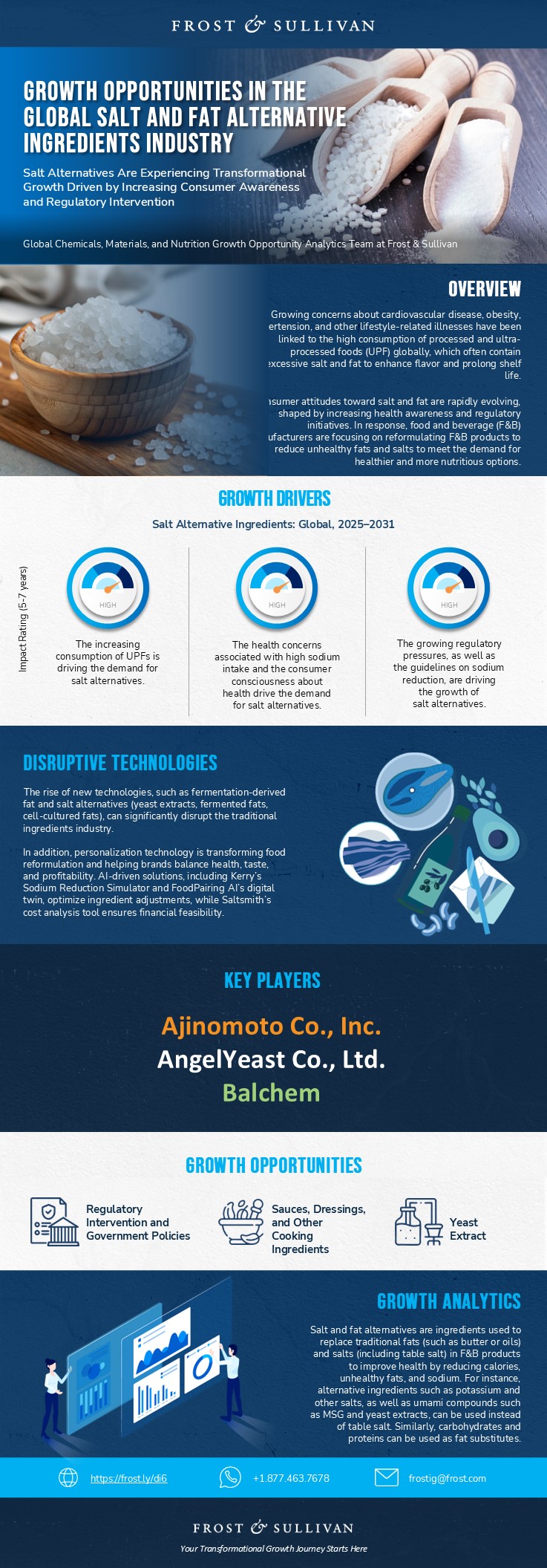
Growing concerns about cardiovascular disease, obesity, hypertension, and other lifestyle-related illnesses have been linked to the high consumption of processed and ultra-processed foods (UPF) globally, which often contain excessive salt and fat to enhance flavor and prolong shelf life.
Consumer attitudes toward salt and fat are rapidly evolving, shaped by increasing health awareness and regulatory initiatives. In response, food and beverage (F&B) manufacturers are focusing on reformulating F&B products to reduce unhealthy fats and salts to meet the demand for healthier and more nutritious options.
Salt and fat alternatives are ingredients used to replace traditional fats (such as butter or oils) and salts (including table salt) in F&B products to improve health by reducing calories, unhealthy fats, and sodium. For instance, alternative ingredients such as potassium and other salts, as well as umami compounds such as MSG and yeast extracts, can be used instead of table salt. Similarly, carbohydrates and proteins can be used as fat substitutes. These alternatives help preserve flavor and texture while providing healthier options for those managing their diets or having health concerns.
The market penetration of salt alternative ingredients in the F&B industry remains limited; however, increasing regulatory intervention, favorable policies, and rising consumer awareness are gradually driving growth. In contrast, the penetration of fat alternative ingredients is expected to decline during the forecast period due to the growing clean-label trend and the rising consumer awareness of the importance of healthy fats in the diet.
Geographically, high-income countries with high UPF consumption and associated non-communicable diseases, such as North America and Europe, will drive the most demand for salt alternatives during the forecast period. North America and Europe, having previously led the adoption of fat alternatives, are now showing a decline in demand for fat alternatives due to a strong shift to natural and clean-label products.
Frost & Sullivan covers 5 regions in this study: North America, Europe, Asia-Pacific, Latin America, and the Middle East and Africa. The study period is from 2022 to 2031, the base year is 2024, and the forecast period is from 2025 to 2031.
Author: Nimisha Dhomne
The Impact of the Top 3 Strategic Imperatives on the Salt and Fat Alternative Ingredients Market
Transformative Megatrends
- Why:
- The fat and salt alternative ingredients market, including the clean-label food ingredients market, is shaped by megatrends such as health-conscious eating, sustainability, and clean-label demands.
- MSG is linked to headaches, flushing, nausea, dizziness, heart palpitations, and numbness, which lowers the ingredient’s adoption as a salt alternative to a certain extent in the salt alternative ingredients market.
- Concerns over palm oil’s environmental and health impact are driving RSPO-certified sustainable options and alternatives such as high-oleic sunflower, olive oils, and coconut oil.
- Meanwhile, low-fat products using artificial alternatives face declining demand as consumers prioritize transparency and natural ingredients, impacting the fat and salt alternatives market.
- Frost Perspective:
- Companies must proactively invest in reformulation and ingredient innovation to stay ahead of evolving consumer preferences and ensure that their products align with emerging health and sustainability standards while maintaining taste and functionality in the fat substitutes market.
- Companies that can position themselves as leaders in providing solutions aligned with these broader societal goals will be better equipped to capture share in the salt alternative ingredients market.
Disruptive Technologies
- Why:
- The rise of new technologies, such as fermentation-derived fat and salt alternatives (yeast extracts, fermented fats, cell-cultured fats), can significantly disrupt the traditional ingredients industry, affecting the regional salt alternative demand market.
- In addition, personalization technology is transforming food reformulation and helping brands balance health, taste, and profitability. AI-driven solutions, including Kerry’s Sodium Reduction Simulator and FoodPairing AI’s digital twin, optimize ingredient adjustments, while SaltSim’s cost analysis tool ensures financial feasibility in the fat substitutes market.
- Frost Perspective:
- Failing to anticipate and adapt to these disruptive technologies could leave companies struggling with outdated formulations, reduced consumer demand, and regulatory pressures, impacting the clean-label food ingredients market.
- Competitors are innovating rapidly in the fat and salt alternatives market, making it critical for businesses to stay ahead through continuous R&D, strategic partnerships, and agile product reformulation to ensure relevance in a rapidly evolving market.
Innovative Business Models
- Why:
- Reducing salt and fat in food requires a multifaceted approach, as no single solution fits all formulations or consumer preferences in the salt alternative ingredients market.
- To stay competitive, companies should adopt innovative business models such as co-development partnerships, diverse ingredients and solutions offerings, and effective consumer education campaigns around food preparation, impacting the fat substitutes market.
- For example, Cargill provides technologically advanced Alberger® flake salts and potassium chloride ingredients for sodium reduction, aligning with the trends in the growth of the regional salt alternative demand market.
- Frost Perspective:
- By embracing these models, companies can deliver unique value propositions and meet changing consumer preferences for low-fat and low-sodium products in the fat and salt alternatives market.
- Companies that fail to experiment with new business models risk missing out on emerging market segments, particularly in the clean-label food ingredients market.
Competitive Environment
| Number of Competitors | 50–100 |
|---|---|
| Competitive Factors | Price, offerings, innovation, performance, technology, reliability, customer relationships |
| Key End-user Industry Verticals | F&B |
| Leading Competitors | Including Ajinomoto Co., Inc., AngelYeast Co., Ltd., Balchem, Cargill Incorporated, Compass Minerals, Fufeng Group, Cargill, and CP Kelco |
| Distribution Structure | Distributors, direct sales |
Key Competitors
| Salt Alternatives | Fat Alternatives |
|---|---|
| ABF Ingredients | ADM |
| ADM | AMCO Proteins |
| Ajinomoto Co., Inc. | Arla Foods Ingredients Group P/S |
| AngelYeast Co., Ltd. | Armor Proteines |
| Balchem | Beneo |
| Cargill Incorporated | Cargill |
| Compass Minerals | CP Kelco |
| Fufeng Group | Erie Foods International Inc. |
| ICL | FrieslandCampina |
| Ingreland | Glanbia plc |
| Intrepid Potash | Grain Processing Corporation |
| Kerry | Hilmar Ingredients |
| Kosnature | IGRECA France |
| K+S Aktiengesellschaft | Kerry |
| Lesaffre | Lactalis Ingredients |
| Linghua Group Limited | Leprino Foods Company |
| Lotus Health Group Food Co., Ltd. | Meihua Bio |
| MCLS Europe | OVODAN EGG GROUP |
| Meihua Holdings Group Co., Ltd. | Tate & Lyle PLC |
| Muby Chemicals | |
| Netmag B.V. |
Growth Drivers
- The increasing consumption of UPFs is driving the demand for salt alternatives in the salt alternatives market.
- The health concerns associated with high sodium intake and the growing consumer consciousness about health drive the demand for salt alternatives in the fat substitutes market.
- The growing regulatory pressures, as well as the guidelines on sodium reduction, are driving the growth of the salt alternatives market and influencing the clean-label food ingredients market.
Growth Restraints
- Challenges with the reformulation and the cost involved hinder the adoption of salt alternatives in the salt alternative ingredients market.
- Health concerns about certain salt alternatives limit their demand in the fat and salt alternatives market.
- Gaps between consumer knowledge and action on salt intake restrain market growth in the clean-label food ingredients market.
Introduction
Salt and Fat Alternatives Ecosystem and Scope of Current Research
Segmentation by Product Type
Market Definitions
Why is it Increasingly Difficult to Grow?
The Strategic Imperative 8™
The Impact of the Top 3 Strategic Imperatives on the Salt and Fat Alternative Ingredients Market
Value Chain
Competitive Environment
Key Competitors
Competitive Benchmarking—Salt Alternative Ingredients
FoP Nutrition Labeling on Prepackaged Foods
FoP Labeling Initiatives in North America
FoP Labeling Initiatives in Europe
FoP Labeling Initiatives in APAC
FoP Labeling Initiatives in LATAM and MEA
Forecast Assumptions
Growth Metrics
Salt Functionality and How Salt Enters our Plate
Alternatives to Table Salt in the Market
Conventional Salt Replacers Used in Home Cooking or HORECA Settings
Sodium Content of Common Food Sources
Product Formulators’ Initiatives and Targets
Emerging Salt-Reduction Technologies
Market Trends Driving Innovation in Sodium Reduction
Growth Drivers
Growth Driver Analysis
Growth Restraints
Growth Restraint Analysis
Revenue and Volume Forecast
Revenue and Volume Forecast Analysis
Revenue Forecast by Ingredient
Volume Forecast by Ingredient
Revenue and Volume Forecast Analysis, by Ingredients
Revenue Forecast by Application
Volume Forecast by Application
Revenue and Volume Forecast Analysis, by Applications
Revenue Forecast by Region
Volume Forecast by Region
Revenue and Volume Forecast Analysis, by Regions
Growth Metrics
Fat Functionality and How Fat Enters our Plate
Sustainable and Emerging Innovations in Alternative Fats
Fat Alternative Types
Evolution of the Low-Fat Industry
Growth Drivers
Growth Driver Analysis
Growth Restraints
Growth Restraint Analysis
Market Evolution of Olestra
Revenue and Volume Forecast
Revenue and Volume Forecast Analysis
Growth Opportunity 1: Regulatory Intervention and Government Policies
Growth Opportunity 2: Sauces, Dressings, and Other Cooking Ingredients
Growth Opportunity 3: Yeast Extract
Benefits and Impacts of Growth Opportunities
Next Steps
List of Exhibits
Legal Disclaimer
Speak directly with our analytics experts for tailored recommendations.
Recent related Nutritional and Health Ingredients research
05 Oct 2026 | Global | Market Research
Impact of GLP-1 on Nutraceuticals, Global, 2025–2032
The rapid adoption of GLP-1 therapies is reshaping the weight management landscape and creating a new set of nutritional needs among consumers using these treatments. While GLP-1 therapies have demonstrated significant benefits for weight loss and metabolic health, associated challenges—including re...
03 Sep 2026 | Global | Market Research
Biotics in Animal Nutrition, Global, 2025–2032
The study analyzes probiotics, prebiotics, and postbiotics used in animal feed, pet food, and supplements, focusing strictly on ingested biotics impacting gut health and performance outcomes. The scope excludes non-feed applications (e.g., silage inoculants, aquaculture bioremediation, and other env...
03 Jul 2026 | Global | Market Research
Medical Food Ingredients Market, Global, 2025–2032
The research assesses growth opportunities for medical food ingredients across key therapeutic applications and regional markets. Medical foods, also referred to as Foods for Special Medical Purposes (FSMPs), occupy a distinct regulatory and commercial position between pharmaceuticals and nutraceuti...
16 Jun 2026 | Global | Market Research
Infant Formula Ingredients Market, Global, 2025–2032
The research assesses growth opportunities for infant formula ingredients across key application segments and regional markets. Driven by demographic shifts, urbanization, and changing lifestyles, infant formula continues to play a critical role in meeting infant nutrition needs, particularly where ...
29 Apr 2026 | Global | Frost Radar
Frost Radar: Non-polluting Flavoring and Coloring Agents, 2026
The market for non-polluting flavoring and coloring agents is transforming because of stricter regulation of synthetic additives, demand for clean-label products, and a focus on sustainability. Natural, bio-based alternatives, such as plant-derived extracts and upcycled ingredients, are replacing co...
Purchase includes:
- Report download
- Growth Dialog™ with our experts
Growth Dialog™
A tailored session with you where we identify the:- Strategic Imperatives
- Growth Opportunities
- Best Practices
- Companies to Action
Impacting your company's future growth potential.
Consumer attitudes toward salt and fat are rapidly evolving, shaped by increasing health awareness and regulatory initiatives. In response, food and beverage (F&B) manufacturers are focusing on reformulating F&B products to reduce unhealthy fats and salts to meet the demand for healthier and more nutritious options.
Salt and fat alternatives are ingredients used to replace traditional fats (such as butter or oils) and salts (including table salt) in F&B products to improve health by reducing calories, unhealthy fats, and sodium. For instance, alternative ingredients such as potassium and other salts, as well as umami compounds such as MSG and yeast extracts, can be used instead of table salt. Similarly, carbohydrates and proteins can be used as fat substitutes. These alternatives help preserve flavor and texture while providing healthier options for those managing their diets or having health concerns.
The market penetration of salt alternative ingredients in the F&B industry remains limited; however, increasing regulatory intervention, favorable policies, and rising consumer awareness are gradually driving growth. In contrast, the penetration of fat alternative ingredients is expected to decline during the forecast period due to the growing clean-label trend and the rising consumer awareness of the importance of healthy fats in the diet.
Geographically, high-income countries with high UPF consumption and associated non-communicable diseases, such as North America and Europe, will drive the most demand for salt alternatives during the forecast period. North America and Europe, having previously led the adoption of fat alternatives, are now showing a decline in demand for fat alternatives due to a strong shift to natural and clean-label products.
Frost & Sullivan covers 5 regions in this study: North America, Europe, Asia-Pacific, Latin America, and the Middle East and Africa. The study period is from 2022 to 2031, the base year is 2024, and the forecast period is from 2025 to 2031.
Author: Nimisha Dhomne
| Deliverable Type | Market Research |
|---|---|
| Industries | Chemicals and Materials |
| No Index | No |
| Is Prebook | No |
| Keyword 1 | salt reducers market |
| Keyword 2 | fat replacers Market |
| Keyword 3 | fat replacement solutions |
| Podcast | No |
| Predecessor | None |
| WIP Number | PFTK-01-00-00-00 |