 USD
USD GBP
GBP  CNY
CNY  EUR
EUR  INR
INR  JPY
JPY  MYR
MYR  ZAR
ZAR  KRW
KRW  THB
THB 


Synergy with Google Holds the Key to Completing the Connected Devices Ecosystem for Alphabet Inc.
27-Jun-2017
Global
Market Research
K1E7-01-00-00-00
AU01502-GL-MR_20304
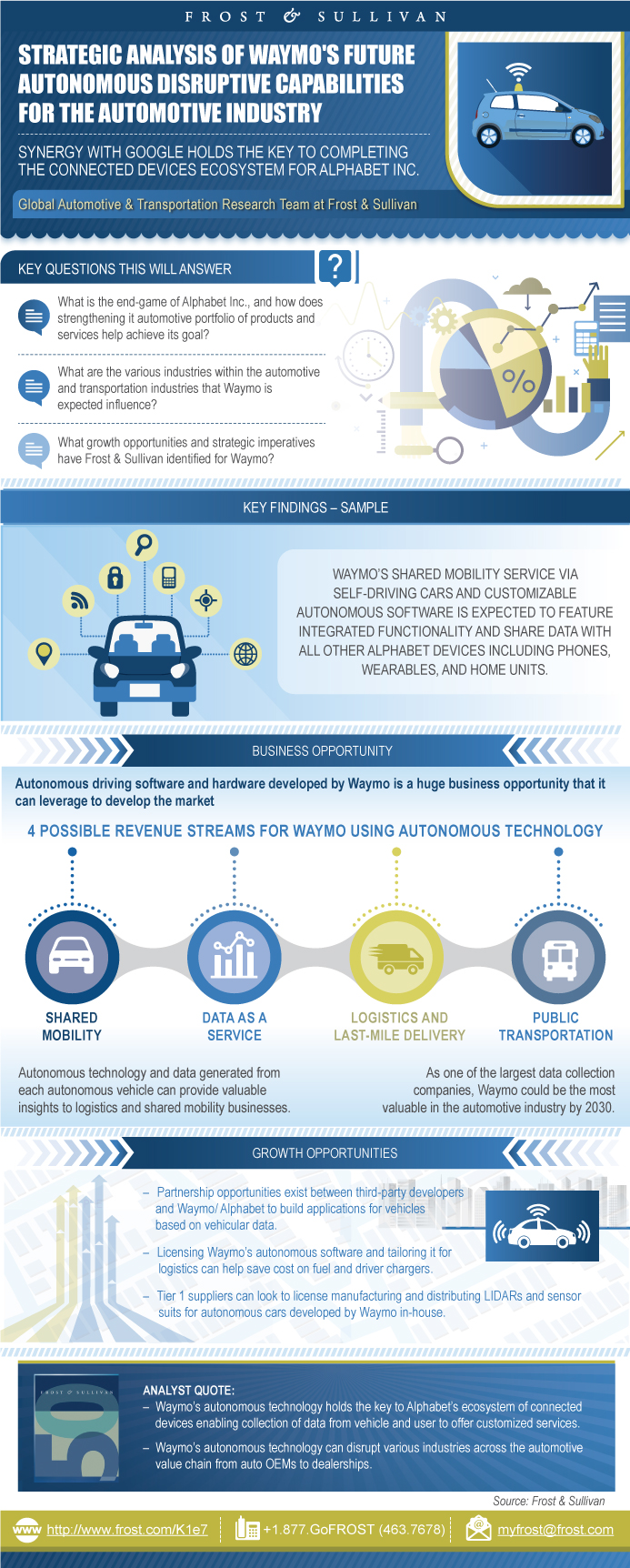
Waymo, the autonomous technology company under the Alphabet conglomerate, is at the forefront of developing autonomous driving software for cars. Vehicles powered by Waymo's software help Alphabet complete its ecosystem of connected devices by serving as a data collection node when users are on the move. In a steadfast effort to enter the automotive industry, Alphabet Inc. has laid out a clear strategy targeting the connected and autonomous car spaces via Android OS for cars and Waymo, respectively. With Waymo completing more than 3 million miles of on-road driving and the introduction of the industry-first car without a steering wheel and pedals, it is expected to commercialize its technology ahead of competition.
Innovation in the fields of autonomous technology and artificial intelligence is bound to transform the automotive ecosystem; Waymo’s autonomous hardware and software are expected to catalyze this transformation, with cross-industry applications from shared mobility to logistics.
The aim of this study is to understand the various application areas of Waymo’s autonomous software, including shared mobility and logistics, and highlight the impact of Waymo's innovations on global automotive ecosystem.
Key Questions this Study will Answer:
• What is the endgame of Alphabet Inc., and how does strengthening its portfolio of automotive products and services help achieve its goal?
• How important is Waymo's autonomous technology in strengthening Alphabet’s automotive product portfolio, and what roles will companies in the Alphabet conglomerate play in supporting the development of Waymo?
• Why is on-road testing of autonomous cars important for Waymo, and how is it planning on increasing its test fleet?
• What parts of the automotive and transportation industries are Waymo expected to influence?
• What are various growth opportunities and strategic imperatives that Frost & Sullivan identifies for Waymo?
Applications areas covered:
• Autonomous software licensing
• Autonomous hardware licensing
• Impact of Waymo on automotive retail
• Evolution of the global automotive ecosystem with and without Waymo
• Shared mobility
• Data as a service
• Logistics and last-mile delivery
• Public transportation
Analysis covered in this study:
• Competitive landscape: autonomous technology testing/development
• Growth opportunities and strategic imperatives for success
• Waymo’s milestones: who should take note and why?
Benefit to the client:
The study offers a complete Look into Waymo’s recent activities and the most probable steps Waymo will consider for partnership, fleet, testing and application area expansion. It covers Waymo’s ACES (Autonomous, Connected, Electric and Shared Mobility) vision and the impact of Waymo’s autonomous technology across various spaces in the automotive value chain and across industries. Top companies that are working towards autonomous technology are highlighted, along with their partnership/acquisition efforts. Thus, this study would be of interest to various organizations ranging from automotive OEMs, suppliers, city municipalities, tech companies, dealerships, logistics companies, shared mobility firms, application developers, and public transportation providers.
Countries/regions that would find this study useful:
• United States
• Europe: Netherlands, Scandinavian countries, Germany, France, United Kingdom
• China
• Singapore
Executive Summary—Key Findings
Executive Summary—Alphabet’s Products as Data Collection Nodes
Executive Summary—Competitors’ Efforts in Creating an Ecosystem
Executive Summary—Alphabet’s Progress into the Auto Industry
Executive Summary—Waymo’s ACES Vision
Executive Summary—Impact on Business and Application Areas
Research Scope
Research Aims and Objectives
Key Questions this Study will Answer
Research Background
Research Methodology
Targeted Endgame—The Alphabet Ecosystem
Alphabet’s Efforts in Strengthening its Automotive Portfolio
Autonomous Cars—Alphabet’s Automotive Goal
Alphabet’s Product and Service Offerings’ Role in Waymo
Timeline of Recent Activities
Autonomous Vehicle Testing—Fleet Expansion
Autonomous Vehicle Testing—Location Expansion
Competitive Landscape
Evolving Automotive Ecosystem
Waymo’s Autonomous Software Licensing
Waymo’s Autonomous Sensor Suite Manufacturing
Waymo-Powered Vehicle for Independent Ownership
Global Automotive Ecosystem With and Without Waymo
Waymo’s Business Opportunity
Business Case 1—Waymo Partnering with Shared Mobility Companies
Business Case 2—Waymo Enabling Data as a Service
Business Case 3—Last-Mile Delivery and Logistics
Business Case 4—Waymo’s Impact on Public Transportation
Summary of Various Business Cases
Growth Opportunity for Waymo
Strategic Imperatives for Success and Growth
Milestones and Significance—So What?
Key Highlights and Future Outlook
The Last Word—3 Big Predictions
Legal Disclaimer
Market Engineering Methodology
Speak directly with our analytics experts for tailored recommendations.
Recent related New Mobility research
06 Aug 2018 | Europe | Market Research
European Carsharing Technologies Market, Forecast to 2022
Over the years, Carsharing technology has evolved from simple manual systems to increasingly complex computer-based systems. There are now a wide range of technology service providers offering solutions, from factory installed to aftermarket, to Carsharing operators. Currently, more than 15 technolo...
26 Jul 2018 | Europe | Market Research
Competitive Benchmarking of Corporate Mobility Solutions of Key OEMs and Leasing Companies in Europe, 2017
We are witnessing a shift in products and services being provided to business travelers and the way in which companies set up their administration of these activities. New mobility business models, such as carsharing, ridesharing, and ridehailing/taxi services for personal use, are also developing i...
08 Jun 2018 | Europe | Market Research
Strategic Analysis of the Global Demand-Responsive Transit (DRT) Market, Forecast to 2030
Traditional public transit modes have remained unchanged over decades and inherent flaws have remained unaddressed. The fixed-route and fixed-schedule model works efficiently on high-density routes but routes with lower demand and density along with demand at odd hours are not as efficiently catered...
07 May 2018 | North America | Market Research
M&A, Investment Trends and Opportunities in the Global Mobility Space, 2017
The global shared mobility market has been expanding at a tremendous pace. With growing demand for shared mobility business models over the last few years, the overall market has paved way for numerous innovative startups in this space. Shared mobility has not only provided solutions to tackle growi...
13 Dec 2017 | North America | Market Research
Strategic Analysis of the Mobility Value Chain, 2017
This research service analyses the mobility market value chain in detail and discusses the expected trends. The study delves into evolving business models, market consolidations and partnerships, and advanced technology trends shaping the market. It provides the market trends and outlines potential ...
Purchase includes:
- Report download
- Growth Dialog™ with our experts
Growth Dialog™
A tailored session with you where we identify the:- Strategic Imperatives
- Growth Opportunities
- Best Practices
- Companies to Action
Impacting your company's future growth potential.
| Deliverable Type | Market Research |
|---|---|
| No Index | No |
| Podcast | No |
| Author | Ajay Natteri Mangadu |
| Industries | Automotive |
| WIP Number | K1E7-01-00-00-00 |
| Is Prebook | No |
| GPS Codes | 9694,9800-A6,9A57-A6,9A70-A6,9AF6-A6,9B01-A6,9B07-C1 |
Strategic Analysis of Waymo's Future Autonomous Disruptive Capabilities for the Automotive Industry
$4,950.00
Special Price $3,712.50 save 25 %