 USD
USD GBP
GBP  CNY
CNY  EUR
EUR  INR
INR  JPY
JPY  MYR
MYR  ZAR
ZAR  KRW
KRW  THB
THB 


Strategic Partnering and Technology Strategy to Accelerate the Transformational Growth of Autonomous Vehicles
30-Sep-2020
Asia Pacific
Market Research
PB0F-01-00-00-00
AU02054-AP-MT_24801
Japan’s automotive market is highly developed and evolving. Autonomous driving is advancing for both commercial and personal use. Naturally, global OEMs, suppliers, and technology companies are leading the charge, with significant inputs from research institutes and universities.
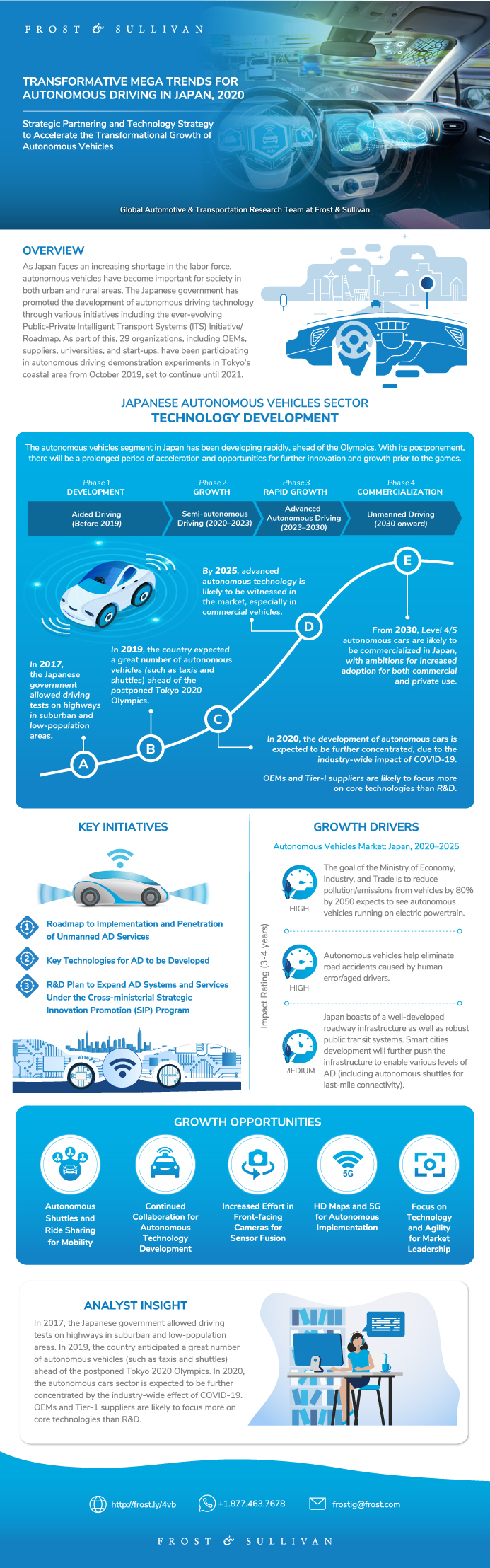
In 2017, the Japanese government allowed driving tests on highways in suburban and low-population areas. In 2019, the country anticipated a great number of autonomous vehicles (such as taxis and shuttles) ahead of the postponed Tokyo 2020 Olympics. In 2020, the autonomous cars market is expected to be further concentrated by the industry-wide effect of COVID-19. OEMs and Tier-1 suppliers are likely to focus more on core technologies than R&D.
Most major Japanese OEMs are looking to enter the autonomous vehicles arena, especially because of the postponed but upcoming Olympics set for 2021. Autonomous shuttles and public transport are likely to be introduced ahead of personal vehicles. This is in accordance with the anticipated needs of the country, including the movement of large numbers of people for the Tokyo Olympics, and the improving transit options for the aging population in the country.
As Japan faces increasing shortage in labor force, autonomous vehicles become important for the society in both urban and rural areas. The Japanese government has promoted the development of autonomous driving technology through various initiatives including the ever-evolving Public-Private Intelligent Transport Systems (ITS) Initiative/Roadmap. As part of this, 29 organizations, including OEMs, suppliers, universities, and start-ups, have been participating in autonomous driving demonstration experiments in Tokyo’s coastal area from October 2019, set to continue until 2021.
The global automotive industry was dramatically impacted by COVID-19, halting production and sales for all major industry participants. However, R&D activities continues. Strategic partnerships and ventures between industry participants, as well as the adoption and development of relevant technologies, are imperative and will drive the market further.
Japan is poised to be a leader in the global development of autonomous vehicles through to full autonomy. Advanced autonomous technology is likely to be witnessed in the market from 2025, especially for commercial vehicles. Level 4/5 autonomous cars are likely to be commercialized in Japan from 2030, with ambitions for increased adoption for both commercial and private use.
This study explores the ecosystem of the autonomous driving market in Japan, along with its drivers and restraints, and profiles key participants and opportunities.
Why is it Increasingly Difficult to Grow?
The Strategic Imperative 8™
Impact of the Top 3 Strategic Imperatives on Japan’s Autonomous Vehicles Market
Growth Opportunities Fueling the Growth Pipeline Engine™
Autonomous Vehicles Market—Scope of Analysis
Autonomous Vehicles Market—Segmentation
Autonomous Vehicles Market—Definitions
Key Competitors for the Autonomous Vehicles Market
Key Competitors for the Autonomous Vehicles Market (continued)
Japanese Autonomous Vehicles Market—Technology Development
Growth Drivers for Autonomous Vehicles Market
Growth Restraints for Autonomous Vehicles Market
Government Initiatives
Autonomous Vehicle Implementation Roadmap
Autonomous Vehicle Implementation Roadmap (continued)
Autonomous Vehicle Implementation Roadmap (continued)
Current Legislation
Current Legislation (continued)
Current Legislation (continued)
Future Legislation
Key AD Technologies to be Developed
Key AD Technologies to be Developed (continued)
Key AD Technologies to be Developed (continued)
Key Developments—Toyota
Key Developments—Honda
Key Developments—Nissan
Key Developments—Mobility Suppliers
Key Developments—Mobility Suppliers (continued)
Key Developments—Mobility Suppliers (continued)
Other Key Stakeholder Collaborations
Key Investments and Ventures Involving Japanese Industry Participants
Key Investments and Ventures Involving Japanese Industry Participants (continued)
Case Study—TRI-AD
Case Study—MONET
Growth Opportunity 1: Autonomous Shuttles and Ride Sharing for Mobility, 2020
Growth Opportunity 1: Autonomous Shuttles and Ride Sharing for Mobility, 2020 (continued)
Growth Opportunity 2: Continued Collaboration for Autonomous Technology Development, 2020
Growth Opportunity 2: Continued Collaboration for Autonomous Technology Development, 2020 (continued)
Growth Opportunity 3: Increased Effort in Front-facing Cameras for Sensor Fusion, 2020
Growth Opportunity 3: Increased Effort in Front-facing Cameras for Sensor Fusion, 2020 (continued)
Growth Opportunity 4: HD Maps and 5G for Autonomous Implementation, 2020
Growth Opportunity 4: HD Maps and 5G for Autonomous Implementation, 2020 (continued)
Growth Opportunity 5: Focus on Technology and Agility for Market Leadership, 2020
Growth Opportunity 5: Focus on Technology and Agility for Market Leadership, 2020 (continued)
Your Next Steps
Why Frost, Why Now?
List of Exhibits
List of Exhibits (continued)
Legal Disclaimer
Speak directly with our analytics experts for tailored recommendations.
Recent related Autonomous Vehicles research
25 Sep 2026 | Global | Technology Research
Growth Opportunities in Next-Gen Wireless EV charging, Automotive Grade IoT module, Autonomous driving, E-bike Platform, UAVs, and 4D Radars
The Mobility Technology Opportunity Engine (TOE) covers innovations pertaining to EV charging, Automotive Grade IoT module, Autonomous driving, E-bike Platform, UAVs, and 4D Radars.The purpose of the Mobility Technology TOE is to raise awareness of global technology innovations in self-propelled gro...
22 Sep 2026 | Global | Market Research
Growth Opportunities in the Global EV Power Electronics Market, 2025–2032
The rapid push toward e-mobility is accelerating adoption of advanced power electronics by major OEMs. Power electronics underpin electric vehicle reliability, efficiency, and performance. Core systems, including traction inverters, onboard chargers, and DC-DC converters, are gaining strategic impor...
31 Aug 2026 | Global | Market Outlook
Off-Highway Equipment Market Predictions and Growth Opportunities, Global, 2026
The global off-highway (OHW) equipment industry enters 2026 amid a complex and evolving macroeconomic environment characterized by geopolitical uncertainty, energy price volatility, and shifting trade dynamics. While the baseline outlook suggests moderate global GDP growth of about 3%, downside scen...
27 Aug 2026 | Global | Market Outlook
Global EV Charging Infrastructure, 2026: Growth Trajectory and Emerging Opportunities
The rapid rise of electric vehicles (EVs) is intensifying the need for a robust, accessible charging infrastructure. Enabled by IoT integration, EVs are becoming a smarter alternative to conventional ICE vehicles. Expanding fast-charging stations along highways and at key destinations is critical to...
21 Aug 2026 | South Asia, Middle East & North Africa | Market Research
High-Traffic Truck Charging Infrastructure Revenue Opportunities, India, 2026–2041
India’s electric truck charging ecosystem is entering a critical phase of commercialization, with revenue generation and investment returns emerging as key focus areas alongside infrastructure deployment. As medium- and heavy-duty electric trucks scale up, charging infrastructure development across ...
Purchase includes:
- Report download
- Growth Dialog™ with our experts
Growth Dialog™
A tailored session with you where we identify the:- Strategic Imperatives
- Growth Opportunities
- Best Practices
- Companies to Action
Impacting your company's future growth potential.
| Deliverable Type | Market Research |
|---|---|
| No Index | No |
| Podcast | No |
| Author | Georgia Edell |
| Industries | Automotive |
| WIP Number | PB0F-01-00-00-00 |
| Is Prebook | No |
| GPS Codes | 9673-A6,9800-A6,9B13-A6 |
Transformative Mega Trends of Autonomous Driving in Japan, 2020
$4,950.00
Special Price $3,712.50 save 25 %